
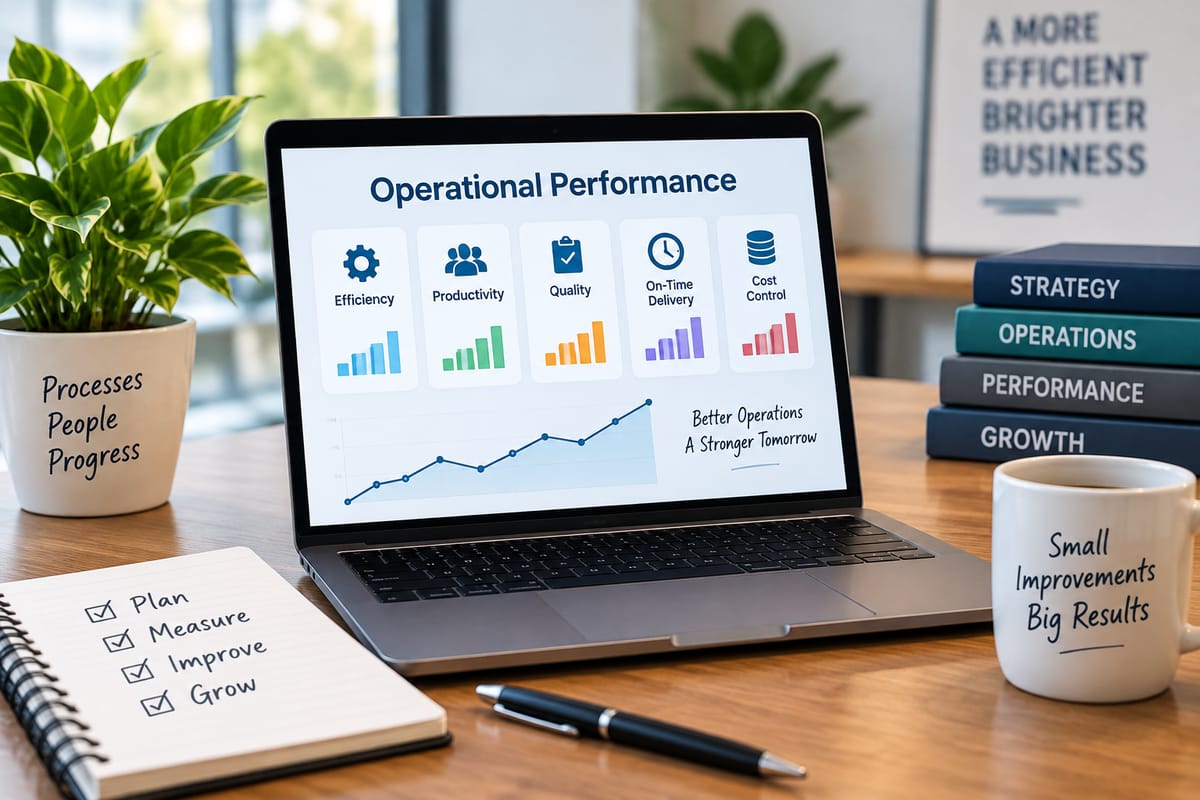
**How Businesses Measure Operational Performance
Operational performance is one of the clearest indicators of how well a business is functioning behind the scenes. While revenue, profit and market share show the results of business activity, operational performance measures many of the processes that produce those results.
A company can have strong sales and still struggle with inefficient processes, rising costs, delayed deliveries, excessive waste or poor resource utilization. Measuring operations helps businesses identify those issues before they become larger financial or customer problems.
Effective measurement also gives managers a practical way to understand whether the organization is using its people, time, technology and resources as efficiently as possible.
What Is Operational Performance?
Operational performance refers to how effectively a business carries out the activities required to deliver its products or services.
These activities can include manufacturing, purchasing, inventory management, logistics, customer service, order processing, staffing, technology operations and administrative processes.
Businesses typically evaluate operational performance by comparing actual results with defined targets or benchmarks. Depending on the organization, measurements may focus on:
- Productivity
- Operating costs
- Process efficiency
- Quality
- Delivery speed
- Customer service
- Resource utilization
- Employee performance
- Capacity
- Inventory turnover
- Downtime
- Error rates
The specific measurements vary considerably between industries. A factory may focus heavily on production efficiency and defect rates, while a software company may pay more attention to system availability, development cycles and customer-support response times.
Why Operational Performance Matters
Operational performance affects nearly every part of a business.
When processes work efficiently, businesses can often produce or deliver more without increasing resources at the same rate. Better processes can also reduce unnecessary spending, minimize errors and make customer experiences more consistent.
Poor operational performance can have the opposite effect. Delays may increase costs, inefficient workflows can consume employee time, and recurring quality problems can damage customer relationships.
Operational measurement therefore provides more than a collection of statistics. It gives management information that can be used to identify problems, allocate resources and improve processes.
This fits into the broader discipline of business planning. Companies looking at the relationship between long-term objectives and day-to-day execution can explore the Complete Guide to Business Strategy and Strategic Planning to understand how operational activity connects with wider strategic priorities.
Key Metrics Businesses Use to Measure Operations
There is no universal list of operational metrics that works for every organization. However, several categories are widely used.
Productivity
Productivity measures how much output a business generates relative to the resources used to produce it.
For example, a manufacturer might measure units produced per employee-hour. A customer service department could measure the number of cases handled per representative.
Productivity measurements can help businesses determine whether changes in staffing, technology or processes are improving output.
However, productivity should not be considered in isolation. Producing more units is not necessarily beneficial if quality falls or costs rise substantially.
Operating Costs
Businesses track the costs associated with running their operations to determine whether resources are being used efficiently.
Common operational costs include:
- Labor
- Materials
- Energy
- Transportation
- Warehousing
- Equipment maintenance
- Technology
- Facilities
- Outsourced services
Managers can compare actual costs with budgets, historical results and operational output to identify unusual increases or opportunities for improvement.
Quality and Error Rates
Quality metrics show whether products or services consistently meet established standards.
Businesses may track:
- Defective products
- Returns
- Rework
- Customer complaints
- Transaction errors
- Failed inspections
- Service mistakes
A high output level can conceal serious operational problems if a significant percentage of that output requires correction.
For this reason, productivity and quality are often measured together.
Cycle Time
Cycle time measures how long it takes to complete a particular process.
Depending on the business, this might mean:
- The time required to manufacture an item
- The time needed to process an order
- The time taken to resolve a customer request
- The duration of a software development process
- The time between receiving and shipping an order
Reducing unnecessary cycle time can allow a company to serve customers faster and increase its effective capacity.
On-Time Delivery
For businesses that depend on logistics, manufacturing or scheduled services, on-time delivery is an important operational measurement.
The metric generally compares deliveries completed within the promised timeframe with total deliveries.
Consistently missing delivery commitments can create additional costs while also affecting customer satisfaction.
Capacity Utilization
Capacity utilization measures how much of the available productive capacity a business is actually using.
A factory operating substantially below its practical capacity may have unused resources, while an operation consistently operating at maximum capacity may face bottlenecks, overtime costs and limited flexibility.
The objective is not necessarily to maximize utilization at all times. Businesses need enough capacity to handle fluctuations in demand without creating excessive idle resources.
Measuring Employee and Workforce Performance
Employees are central to operational performance, but measuring workforce performance requires more than simply counting hours worked.
Businesses may examine indicators such as output, completed tasks, service response times, absenteeism, turnover and training progress.
The appropriate metrics depend heavily on the role.
For example, measuring a warehouse employee exclusively by the number of items processed could encourage speed at the expense of accuracy and safety. A broader measurement system can balance productivity with quality and other operational requirements.
Businesses also need to distinguish individual performance from problems caused by inadequate systems, unclear processes, insufficient staffing or outdated technology.
Using Key Performance Indicators
Key performance indicators, commonly known as KPIs, provide a structured way to monitor important operational outcomes.
A useful KPI should have a clear definition and measurement method. It should also connect to something the organization is actually trying to improve.
For example, a logistics company might track:
On-time delivery rate = On-time deliveries ÷ Total deliveries × 100
A business could then compare the result across different months, locations, products or delivery routes.
Other operational KPIs might include cost per unit, average processing time, inventory accuracy, equipment downtime and order fulfillment rates.
Businesses also need to establish appropriate targets. A metric without context can be difficult to interpret.
Comparing Actual Performance With Targets
One of the simplest ways to evaluate operational performance is to compare actual results against planned results.
For example:
| Operational Measure | Target | Actual | Difference |
|---|---|---|---|
| Order processing time | 24 hours | 31 hours | +7 hours |
| On-time delivery | 95% | 91% | -4 percentage points |
| Defect rate | 2% | 1.5% | -0.5 percentage points |
| Cost per unit | $12 | $13.20 | +$1.20 |
| Equipment availability | 98% | 96% | -2 percentage points |
This type of comparison can reveal where operations are performing differently from expectations.
The next step is determining why the difference exists.
A higher-than-expected processing time, for example, could result from insufficient staffing, increased demand, equipment problems, poor workflow design or delays elsewhere in the supply chain.
Connecting Operational Metrics With Business Goals
Operational performance should not be measured independently from broader business objectives.
A company may want to increase customer retention, reduce costs, expand capacity or introduce new products. Each objective can have operational implications.
This is why businesses often connect operational KPIs to broader goal-setting systems. The relationship between objectives, measurements and organizational performance is explored in How Businesses Set Goals and Measure Performance.
For example, if a business wants to improve customer retention, management may track customer complaints, response times, product quality and order accuracy alongside retention itself.
This creates a clearer connection between what employees do every day and what the company is trying to achieve over the longer term.
Identifying Bottlenecks
Operational measurement can help businesses locate bottlenecks that restrict overall performance.
A bottleneck occurs when one part of a process cannot keep up with the demand placed on it. The problem can then affect activities that depend on that stage.
Consider an order fulfillment operation. If picking and packing can process 1,000 orders per day but shipping can handle only 700, shipping becomes a constraint on the overall process.
Managers can use measurements such as queue lengths, processing times, capacity utilization and waiting times to identify these restrictions.
Fixing a bottleneck may sometimes produce a larger improvement than optimizing processes that are already operating efficiently.
Measuring Resource Efficiency
Businesses use a wide range of resources, including employees, equipment, facilities, materials, capital and technology.
Operational measurement helps managers understand how effectively these resources are being used.
For example, a business might measure:
- Revenue or output per employee
- Material waste per production run
- Equipment utilization
- Energy consumption per unit
- Inventory turnover
- Technology system uptime
- Workspace utilization
Resource efficiency becomes particularly important when operating costs increase. Understanding where resources are being consumed can help management determine which processes require attention.
Businesses can also examine the broader relationship between processes, resources and efficiency through How Businesses Manage Operations, Processes, Resources and Efficiency.
Using Customer Metrics to Evaluate Operations
Some operational problems become visible through customer behavior before they appear in financial statements.
Customer complaints, returns, delivery delays, support response times and service cancellations can all provide information about operational effectiveness.
For example, an increase in product returns could indicate a manufacturing quality problem, packaging issue or fulfillment error.
Customer-facing metrics can therefore complement internal operational measurements.
Businesses should also be careful about interpreting customer metrics in isolation. A rise in complaints may reflect increased sales volume rather than a deterioration in the underlying service process.
Measuring Operational Performance Over Time
A single measurement provides limited information. Trends often reveal much more.
Suppose a company’s order processing time is 26 hours in one month. That number may appear acceptable or unacceptable depending on its target and circumstances.
If processing time was 18 hours six months earlier and has steadily increased, however, the trend may indicate an emerging operational problem.
Businesses can therefore track performance over weeks, months or years and examine changes alongside factors such as demand, staffing, technology investments and process changes.
Trend analysis can also help determine whether an improvement is temporary or sustained.
Using Benchmarks Carefully
Businesses sometimes compare their operational performance with industry benchmarks or competitors.
Benchmarking can provide useful context, particularly when a company wants to understand whether a particular cost, processing time or productivity level is unusual.
However, comparisons need to account for differences in business models, geography, customer requirements, product complexity, company size and accounting practices.
A metric that is appropriate for one organization may not have the same meaning for another.
Internal benchmarks can also be valuable. Comparing different facilities, teams, products or periods may reveal performance differences without requiring an external comparison.
Financial Results and Operational Performance
Operational performance and financial performance are closely connected, but they are not interchangeable.
Revenue and profit measure financial outcomes. Operational indicators often measure the processes that contribute to those outcomes.
For example, improved production efficiency could reduce unit costs. Better inventory management could reduce storage expenses and working capital requirements. Faster order fulfillment could support customer satisfaction and repeat purchases.
At the same time, an operational improvement may not immediately produce a financial benefit.
A company might invest in automation that initially increases expenses while improving capacity or reducing future processing costs. Management therefore needs to consider both immediate results and longer-term effects.
The relationship between operational improvement and expansion is also important for growing companies, as discussed in How Businesses Grow Revenue, Customers, Operations and Market Share.
Turning Measurements Into Operational Improvements
Collecting data is only the first step.
Businesses need processes for reviewing performance and deciding what action should follow.
A practical improvement cycle might involve:
- Define the objective — Establish what the business wants to improve.
- Select relevant metrics — Choose measurements that directly relate to the objective.
- Establish a baseline — Determine current performance.
- Set a target — Define the desired level of performance.
- Monitor results — Collect data consistently.
- Investigate deviations — Determine why performance differs from expectations.
- Implement changes — Modify processes, resources or systems where appropriate.
- Measure again — Determine whether the change produced the intended result.
This creates a continuous feedback loop rather than treating performance measurement as a one-time reporting exercise.
Avoiding Common Measurement Problems
Operational measurement can create problems when businesses focus on the wrong indicators.
One common mistake is tracking too many KPIs. An organization with dozens of competing measurements can make it difficult for managers and employees to determine which results actually matter.
Another problem occurs when metrics encourage undesirable behavior. For example, emphasizing speed without measuring quality could encourage employees to prioritize volume over accuracy.
Businesses should also avoid relying exclusively on averages. An average processing time may hide significant differences between simple and complex cases.
Data quality matters as well. Inaccurate, inconsistent or outdated information can lead to incorrect conclusions.
Effective operational measurement therefore requires both good metrics and good interpretation.
The Role of Technology in Performance Measurement
Modern businesses increasingly rely on digital systems to collect and analyze operational data.
Enterprise software, customer relationship management systems, inventory platforms, accounting applications, production systems and analytics tools can provide information about business activity in near real time.
Dashboards can bring multiple KPIs together so managers can monitor performance without manually combining information from numerous sources.
Automation can also reduce the administrative work involved in collecting measurements.
However, technology does not automatically produce meaningful performance management. Businesses still need clearly defined metrics, reliable data and people who understand what the numbers mean.
Creating a Balanced Performance Measurement System
A strong operational measurement system usually combines several perspectives rather than concentrating on one number.
A business might monitor:
- Cost: How much does the process consume?
- Speed: How quickly is work completed?
- Quality: Does the output meet required standards?
- Productivity: How much output is generated from available resources?
- Reliability: Does the process perform consistently?
- Customer impact: How does the operation affect customers?
- Capacity: Can the process handle current and expected demand?
- Financial impact: Does the operational activity contribute to business objectives?
This balanced approach can provide a more complete picture of organizational performance.
Why Operational Performance Is a Continuous Process
Businesses operate in changing environments. Customer expectations, technology, costs, staffing levels, suppliers and demand can all change over time.
As a result, an operational process that works effectively today may become less efficient as circumstances change.
Regular measurement helps businesses detect these changes and respond accordingly. It also creates a factual basis for conversations about staffing, investments, process redesign and resource allocation.
The goal is not simply to produce more reports or collect more data. The purpose is to understand how work gets done, identify where performance differs from expectations and determine which changes can improve the way the organization operates.
For businesses seeking sustainable growth, operational performance measurement provides an important connection between everyday execution and broader organizational objectives. When the right measures are selected and interpreted in context, they can help management see not only what happened, but also where processes may need attention and how operational decisions can support the company’s longer-term direction.



2 Comments
Micle harison
June 7, 2019Lorem ipsum dolor sit amet, usu ut perfecto postulant deterruisset, libris causae volutpat at est, ius id modus laoreet urbanitas. Mel ei delenit dolores.
John Doe
June 7, 2019Some consultants are employed indirectly by the client via a consultancy staffing company.