
What Stakeholders Mean in Business
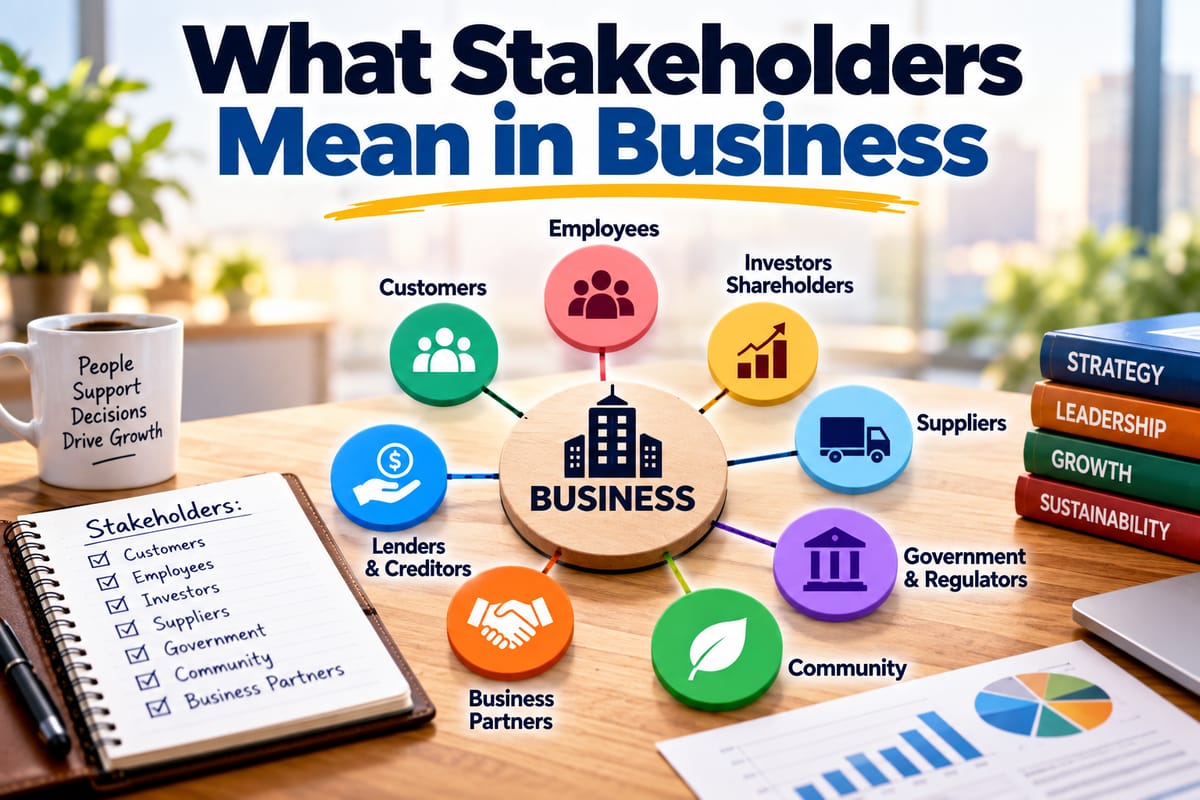
Businesses operate within networks of people and organizations that can influence, support, depend on, or be affected by their activities. Customers purchase products and services, employees perform the work, investors provide capital, suppliers provide resources, governments establish rules, and communities may experience the effects of business operations.
These groups are commonly described as stakeholders.
Understanding stakeholders is important because a business rarely operates in isolation. Decisions about pricing, hiring, product development, expansion, environmental practices, financing, and customer service can affect different groups in different ways.
Stakeholder analysis helps businesses identify who matters to a particular decision, what those groups expect, how they may be affected, and how the organization can communicate with them effectively.
What Is a Stakeholder in Business?
A stakeholder is a person, group, organization, or other entity that has an interest in a business, can influence its activities, or may be affected by its decisions and performance.
Stakeholders can exist both inside and outside the organization.
Common stakeholders include:
- Owners
- Shareholders
- Investors
- Employees
- Managers
- Customers
- Suppliers
- Lenders
- Business partners
- Government agencies
- Regulators
- Local communities
- Industry organizations
Not every stakeholder has the same relationship with a business.
An employee may depend on the organization for income and career development. A customer may depend on it for products or services. An investor may be interested in financial performance. A regulator may focus on legal and regulatory compliance.
Stakeholder analysis recognizes these different relationships rather than treating everyone affected by a business as having identical interests.
Internal and External Stakeholders
One of the simplest ways to understand stakeholders is to divide them into internal and external groups.
Internal Stakeholders
Internal stakeholders are closely connected to the organization itself.
They can include:
- Owners
- Executives
- Managers
- Employees
- Directors
These stakeholders participate directly in the organization’s activities.
External Stakeholders
External stakeholders exist outside the organization’s internal structure.
They can include:
- Customers
- Suppliers
- Investors
- Lenders
- Government agencies
- Regulators
- Communities
- Business partners
The distinction is useful, although some stakeholder relationships can overlap.
For example, a major investor may have substantial influence over internal decisions despite being outside the organization’s day-to-day operations.
Why Stakeholders Matter
Stakeholders matter because their decisions, expectations, resources, and responses can influence business outcomes.
For example:
- Customers determine whether products and services are purchased.
- Employees determine how effectively much of the organization’s work is performed.
- Suppliers affect the availability and cost of inputs.
- Investors can provide capital.
- Lenders provide financing under agreed conditions.
- Regulators establish requirements businesses must follow.
- Communities can be affected by local business activity.
A business that ignores important stakeholder relationships may encounter operational, financial, reputational, or strategic challenges.
Shareholders and Stakeholders Are Not the Same
The terms shareholder and stakeholder are sometimes confused.
A shareholder owns shares in a company.
A stakeholder is a broader concept that includes anyone with a relevant interest in or relationship with the business.
Therefore, shareholders are generally stakeholders, but many stakeholders are not shareholders.
For example, an employee may have a significant interest in the company’s stability without owning any shares.
A customer can be an important stakeholder without having an ownership interest.
Customers as Stakeholders
Customers are among the most visible stakeholders in many businesses.
They provide revenue by purchasing products or services, but their influence extends beyond individual transactions.
Customers can affect:
- Product development
- Pricing
- Service standards
- Brand reputation
- Marketing
- Distribution
- Business priorities
Customer feedback can reveal changing expectations, product problems, or opportunities for innovation.
The relationship between customers and organizational decisions is explored in How Customers Influence Business Decisions.
Understanding customers as stakeholders encourages businesses to consider not only what they want to sell but also what customers actually need and value.
Employees as Stakeholders
Employees are internal stakeholders because they contribute directly to the organization’s activities.
They can influence business performance through:
- Skills
- Productivity
- Creativity
- Customer interactions
- Operational knowledge
- Problem-solving
- Innovation
Employees also have interests of their own, including compensation, working conditions, career development, job security, and opportunities for advancement.
A business therefore needs to consider both what employees contribute and how organizational decisions affect them.
Managers as Stakeholders
Managers occupy an important position because they often connect organizational strategy with everyday execution.
They make decisions about:
- Resources
- Employees
- Processes
- Budgets
- Customers
- Projects
- Performance
Managers may also have responsibility for communicating organizational objectives to employees and reporting results to senior leadership.
Their decisions can affect several stakeholder groups simultaneously.
Owners and Shareholders
Owners and shareholders have an ownership interest in a business.
Depending on the organization’s structure, they may be interested in:
- Financial performance
- Business growth
- Dividends
- Asset value
- Risk
- Long-term sustainability
Their interests can sometimes differ from those of other stakeholders.
For example, shareholders may want increased returns while employees may be concerned about compensation or job security.
Stakeholder management does not necessarily mean eliminating these differences. It means recognizing them and making decisions with an understanding of their potential effects.
Investors as Stakeholders
Investors provide capital to businesses with expectations about financial performance, growth, risk, or other outcomes.
They may examine:
- Revenue
- Profitability
- Cash flow
- Growth
- Market position
- Management quality
- Risk
- Strategic plans
Businesses often communicate with investors through financial reports, presentations, meetings, and other formal channels.
Clear communication can help investors understand both current performance and the organization’s broader direction.
Suppliers as Stakeholders
Suppliers provide the goods, materials, services, technology, or other resources that businesses need to operate.
A business may depend on suppliers for:
- Raw materials
- Inventory
- Equipment
- Software
- Transportation
- Professional services
- Packaging
- Utilities
Supplier relationships can influence costs, quality, availability, and delivery times.
For this reason, supplier management can become strategically important, particularly when a company depends heavily on a small number of suppliers.
Lenders and Creditors
Banks and other lenders can also be stakeholders.
They provide financing under specific repayment terms.
Lenders may be interested in:
- Cash flow
- Debt levels
- Financial performance
- Repayment capacity
- Assets
- Risk
Businesses need to understand their financing obligations because borrowing decisions can affect future cash flow and strategic flexibility.
Governments and Regulators
Government agencies and regulators can influence business activity through laws, regulations, taxes, licensing requirements, standards, and enforcement.
Depending on the industry, businesses may need to comply with rules relating to:
- Employment
- Taxes
- Consumer protection
- Product safety
- Environmental practices
- Data protection
- Financial reporting
- Competition
- Industry-specific requirements
Regulators therefore represent an important external stakeholder group.
Communities as Stakeholders
Businesses can affect the communities in which they operate.
A company may provide:
- Employment
- Products and services
- Local investment
- Tax contributions
- Infrastructure
- Economic activity
At the same time, business operations can create concerns involving:
- Traffic
- Noise
- Environmental effects
- Resource use
- Housing pressure
- Changes in local economic activity
Community stakeholders may therefore have legitimate interests in how a business operates.
Business Partners
Business partners can include organizations that collaborate with a company to create, distribute, market, finance, or deliver products and services.
Examples include:
- Joint-venture partners
- Distribution partners
- Technology partners
- Marketing partners
- Licensing partners
- Strategic alliances
The success of one organization may depend partly on the performance of another.
Strong partnerships therefore require clear expectations and communication.
Competitors as Part of the Business Environment
Competitors are not always described as direct stakeholders in the same way as customers or employees, but they are important participants in the broader business environment.
Competitive activity can influence:
- Pricing
- Product development
- Customer expectations
- Marketing
- Hiring
- Innovation
- Investment
Businesses need to understand competitors when developing strategy and making decisions about how they will create value.
Stakeholder Interests Can Conflict
Different stakeholders may want different outcomes.
For example:
- Customers may want lower prices.
- Employees may want higher compensation.
- Investors may seek stronger returns.
- Suppliers may seek higher prices.
- Management may want to invest more in growth.
These interests can conflict because resources are limited.
A business may therefore need to evaluate trade-offs when making decisions.
Stakeholder analysis does not eliminate these conflicts. It helps make them visible.
Stakeholder Influence Can Vary
Not every stakeholder has the same level of influence.
A large institutional investor may have considerable influence over a publicly traded company.
A major customer may account for a substantial share of revenue.
A small supplier may have less influence individually but could become highly important if the business depends on its specialized products.
The influence of a stakeholder can therefore depend on the specific situation.
Stakeholder Interest Can Vary Too
Influence is not the only factor to consider.
Stakeholders can also differ in how strongly they care about a particular issue.
For example, a customer may have little interest in a company’s internal software system but significant interest in product quality and price.
An employee may care strongly about workplace conditions but have little involvement in pricing decisions.
Businesses can therefore consider both influence and interest when determining how to manage stakeholder relationships.
Stakeholder Mapping
Stakeholder mapping is a practical method for organizing stakeholder information.
A business can identify stakeholders and consider factors such as:
- Level of influence
- Level of interest
- Potential impact
- Business dependence
- Communication needs
- Decision relevance
A simple matrix might look like this:
| Stakeholder | Potential Interest | Potential Influence |
|---|---|---|
| Customers | High | High |
| Employees | High | Medium to High |
| Major investors | High | High |
| Suppliers | Medium to High | Medium |
| Regulators | High | High |
| Local community | Variable | Variable |
These categories are not universal. Each business should assess its own stakeholders according to the specific issue being considered.
Stakeholder Analysis for Business Decisions
Stakeholder analysis can be useful before making significant decisions.
For example, suppose a company plans to close a physical location and move operations elsewhere.
Relevant stakeholders might include:
- Employees
- Customers
- Suppliers
- Local authorities
- Property owners
- Investors
- Local communities
Each group may be affected differently.
Employees may face changes in commuting or employment arrangements.
Customers may experience changes in access.
Suppliers may need new delivery arrangements.
Investors may focus on the financial implications.
Considering these perspectives can help management identify issues that might otherwise be overlooked.
Stakeholders and Business Strategy
Stakeholders can influence the development and implementation of business strategy.
Strategic planning involves decisions about where an organization wants to go and how it intends to get there.
Stakeholder considerations can influence decisions about:
- Markets
- Products
- Customers
- Operations
- Investments
- Partnerships
- Resources
- Risk
The Complete Guide to Business Strategy and Strategic Planning provides broader context on how organizations establish strategic direction and develop plans.
Stakeholder analysis can complement strategic planning by showing how important groups may respond to different strategic choices.
Stakeholders and Business Goals
Business goals provide measurable or clearly defined targets for an organization.
Examples include:
- Increasing revenue
- Improving customer retention
- Expanding into new markets
- Reducing operating costs
- Improving product quality
- Increasing productivity
Stakeholder considerations can help determine whether goals are realistic and how they should be pursued.
For example, a company seeking rapid expansion may need to consider whether employees, suppliers, technology systems, and financial resources can support the planned growth.
How Businesses Set Goals and Measure Performance explores how businesses establish objectives and evaluate progress.
Stakeholders and Competitive Advantage
Stakeholder relationships can also affect a company’s ability to compete.
Strong relationships with customers may support loyalty.
Strong relationships with employees may support knowledge retention and productivity.
Reliable suppliers may help maintain consistent quality and availability.
Effective partnerships may provide access to technology, distribution, or expertise.
A business can therefore consider stakeholder relationships as part of its broader competitive environment.
How Businesses Build and Maintain Competitive Advantage explores the broader factors that can help organizations establish and sustain advantages in their markets.
Stakeholder Communication
Communication is one of the most important elements of stakeholder management.
Different groups require different types of information.
For example:
Employees: Internal policies, organizational changes, expectations, and performance information.
Customers: Product information, pricing, service updates, and support.
Investors: Financial performance, strategy, risks, and major developments.
Suppliers: Orders, specifications, schedules, payment arrangements, and forecasts.
Regulators: Required reports, documentation, and compliance information.
The objective is not to communicate the same information to everyone.
It is to provide relevant information to the appropriate stakeholder group.
Listening to Stakeholders
Stakeholder management involves more than sending information.
Businesses can also gather information from stakeholders.
Methods include:
- Customer surveys
- Employee surveys
- Interviews
- Focus groups
- Supplier meetings
- Investor discussions
- Community consultations
- Customer service records
- Market research
Listening can reveal problems and opportunities that internal analysis may not identify.
Customer Feedback as Stakeholder Information
Customer complaints and feedback can provide valuable information.
A pattern of complaints about a product may indicate:
- Quality problems
- Confusing instructions
- Poor customer service
- Pricing concerns
- Delivery problems
Businesses can use this information to identify areas for improvement.
A single complaint does not necessarily establish a widespread problem, but repeated patterns can deserve investigation.
Employee Feedback as Stakeholder Information
Employees are often close to the organization’s daily operations.
They may identify:
- Process inefficiencies
- Customer problems
- Safety concerns
- Technology limitations
- Training needs
- Communication problems
Creating appropriate channels for employee feedback can help management identify issues earlier.
However, feedback systems work best when employees understand how their information will be handled and when management takes credible concerns seriously.
Managing Stakeholder Expectations
Stakeholders can develop expectations based on:
- Company promises
- Contracts
- Past behavior
- Industry standards
- Public statements
- Legal requirements
Problems can occur when expectations are unrealistic or poorly communicated.
Businesses can reduce confusion by clearly explaining:
- What they can provide
- What they cannot provide
- When something will happen
- What conditions apply
- Who is responsible
Clear expectations can improve relationships and reduce avoidable misunderstandings.
Stakeholder Engagement
Stakeholder engagement refers to deliberate efforts to communicate with and involve relevant stakeholder groups.
The level of engagement should depend on the issue.
A minor operational change may require simple notification.
A major project affecting employees, customers, suppliers, or communities may require more extensive consultation.
Engagement can include:
- Information sharing
- Meetings
- Consultations
- Surveys
- Workshops
- Negotiations
- Formal partnerships
The appropriate method depends on the stakeholder and the situation.
Stakeholders and Business Risk
Stakeholders can influence business risk.
For example:
A major supplier failure can disrupt operations.
A significant customer loss can reduce revenue.
An employee shortage can affect productivity.
A regulatory change can require costly adjustments.
A community dispute can delay a project.
Understanding stakeholder relationships can therefore help businesses identify potential risks.
Stakeholders and Corporate Reputation
A company’s reputation can be influenced by how different groups experience its behavior.
Customers may discuss service quality.
Employees may discuss workplace conditions.
Suppliers may assess payment practices.
Communities may evaluate local impacts.
Investors may evaluate management decisions.
Reputation is not controlled entirely by marketing.
The actual experiences of stakeholders can influence how an organization is perceived.
Stakeholders and Corporate Governance
Corporate governance refers broadly to the structures and processes through which companies are directed, controlled, and held accountable.
Stakeholder considerations can appear in governance through:
- Board oversight
- Risk management
- Compliance
- Financial reporting
- Internal controls
- Ethics policies
- Stakeholder communication
The exact governance structure depends on the organization’s legal form, ownership, size, and jurisdiction.
Stakeholder Management Is Not About Pleasing Everyone
A common misunderstanding is that stakeholder management means satisfying every stakeholder in every decision.
That is rarely possible.
Different stakeholders can have competing interests.
Instead, stakeholder management involves understanding relevant interests, evaluating impacts, communicating appropriately, and making decisions within the organization’s responsibilities and constraints.
Some decisions will inevitably produce different outcomes for different groups.
The important point is that those effects are considered rather than ignored.
Prioritizing Stakeholders
When resources are limited, businesses may need to prioritize stakeholder relationships.
Factors that can influence prioritization include:
- Legal obligations
- Contractual obligations
- Degree of impact
- Level of influence
- Urgency
- Strategic importance
- Business dependence
Priorities can also change depending on the issue.
A regulator may become especially important during a compliance matter.
A supplier may become critical during a supply shortage.
Customers may become the central stakeholder when a product quality problem emerges.
Stakeholder Relationships Change Over Time
A stakeholder’s importance is not necessarily permanent.
A small supplier may become strategically important as a company grows.
A customer segment may become more significant as markets change.
A new regulation may increase the importance of government agencies.
A technology partner may become critical when a business adopts a new digital system.
Businesses should therefore review stakeholder relationships periodically rather than relying on an outdated stakeholder map.
Stakeholders in Small Businesses
Small businesses have stakeholders too.
They may include:
- Owners
- Employees
- Customers
- Suppliers
- Banks
- Family members
- Local communities
- Government agencies
Because small businesses often have fewer employees, relationships can be more personal.
The owner may interact directly with customers, suppliers, lenders, and employees.
This can make stakeholder communication relatively direct, although it can also mean that one person carries responsibility for many relationships.
Stakeholders in Large Businesses
Large organizations typically have more complex stakeholder networks.
They may operate across multiple markets and interact with:
- Thousands of employees
- Large customer bases
- Multiple suppliers
- Investors
- Regulators
- Governments
- Communities
- Business partners
Formal systems may therefore be needed to manage communication and accountability.
These can include dedicated investor-relations teams, customer-service departments, human-resource functions, supplier-management systems, and regulatory-compliance teams.
A Practical Stakeholder Analysis Process
Businesses can use a straightforward process to understand their stakeholders.
Step 1: Identify Stakeholders
List people, groups, and organizations affected by or able to influence the business or the specific decision.
Step 2: Understand Their Interests
Determine what each group is likely to care about.
Step 3: Assess Influence
Consider how strongly each stakeholder can affect the business or the decision.
Step 4: Assess Impact
Consider how strongly the business decision could affect the stakeholder.
Step 5: Determine Communication Needs
Decide what information each group needs and how it should be communicated.
Step 6: Identify Potential Conflicts
Look for situations where stakeholder interests may compete.
Step 7: Establish Appropriate Actions
Determine whether the business needs to inform, consult, negotiate, collaborate, or otherwise engage with each stakeholder.
Step 8: Review Regularly
Update the analysis when circumstances change.
A Simple Stakeholder Example
Imagine a company launching a new food product.
Its stakeholders might include:
Customers: Want a safe, useful, affordable product.
Employees: Need appropriate training and resources.
Suppliers: Need clear specifications and purchasing arrangements.
Retailers: Need reliable delivery and product information.
Investors: May be interested in sales and profitability.
Regulators: May require compliance with relevant standards.
Community: May be affected by production or distribution activities.
The company cannot assume that one communication approach will work for all of these groups.
Each stakeholder has different interests and information needs.
The Difference Between Stakeholders and Stakeholder Groups
A stakeholder can refer to an individual or an entire category.
For example:
- One customer is a stakeholder.
- Customers as a group are a stakeholder category.
Likewise:
- One employee is a stakeholder.
- Employees collectively form a stakeholder group.
Businesses often analyze stakeholder groups for practical reasons, while recognizing that individuals within the same group can have different experiences and expectations.
Why Stakeholder Thinking Matters for Managers
Managers make decisions that affect multiple parts of an organization.
Stakeholder thinking encourages managers to ask broader questions:
- Who will be affected?
- Who can influence the outcome?
- What does each group need to know?
- What conflicts might occur?
- What risks could emerge?
- Which relationships are critical?
- What trade-offs need to be considered?
This can improve decision-making by expanding the analysis beyond immediate financial results.
Stakeholders and Long-Term Business Performance
Businesses often depend on relationships that develop over time.
Customers return when they continue to find value.
Employees contribute more effectively when organizations provide appropriate conditions and support.
Suppliers become more reliable when relationships are managed professionally.
Investors may remain engaged when communication is clear.
Communities may respond differently depending on how organizations behave locally.
Long-term performance can therefore depend partly on how businesses maintain important stakeholder relationships.
Stakeholder Management in Everyday Business
Stakeholder management is not limited to major corporate decisions.
It appears in everyday activities.
A sales representative manages customer relationships.
A purchasing manager works with suppliers.
A human-resources team works with employees.
A finance team communicates with lenders and investors.
A compliance team interacts with regulators.
A manager coordinates across departments.
These activities all involve stakeholder relationships.
Building a Business Around Stakeholder Awareness
Understanding stakeholders gives businesses a broader view of how decisions affect the organization and its surrounding environment.
The concept is straightforward: businesses interact with many groups, and those groups can influence or be affected by what the organization does.
Customers, employees, owners, investors, suppliers, lenders, regulators, communities, and partners can all have different interests and levels of influence.
Effective stakeholder management does not require a business to satisfy every demand. Instead, it requires the organization to identify relevant stakeholders, understand their interests, communicate appropriately, recognize potential conflicts, and consider important effects when making decisions.
When stakeholder awareness becomes part of ordinary business planning and management, organizations can make decisions with a clearer understanding of the relationships that support their operations and shape their long-term development.




2 Comments
Micle harison
June 7, 2019Lorem ipsum dolor sit amet, usu ut perfecto postulant deterruisset, libris causae volutpat at est, ius id modus laoreet urbanitas. Mel ei delenit dolores.
John Doe
June 7, 2019Some consultants are employed indirectly by the client via a consultancy staffing company.