
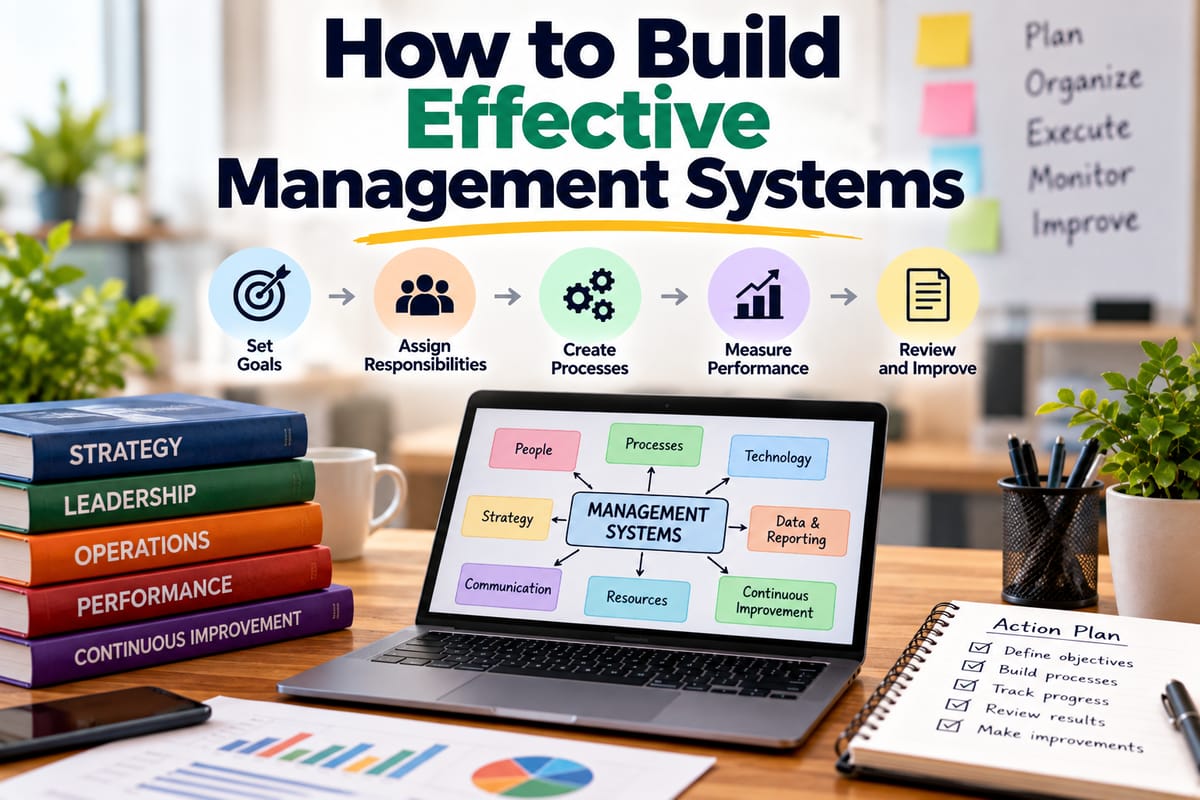
How to Build Effective Management Systems
Effective management systems give businesses a structured way to organize people, processes, information, resources, and decisions. They help managers understand what needs to happen, who is responsible, how progress should be measured, and what needs to change when results fall short.
Without clear management systems, businesses can become dependent on individual managers remembering every detail, employees making assumptions, or teams repeatedly solving the same problems. As organizations grow, these weaknesses can become increasingly difficult to manage.
A well-designed management system does not have to be complicated. Its purpose is to make the business easier to coordinate, measure, improve, and adapt.
What Is a Management System?
A management system is a structured framework that helps an organization plan activities, assign responsibilities, monitor performance, make decisions, and improve how work is performed.
It can include:
- Business goals
- Policies and procedures
- Organizational responsibilities
- Performance measures
- Communication processes
- Planning routines
- Reporting systems
- Decision-making processes
- Resource allocation
- Risk management
- Continuous improvement practices
Management systems can exist at different levels of a business.
A small company might rely on a relatively simple combination of weekly meetings, financial reports, task lists, and operating procedures. A larger organization may use formal management frameworks supported by specialized software, dashboards, reporting structures, and multiple layers of leadership.
The underlying objective remains similar: create a reliable way to coordinate the organization.
Why Management Systems Matter
Businesses involve many moving parts.
Employees have different responsibilities. Customers have different needs. Suppliers deliver resources. Financial obligations must be managed. Projects have deadlines. Managers need information to make decisions.
Without a system connecting these activities, problems can easily become fragmented.
A management system can help a business:
- Clarify responsibilities
- Coordinate teams
- Establish priorities
- Monitor performance
- Identify problems earlier
- Standardize important processes
- Improve communication
- Allocate resources
- Support better decisions
- Create accountability
The system becomes a framework that helps employees understand how their individual work contributes to broader business objectives.
Management Systems and Business Strategy
Management systems should support the direction of the organization rather than operate separately from it.
A business may have ambitious strategic goals, but those goals only become meaningful when they influence everyday decisions and activities.
For example, if a company wants to compete through exceptional customer service, its management system may need to include:
- Customer-service standards
- Employee training
- Response-time measures
- Customer feedback
- Service quality reviews
- Escalation procedures
Strategy therefore provides direction, while management systems help turn that direction into organized action.
The Complete Guide to Business Strategy and Strategic Planning provides broader context on how businesses develop strategic direction and translate priorities into plans.
Start With Clear Business Objectives
An effective management system begins with clarity about what the organization is trying to accomplish.
Objectives should describe meaningful outcomes rather than simply listing activities.
For example:
Activity: Contact 100 potential customers.
Outcome: Increase qualified sales opportunities by a defined amount.
The distinction matters because completing an activity does not necessarily mean the business achieved its intended result.
Clear objectives give managers a reference point for deciding what deserves attention and how resources should be allocated.
Define Who Is Responsible for What
Unclear responsibility is one of the most common causes of organizational confusion.
If several people are involved in a task but nobody clearly owns the result, problems can remain unresolved.
A management system should establish:
- Who owns each major responsibility
- Who performs the work
- Who approves important decisions
- Who receives updates
- Who is responsible when something goes wrong
This does not mean every task needs an elaborate organizational chart.
Even simple businesses benefit from making ownership visible.
For example:
| Area | Primary Responsibility | Supporting Roles |
|---|---|---|
| Sales | Sales Manager | Sales Representatives |
| Finance | Finance Lead | Accounting Staff |
| Operations | Operations Manager | Operations Team |
| Customer Service | Service Manager | Support Staff |
| Marketing | Marketing Lead | Marketing Team |
The exact structure will vary depending on the organization’s size and industry.
Build Clear Processes
A management system needs processes that explain how important work gets done.
Processes might cover:
- Hiring
- Sales
- Purchasing
- Customer support
- Product development
- Inventory management
- Financial reporting
- Quality control
- Project management
A process does not need to be excessively detailed.
For a routine task, a simple sequence can be enough:
- Receive request.
- Record request.
- Assign responsibility.
- Complete work.
- Review result.
- Communicate outcome.
- Record relevant information.
The purpose is to create consistency while still allowing employees to use appropriate judgment.
Standardize What Should Be Consistent
Not every business activity needs to be standardized.
Some decisions require creativity and professional judgment.
However, repetitive and important processes can often benefit from consistent procedures.
Examples include:
- Invoice processing
- Employee onboarding
- Safety checks
- Customer complaints
- Quality inspections
- Expense approvals
- Data entry
- Equipment maintenance
Standardization can reduce unnecessary variation and make training easier.
It can also make it easier to identify when something has deviated from the expected process.
Avoid Overcomplicating Procedures
A management system can become counterproductive when it contains too many rules.
Employees may struggle if every minor action requires multiple approvals or lengthy documentation.
Effective systems should answer important questions without creating unnecessary administrative work.
Before adding a procedure, managers can ask:
- What problem does this solve?
- Is the problem frequent enough to justify the process?
- Who needs to follow it?
- How much time will it require?
- Can it be simplified?
- How will we know whether it is working?
The best system is not necessarily the most complicated one.
It is the one that provides enough structure to improve consistency without preventing people from doing their jobs effectively.
Establish Management Routines
Management systems become more useful when important activities happen consistently.
Common management routines include:
Daily Check-Ins
Useful for teams handling fast-moving operational work.
Weekly Reviews
Useful for examining progress, problems, priorities, and upcoming work.
Monthly Performance Reviews
Useful for examining broader financial and operational results.
Quarterly Planning
Useful for reviewing strategic priorities and adjusting plans.
Annual Planning
Useful for setting major organizational objectives and resource priorities.
The appropriate frequency depends on the business.
A rapidly changing operation may require frequent reviews, while a stable process may only need periodic monitoring.
Create Effective Reporting Systems
Managers need reliable information to understand what is happening inside the business.
A reporting system should provide information that helps answer practical questions.
For example:
- Are we meeting our targets?
- Where are problems occurring?
- Are costs increasing?
- Are customers satisfied?
- Are projects on schedule?
- Are employees adequately resourced?
- Are important risks changing?
Reports should focus on information that supports decisions.
A report containing dozens of metrics may look comprehensive while making it harder to identify what actually matters.
Choose Useful Performance Measures
A management system needs appropriate measures.
Common business metrics include:
- Revenue
- Profit
- Cash flow
- Customer retention
- Customer acquisition
- Sales conversion
- Productivity
- Quality
- Employee turnover
- Delivery times
- Customer satisfaction
The right measures depend on the organization’s objectives.
A manufacturing company may emphasize production quality and efficiency, while a subscription business may focus heavily on customer retention and recurring revenue.
The important principle is alignment.
Measures should help managers understand whether the business is moving toward its objectives.
For a broader explanation of performance measurement, How Businesses Set Goals and Measure Performance examines how organizations can establish objectives and evaluate progress.
Distinguish Leading and Lagging Indicators
Not every performance measure tells managers the same thing.
A lagging indicator shows what has already happened.
Examples include:
- Last month’s revenue
- Quarterly profit
- Completed sales
- Employee turnover
A leading indicator can provide information about activities or conditions that may influence future results.
Examples might include:
- Qualified sales opportunities
- Customer inquiries
- Production backlog
- Employee training completion
- Website leads
Using both types of indicators can give managers a broader picture.
Lagging measures show outcomes, while leading measures can provide clues about what may influence future outcomes.
Build Strong Communication Channels
A management system depends heavily on communication.
Employees need to know:
- What is expected
- What has changed
- Which priorities matter
- Who makes decisions
- Where to report problems
- When information needs to be shared
Communication can take many forms:
- Team meetings
- Messaging platforms
- Project-management systems
- Dashboards
- Reports
- One-to-one meetings
- Company announcements
The objective is not to communicate constantly.
It is to ensure that important information reaches the right people at the right time.
Create a Reliable Decision-Making Process
Managers make decisions constantly.
Some decisions are routine. Others have significant consequences.
A management system can clarify which decisions employees can make independently and which require approval.
For example:
Routine purchase: Department manager approval.
Large capital expenditure: Senior management approval.
Major strategic change: Executive leadership review.
The exact thresholds depend on the organization.
Clear decision rights can prevent both problems: decisions being made without appropriate oversight and minor decisions becoming unnecessarily slow.
Give Managers the Information They Need
A management system is only useful if managers have access to relevant information.
Information may come from:
- Financial systems
- Customer databases
- Sales platforms
- Inventory systems
- Employee records
- Project-management tools
- Operational reports
The challenge is not simply collecting more information.
Managers need information that is:
- Accurate
- Timely
- Relevant
- Understandable
- Consistent
Poor-quality information can lead to poor decisions even when the management structure itself is well designed.
Connect Management Systems With Operations
Management systems should reflect how work actually happens.
If the organization’s operational processes are unclear, managers may struggle to determine where problems originate.
For example, a company experiencing late customer deliveries might discover that the real problem involves:
- Poor demand forecasting
- Inventory shortages
- Slow purchasing
- Production bottlenecks
- Inadequate transportation planning
- Communication failures
Management needs visibility across the entire process rather than focusing only on the final delivery problem.
The broader relationship between processes, resources, and business efficiency is explored in How Businesses Manage Operations, Processes, Resources and Efficiency.
Build Accountability Without Creating a Blame Culture
Accountability means making responsibilities and expectations clear.
It does not have to mean punishing people whenever something goes wrong.
A healthy management system can ask:
- What was expected?
- What actually happened?
- Why was there a difference?
- Was the process clear?
- Did the employee have the necessary resources?
- Was the training adequate?
- Did external circumstances contribute?
- What should change?
This approach focuses on learning and improvement as well as individual responsibility.
Use Feedback to Improve the System
Management systems should not remain unchanged forever.
Employees often have valuable knowledge about how processes work in practice.
Managers can gather feedback through:
- Team discussions
- Employee surveys
- One-to-one conversations
- Process reviews
- Customer feedback
- Performance analysis
- Post-project evaluations
A process that looks efficient on paper may create unnecessary work in practice.
Listening to employees can reveal these problems.
Create a Continuous Improvement Cycle
An effective management system should encourage continuous improvement.
A simple cycle might look like this:
Plan → Execute → Measure → Review → Improve → Repeat
Plan
Define the desired result and determine how the work should be performed.
Execute
Carry out the process.
Measure
Collect relevant information about the results.
Review
Compare actual performance with expectations.
Improve
Change the process when evidence suggests that improvement is needed.
Repeat
Continue monitoring and refining the system.
This creates a management environment in which processes evolve rather than becoming permanently fixed.
Use Technology Where It Adds Value
Technology can make management systems easier to operate.
Businesses may use software for:
- Project management
- Customer relationship management
- Accounting
- Human resources
- Inventory
- Communication
- Reporting
- Scheduling
- Workflow automation
Technology can improve visibility and reduce manual work.
However, software does not automatically create an effective management system.
If a business has unclear responsibilities and poorly designed processes, adding software may simply make those problems more complicated.
The process should be understood before technology is used to automate or manage it.
Document Important Knowledge
Businesses can become vulnerable when critical knowledge exists only in one employee’s memory.
Documentation can help preserve important information.
Useful documents might include:
- Standard operating procedures
- Training guides
- Process maps
- Approval rules
- Job responsibilities
- Customer-service procedures
- Emergency procedures
- Reporting definitions
Documentation is particularly valuable when employees change roles or leave the organization.
It also helps new employees learn how the business operates.
Train Employees to Use the System
A management system is only effective if people understand it.
Training should explain:
- What the process is
- Why it exists
- Who is responsible
- Which tools are used
- What information must be recorded
- What happens when something goes wrong
Training should also be updated when processes change.
Simply publishing a procedure document does not guarantee that employees understand how to apply it.
Make Systems Easy to Understand
Employees should not need to interpret complicated organizational structures just to understand their basic responsibilities.
Effective management systems often benefit from visual clarity.
For example, a process map can show:
Request → Review → Approval → Execution → Quality Check → Completion
An organizational responsibility chart can show who owns each stage.
A dashboard can display a small group of key performance indicators.
Simple visual structures can make complex operations easier to understand.
Manage Risks Within the System
Risk management should be integrated into normal business management rather than treated as an entirely separate activity.
Managers can identify:
- Financial risks
- Operational risks
- Technology risks
- Supply-chain risks
- Compliance risks
- Customer risks
- Staffing risks
- Reputation risks
For important risks, businesses can establish:
- Preventive controls
- Monitoring measures
- Contingency plans
- Responsible owners
- Escalation procedures
This makes risk management part of everyday decision-making.
Review Resource Allocation
Management systems should help businesses determine whether resources are being used effectively.
Resources can include:
- Money
- Employees
- Equipment
- Time
- Technology
- Facilities
- Inventory
- Information
Managers can periodically ask whether resources are being directed toward the organization’s highest priorities.
A department may be meeting its individual targets while consuming resources that could have a greater impact elsewhere.
Effective management therefore requires looking beyond individual activities and considering the organization as a whole.
Align Teams Around Shared Priorities
Different departments can develop conflicting priorities.
For example:
- Sales may want maximum product availability.
- Finance may want lower inventory.
- Operations may want stable production schedules.
- Customer service may want greater flexibility.
Each objective can make sense independently.
A management system helps create shared priorities so departments understand how their decisions affect other parts of the organization.
This reduces the risk of optimizing one department while creating problems somewhere else.
Review Management Systems Regularly
A management system should be reviewed periodically.
Questions might include:
- Are responsibilities still clear?
- Are important processes being followed?
- Are reports providing useful information?
- Are performance measures still relevant?
- Are meetings producing decisions?
- Are employees spending too much time on administration?
- Are customers experiencing recurring problems?
- Have business priorities changed?
If the organization has changed substantially, its management system may need to change as well.
Signs That a Management System Needs Improvement
Certain patterns can indicate that the existing system is not working effectively.
These may include:
- Repeated operational mistakes
- Unclear ownership
- Frequent communication failures
- Delayed decisions
- Conflicting priorities
- Excessive meetings
- Too many manual reports
- Employees repeatedly solving the same problems
- Important information being unavailable
- Performance targets that do not reflect business priorities
- Managers spending too much time reacting to problems
These signs do not necessarily mean the entire system needs to be replaced.
Sometimes a focused improvement in one process can make a significant difference.
Common Mistakes When Building Management Systems
Businesses can encounter several problems when designing management structures.
Making the System Too Complicated
More rules do not automatically produce better management.
Measuring Everything
Too many metrics can obscure the measures that actually matter.
Ignoring Employees
People who perform the work often understand operational problems better than anyone else.
Automating Broken Processes
Technology cannot automatically fix a poorly designed process.
Creating Unclear Accountability
Responsibilities should be visible rather than assumed.
Focusing Only on Short-Term Results
A system should support sustainable performance rather than encourage decisions that damage longer-term objectives.
Failing to Review the System
Business conditions change, and management structures need to adapt.
A Practical Framework for Building a Management System
A business can approach management-system development through a sequence of practical steps.
Step 1: Understand the Business
Identify the organization’s strategy, customers, products, services, resources, and major challenges.
Step 2: Define Objectives
Establish the outcomes the business needs to achieve.
Step 3: Map Key Responsibilities
Determine who owns important decisions and processes.
Step 4: Document Critical Processes
Identify how important work should be performed.
Step 5: Select Meaningful Measures
Choose indicators that show whether the business is achieving its objectives.
Step 6: Establish Review Routines
Determine when managers will review performance and make adjustments.
Step 7: Create Communication Channels
Make sure relevant information moves between teams and leadership.
Step 8: Introduce Appropriate Technology
Use tools where they genuinely improve visibility, coordination, or efficiency.
Step 9: Train Employees
Make sure people understand their responsibilities and the processes they need to follow.
Step 10: Improve Continuously
Use results and feedback to refine the system over time.
Management Systems Should Support People
It can be tempting to think of management systems primarily as structures, procedures, and measurements.
But people remain at the center of the organization.
Managers need enough flexibility to respond to circumstances. Employees need clarity about expectations. Teams need access to useful information. Customers need consistent service.
A management system should therefore support human decision-making rather than attempt to eliminate judgment entirely.
Good systems create clarity while leaving appropriate room for experience and professional judgment.
Building a System That Can Grow With the Business
A management system that works for a five-person company may not be sufficient for a 500-person organization.
As businesses grow, they often need more formal approaches to:
- Delegation
- Reporting
- Performance management
- Process documentation
- Financial controls
- Communication
- Risk management
- Decision-making
However, growth does not mean every process needs to become complicated.
The objective is to introduce structure when the organization needs it while preserving efficiency and flexibility.
Connecting Management With Leadership
Management systems provide structure, but leadership gives that structure direction and context.
Managers have to communicate priorities, resolve conflicts, make decisions, develop employees, and respond to changing circumstances.
The human side of management is therefore just as important as processes and metrics. How Managers Lead People, Make Decisions and Improve Business Performance explores these responsibilities in greater detail.
A strong management system should make good leadership easier rather than attempt to replace it.
Creating a Management System That Actually Works
An effective management system does not need to be the most sophisticated system possible.
It needs to provide the organization with enough clarity to answer fundamental questions:
What are we trying to achieve?
Who is responsible?
How should the work be performed?
How will we measure progress?
How will problems be identified?
Who makes important decisions?
How will we improve?
When those questions have clear answers, a business has a foundation for more consistent management.
The strongest systems also remain adaptable. They evolve as the company grows, customers change, technology develops, and new challenges emerge.
By combining clear objectives, defined responsibilities, practical processes, useful performance measures, effective communication, and continuous improvement, businesses can create management systems that support both everyday execution and long-term organizational development.




2 Comments
Micle harison
June 7, 2019Lorem ipsum dolor sit amet, usu ut perfecto postulant deterruisset, libris causae volutpat at est, ius id modus laoreet urbanitas. Mel ei delenit dolores.
John Doe
June 7, 2019Some consultants are employed indirectly by the client via a consultancy staffing company.