
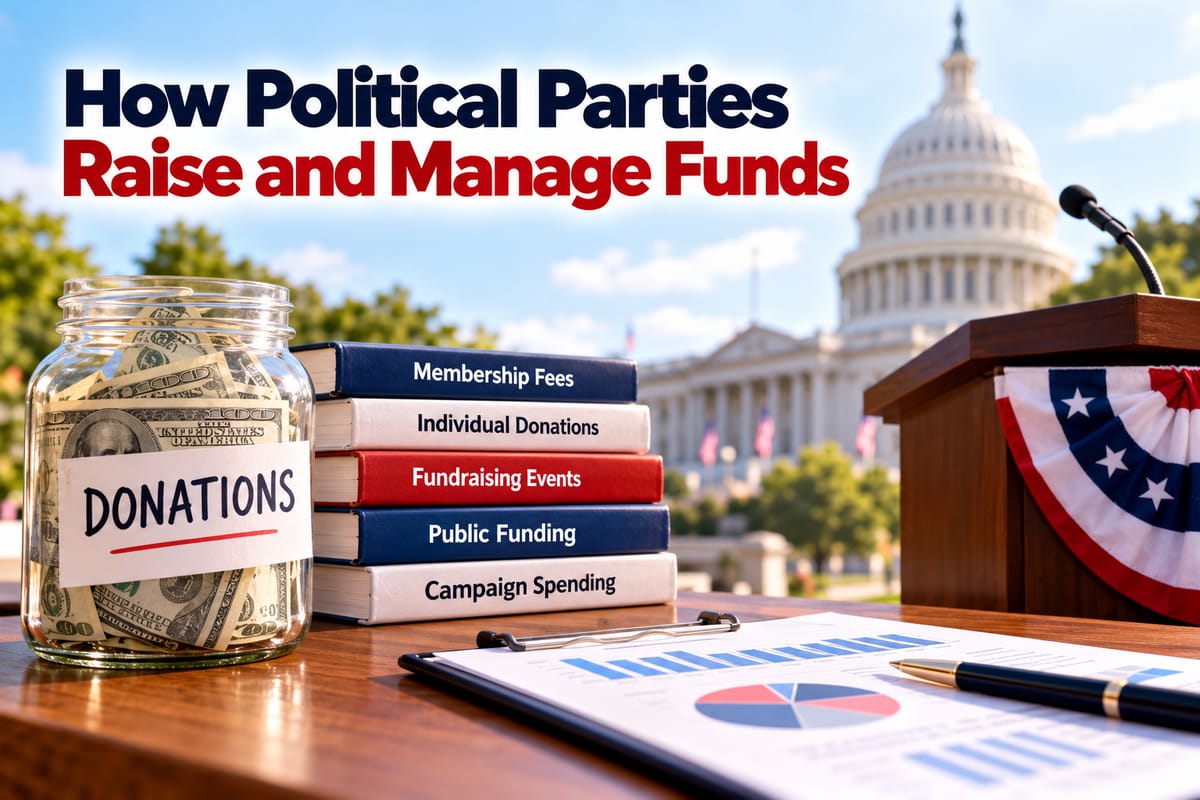
How Political Parties Raise and Manage Funds
Political parties need money to operate. They use funds to maintain organizations, communicate with members and voters, support candidates, conduct research, organize events, pay staff, operate offices and participate in elections.
The way parties raise and manage this money is an important part of how political systems function. It also raises questions about transparency, accountability, political influence and equal participation.
Political finance rules differ considerably between countries. Some systems permit public funding for political parties, while others rely more heavily on private contributions, membership fees or other sources of income. Many countries impose rules concerning donations, spending, reporting and disclosure. The OECD’s 2026 review, for example, shows substantial variation among countries in requirements for public financial reporting and campaign-finance disclosure.
Understanding political party finance therefore requires looking at both the sources of money and the systems used to control, record and disclose it.
What Is Political Party Finance?
Political party finance refers broadly to the money and other financial resources that political parties receive, manage and spend.
It can cover:
- Membership fees
- Individual donations
- Fundraising events
- Public funding
- Contributions from affiliated organizations
- Transfers within a party organization
- Lawful business or investment income
- Loans
- In-kind contributions
- Other sources permitted by national law
The exact categories vary by jurisdiction.
Political parties may also operate several accounts or financial structures for different purposes, particularly where election laws distinguish between campaign activity, ordinary party administration and other political activities.
Why Political Parties Need Money
Political parties are organizations, and organizations have operating costs.
A party may need funding for:
- Office space
- Staff salaries
- Communications
- Websites and digital systems
- Meetings
- Research
- Legal and accounting services
- Travel
- Candidate support
- Voter outreach
- Election-related activities
- Training
- Membership administration
During election periods, expenses can increase substantially because parties may organize larger campaigns, produce more communications and deploy staff and volunteers across constituencies.
The role of parties within broader political systems is explained in the Complete Guide to Political Parties and Party Systems.
Membership Fees
Membership fees are one traditional way political parties can raise money.
Members may pay regular fees to belong to the organization. The amount can vary according to the party and its membership structure.
Membership-based funding can provide parties with an ongoing source of income outside election periods.
It can also connect financing to the size and engagement of the party’s membership.
However, membership fees may not be sufficient to finance large organizations or expensive national election campaigns.
Individual Donations
Individuals can provide money directly to political parties in jurisdictions where such contributions are legally permitted.
Donations may be:
- Small recurring contributions
- One-time donations
- Large individual contributions
- Donations connected to fundraising events
The rules governing who can donate, how much can be donated and whether donations must be publicly disclosed vary significantly between countries.
Some systems impose contribution limits, while others use different mechanisms to regulate political donations.
Fundraising Events
Political parties can organize fundraising events to collect contributions.
Examples can include:
- Dinners
- Public meetings
- Online fundraising campaigns
- Auctions
- Ticketed events
- Membership drives
- Community fundraising activities
The money raised may support the party generally or be directed toward particular activities where the relevant laws permit such arrangements.
Fundraising also serves a political function beyond generating money because it can create opportunities for parties to communicate with supporters and build organizational networks.
Public Funding
Some political systems provide public funding to political parties.
Public funding can be designed to support party organizations, election campaigns or specific political activities.
Eligibility and allocation formulas vary.
A public-funding system might distribute money according to factors such as:
- Votes received
- Seats won
- Number of candidates
- Parliamentary representation
- Membership
- Eligibility thresholds
Public funding can reduce reliance on private donations, but it also raises questions about how public money should be distributed among established parties, smaller parties and new political organizations.
Party Funding From Affiliated Organizations
In some political systems, parties are connected to organizations such as labor unions, professional associations or other political groups.
Financial relationships between these organizations and political parties are subject to the laws of the relevant jurisdiction.
Such relationships may involve direct contributions, transfers, shared activities or other forms of support.
The legal treatment varies considerably, so a funding arrangement permitted in one country may be restricted or prohibited in another.
In-Kind Contributions
Political support does not always take the form of cash.
An in-kind contribution can involve goods or services provided to a party or campaign instead of money.
Examples could include:
- Donated office space
- Printing services
- Transportation
- Professional services
- Equipment
- Event facilities
Some legal systems treat the value of such contributions as part of political contributions and require them to be recorded or reported.
For example, U.S. federal rules recognize in-kind contributions as contributions whose value can count toward applicable limits.
Loans and Political Party Finance
Political organizations can sometimes use loans as part of their financial arrangements.
A loan provides access to money that must generally be repaid according to agreed terms.
Loans can be used for:
- Operating expenses
- Campaign costs
- Temporary cash-flow needs
- Large organizational expenditures
Political-finance regulations may impose specific requirements concerning loans, repayment, interest, guarantees and reporting.
These rules are intended in part to make financial relationships visible and distinguish legitimate financing from arrangements that could otherwise conceal the source or nature of political support.
Investment and Other Income
Some political parties can generate income through investments, property, publications, events or other lawful activities.
The extent to which parties may engage in commercial or investment activity depends on national law.
For example, Kenya’s Political Parties Act identifies membership fees, lawful voluntary contributions, certain donations and grants, and proceeds from investments, projects or undertakings as possible sources of party funds, subject to the Act’s restrictions.
This illustrates why the source of party funding needs to be examined within the legal framework of each country.
How Campaign Finance Differs From Ordinary Party Finance
A political party can have expenses that are not directly connected to a particular election.
For example, a party may maintain offices and staff throughout the year.
Election campaigns create additional expenses, such as:
- Candidate communications
- Advertising
- Travel
- Events
- Campaign materials
- Polling operations
- Election-related staff
Some jurisdictions have separate rules for campaign finance and ordinary party operations.
The distinction can affect how money is raised, spent and reported.
How Political Parties Manage Their Money
Raising money is only one part of political finance.
Parties also need systems for managing funds.
Financial management can involve:
- Creating a budget
- Recording income
- Verifying donations
- Paying authorized expenses
- Maintaining financial records
- Monitoring spending
- Preparing financial reports
- Meeting disclosure deadlines
- Auditing accounts where required
The complexity of these processes depends on the size of the party and the legal framework governing it.
Political Party Treasurers and Financial Officers
Many political organizations designate individuals or committees to oversee financial activity.
Their responsibilities can include:
- Maintaining accounts
- Recording contributions
- Approving expenditures
- Preparing reports
- Monitoring legal limits
- Retaining financial documentation
- Communicating with regulators
The precise responsibilities vary according to the country’s political-finance system.
In the United States, for example, political party committees have formal registration and reporting requirements with the Federal Election Commission.
Budgeting
A political party needs to decide how much money it can afford to spend and where that money should go.
A budget might divide funds among:
- Administration
- Staff
- Communications
- Research
- Candidate support
- Election operations
- Events
- Technology
- Legal and compliance work
Budgeting can help prevent an organization from committing money that it does not have.
It can also help party officials compare expected income with planned expenditure.
Cash Flow Management
Political parties may receive money at different times from different sources.
For example, membership fees may arrive throughout the year while large donations or public funds may arrive at specific times.
Expenses can also vary considerably.
Election periods may produce large increases in spending, while ordinary administrative expenses continue throughout the year.
Cash-flow management helps organizations ensure that money is available when legitimate expenses become due.
Recordkeeping
Accurate records are central to political finance.
Records may include:
- Donor information
- Donation amounts
- Dates
- Bank transactions
- Expenses
- Receipts
- Contracts
- Loans
- Transfers
- In-kind contributions
Recordkeeping requirements differ by jurisdiction.
In systems with formal campaign-finance reporting, financial committees may be required to maintain records that support their official reports.
Financial Disclosure
Financial disclosure allows the public, regulators and other stakeholders to see information about political money.
Disclosure requirements can cover:
- Sources of contributions
- Contribution amounts
- Expenditures
- Loans
- Debts
- Transfers
- Assets
- Financial reports
The extent and timing of disclosure differ across political systems.
The OECD’s 2026 data shows that many OECD and partner countries require political parties or candidates to report campaign finances, while the availability and timeliness of public financial information varies.
Why Transparency Matters
Transparency allows people to see where political organizations receive money and how they use it.
It can help reveal:
- Major sources of funding
- Significant expenditures
- Potential conflicts of interest
- Patterns in political finance
- Whether organizations are complying with applicable rules
Transparency does not by itself establish whether a particular contribution influenced a political decision.
It does, however, make financial relationships more visible.
Spending Limits
Some political systems impose limits on particular types of political contributions or expenditures.
The rules can apply to:
- Individual donations
- Party contributions
- Candidate contributions
- Campaign spending
- Coordinated spending
- Third-party political activity
Other systems may rely more heavily on disclosure than spending caps.
The design of these rules is a matter of national law and constitutional arrangements.
For example, U.S. federal law contains contribution limits for various political committees, while other categories of political activity are governed by different rules.
Restrictions on Funding Sources
Political-finance laws can restrict who is permitted to provide money to political parties.
Depending on the jurisdiction, restrictions may concern:
- Foreign governments
- Foreign organizations
- Corporations
- Labor organizations
- Anonymous donors
- Public bodies
- Certain contractors
- Other specified entities
Kenya’s Political Parties Act, for example, establishes restrictions on certain foreign sources while specifying other lawful sources of party funds.
Because these restrictions differ by country, a party’s legal ability to accept a particular donation cannot be assumed without examining the applicable law.
Anonymous Donations
Anonymous contributions can create transparency challenges because the public and regulators may not know who provided the money.
Some political-finance systems restrict anonymous donations or establish thresholds above which donor identification is required.
Others may permit limited anonymous contributions under defined circumstances.
The purpose of such rules is generally to balance fundraising with transparency and enforcement.
Campaign Advertising and Political Funds
A significant share of election spending can go toward communicating with voters.
Campaign expenditure can include:
- Television advertising
- Radio advertising
- Newspapers
- Websites
- Social media
- Printed materials
- Events
- Direct communications
- Polling
- Campaign staff
Political campaigns use these resources to communicate policy positions, introduce candidates and organize supporters.
For a broader explanation of campaign activity, see How Political Campaigns Work and Persuade Voters.
Digital Fundraising
The internet has changed how political organizations can raise money.
Parties can use:
- Websites
- Mobile payment systems
- Online donation platforms
- Social media
- Digital advertising
Online fundraising can make it easier to solicit many small contributions.
It can also create new administrative requirements involving payment processing, donor verification, cybersecurity and financial records.
Small Donations
Small contributions can allow parties to raise money from a large number of supporters.
A party receiving many relatively small donations may have a different fundraising structure from one relying primarily on a smaller number of large contributors.
Small-donor fundraising can also become an important organizational activity because asking supporters for contributions can create additional opportunities for engagement.
Large Donations
Large contributions can provide political organizations with substantial resources relatively quickly.
Where such contributions are lawful, transparency rules may require parties or candidates to disclose the donor and amount.
Large contributions can attract public attention because of questions about political access and influence.
The existence of a large donation does not by itself establish that the donor received a particular policy outcome. Any claim about influence requires evidence concerning the specific circumstances.
Bundled Contributions
In some political systems, individuals can collect contributions from multiple donors and transmit them to a political organization.
These arrangements can be subject to special reporting requirements.
For example, U.S. federal rules include reporting requirements for certain contributions bundled by lobbyists or registered organizations.
Bundling can be an important fundraising mechanism because it allows political organizations to identify networks of supporters and raise substantial amounts through organized solicitation.
Party Transfers
Political parties can operate through networks of national, regional, state, provincial or local organizations.
Money can sometimes move between different party committees or organizational units.
The rules governing such transfers vary by jurisdiction.
In the U.S. federal system, for example, party committees have specific reporting categories for transfers and other financial transactions.
How Parties Decide What to Spend
Political parties generally have competing financial priorities.
A party may need to decide how much to allocate to:
- Candidate support
- Voter outreach
- Digital communications
- Traditional advertising
- Staff
- Research
- Polling
- Offices
- Transportation
- Election-day operations
The allocation of funds reflects organizational decisions and the legal restrictions applicable to the party.
Spending priorities can also change as an election approaches.
Political Parties and Candidate Support
Parties can support candidates in several ways.
Depending on the jurisdiction, this may include:
- Direct financial contributions
- Advertising
- Campaign materials
- Staff assistance
- Polling
- Training
- Organizational support
- Coordinated activities
The legal classification of these activities matters because different forms of support can be subject to different rules.
In the U.S. federal system, for example, party committees can support candidates through contributions, coordinated expenditures and certain other party activities under specific rules.
Political Parties and Elections
Money is closely connected to election organization.
Parties may use funds to recruit candidates, train campaign workers, communicate with voters and coordinate election operations.
However, elections themselves are broader than campaign finance.
Voting systems, electoral rules, ballot procedures and voter eligibility also shape how elections work. These subjects are covered in the Complete Guide to Elections and Voting.
Funding and Political Representation
Political parties are also connected to representation.
Parties can recruit candidates, develop platforms and organize legislators around shared political programs.
Once elected, representatives may participate in legislative organizations and party structures.
The broader relationship between voters, elected officials and institutions is discussed in How Political Representation Works in Legislatures and Governments.
Political Finance and Party Competition
Access to financial resources can affect how parties organize and communicate.
Parties need resources to maintain operations, communicate with voters and participate effectively in elections.
At the same time, political-finance systems may attempt to prevent financial resources from producing disproportionate advantages through contribution limits, public funding, disclosure rules or spending regulations.
Different countries balance these objectives differently.
Public Funding and Smaller Parties
Public funding can be designed in ways that provide resources to parties based on votes, seats or other eligibility criteria.
Such systems can create a financial relationship between electoral support and public resources.
Eligibility thresholds can also matter.
If a party must reach a minimum level of electoral support to qualify for public funding, parties below that threshold may have to rely more heavily on membership fees and private fundraising.
The specific consequences depend on the design of each country’s funding system.
Political Finance and New Parties
New political parties often face different financial circumstances from established organizations.
An established party may have:
- Existing members
- Donor networks
- Offices
- Staff
- Public funding
- Established fundraising systems
A new party may need to build these structures from the beginning.
Some political-finance systems therefore use public funding or other mechanisms intended to support political competition, while others rely more heavily on private fundraising.
The Role of Financial Compliance
Political parties must generally comply with the financial laws applicable to them.
Compliance can involve:
- Identifying permitted donors
- Applying contribution limits
- Recording transactions
- Filing reports
- Disclosing required information
- Maintaining financial records
- Following expenditure rules
Failure to comply can result in penalties or other legal consequences depending on the jurisdiction.
In the United States, for example, political committees have formal filing obligations, and certain reporting failures can result in enforcement actions or administrative fines.
Auditing Political Party Accounts
Some political-finance systems require or permit financial audits.
Auditing can involve reviewing:
- Income
- Expenditure
- Bank records
- Receipts
- Donor records
- Assets
- Debts
- Compliance with financial rules
An audit can help identify discrepancies and strengthen confidence in financial reporting.
The exact audit requirements depend on national law and the type of political organization involved.
Managing Political Party Debts
Political parties can have financial obligations just like other organizations.
Debts can arise from:
- Loans
- Unpaid invoices
- Campaign expenses
- Staff costs
- Service contracts
- Other organizational obligations
Debt management requires parties to track what they owe and when payments are due.
Political-finance rules may also require debts and loans to be disclosed.
Election-Year Spending
Political parties often experience major changes in income and expenditure during election periods.
Fundraising may increase as parties seek additional resources for campaigns.
Spending can also rise because of:
- Advertising
- Travel
- Events
- Candidate support
- Polling
- Campaign materials
- Digital outreach
Financial reporting systems often use specific election-related reporting schedules to make these activities visible.
In the U.S. federal system, party committees have different reporting schedules depending on their status and activities, including additional pre- and post-election reporting requirements.
Spending After an Election
Political party finance does not end when voting ends.
Parties may still need money for:
- Staff
- Offices
- Legal matters
- Debt repayment
- Recounts
- Organizational activities
- Future election preparation
Some political systems have specific rules for election recounts and related expenditures.
This means responsible financial planning needs to account for both the campaign period and the period afterward.
Political Finance and Public Trust
Political finance can affect public confidence in political institutions.
People may reasonably want to know:
- Who funds political organizations?
- How much money do parties receive?
- How is the money spent?
- Are financial rules being followed?
- Are reports publicly available?
- Are political organizations treated consistently under the law?
Transparent financial systems can make these questions easier to investigate.
At the same time, transparency requirements need to operate within the legal framework concerning privacy, political participation and freedom of association.
Why Political Finance Rules Differ Between Countries
There is no single global model for political party finance.
Countries have different:
- Constitutional systems
- Electoral systems
- Political traditions
- Party structures
- Public funding arrangements
- Disclosure requirements
- Contribution limits
- Spending regulations
For example, some countries place greater emphasis on public financing, while others rely more heavily on private contributions.
Some use detailed disclosure systems, while others have different approaches to reporting and enforcement.
This variation means that political-finance claims should always be interpreted in their jurisdictional context.
What Political Parties Need to Balance
Managing political money involves several competing considerations.
A party may need to balance:
Fundraising — obtaining enough resources to operate.
Compliance — following applicable political-finance laws.
Transparency — providing required information about money received and spent.
Privacy — protecting information that laws do not require to be publicly disclosed.
Financial stability — ensuring the organization can meet its obligations.
Political activity — using lawful resources to communicate and participate in elections.
The exact balance depends on the legal and institutional environment.
The Basic Political Finance Cycle
Political party finance can be understood as a continuous cycle:
Raise funds → Verify funds → Record funds → Budget → Spend → Report → Review
During an election year, the cycle can become faster and more complicated because fundraising and expenditure increase.
Strong financial administration helps a party understand how much money it has, where it came from and where it is going.
What Voters Can Learn From Financial Reports
Where financial reports are publicly available, voters and researchers can use them to examine a party’s finances.
Questions might include:
- What are the major sources of funding?
- How diversified are the party’s funding sources?
- How much is being spent on campaigns?
- How much is spent on administration?
- What organizations or individuals provide significant support?
- How much debt does the organization have?
Financial reports provide information, but interpreting them requires understanding the relevant legal and political context.
A contribution by itself does not establish that a donor controls a party or that a particular policy decision was purchased.
The Importance of Context
A large political contribution can attract attention, but the meaning of that contribution depends on the surrounding facts.
Important considerations can include:
- Whether the contribution was legal
- Whether it was disclosed
- The donor’s relationship with the party
- The party’s other funding sources
- The timing of the contribution
- The party’s subsequent activities
- Applicable contribution limits
Careful analysis is preferable to assuming a direct relationship between money and political decisions without evidence.
Political Parties as Financial Organizations
Political parties are political institutions, but they also have organizational and financial responsibilities.
They need systems for collecting funds, maintaining records, paying bills, preparing budgets and complying with applicable laws.
The quality of these financial systems can affect the party’s ability to function effectively.
Financial administration is therefore not separate from political organization. It is part of the infrastructure that allows a political party to operate.
How Political Finance Connects to Democratic Competition
Political parties require resources to communicate political ideas, organize supporters and participate in elections.
At the same time, political systems need rules that address the risks associated with financial influence, unequal access and hidden funding.
This creates a continuing policy challenge: designing rules that permit legitimate political participation while providing appropriate transparency and safeguards.
Different countries approach that challenge in different ways.
The Continuing Role of Political Money
Political parties raise and manage funds through a combination of mechanisms that can include membership fees, private contributions, fundraising, public funding, transfers, loans and other legally permitted sources.
They then use those resources to maintain organizations, communicate with voters, support candidates and participate in elections.
The financial side of party politics is governed by rules that vary substantially between jurisdictions. Those rules can address who may provide money, how much can be contributed, what parties may spend, what must be disclosed and when reports must be filed.
Understanding political party finance therefore requires looking at the entire system rather than focusing on individual donations or campaign expenditures in isolation. Fundraising, budgeting, recordkeeping, spending, disclosure and oversight are interconnected parts of how political organizations manage the resources they use to participate in public life.



2 Comments
Micle harison
June 7, 2019Lorem ipsum dolor sit amet, usu ut perfecto postulant deterruisset, libris causae volutpat at est, ius id modus laoreet urbanitas. Mel ei delenit dolores.
John Doe
June 7, 2019Some consultants are employed indirectly by the client via a consultancy staffing company.