
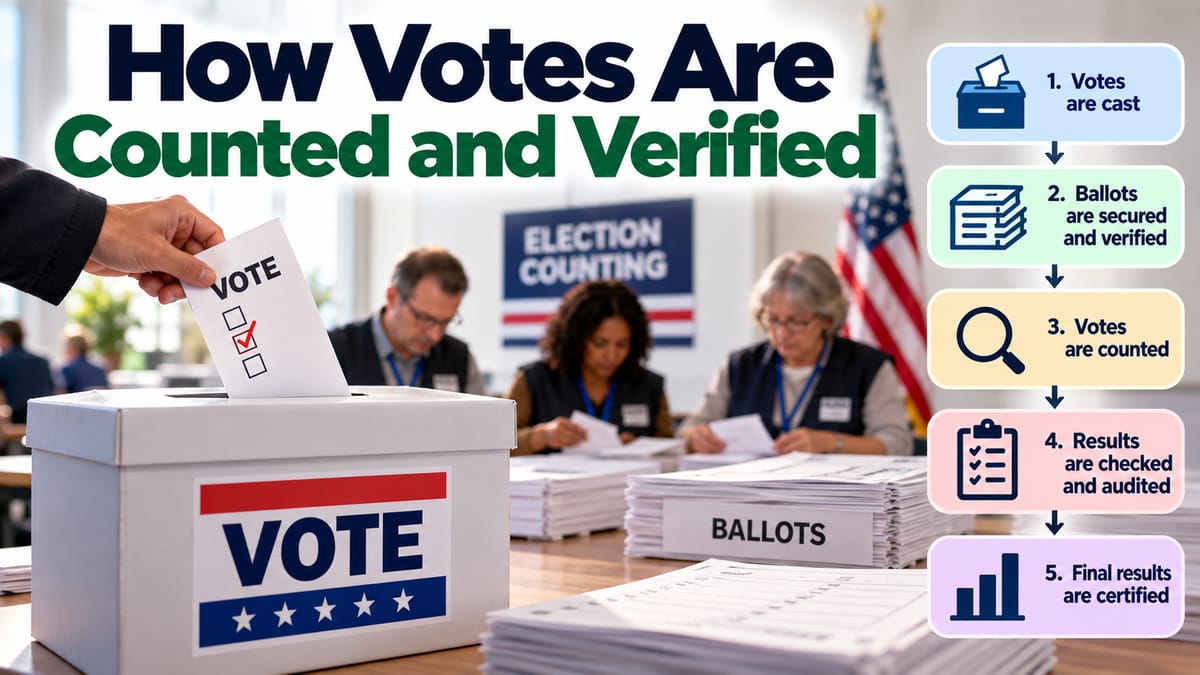
How Votes Are Counted and Verified
Voting does not end when a ballot is placed into a ballot box or submitted through an authorized voting system. After polling closes, election officials begin a series of procedures designed to count valid votes, reconcile election materials, review questionable ballots, publish results, and eventually establish the official outcome.
The exact process varies according to a country’s laws, voting system, election type, and method of voting. Some elections rely primarily on paper ballots, while others use ballot-scanning equipment, electronic systems, or combinations of technologies. Some systems count votes locally and then aggregate the totals at higher administrative levels.
Despite these differences, a common principle runs through modern election administration: the reported result should be supported by a documented process for counting, checking, reconciling, and certifying the votes.
Understanding that process makes it easier to distinguish an initial election-night result from a final certified result.
What Happens When Polls Close?
When voting ends, election officials secure ballots and election records and begin the next stage of the electoral process.
Depending on the jurisdiction, ballots may be:
- Counted at individual polling stations
- Transported to centralized counting centers
- Scanned using approved tabulation equipment
- Counted manually
- Counted through a combination of manual and electronic procedures
In some systems, counting begins immediately after polls close. In others, certain ballots may be processed earlier but cannot be included in the count until legally permitted.
For example, the UK’s Electoral Commission describes a process in which ballot boxes and associated paperwork are transported to counting centers, where verification occurs before the votes are counted.
The rules governing the timing of these steps are determined by the applicable election law.
The Difference Between Counting and Verification
Counting and verification are related but distinct activities.
Counting determines how many valid votes were cast for each candidate, party, option, or other choice on the ballot.
Verification checks whether the number of ballot papers or voting records being processed corresponds with the records created during voting.
For example, the Electoral Commission in the United Kingdom describes verification as counting the ballot papers in a ballot box and checking that the number corresponds with the polling-station paperwork recording the number of ballot papers issued.
Verification therefore helps establish that the physical or electronic records being counted are properly accounted for before the results are finalized.
Why Ballot Reconciliation Matters
Election officials need to account for the materials involved in an election.
This can include comparing:
- Ballots issued
- Ballots returned
- Ballots counted
- Spoiled ballots
- Rejected ballots
- Unused ballots
- Voter participation records
- Electronic voting records where applicable
The exact reconciliation procedure depends on the election system.
In U.S. election administration, for example, the Election Assistance Commission describes canvassing as a process that reconciles different categories of ballots and voting records and helps identify discrepancies before certification.
Reconciliation does not mean that every numerical difference automatically indicates misconduct. A discrepancy can have an administrative explanation and may be investigated and documented according to the applicable rules.
How Paper Ballots Are Counted
Paper-ballot elections can involve several stages.
After ballots are received at a counting location, officials may first verify the ballot materials. The ballots can then be sorted according to the contest and candidate or option selected.
Depending on the voting system, counting may be performed manually, by scanning equipment, or through a combination of methods.
Human officials remain important even when technology is used. Ballots that cannot be automatically interpreted or that require a decision about voter intent may need to be reviewed according to established rules.
The UK’s Electoral Commission, for example, explains that doubtful ballots can be considered by the returning officer to determine whether the voter’s intention can be established and whether the ballot should be counted.
What Happens to a Marked or Unclear Ballot?
Not every ballot will be perfectly marked.
A voter might accidentally:
- Mark more choices than permitted
- Leave a ballot blank
- Make an unclear mark
- Mark a ballot in a way that differs from the instructions
- Damage part of the paper
Election laws normally establish rules for determining whether such ballots are valid.
The key issue is generally whether the ballot demonstrates the voter’s intention in a manner permitted by the applicable rules.
Officials may set aside questionable ballots for adjudication rather than automatically rejecting them. The exact standards vary by jurisdiction and voting system.
How Electronic Vote Tabulation Works
Electronic systems can be used to scan paper ballots, record selections, calculate totals, or perform other tabulation functions.
A ballot scanner, for example, can interpret marks on a paper ballot and assign the corresponding votes to the appropriate contest.
Electronic tabulation can make large-scale counting faster, but it does not eliminate the need for verification.
Voting systems are typically subject to testing, certification, security procedures, or other controls established by the relevant election authority. In the United States, the Election Assistance Commission operates a testing and certification program for voting systems used by state and local election officials.
The precise technology and certification framework differs internationally.
Why Election Results Can Change After Polls Close
People watching election coverage may see results change over several hours or days.
This does not necessarily mean that previously counted votes were changed.
Results can change because:
- More ballots are still being counted
- Different voting locations report at different times
- Postal or absentee ballots are processed according to applicable rules
- Provisional or otherwise conditional ballots require additional review
- Results are being aggregated from smaller counting areas
- Previously reported totals are corrected
- Recounts or other legally required procedures take place
The U.S. Election Assistance Commission specifically notes that election-night results are unofficial and can change while outstanding ballots are processed and officials conduct canvassing and other required procedures.
The important distinction is between reported preliminary information and official certified results.
What Is Canvassing?
Canvassing is a formal post-election review and reconciliation process used in some election systems.
The precise meaning varies by jurisdiction, but it generally involves bringing together election records and confirming that the reported totals are complete and properly supported.
In the U.S. system described by the Election Assistance Commission, canvassing involves aggregating and confirming valid ballots from different voting methods and resolving discrepancies before certification.
This process is an important reason why the numbers seen on election night should not automatically be treated as the final official result.
Certification Comes After the Counting Process
Certification is the formal step through which the legally responsible election authority confirms the official results.
The authority responsible for certification differs between countries and, in some systems, between different levels of government.
The U.S. Election Assistance Commission describes certification as officials attesting that the election results constitute an accurate accounting of the votes cast within the jurisdiction.
Certification therefore represents more than simply announcing which candidate has the highest reported total. It comes after required administrative checks have been completed.
Different Voting Systems Produce Different Counting Methods
There is no universal method for counting every election.
The counting procedure depends partly on the electoral system.
First-Past-the-Post
In a first-past-the-post contest, the candidate receiving the highest number of votes in the relevant constituency or district wins.
This is comparatively straightforward once valid votes have been sorted and counted.
Proportional Representation
Proportional systems can involve additional calculations because seats may be allocated according to the share of votes received by parties or candidates.
Depending on the system, calculations may involve electoral thresholds, quotas, divisors, or allocation formulas.
Ranked-Choice and Preferential Voting
In preferential systems, voters may rank candidates.
The count can therefore occur in multiple rounds. Candidates may be elected after reaching a required threshold, while votes can be transferred according to the applicable rules.
The UK’s Electoral Commission, for example, describes the single transferable vote as a multi-stage process involving quotas, elimination, and transfer of votes.
The counting process can consequently be more complex than simply adding first-choice votes.
Why the Electoral System Matters
Understanding the voting system is essential when interpreting election results.
A candidate receiving the largest number of votes in a constituency may win a seat under one system, while another system may allocate seats based on proportional calculations.
Similarly, a party’s overall vote share does not necessarily translate directly into the same percentage of seats under every electoral system.
The Complete Guide to Elections and Voting provides broader context on how elections, voting systems, ballots, and electoral procedures fit together.
How Results Are Aggregated
Many elections involve several administrative levels.
A local counting location may produce a preliminary total. That total can then be combined with results from other locations to establish a constituency, district, regional, or national result.
This aggregation process requires accurate transmission and documentation.
Election authorities may use standardized forms, electronic reporting systems, secure communications, or other procedures to transfer totals.
The UK’s Electoral Commission notes that where counting occurs in multiple local venues, local totals may need to be communicated and aggregated to establish the overall result.
What Is an Election Audit?
An election audit is a review designed to provide additional evidence that election procedures or vote tabulation operated as intended.
Audits can take different forms.
They may examine:
- A sample of ballots
- Voting equipment
- Tabulation records
- Procedures followed by election workers
- Chain-of-custody documentation
- Reconciliation records
- Compliance with election requirements
The precise audit framework varies significantly between jurisdictions.
The U.S. Election Assistance Commission notes that audit methods can include procedural, traditional, risk-limiting, or combined approaches.
How a Tabulation Audit Works
A tabulation audit can involve selecting a sample of ballots and comparing a human examination or retabulation with the original reported results.
For example, officials may randomly select particular batches, precincts, or ballots and manually examine them.
If the audit identifies a discrepancy, the applicable rules may require additional investigation or auditing.
The objective is to provide an independent check on the tabulation process rather than simply repeating the original count without additional controls.
What Is a Risk-Limiting Audit?
A risk-limiting audit is a statistical approach to checking whether the reported outcome of an election is correct.
Rather than necessarily recounting every ballot, an audit examines a statistically selected sample.
If the sample provides sufficient evidence that the reported outcome is correct within the specified risk limit, the audit can stop. If the evidence is insufficient, additional ballots are examined.
The U.S. Election Assistance Commission describes risk-limiting audits as focusing on whether the reported outcome is correct and using progressively larger samples when necessary.
Risk-limiting audits are one particular form of post-election verification and are not used in every jurisdiction.
Audits and Recounts Are Not the Same
Audits and recounts serve different purposes.
An audit generally examines selected ballots, records, procedures, or systems to provide evidence about the accuracy of the election process or reported result.
A recount involves counting ballots again under the rules applicable to that election.
A recount may be triggered by:
- A legally defined margin
- A candidate request
- A court order
- Another statutory condition
The specific rules differ between jurisdictions.
The U.S. Election Assistance Commission notes that recounts can affect official results, whereas audits are generally designed as verification procedures.
Why Chain of Custody Matters
Ballots and election records must remain properly accounted for throughout the counting process.
Chain-of-custody procedures document how election materials move from one stage to another.
Depending on the system, records may cover:
- Who received the ballots
- When they were transferred
- Where they were stored
- Whether containers were sealed
- Which batches were counted
- Which equipment was used
- Who had authorized access
- When materials were returned to secure storage
The U.S. Election Assistance Commission’s current chain-of-custody guidance includes documentation for ballot containers, ballot totals, damaged or adjudicated ballots, ballot batches, voting devices, and reconciliation between ballots and voters.
These records create an audit trail that can be examined if questions arise.
Why Transparency Matters
Counting does not have to mean that every part of the process is visible to everyone at every moment.
Instead, election systems can provide transparency through defined procedures, authorized observers, documentation, public reporting, and legally established opportunities to inspect or challenge parts of the process.
For example, UK election guidance provides for candidates, agents, and accredited observers to attend certain verification and counting activities.
The exact rights of observers, candidates, political parties, journalists, and members of the public vary by jurisdiction.
The Role of Election Observers
Election observers can provide another layer of independent observation.
Observers may monitor whether procedures are being followed and document issues according to the rules governing their role.
Candidate or party counting agents may also have specific rights to observe aspects of counting and raise procedural concerns.
Observation does not mean that observers themselves determine the result. Election officials or legally designated authorities remain responsible for administering the count and applying the relevant rules.
What Happens When a Discrepancy Is Found?
A discrepancy does not automatically establish that an election result is wrong.
Election officials may investigate the discrepancy by checking:
- Original paperwork
- Ballot containers
- Counting records
- Scanner reports
- Reconciliation figures
- Data-entry records
- Transfer documentation
- Other relevant evidence
Depending on the circumstances and local law, officials may recount a batch, correct an administrative error, conduct additional audits, or take another prescribed action.
The goal is to identify the source of the discrepancy and determine what effect, if any, it has on the official results.
Why Election Results Are Sometimes Delayed
A delay does not necessarily indicate a problem with the election.
Additional time may be required because:
- Large numbers of ballots must be processed
- Multiple voting methods are involved
- Ballots require adjudication
- Reconciliation is incomplete
- Postal ballots are governed by specific rules
- Results must be aggregated across jurisdictions
- Audits or recounts are required
- Certification deadlines have not yet arrived
The U.S. Election Assistance Commission notes that final results can take days or sometimes weeks after voting, depending on the procedures and ballots involved.
Speed and accuracy therefore have to be balanced within the requirements established by election law.
How Political Representation Connects to Vote Counting
Counting votes is ultimately part of a larger representative process.
Once votes are counted and the legally required procedures are completed, the results determine which candidates, parties, or options receive the representation or outcome provided by the electoral system.
The How Political Representation Works in Legislatures and Governments guide explains the broader relationship between elections, voters, representatives, legislatures, and government.
This connection helps explain why accurate vote counting matters: the numbers produced by election administration can determine who occupies public offices and how voters are represented.
Elections Are One Part of Democratic Government
Vote counting is not an isolated technical activity.
It is one component of a broader system involving voters, candidates, political organizations, election authorities, courts, legislatures, and government institutions.
The How Democratic Governments Work and Why They Matter guide provides additional context on how elections fit within democratic government.
The rules governing counting and verification are therefore important because they connect individual ballots to the formal institutions created through elections.
Citizens Also Have a Role Beyond Election Day
Political participation does not end when ballots are counted.
Citizens may participate through voting, public discussion, community activity, contacting representatives, political organizations, lawful advocacy, and other forms of civic engagement.
The Political Participation Explained: How Citizens Engage guide explores the broader ways people participate in political life.
Understanding vote counting can itself be a form of civic knowledge because it helps people understand what happens to their vote after it is cast.
A Simple Way to Understand the Entire Process
Although election systems differ, the overall sequence can often be understood through several broad stages:
1. Voting takes place.
Eligible voters cast ballots through the methods permitted by law.
2. Ballots or voting records are secured.
Election materials are transported, stored, or transmitted using procedures established by the relevant authority.
3. Verification and reconciliation begin.
Officials account for ballots and compare voting materials with the appropriate records.
4. Valid votes are counted.
Votes are tabulated according to the electoral system being used.
5. Questionable ballots are reviewed.
Officials apply legal rules to ballots where validity or voter intent requires examination.
6. Results are aggregated.
Local or preliminary totals are combined into the relevant electoral result.
7. Canvassing or equivalent review takes place.
Officials reconcile records, investigate discrepancies, and confirm that required procedures have been completed.
8. Audits may provide additional verification.
Where required, selected ballots, equipment, records, or procedures may be reviewed.
9. Recounts may occur where legally required or authorized.
A recount involves another tabulation under the applicable rules.
10. Results are certified.
The legally responsible authority formally establishes the official result.
This sequence is a useful framework, but the exact order and terminology can vary considerably between elections.
Why Preliminary Results Should Be Treated Differently From Certified Results
Election-night reporting is designed to communicate information quickly.
Certification is designed to establish the official result after required procedures have been completed.
Those are different functions.
A preliminary result may provide a useful picture of the count so far, while later reporting can incorporate additional ballots, corrections, reconciliation, audits, or other legally required procedures.
The U.S. Election Assistance Commission explicitly distinguishes unofficial results from certified results and notes that reporting can continue until the required counting and canvassing processes are complete.
This distinction is important when reading election coverage or discussing changing vote totals.
What Makes a Vote-Counting System Verifiable?
A verifiable election-counting process generally benefits from several characteristics:
- Clearly defined rules
- Secure handling of election materials
- Accurate records
- Reconciliation procedures
- Tested voting equipment where technology is used
- Transparent counting procedures
- Appropriate observation
- Documented audit trails
- Post-election verification
- Procedures for resolving discrepancies
- Legally defined recount mechanisms
- Formal certification
No single safeguard performs every function.
Instead, election administration uses multiple layers of procedure so that errors or irregularities can be identified and addressed at different stages.
From Ballot to Official Result
Counting votes is more than adding numbers together.
It is a structured administrative process that connects individual ballots with an official election result. Verification helps account for the ballots being processed. Counting determines the votes represented on those ballots. Reconciliation checks the consistency of election records. Audits provide additional examination in systems where they are used. Recounts provide another tabulation when legally triggered. Certification establishes the official result.
The details vary from one jurisdiction to another, but understanding these stages makes election reporting easier to interpret.
A number displayed shortly after polls close is not necessarily the final official result. The complete electoral process can continue through counting, verification, reconciliation, auditing, recounts where applicable, and certification before the result becomes formally established.




2 Comments
Micle harison
June 7, 2019Lorem ipsum dolor sit amet, usu ut perfecto postulant deterruisset, libris causae volutpat at est, ius id modus laoreet urbanitas. Mel ei delenit dolores.
John Doe
June 7, 2019Some consultants are employed indirectly by the client via a consultancy staffing company.