
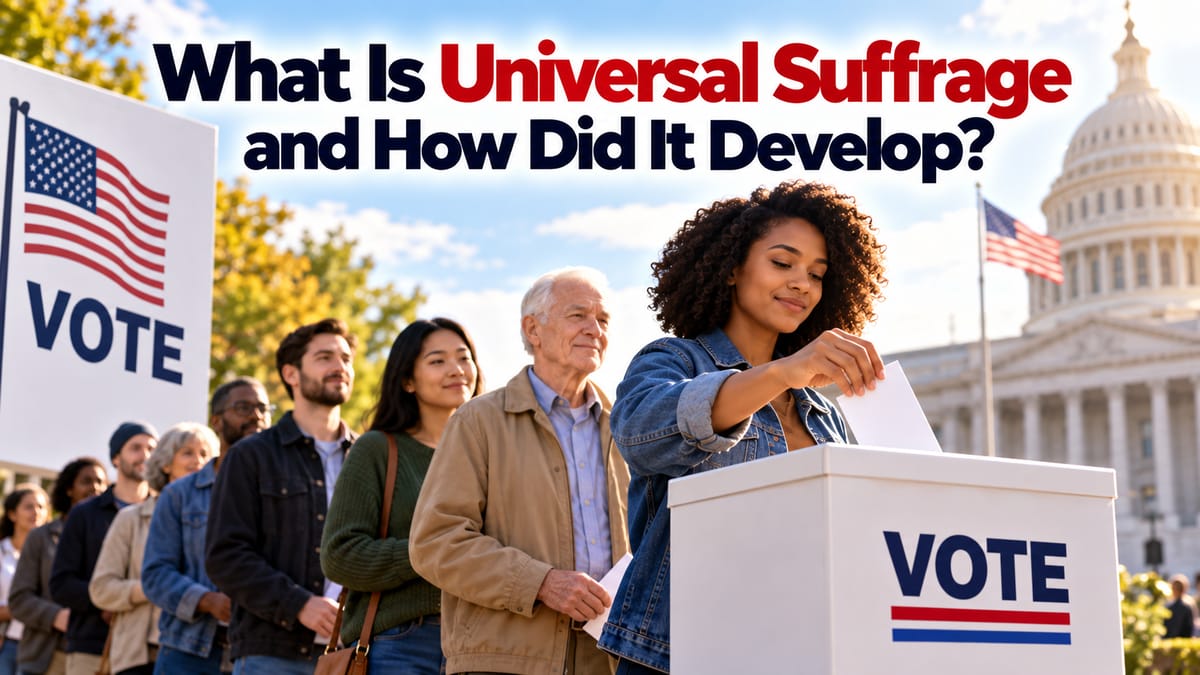
What Is Universal Suffrage and How Did It Develop?
Universal suffrage is the principle that adult citizens should have the right to participate in elections without being excluded because of characteristics such as sex, race, wealth, social status, or similar arbitrary distinctions.
The idea sounds straightforward today, but voting rights were historically limited in many societies. Political participation was often restricted to men, property owners, particular social classes, racial groups, or other categories of people.
The expansion of suffrage therefore took place gradually. Different countries followed different paths, and the legal meaning of universal suffrage has continued to develop as governments have addressed barriers to political participation.
Today, universal and equal suffrage is recognized as an important principle of democratic elections and human rights. Article 21 of the Universal Declaration of Human Rights states that government authority should be based on the will of the people expressed through periodic and genuine elections conducted by universal and equal suffrage.
What Does Universal Suffrage Mean?
Universal suffrage means that the right to vote is extended broadly to eligible adult citizens rather than being restricted to a privileged group.
The word universal does not normally mean that literally every person in a country can vote regardless of age, citizenship, or legal status.
Modern electoral systems generally establish eligibility rules, such as:
- Minimum voting age
- Citizenship requirements
- Electoral registration
- Residency requirements in some systems
- Legal rules concerning particular categories of voters
The central principle is that eligibility should not be arbitrarily restricted based on characteristics such as wealth, sex, race, or social class.
The United Nations describes universal and equal suffrage as part of the right to participate in government through genuine elections.
Suffrage, Franchise, and Voting Rights
The terms suffrage, franchise, and voting rights are often used in discussions about elections.
They generally refer to the right or legal entitlement to participate in voting.
A country’s electoral franchise defines who is legally entitled to vote.
Universal suffrage describes a broad form of that franchise in which voting rights are not reserved for a particular social, economic, racial, or gender group.
The exact rules still vary between countries.
Why Voting Was Historically Restricted
Early electoral systems in many societies did not treat political participation as a universal right.
Voting could be associated with:
- Property ownership
- Tax payments
- Social status
- Gender
- Race
- Religion
- Citizenship status
- Residence
- Wealth
- Age
In some systems, political power was concentrated among relatively small groups of men with property or other qualifications.
The gradual removal of these restrictions became a major part of the development of modern representative government.
The Link Between Suffrage and Representation
Voting rights are closely connected to political representation.
In a representative system, citizens select individuals or parties to exercise public authority on their behalf.
Broadening the electorate changes who participates in that process.
As more groups gain voting rights, political parties and candidates must potentially address a wider range of citizens and interests.
For a broader explanation of the relationship between citizens and government institutions, see How Political Representation Works in Legislatures and Governments.
The Early Expansion of the Male Franchise
In several European countries, the expansion of voting rights initially focused heavily on men.
The United Kingdom provides a useful example of this gradual process.
The 1832 Reform Act expanded the parliamentary franchise to additional men who met property qualifications, but it also formally defined parliamentary voters as male persons. The majority of working men still could not vote.
Further reforms followed.
The 1867 Reform Act expanded voting rights among urban working men who met specified property qualifications, roughly doubling the electorate in England and Wales from one million to two million men.
The 1884 Reform Act established a more uniform franchise between counties and boroughs, although significant restrictions remained.
These reforms demonstrate that universal suffrage usually developed through multiple stages rather than through a single legal change.
The Chartist Movement and Universal Male Suffrage
In nineteenth-century Britain, the Chartist movement made broader political reform a major public issue.
Chartists campaigned for measures including universal male suffrage and other electoral reforms.
Although their demands were not immediately adopted in full, their campaign contributed to a broader political debate about who should participate in government.
The gradual expansion of the British franchise illustrates how organized political movements, parliamentary reform, and changing social conditions could interact over time.
Women’s Suffrage Became a Major Part of the Movement
Expanding voting rights to more men did not automatically create universal suffrage.
Women remained excluded from parliamentary voting in many countries well into the nineteenth and twentieth centuries.
Women’s suffrage movements challenged these restrictions through petitions, public campaigns, political organizing, demonstrations, lobbying, legal challenges, and other forms of activism.
The movement developed differently in different countries, but the underlying issue was whether political rights should be extended to women on equal terms with men.
The Development of Women’s Suffrage in the United Kingdom
The British experience shows how universal adult suffrage could emerge in stages.
The Representation of the People Act 1918 gave the vote to virtually all men over 21 while also granting voting rights to certain women over 30 who met property requirements.
Women therefore did not immediately receive voting rights on the same basis as men.
The Equal Franchise Act of 1928 subsequently gave women the vote on the same terms as men.
The first UK general election conducted on the basis of complete adult suffrage was held in 1929.
Women’s Suffrage in the United States
The United States followed a different path.
The movement for women’s voting rights developed during the nineteenth century, with activists organizing petitions, conventions, public campaigns, and other forms of political action.
The National Archives records that a national petition campaign for “universal suffrage” began in 1866, combining demands associated with women’s voting rights and broader enfranchisement.
The Nineteenth Amendment was passed by Congress in 1919 and ratified in 1920, prohibiting the denial or abridgment of voting rights on the basis of sex.
However, the amendment did not immediately eliminate every barrier that prevented women from voting. The National Archives notes that discriminatory laws continued to prevent many women, particularly women from racial minorities, from exercising the franchise.
Race and the Expansion of Suffrage
The history of universal suffrage also involves struggles over racial exclusion.
In the United States, the Fifteenth Amendment, ratified in 1870, prohibited denying the vote on account of race, color, or previous condition of servitude. Yet discriminatory practices continued to restrict African American voting for decades.
The Voting Rights Act of 1965 targeted discriminatory voting practices, including literacy tests that had been used in some southern states to obstruct voting by African Americans.
This history illustrates an important distinction between formal voting rights and effective access to those rights.
A constitution may recognize a broad right to vote while laws, administrative practices, intimidation, or other barriers make exercising that right difficult for particular groups.
Universal Suffrage Is More Than a Legal Declaration
Universal suffrage involves both formal eligibility and practical access.
A person may technically possess the right to vote but still encounter barriers involving:
- Voter registration
- Identification requirements
- Polling-place access
- Electoral boundaries
- Physical accessibility
- Administrative procedures
- Information barriers
- Intimidation
- Discriminatory practices
International human rights standards therefore address not only who may vote but also the conditions under which elections should be conducted.
The UN human rights framework describes suffrage as needing to be universal, equal, and non-discriminatory.
Universal Suffrage and Equal Suffrage
Universal and equal suffrage are related principles.
Universal suffrage concerns broad access to voting rights.
Equal suffrage concerns equality among voters.
The principle of equal suffrage generally means that eligible voters should have an equal vote rather than some citizens receiving greater voting power because of wealth, social status, or other characteristics.
International human rights guidance identifies equality of voting power as an important component of genuine electoral participation.
The Secret Ballot and Universal Suffrage
The expansion of voting rights also involved changes to how votes were cast.
A secret ballot helps protect voters from pressure, intimidation, or retaliation by allowing individuals to make their choices privately.
The United Nations includes secret voting or equivalent free voting procedures among the principles associated with genuine elections and universal and equal suffrage.
In Britain, the Ballot Act of 1872 introduced the secret ballot, while later reforms addressed corruption and electoral practices.
Universal Suffrage and Electoral Administration
Expanding the electorate requires systems capable of registering and serving large numbers of voters.
As suffrage expanded, governments developed more extensive systems for:
- Voter registration
- Electoral rolls
- Polling places
- Ballot distribution
- Vote counting
- Election administration
- Electoral boundaries
The expansion of voting rights therefore went together with the development of modern election administration.
How Elections Became Mass Political Events
When only a small proportion of the population could vote, elections were often centered on relatively narrow electorates.
As voting rights expanded, elections became mass-participation events.
Political parties increasingly needed to communicate with broader populations and organize campaigns capable of reaching large numbers of voters.
This contributed to changes in political organization, campaigning, public communication, and party structures.
For an overview of how modern elections function, see the Complete Guide to Elections and Voting.
Universal Suffrage and Political Participation
Voting is only one form of political participation.
Citizens can also participate by:
- Joining political parties
- Attending public meetings
- Contacting elected representatives
- Signing petitions
- Participating in civic organizations
- Campaigning
- Standing for public office
- Engaging in public debate
- Taking part in peaceful demonstrations
Universal suffrage expands formal electoral participation, while broader political participation includes many activities outside elections.
A wider discussion is available in Political Participation Explained: How Citizens Engage.
Finland and the Expansion of Suffrage
Finland provides an important historical example.
International IDEA notes that Finland adopted universal suffrage in 1906 and became the first European country to grant full voting and candidacy rights to both women and men, although the voting age at the time was 24.
The example demonstrates that different countries reached broad suffrage at different points and through different institutional arrangements.
Sri Lanka and Universal Adult Suffrage
Sri Lanka is another significant example.
Universal adult suffrage was introduced there in 1931. International IDEA describes Sri Lanka as the first British colony and the first country in Asia to hold elections based on universal adult suffrage for both men and women.
The development of universal franchise in Sri Lanka therefore occurred before independence in 1948.
This illustrates that the expansion of voting rights was not limited to European and North American political systems.
South Africa and Universal Suffrage
South Africa provides another major example of how the development of universal suffrage can occur much later than initial democratic institutions.
The 1994 elections were the first South African elections in which citizens of all races were permitted to participate under a system of universal suffrage.
The election followed the end of apartheid and a transitional process that reshaped the country’s political institutions.
The South African example shows how universal suffrage can become a central component of constitutional and political transformation.
Universal Suffrage and Colonial History
The expansion of suffrage also intersected with colonialism.
In colonial systems, political rights could be structured around distinctions between colonizers and colonized populations.
The introduction of broader suffrage in some colonies sometimes preceded independence, while in other cases voting rights expanded alongside or after independence.
The history therefore differs substantially from country to country.
There is no single worldwide date at which universal suffrage was established.
The International Recognition of Universal Suffrage
By the twentieth century, universal and equal suffrage had increasingly become part of international human rights standards.
The Universal Declaration of Human Rights, adopted in 1948, states that the authority of government should be based on the will of the people expressed through periodic and genuine elections using universal and equal suffrage.
International human rights guidance subsequently developed this principle further, emphasizing that suffrage should be universal, equal, and non-discriminatory.
Universal Suffrage Does Not Mean Identical Election Systems
Countries can have universal suffrage while using very different electoral systems.
For example, countries may use:
- First-past-the-post systems
- Two-round systems
- Proportional representation
- Mixed electoral systems
- Ranked voting systems
Universal suffrage concerns who has the right to participate, while the electoral system determines how votes are translated into political representation.
These are related but distinct questions.
Universal Suffrage and Political Equality
Universal suffrage reflects a principle of political equality: eligible citizens should have the opportunity to participate in choosing representatives without being excluded because they belong to a particular social category.
Political equality does not necessarily mean that all citizens have identical political views, resources, or levels of participation.
It means that the formal electoral right is broadly shared among eligible citizens on an equal basis.
Registration and the Practical Exercise of Voting Rights
Even where universal suffrage is legally established, voters generally need to satisfy administrative requirements before casting a ballot.
Registration systems can help election authorities determine who is eligible and prevent duplicate voting.
At the same time, registration procedures can affect practical access to elections.
This is why electoral systems often need mechanisms that balance accurate voter identification and administration with reasonable access for eligible voters.
The Voting Age and the Meaning of “Universal”
Modern universal suffrage generally does not include children.
Countries establish minimum voting ages, with 18 being common internationally.
The existence of an age threshold illustrates why “universal” should be understood in the context of a country’s legally defined electorate.
The principle is generally that all eligible adult citizens should have the right to vote without unjustified discrimination.
Citizenship and Universal Suffrage
Universal suffrage also does not necessarily mean that every person physically living in a country can vote in its national elections.
Citizenship is commonly an important qualification for participation in national elections.
Some countries provide voting rights to certain non-citizens in particular local elections, while others restrict national voting to citizens.
The exact rules are established by national constitutions and electoral laws.
Universal Suffrage and Representation
Broad voting rights affect the composition and accountability of representative institutions.
When large sections of the population can vote, elected officials operate within an electorate that includes a wider range of social groups.
The resulting institutions may therefore need to address a broader range of interests and public concerns.
How votes are translated into seats or offices remains dependent on the electoral system.
How Votes Become Political Results
Universal suffrage establishes who can participate, but the process does not end when a voter casts a ballot.
Election officials must collect, count, verify, and report votes according to the applicable rules.
For a detailed explanation of this stage, see How Votes Are Counted and Verified.
The procedures used to count and verify votes are important because universal suffrage depends on votes being accurately incorporated into the electoral result.
The Development Was Uneven
The history of universal suffrage was not a straight or uniform progression.
Countries expanded voting rights at different times and often reversed or restricted rights during periods of political conflict.
Even within countries that formally recognized broad suffrage, particular groups sometimes continued to face barriers.
This means that historians generally describe universal suffrage as an evolving political and legal development rather than a single event.
Suffrage Movements and Political Change
Campaigns for voting rights often involved organized movements.
Activists used different methods, including:
- Petitions
- Public meetings
- Newspapers
- Political organizations
- Marches
- Lobbying
- Legal challenges
- Civil disobedience
- Electoral campaigns
The methods and political circumstances varied by country.
The women’s suffrage movements in Britain and the United States are particularly well documented, but comparable struggles took place elsewhere.
Political Opposition to Expanded Suffrage
Expansion of the electorate often faced political opposition.
Opponents sometimes argued that particular groups lacked the qualifications considered necessary for voting or that expanding the electorate would alter existing political institutions.
In the British case, opposition to women’s suffrage remained significant even as campaigners organized for reform. Parliamentary records document both suffrage campaigns and organized anti-suffrage activity.
The political debates surrounding suffrage therefore involved competing views about citizenship, representation, social roles, and the structure of government.
Universal Suffrage and Modern Democracy
Universal suffrage is now widely associated with representative democracy.
It allows eligible citizens to participate directly in elections that determine who will hold public office.
It also creates a formal mechanism through which governments and political representatives can be held accountable to a broad electorate.
However, universal suffrage is only one component of a democratic system. Elections also involve questions of political competition, freedom of expression, electoral administration, representation, transparency, and the protection of political rights.
Why the History of Suffrage Still Matters
The development of universal suffrage shows that voting rights were not always distributed broadly.
The modern electorate emerged through decades or centuries of political change involving constitutional reforms, social movements, legislation, court decisions, political negotiations, and struggles over citizenship.
The experience of countries such as Britain, the United States, Finland, Sri Lanka, and South Africa demonstrates that there was no single route to universal suffrage.
Each country’s path reflected its own institutions and historical circumstances.
Universal Suffrage as an Ongoing Principle
Universal suffrage is best understood as both a historical achievement and an ongoing principle of electoral law.
Its development involved the gradual removal of restrictions based on characteristics such as property, sex, race, and social status. International standards subsequently gave the principle a broader human-rights dimension by recognizing universal and equal suffrage as part of genuine elections.
The history also demonstrates why having a formal right to vote and being able to exercise that right effectively are related but distinct issues.
Modern electoral systems continue to address questions surrounding registration, accessibility, administration, representation, and equal participation. Understanding how universal suffrage developed provides useful context for understanding why those elements remain central to the operation of elections today.



2 Comments
Micle harison
June 7, 2019Lorem ipsum dolor sit amet, usu ut perfecto postulant deterruisset, libris causae volutpat at est, ius id modus laoreet urbanitas. Mel ei delenit dolores.
John Doe
June 7, 2019Some consultants are employed indirectly by the client via a consultancy staffing company.