
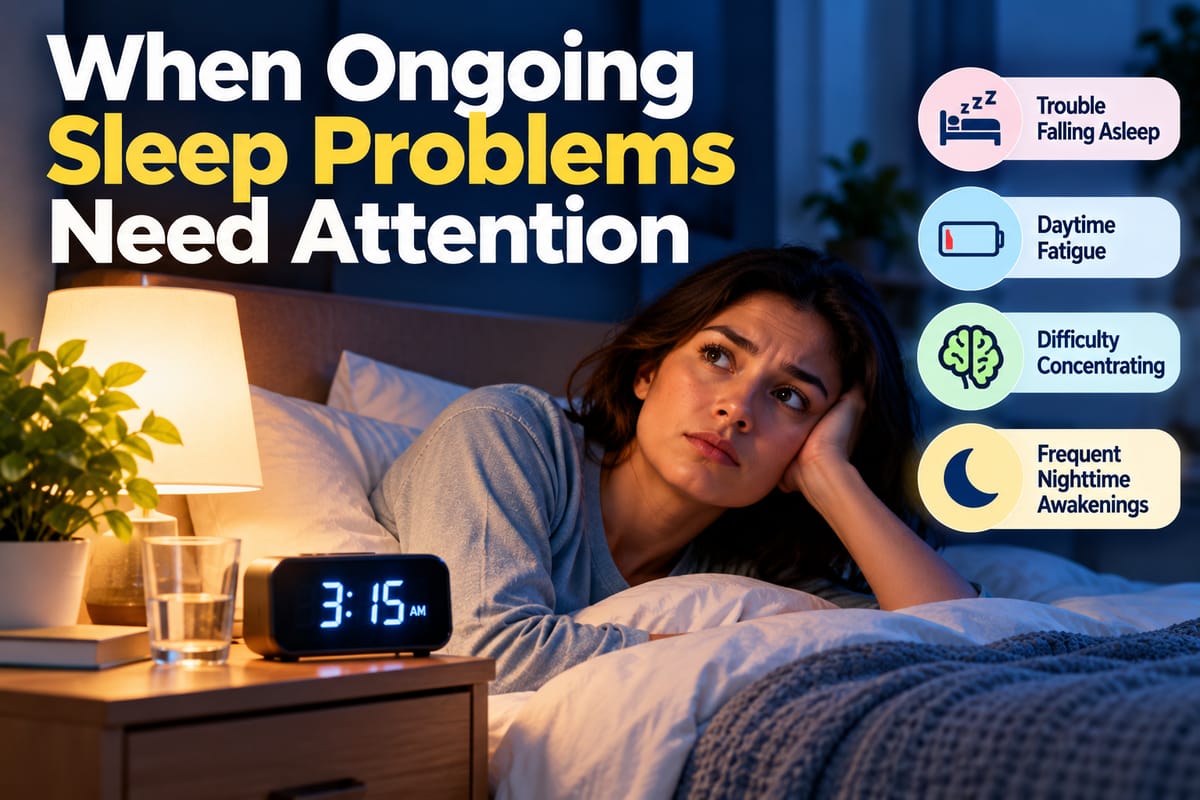
When Ongoing Sleep Problems Need Attention
Occasional difficulty sleeping is something many people experience. A stressful day, an unusual schedule, travel, illness, or changes in daily routines can temporarily interfere with sleep. But when sleep problems continue for weeks or repeatedly affect daytime life, they deserve closer attention.
Persistent sleep difficulties can involve more than simply having trouble falling asleep. Some people wake repeatedly during the night, wake much earlier than intended, feel unrefreshed despite spending enough time in bed, or experience excessive sleepiness during the day.
Sleep is closely connected with physical health, emotional well-being, metabolism, attention, memory, and daily performance. Understanding when an occasional problem has become a recurring pattern can help people take appropriate steps to improve their sleep and determine when professional guidance may be useful.
Why Sleep Matters to Overall Health
Sleep is an active biological process rather than simply a period when the body stops working.
During sleep, the body moves through different stages that support processes including physical restoration, memory, learning, immune function, and regulation of various physiological systems.
The relationship between sleep and health is explored in greater detail in The Science of Sleep, which explains why sleep is an important part of normal human functioning.
When sleep becomes consistently disrupted, the effects can extend beyond feeling tired the following morning.
What Counts as an Ongoing Sleep Problem?
There is no single sleep pattern that is ideal for every person. Sleep needs vary with age, individual circumstances, health, activity levels, and other factors.
An ongoing sleep problem generally involves a persistent or recurring difficulty with sleep that does not resolve as expected and may interfere with daytime functioning.
Examples can include:
- Regular difficulty falling asleep
- Repeated nighttime awakenings
- Waking too early and being unable to return to sleep
- Frequently feeling unrefreshed after sleeping
- Persistent daytime sleepiness
- Regularly needing unusually long periods of sleep
- A sleep schedule that repeatedly conflicts with daily responsibilities
- Loud snoring or unusual breathing during sleep
- Recurrent nighttime movements or sensations that disrupt sleep
The pattern matters as much as an individual night. One poor night’s sleep does not necessarily indicate a lasting problem.
When Occasional Poor Sleep Becomes a Pattern
Temporary sleep disruption can occur for many ordinary reasons.
A demanding project, examination, new baby, long journey, noisy environment, or stressful event can temporarily change someone’s sleep.
The concern increases when sleep difficulties become a recurring part of everyday life.
Signs that a problem may be becoming persistent include:
- Sleep difficulties occurring repeatedly
- Increasing dependence on routines or substances to fall asleep
- Regular daytime fatigue
- Difficulty concentrating at work or school
- Irritability or changes in mood
- Reduced ability to perform normal activities
- Worrying extensively about sleep itself
- Repeated attempts to catch up on sleep without resolving the underlying pattern
Keeping a simple sleep diary can help reveal whether a problem is occasional or recurring.
Daytime Symptoms Can Be Just as Important
Sleep problems are sometimes overlooked because people focus only on what happens at night.
However, the effects during the day can provide important information.
Persistent sleep disruption may be associated with:
- Reduced alertness
- Difficulty concentrating
- Memory difficulties
- Slower reactions
- Reduced motivation
- Irritability
- Changes in mood
- Reduced physical performance
- Greater reliance on caffeine
Not every daytime symptom is caused by poor sleep. Fatigue and difficulty concentrating can have many possible explanations, which is why persistent or significant symptoms should not automatically be attributed to sleep alone.
Sleep and Metabolism Are Connected
Sleep also interacts with metabolic processes.
Sleep timing, duration, and quality can influence systems involved in energy regulation and glucose metabolism. Conversely, metabolic changes can sometimes affect sleep patterns.
The relationship is discussed in How Sleep Affects Metabolism and Blood Sugar.
This connection is one reason persistent sleep disruption should be considered as part of overall health rather than treated solely as a nighttime inconvenience.
Common Factors That Can Disrupt Sleep
Ongoing sleep problems can have many potential contributors. Sometimes several factors occur at the same time.
Irregular Schedules
Frequently changing sleep and wake times can make it harder for the body to maintain a consistent rhythm.
Shift work, changing work schedules, late-night activities, and irregular weekend routines can all contribute to inconsistent sleep timing.
Stress and Mental Overload
Stress can make it difficult to relax at bedtime. People may continue thinking about work, finances, relationships, responsibilities, or upcoming events after getting into bed.
This can create a cycle in which difficulty sleeping produces additional worry about not sleeping.
Caffeine and Other Stimulants
Caffeine can remain active in the body for several hours. Consuming it later in the day can interfere with sleep in some people.
Sensitivity varies, so the effect of caffeine is not identical for everyone.
Alcohol
Alcohol may make some people feel sleepy initially, but it can also interfere with normal sleep patterns later in the night.
Using alcohol regularly as a strategy for falling asleep can therefore be counterproductive.
Evening Light and Technology
Bright light in the evening can affect the body’s timing signals. Phones, tablets, computers, televisions, and other devices can also keep people mentally engaged when they are trying to wind down.
The issue is not necessarily the device itself. What matters can include brightness, timing, content, notifications, and whether device use delays bedtime.
Physical Discomfort
Pain, itching, congestion, digestive discomfort, temperature changes, and other physical sensations can interfere with sleep.
If a physical problem repeatedly disrupts sleep, addressing the underlying issue may be more useful than focusing exclusively on bedtime routines.
Lifestyle Habits Can Influence Sleep and Health Together
Sleep does not exist independently from the rest of a person’s lifestyle.
Physical activity, nutrition, alcohol consumption, stress, tobacco use, daily schedules, and other habits can interact with sleep.
These relationships are part of the broader picture discussed in How Lifestyle Factors Influence Disease Risk.
Improving one part of a daily routine may sometimes make other healthy behaviors easier to maintain as well.
When Snoring and Breathing Problems Need Attention
Not all sleep disruption looks like insomnia.
Some people may spend enough time in bed but experience repeated interruptions because their breathing is disturbed during sleep.
Potential warning signs can include:
- Loud, persistent snoring
- Gasping or choking sounds during sleep
- Noticeable pauses in breathing
- Frequent nighttime awakenings
- Morning headaches
- Persistent daytime sleepiness
- Waking with a dry mouth
A person may not be aware of nighttime breathing changes because they are asleep when they occur. A bed partner or household member may notice them first.
Persistent breathing-related symptoms warrant discussion with a healthcare professional rather than simply being treated as ordinary snoring.
Sleep Problems and Cognitive Function
Sleep is closely associated with attention, learning, memory, and other aspects of cognitive functioning.
A night of inadequate sleep can make it harder to concentrate or remain alert. Repeated disruption can create more persistent difficulties with daytime functioning.
This does not mean every memory lapse or concentration problem is caused by poor sleep. Cognitive changes can have many possible causes.
For a broader look at maintaining brain health, see How Cognitive Health Can Be Supported.
How to Track Persistent Sleep Problems
Before making major changes, it can be useful to observe what is actually happening.
A simple sleep diary can record:
| Factor | What to Record |
|---|---|
| Bedtime | When you went to bed |
| Estimated sleep time | Approximate time actually spent sleeping |
| Awakenings | How often you woke during the night |
| Wake time | When you got up for the day |
| Daytime naps | Timing and duration |
| Caffeine | Amount and timing |
| Alcohol | Amount and timing |
| Exercise | Type and timing |
| Daytime symptoms | Fatigue, sleepiness, concentration, mood |
| Sleep environment | Noise, temperature, light, interruptions |
Patterns may become easier to recognize after several days or weeks of consistent tracking.
A sleep diary is not a substitute for professional assessment, but it can provide useful information when discussing ongoing concerns with a healthcare provider.
Build a Consistent Sleep Routine
A predictable schedule can help reinforce the body’s regular sleep-wake rhythm.
Useful habits may include:
- Going to bed and waking at relatively consistent times
- Creating a relaxing pre-bed routine
- Keeping the bedroom comfortable and reasonably dark
- Limiting stimulating activities immediately before bed
- Getting regular physical activity
- Spending time outdoors during the day
- Managing caffeine timing
- Avoiding unnecessarily long daytime naps
The goal is consistency rather than perfection.
One unusually late night does not erase healthy habits, just as one good night’s sleep does not necessarily resolve a persistent sleep problem.
Make the Bedroom Supportive of Sleep
The sleep environment can influence how easily someone falls asleep and stays asleep.
Consider factors such as:
- Room temperature
- Noise
- Light exposure
- Mattress and pillow comfort
- Bedding
- Electronic notifications
- Pets or other nighttime interruptions
Small environmental changes can sometimes make a noticeable difference, particularly when a specific environmental factor repeatedly disrupts sleep.
Avoid Turning Sleep Into a Source of Constant Pressure
Trying extremely hard to force sleep can sometimes increase frustration.
Watching the clock repeatedly, worrying about the consequences of being tired tomorrow, or becoming anxious about whether sleep will happen can create additional mental stimulation at bedtime.
A more sustainable approach is to establish supportive routines and allow sleep to occur rather than treating every night as a test that must be passed.
If persistent difficulty continues despite reasonable changes, professional guidance may be more useful than continually adding new sleep rules.
When It Makes Sense to Seek Professional Help
Persistent sleep problems deserve professional attention when they interfere significantly with daily life or continue despite reasonable efforts to improve sleep habits.
It can be appropriate to discuss sleep concerns with a healthcare professional when:
- Sleep problems persist or repeatedly return
- Daytime sleepiness affects normal activities
- Concentration or memory problems are interfering with daily responsibilities
- Snoring is accompanied by breathing pauses or gasping
- Sleep problems are affecting mood or quality of life
- Pain or another physical symptom repeatedly disrupts sleep
- You regularly rely on alcohol, medications, or other substances to sleep
- You are concerned about a significant change in your normal sleep pattern
A healthcare professional can consider the broader context and determine whether further evaluation is appropriate.
Why Self-Diagnosis Can Be Misleading
Several different sleep-related problems can produce similar symptoms.
For example, feeling tired during the day could be related to insufficient sleep, fragmented sleep, an inconsistent schedule, medication effects, stress, or another health issue.
Similarly, difficulty falling asleep does not automatically identify a particular sleep disorder.
This is why persistent problems are better approached through observation and professional assessment rather than assuming a specific diagnosis based on symptoms alone.
Be Careful With Sleep Supplements and Medications
The popularity of sleep products can make it tempting to treat persistent sleep difficulties independently.
However, supplements and medications can have different effects depending on the individual, dose, timing, other medications, and underlying health circumstances.
Some products can also create unwanted side effects or interactions.
Anyone considering regular use of a medication or supplement for sleep should discuss it with an appropriate healthcare professional, particularly when sleep problems are persistent.
Sleep Quality Is About More Than Hours in Bed
Spending a certain number of hours in bed does not necessarily mean someone is getting restorative, uninterrupted sleep.
Sleep quality can also involve:
- How easily sleep begins
- How often sleep is interrupted
- How continuous sleep remains
- Whether normal sleep stages are occurring
- How refreshed a person feels afterward
- How alert they remain during the day
This distinction is important because someone can spend plenty of time in bed and still experience disrupted sleep.
Pay Attention to Changes From Your Normal Pattern
There is no universal sleep schedule that works identically for everyone.
Instead of comparing your sleep directly with another person’s routine, pay attention to meaningful changes in your own pattern.
For example, someone who normally sleeps consistently but suddenly begins waking repeatedly every night may have a reason to investigate the change.
Likewise, a sudden increase in daytime sleepiness or a new pattern of loud snoring may be worth discussing with a healthcare professional.
Changes are often more informative than comparisons with an arbitrary standard.
Treat Persistent Sleep Problems as a Health Signal
Sleep difficulties are easy to dismiss as an unavoidable part of modern life, especially when people have demanding schedules. But recurring problems can affect daytime functioning and may sometimes occur alongside other health or lifestyle factors that deserve attention.
The first step is not necessarily to find a complicated solution. It can be as simple as recognizing the pattern, reviewing daily habits, improving the sleep environment, tracking changes, and seeking professional guidance when the problem persists or produces significant daytime effects.
Good sleep is part of the broader foundation of health. Paying attention when normal sleep patterns change can make it easier to identify problems early, protect daily functioning, and build routines that support well-being over the long term.





2 Comments
Micle harison
June 7, 2019Lorem ipsum dolor sit amet, usu ut perfecto postulant deterruisset, libris causae volutpat at est, ius id modus laoreet urbanitas. Mel ei delenit dolores.
John Doe
June 7, 2019Some consultants are employed indirectly by the client via a consultancy staffing company.