
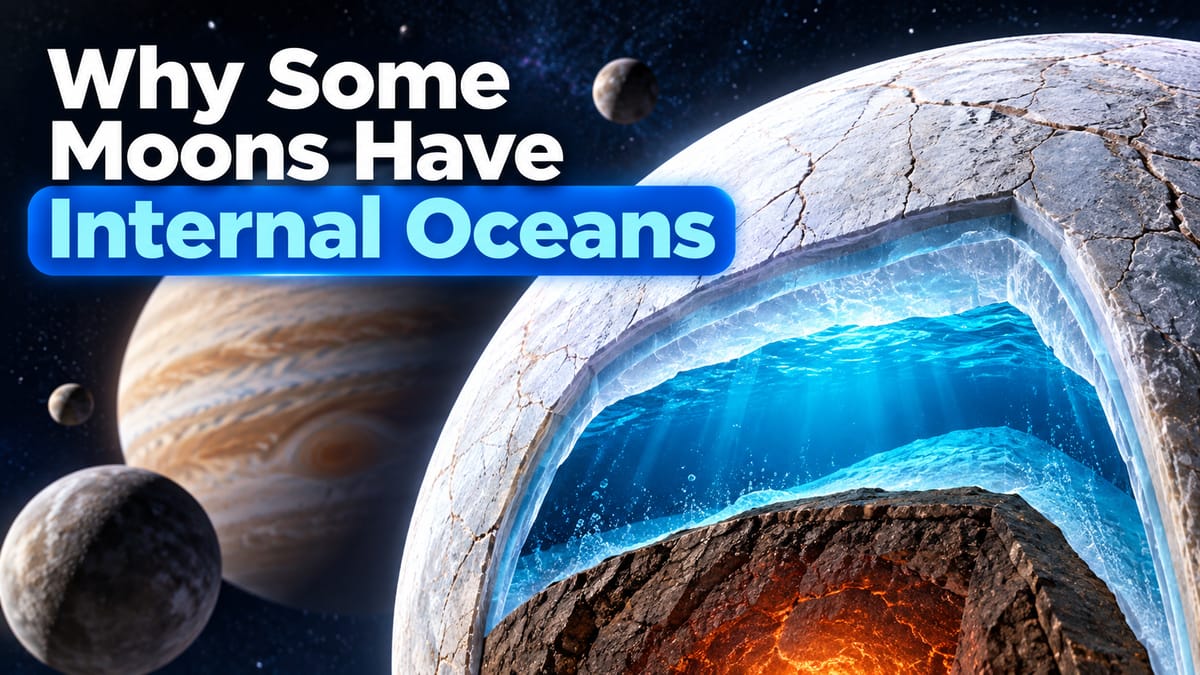
Why Some Moons Have Internal Oceans
When people think about oceans, they usually imagine vast bodies of liquid water covering the surface of a planet. But some of the most intriguing oceans in the solar system may be hidden deep beneath the icy surfaces of moons.
Several moons are believed to contain subsurface oceans—large reservoirs of liquid water buried beneath layers of ice and rock. These hidden oceans are important because they show that potentially habitable environments do not necessarily have to exist on a world’s surface.
The possibility of internal oceans has changed how scientists think about moons, planets, and the conditions that could support complex chemistry. Instead of looking only for worlds with warm, exposed oceans, researchers can also investigate icy worlds where liquid water is protected beneath a frozen exterior.
Understanding why these oceans exist requires looking at gravity, heat, orbital motion, ice, and the internal structure of moons.
What Is an Internal Ocean?
An internal ocean, also called a subsurface ocean, is a layer of liquid water located beneath the outer surface of a planetary body.
In an icy moon, the basic structure may include:
- An outer layer of ice
- A subsurface ocean of liquid water
- A rocky interior
- In some cases, a metallic or partially differentiated core
The ocean does not have to be directly visible from the surface.
Instead, scientists infer its possible existence from evidence such as a moon’s gravitational behavior, magnetic field, surface features, rotation, geological activity, and response to the gravitational forces of nearby objects.
These hidden oceans can exist because the interior of a moon may remain warm even while its surface is exposed to the extremely cold environment of space.
Why Would a Moon Have Liquid Water?
At first glance, liquid water beneath the surface of an icy moon may seem surprising.
Many moons orbit far from the Sun, where temperatures at their surfaces can be extremely low. Under those conditions, exposed water would generally freeze.
The key difference is that the interior of a moon can be much warmer than its surface.
Heat generated inside the moon can prevent some of its water from freezing completely. In certain cases, a thick layer of ice can also act as insulation, helping retain heat below the surface.
The result can be a world with a frozen exterior and liquid water hidden underneath.
Where Does the Heat Come From?
Several processes can contribute to the internal heating of a moon.
One of the most important is tidal heating.
Tidal heating occurs when the gravitational forces acting on a moon repeatedly deform its interior. The mechanical energy associated with those deformations can be converted into heat.
This process is especially important for moons that orbit massive planets and interact gravitationally with other moons.
A moon does not necessarily have to remain perfectly spherical as it moves through its orbit. Its interior can experience repeated stretching and compression.
Over long periods, this can generate substantial heat.
How Gravity Creates Tidal Heating
Gravity is central to understanding internal oceans.
A massive planet exerts a gravitational force on an orbiting moon. If the moon’s distance from the planet changes slightly during its orbit, the strength of that gravitational influence also changes.
Other moons can make the situation even more complicated by exerting their own gravitational forces.
These interactions can prevent a moon from settling into a perfectly circular and unchanging orbit.
As a result, the moon may experience repeated gravitational deformation.
The relationship between gravity and orbital motion is fundamental to understanding this process. How Gravity Controls Motion and Orbits in Space explores the broader role gravity plays in controlling objects throughout space.
Why an Eccentric Orbit Can Matter
An eccentric orbit is an orbit that is not perfectly circular.
When a moon follows an eccentric path around a planet, its distance from that planet changes during each orbit.
That changing distance can produce variations in the gravitational forces acting on the moon.
These changing forces can contribute to tidal deformation and internal heating.
This is one reason orbital dynamics are so important when scientists investigate whether an icy moon might have a subsurface ocean.
A moon’s orbit is not merely a path through space. Its orbital relationship with other bodies can influence its internal environment.
The Role of Other Moons
Large planets can have numerous moons, and those moons can interact gravitationally with one another.
These interactions can sometimes maintain orbital patterns that produce continued tidal heating.
In a system with several moons, their gravitational relationships can influence orbital eccentricities and other characteristics.
This creates a connection between the architecture of a planetary system and the internal geology of individual moons.
A moon’s environment can therefore depend partly on its neighbors.
Why Ice Does Not Always Mean a Completely Frozen World
The presence of ice on a moon’s surface does not necessarily mean that the entire moon is frozen solid.
Ice can exist at the surface while liquid water remains beneath it.
The pressure and temperature conditions inside a moon can differ dramatically from those at the surface.
As depth increases, pressure can rise and internal temperatures can increase. Under the right circumstances, these conditions can allow water to remain liquid beneath an insulating ice shell.
The thickness and structure of that shell can vary considerably between different worlds.
Ice Can Act as an Insulating Layer
An icy surface can help preserve heat within a moon.
The outer ice shell separates the interior from the extremely cold environment of space. This does not mean that heat cannot escape, but it can slow the rate at which the interior loses energy.
A thick ice layer can therefore contribute to maintaining a warmer environment underneath.
This creates an unusual situation: the colder a moon’s surface appears, the more easily scientists might overlook the possibility of liquid water hidden below it.
Which Moons May Have Internal Oceans?
Several moons in the solar system are considered strong candidates for subsurface oceans.
Among the most widely studied are:
- Europa, which orbits Jupiter
- Ganymede, another moon of Jupiter
- Callisto, also orbiting Jupiter
- Enceladus, which orbits Saturn
- Titan, Saturn’s largest moon
Scientists do not necessarily expect all of these worlds to have oceans with identical properties.
Their oceans may differ in depth, salinity, temperature, composition, and relationship with the rocky material beneath them.
The broader study of planets and moons provides important context for understanding these differences. The Complete Guide to Planets and Worlds explores the diversity of planetary bodies and environments found in our solar system and beyond.
Europa’s Hidden Ocean
Europa is one of the most famous examples of a moon suspected of containing a large subsurface ocean.
The moon has a bright, icy surface marked by cracks, ridges, and other unusual features.
Beneath that ice, scientists have found evidence consistent with a substantial body of liquid water.
Europa is particularly interesting because its ocean may be in contact with a rocky seafloor.
If water interacts with rock and receives energy from geological processes, it could create chemical environments that are important when considering habitability.
The possibility of a global ocean beneath Europa’s ice makes the moon one of the most significant targets for studying extraterrestrial water.
Enceladus and Its Water Plumes
Saturn’s moon Enceladus provides another remarkable example.
The moon’s surface is covered in ice, but observations have revealed jets of material emerging from fractures near its south polar region.
These plumes contain water vapor and ice particles, providing scientists with a way to study material originating from beneath the surface without drilling through the entire ice shell.
The discovery of these plumes dramatically changed our understanding of Enceladus.
Instead of being simply a small frozen moon, it became a world with evidence of active internal processes and a possible subsurface ocean.
Why Water Plumes Are So Valuable
A major challenge in studying subsurface oceans is that the water is hidden beneath ice.
Scientists cannot simply look through the surface with a conventional telescope.
Water plumes can provide a natural sampling mechanism.
When material from the interior is expelled into space, spacecraft can potentially analyze that material as they pass through the plume.
Researchers can study particles and gases for clues about the ocean’s chemistry and the processes occurring inside the moon.
This makes active icy moons particularly valuable targets for exploration.
Ganymede’s Internal Ocean
Ganymede is the largest moon in the solar system and has an internal structure that may include a substantial ocean.
The moon is particularly interesting because it also has its own intrinsic magnetic field.
Measurements of its magnetic environment have provided clues about its interior.
The possible presence of a deep ocean adds another layer to Ganymede’s already complex internal structure.
Unlike a simple frozen body, Ganymede appears to have undergone significant geological differentiation and contains several distinct layers.
Callisto and Its Hidden Water
Callisto is another large moon of Jupiter that has been studied as a possible ocean world.
Its surface is heavily cratered and appears less geologically active than some other icy moons.
Yet observations have suggested that liquid water could exist deep beneath its surface.
Callisto demonstrates why surface appearance alone cannot reveal everything about a moon’s interior.
A world can appear ancient and relatively inactive at the surface while still potentially containing a substantial reservoir of liquid water below.
Titan’s Unusual Interior
Titan is Saturn’s largest moon and is particularly fascinating because it has a dense atmosphere and lakes and seas of liquid hydrocarbons on its surface.
Those surface lakes are not made primarily of water. They consist largely of liquid hydrocarbons that remain stable under Titan’s extremely cold surface conditions.
However, scientists have also investigated whether Titan may contain liquid water beneath its icy exterior.
This creates a particularly interesting combination of surface and internal environments.
Titan demonstrates that moons can have complex cycles involving different materials at different depths.
How Scientists Detect Hidden Oceans
Because subsurface oceans cannot usually be seen directly, scientists rely on indirect evidence.
Several techniques can provide clues.
Gravity Measurements
A spacecraft’s motion can reveal information about how mass is distributed inside a moon.
Variations in gravitational fields can help researchers construct models of internal layers.
A moon containing a large ocean may have a different internal mass distribution from one composed entirely of rock and ice.
Magnetic Fields
Magnetic measurements can also provide evidence of conductive liquid layers.
Salty water conducts electricity. If a moon moves through a planetary magnetic environment, interactions involving a conductive ocean can produce measurable effects.
These measurements can help scientists investigate whether an electrically conductive layer exists beneath the ice.
Surface Geology
The surface of an icy moon can preserve clues about what is happening below.
Features such as:
- Cracks
- Ridges
- Ice deformation
- Surface fractures
- Chaotic terrain
- Tectonic features
- Plumes
can all provide information about the moon’s internal activity.
Scientists use these observations to develop models of how the surface and interior interact.
Rotation and Orientation
A moon’s rotation can also contain information about its internal structure.
If an icy outer shell is partially decoupled from the interior by a liquid layer, its movement may differ from that of a completely solid body.
Measurements of the moon’s rotation and orientation can therefore provide additional clues about the presence of an internal ocean.
What Keeps an Internal Ocean From Freezing?
Maintaining a liquid ocean over geological timescales requires a continuing source or retention of heat.
Tidal heating can provide one source.
Radioactive decay inside rocky material can also generate heat. Radioactive elements naturally release energy as they decay, contributing to the thermal evolution of planetary bodies.
The balance between heat production, heat loss, pressure, ice structure, and the composition of the water determines whether an internal ocean can persist.
A moon therefore does not need a single heat source to remain internally active.
Does Salt Help Keep Subsurface Oceans Liquid?
The chemistry of an ocean also matters.
Pure water freezes at a particular temperature under ordinary surface pressure, but dissolved substances can change its freezing behavior.
Salts and other dissolved materials can lower the temperature at which water freezes.
If an internal ocean contains dissolved minerals and salts, its freezing behavior can therefore differ from that of pure water.
The chemical composition of a hidden ocean is consequently an important part of understanding its long-term stability.
Pressure Changes the Interior
Pressure increases with depth inside planetary bodies.
At sufficiently high pressures, water can behave differently from the liquid water found at Earth’s surface.
Different forms of ice can also occur under high-pressure conditions.
This means that a large icy moon may contain several distinct layers of water and ice rather than a simple structure consisting of surface ice above one uniform ocean.
Understanding these phases requires combining planetary science, chemistry, and physics.
Could Internal Oceans Support Life?
The existence of liquid water does not prove that life exists.
However, liquid water is one of the ingredients scientists consider when assessing whether an environment could potentially support life.
Habitability depends on much more than water alone.
Scientists may also consider:
- Available energy
- Chemical ingredients
- Long-term environmental stability
- Organic compounds
- Interactions between water and rock
- Sources of nutrients
An internal ocean could potentially provide some of these conditions while being protected from the harsh environment at the moon’s surface.
Why Water-Rock Interaction Matters
The interaction between liquid water and rock can be especially important.
On Earth, water interacting with minerals can produce chemical reactions and release or transport materials.
If an extraterrestrial ocean comes into contact with a rocky seafloor, similar processes could potentially alter the chemistry of the water.
Heat from the interior could also drive geological or chemical activity.
For scientists studying habitability, an ocean beneath ice is therefore more interesting if it has access to energy and chemically active materials.
Internal Oceans and the Search for Life Beyond Earth
The possibility of subsurface oceans has expanded the search for potentially habitable environments.
For decades, discussions about life beyond Earth often focused on planets with surface conditions resembling those of Earth.
Icy moons introduced another possibility.
A world can be extremely cold at the surface and still potentially have liquid water and chemical activity below.
This greatly increases the range of environments scientists need to consider when searching for signs of life.
Why Earth’s Moon Is Different
Earth’s Moon is not generally considered to have a large global subsurface ocean like Europa or Enceladus.
However, studying Earth’s Moon remains important for understanding how moons form, evolve, cool, and respond to gravitational forces.
Earth’s Moon is also a useful reference point when comparing different types of natural satellites.
For an overview of its formation, surface, interior, and place in the Earth-Moon system, see The Moon Explained.
Comparing Earth’s relatively dry Moon with water-rich icy moons demonstrates how dramatically different moons can be.
Why Some Moons Are More Active Than Others
Not every moon receives the same amount of tidal heating.
A moon’s activity depends on several factors, including:
- Its mass
- Its distance from its planet
- Orbital eccentricity
- Relationships with neighboring moons
- Internal composition
- Heat retained from formation
- Radioactive elements
- The structure of its interior
Two moons of the same planet can therefore have very different geological histories.
Some may remain relatively inactive, while others experience cracking, resurfacing, plumes, or other signs of internal activity.
What Happens When an Internal Ocean Changes?
Internal oceans are not necessarily permanent.
A moon can gradually lose internal heat over geological time.
If heat production decreases sufficiently, the ocean may become smaller or eventually freeze.
Changes in orbital relationships can also alter tidal heating.
If the gravitational interactions responsible for maintaining orbital eccentricity weaken, the associated tidal heating could decrease.
Conversely, changes in orbital dynamics could increase internal heating for periods of time.
This means that the history of an internal ocean may be closely connected to the history of the moon’s orbit.
The Connection Between Orbits and Geology
One of the most remarkable ideas in planetary science is that a moon’s orbit can influence its geology.
A seemingly abstract feature such as orbital eccentricity can determine how strongly a moon is stretched by gravity.
That deformation can generate heat.
The heat can influence whether ice melts, whether geological activity continues, and whether a subsurface ocean remains stable.
In this way, celestial mechanics and geology are directly connected.
Why Internal Oceans Matter to Astronomy
Internal oceans are important because they demonstrate how diverse planetary environments can be.
Astronomy is not limited to observing stars and distant galaxies. It also involves studying planets, moons, planetary systems, and the physical processes that shape them.
The The Complete Guide to Astronomy provides a broader introduction to the field and its many areas of study.
Icy moons occupy an especially interesting position because they combine planetary geology, orbital dynamics, chemistry, atmospheric science, and astrobiology.
Future Exploration of Ocean Worlds
Future spacecraft missions can provide increasingly detailed information about icy moons.
Researchers can measure gravitational fields, magnetic environments, surface chemistry, geological features, and atmospheric or plume material.
A spacecraft does not necessarily need to land on a moon to learn about its interior. Orbital measurements and close flybys can reveal substantial information about hidden layers.
Future exploration may eventually provide stronger evidence about the depth, composition, and activity of these oceans.
A Hidden Class of Worlds
Subsurface oceans reveal that a world’s surface can tell only part of its story.
An icy moon may appear frozen, dark, and inhospitable while concealing a dynamic environment beneath its surface. Gravity can deform the moon, tidal forces can generate heat, and layers of ice can help retain that energy.
These processes can create liquid reservoirs that persist for immense periods.
The study of ocean worlds is therefore about much more than finding water. It is about understanding how heat, gravity, chemistry, geology, and orbital motion interact to create environments hidden beneath the surfaces of distant worlds.
As spacecraft continue to explore the outer solar system, these frozen moons may provide some of the most revealing opportunities to understand how diverse planetary environments can become—and whether conditions suitable for life can exist far beyond Earth’s surface.





2 Comments
Micle harison
June 7, 2019Lorem ipsum dolor sit amet, usu ut perfecto postulant deterruisset, libris causae volutpat at est, ius id modus laoreet urbanitas. Mel ei delenit dolores.
John Doe
June 7, 2019Some consultants are employed indirectly by the client via a consultancy staffing company.