
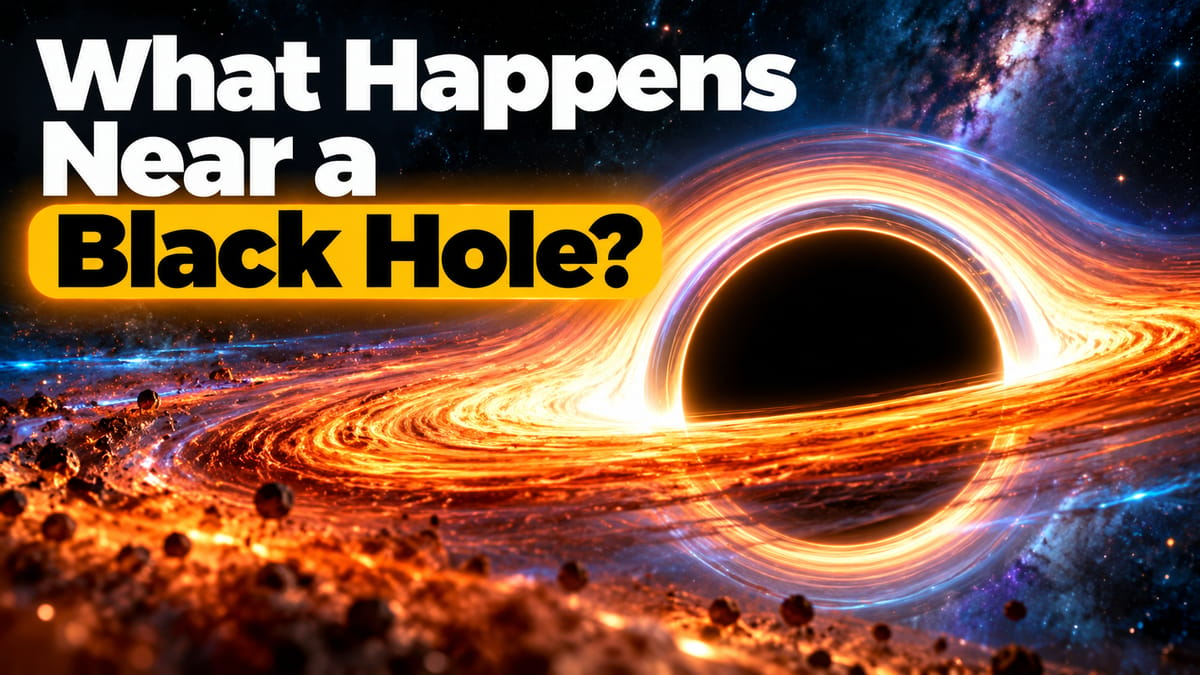
What Happens Near a Black Hole?
Black holes are among the most extreme objects known in the universe. Their gravity is so strong that once something crosses a particular boundary around them, escaping becomes impossible—not even light can get back out.
But what actually happens near a black hole?
The answer depends on how close an object gets. Far from the black hole, gravity behaves much like it does around other massive objects. Closer in, however, gravity becomes extraordinarily strong, space and time become increasingly distorted, and matter can be heated to enormous temperatures as it accelerates around the black hole.
The region around a black hole is therefore not simply an empty, dark area. It can be one of the most energetic environments in the cosmos, filled with rapidly moving gas, powerful radiation, warped light, and extreme gravitational effects.
Understanding these environments provides a window into some of the most important ideas in modern physics and astronomy.
What Is a Black Hole?
A black hole is a region of spacetime where gravity has become strong enough that there is a boundary beyond which escape is impossible.
Black holes can form through several processes, including the collapse of sufficiently massive stars. Larger black holes can also grow through the accumulation of matter and mergers with other compact objects.
The central feature is not simply that a black hole contains an enormous amount of mass. It is that the mass is concentrated within an extremely compact region, producing an intense curvature of spacetime.
For a broader introduction to the subject, How Black Holes Work explains the basic structure and physics behind these extraordinary objects.
The Space Around a Black Hole Is Not Empty
One of the most common misconceptions about black holes is that they are cosmic vacuum cleaners that automatically pull everything nearby into them.
That is not how gravity works.
A black hole has gravity, just like any other object with mass. An object can orbit a black hole if it has the appropriate speed and trajectory.
In fact, from sufficiently far away, the gravitational influence of a black hole can behave similarly to that of another object with the same mass.
The difference becomes dramatic when an object gets much closer.
As distance decreases, gravitational effects become stronger. Objects moving through the region can experience increasingly extreme changes in their trajectories, velocities, and clocks.
The principles behind these orbital effects are part of the broader study of How Gravity Controls Motion and Orbits in Space.
The Event Horizon Marks a Critical Boundary
One of the most important features of a black hole is its event horizon.
The event horizon is a boundary around a black hole beyond which escape to the outside universe is no longer possible.
It is not a solid surface. An object falling through it would not necessarily encounter a physical wall or sudden barrier.
Instead, the event horizon represents a fundamental change in the structure of spacetime.
For a non-rotating black hole, the event horizon is associated with the Schwarzschild radius. This radius depends on the black hole’s mass: more massive black holes have larger event horizons.
For an observer falling toward a sufficiently large black hole, crossing the horizon could happen without encountering a locally dramatic physical boundary.
The consequences become apparent from the structure of spacetime itself.
What Happens as You Approach a Black Hole?
As an object approaches a black hole, several effects can become increasingly important.
These include:
- Stronger gravitational acceleration
- Increasing distortion of spacetime
- Changes in the object’s trajectory
- Gravitational time dilation
- Increasingly severe differences in gravity across the object’s length
- Extreme heating if surrounding matter is present
- Strong bending of light
The exact experience depends on the black hole’s mass, spin, surroundings, and the path taken by the approaching object.
A person falling toward an isolated supermassive black hole could experience a very different environment near the horizon than someone approaching a much smaller black hole.
Gravity Becomes Extreme
Gravity near a black hole can become extraordinarily strong because of the compact concentration of mass.
However, it is important to distinguish between the strength of gravity and the difference in gravitational strength across an object.
This difference is known as a tidal force.
Imagine an object falling toward a black hole. The side closer to the black hole experiences stronger gravity than the side farther away.
If that difference becomes sufficiently large, the object can be stretched in one direction and compressed in another.
This phenomenon is commonly described as spaghettification.
What Is Spaghettification?
Spaghettification is the extreme stretching of an object caused by strong tidal forces.
Consider a spacecraft falling feet-first toward a black hole.
The gravitational pull on the front of the spacecraft would be stronger than the pull on the rear. As the spacecraft gets closer, that difference could become enormous.
The result would be increasing stretching along the direction toward the black hole and compression across other directions.
For a small black hole, these tidal forces can become destructive before an object reaches the event horizon.
For a supermassive black hole, however, the event horizon can be much larger, and the tidal forces at the horizon can be considerably weaker.
That means crossing the horizon of a sufficiently massive black hole might not immediately produce the dramatic stretching often associated with popular illustrations.
The more destructive tidal effects could occur farther inside.
Why Black Hole Size Matters
Not all black holes are the same size.
Astronomers generally discuss several broad categories, including stellar-mass black holes and supermassive black holes.
A stellar-mass black hole can contain several times the mass of the Sun within a remarkably compact region.
A supermassive black hole can contain millions or even billions of solar masses.
This difference affects the environment near the event horizon.
A larger black hole has a larger event horizon and can have weaker tidal gradients at the horizon compared with a smaller black hole.
Therefore, simply saying that “gravity is stronger near a black hole” does not tell the entire story. The mass and size of the black hole matter when determining what an approaching object would experience.
Time Behaves Differently Near a Black Hole
One of the most fascinating effects associated with black holes involves time.
According to general relativity, gravity affects the passage of time. A clock deeper in a strong gravitational field can run differently relative to a clock farther away.
This phenomenon is known as gravitational time dilation.
As an object approaches the event horizon from the perspective of a distant observer, its clock appears to run increasingly slowly.
This creates a striking difference between two perspectives.
From the perspective of the falling object, its own clock continues to behave normally. It does not experience time as suddenly stopping.
From the perspective of a distant observer using distant coordinates, the object’s approach to the horizon can appear increasingly slowed.
These descriptions are not contradictory. They reflect the different ways that observers in different gravitational environments measure time.
Light Is Bent Around Black Holes
Black holes do not merely affect matter. They also dramatically influence the path of light.
Because gravity is associated with the curvature of spacetime, light traveling near a black hole can follow curved paths.
This effect is called gravitational lensing.
A sufficiently strong gravitational field can bend light around a black hole, allowing distant objects to appear distorted, magnified, or duplicated from certain viewing angles.
Extremely close to a black hole, light can follow paths that are strongly influenced by the black hole’s gravitational field.
This can create complicated visual structures, including bright rings and distorted views of material orbiting the black hole.
The Photon Sphere
Around a non-rotating black hole, there is a region called the photon sphere where light can theoretically travel in circular orbits.
These orbits are unstable.
A small disturbance can cause a photon to either move away from the black hole or fall inward.
The photon sphere is located outside the event horizon and is an important part of the region responsible for the characteristic appearance of a black hole.
For rotating black holes, the situation becomes more complicated because the black hole’s spin affects the structure of spacetime around it.
The Black Hole Shadow
When astronomers observe a black hole using electromagnetic observations or other techniques, they may detect a dark central region surrounded by bright material.
This is often referred to as the black hole shadow.
The shadow is not simply a photograph of the event horizon itself.
It is produced by the way gravity affects the paths of light near the black hole. Light can be captured by the black hole, redirected, or strongly bent before reaching an observer.
The resulting appearance depends on the black hole’s mass, spin, viewing angle, and surrounding material.
This makes black hole observations an important test of theories describing gravity under extreme conditions.
Matter Around a Black Hole Can Become Extremely Hot
A black hole itself may not be directly visible, but material falling toward it can produce tremendous amounts of radiation.
Gas and dust can form a rotating structure called an accretion disk.
As material spirals inward, it can collide with other material and experience friction and other processes that convert gravitational energy into heat.
The result can be an extremely hot, luminous disk.
Depending on the black hole system, radiation from the surrounding material can span a broad range of wavelengths.
This is why some black holes can be detected despite emitting no light from inside their event horizons.
Astronomers are often observing the energetic environment around the black hole rather than the black hole itself.
Accretion Disks Can Outshine Stars
The amount of energy released by material falling toward a black hole can be enormous.
A portion of the gravitational energy associated with infalling matter can be converted into radiation before the material crosses the event horizon.
Under the right conditions, an accretion disk can become extraordinarily bright.
This is especially important for supermassive black holes at the centers of galaxies.
When a supermassive black hole is actively consuming large quantities of surrounding material, the resulting system can become an active galactic nucleus, with some examples known as quasars.
These objects can be visible across enormous cosmic distances.
Black Holes Can Produce Powerful Jets
Some actively feeding black holes are associated with enormous jets of energetic particles.
These jets can extend far beyond the immediate environment of the black hole and sometimes reach distances comparable to or greater than the size of their host galaxy.
The exact mechanisms behind jet formation are complex, but magnetic fields and the rotation of the black hole and surrounding accretion disk are believed to play important roles.
Importantly, the material in these jets is not simply being launched from inside the event horizon.
Instead, the powerful environment surrounding the black hole can channel and accelerate particles along directions roughly aligned with the system’s rotational axis.
Rotating Black Holes Twist Spacetime
Many black holes are expected to rotate.
A rotating black hole is described by the Kerr solution of general relativity.
Its rotation produces an effect called frame dragging, in which spacetime itself is dragged around with the rotating black hole.
This creates a region outside the event horizon called the ergosphere.
Inside the ergosphere, an object cannot remain completely stationary relative to distant space. The rotation of spacetime becomes an important part of the local environment.
The ergosphere creates theoretical possibilities for extracting energy from a rotating black hole.
This is one of the reasons rotating black holes are particularly interesting objects for physicists.
What Is the Ergosphere?
The ergosphere is the region surrounding a rotating black hole where frame dragging becomes so strong that stationary motion relative to distant observers is impossible.
An object can still escape from the ergosphere because it is outside the event horizon.
This makes the ergosphere fundamentally different from the event horizon.
The event horizon marks the point beyond which escape is impossible.
The ergosphere is a region where the black hole’s rotation strongly affects spacetime but does not necessarily trap everything permanently.
The Black Hole’s Gravity Does Not Work Like a Vacuum Cleaner
Popular descriptions sometimes make black holes sound as though they automatically consume everything around them.
In reality, an object can remain in orbit around a black hole if its trajectory and velocity are appropriate.
The same basic principles that allow planets to orbit stars also apply to objects orbiting black holes.
The difference is that the environment becomes increasingly relativistic closer to the black hole.
At sufficiently small distances, stable circular orbits can no longer exist.
For a non-rotating black hole, the innermost stable circular orbit, or ISCO, represents an important boundary for material moving in circular orbit.
Inside that region, matter can rapidly spiral inward.
What Happens Inside the Event Horizon?
Crossing the event horizon is a one-way journey for an object.
Once inside, all possible future-directed paths lead deeper into the black hole rather than back out to the external universe.
For a simple, non-rotating black hole described by classical general relativity, the infalling object eventually encounters the central region associated with the singularity.
A singularity is where the classical equations predict that spacetime curvature and certain physical quantities become extreme.
However, this is also where current theories reach their limits.
General relativity does not provide a complete description of quantum gravitational effects, so scientists do not yet have a fully established theory describing exactly what happens at the deepest interior of a black hole.
Does Everything Get Destroyed Immediately?
No.
The experience of approaching a black hole depends heavily on its mass and the surrounding environment.
A small black hole can produce enormous tidal forces near its horizon.
A supermassive black hole can have much weaker tidal forces at its event horizon because the horizon is much farther from the central region.
However, crossing the horizon does not mean the object can eventually escape. The event horizon remains a one-way boundary.
The difference between crossing the horizon and being destroyed by tidal forces is therefore important.
Black Holes and Stars
Black holes can form from the deaths of massive stars, making the relationship between stars and black holes an important part of stellar evolution.
Stars spend much of their lives balancing inward gravitational forces against outward pressure generated by energy-producing processes in their interiors.
Eventually, a sufficiently massive star can reach the end of its life and undergo a dramatic collapse.
Depending on the star’s properties and the details of its evolution, the remnant can become a black hole.
For a broader look at stellar structure and evolution, Everything You Need to Know About Stars provides useful background.
Black Holes Can Orbit Other Objects
Black holes do not necessarily exist alone.
They can orbit:
- Other stars
- Other black holes
- Neutron stars
- Other compact objects
- The centers of galaxies
Binary black hole systems can gradually lose orbital energy through gravitational waves.
Eventually, two black holes can merge, producing a larger black hole and releasing energy through gravitational radiation.
These events have provided astronomers with a new way to study the universe.
Gravitational Waves Reveal Violent Black Hole Events
When massive compact objects accelerate dramatically, they can produce ripples in spacetime known as gravitational waves.
Black hole mergers are among the strongest known sources of these waves.
When two black holes spiral around each other, their orbit can gradually shrink. The objects move faster and faster until they merge.
The resulting disturbance travels outward across the universe.
Detectors on Earth can measure extremely small changes produced by these passing gravitational waves.
This allows scientists to study black holes without relying solely on visible light or other electromagnetic radiation.
What Would an Observer See Near a Black Hole?
The visual experience near a black hole would be unlike ordinary astronomical viewing.
Light from background stars could be distorted into arcs or rings.
Objects behind the black hole could appear in unexpected positions because their light paths are bent.
An accretion disk could appear warped, with light from different portions of the disk reaching the observer along unusual trajectories.
If the black hole were rotating, frame dragging would add another layer of complexity to the appearance.
The result would be an environment in which ordinary assumptions about straight lines and familiar views of the sky no longer apply.
Why Black Holes Matter to Astronomy
Black holes are not merely exotic objects. They provide natural laboratories for studying some of the most fundamental questions in physics.
They allow scientists to investigate:
- General relativity
- Extreme gravity
- The behavior of matter under intense gravitational fields
- The relationship between gravity and time
- Gravitational waves
- The evolution of massive stars
- The growth of galaxies
- The behavior of matter at enormous temperatures and densities
They also force scientists to confront the limits of current theories.
Understanding black holes therefore contributes to the broader study of the universe described throughout The Complete Guide to Astronomy.
The Region Around a Black Hole Is a Natural Physics Laboratory
Near a black hole, gravity becomes more than an ordinary force influencing the movement of objects. The geometry of spacetime itself becomes central to understanding what happens.
Matter can accelerate to enormous speeds.
Light can bend around the black hole.
Clocks can behave differently relative to distant observers.
Tidal forces can stretch and compress objects.
Rotating black holes can drag spacetime around them.
And material in surrounding accretion disks can release enormous amounts of energy before falling inward.
These effects make black holes some of the most powerful natural laboratories for testing our understanding of gravity.
From Extreme Gravity to the Edge of Understanding
What happens near a black hole is ultimately a story about how matter, light, space, and time behave when gravity reaches extraordinary levels. Much of the behavior near the event horizon can be described through general relativity, but the deepest interior remains one of the major unresolved problems in modern physics.
As astronomers continue observing black holes through light, gravitational waves, and other forms of evidence, these mysterious objects are becoming less abstract. Each observation provides another opportunity to test theories about gravity and explore what happens when the universe pushes physics to its limits.



2 Comments
Micle harison
June 7, 2019Lorem ipsum dolor sit amet, usu ut perfecto postulant deterruisset, libris causae volutpat at est, ius id modus laoreet urbanitas. Mel ei delenit dolores.
John Doe
June 7, 2019Some consultants are employed indirectly by the client via a consultancy staffing company.