
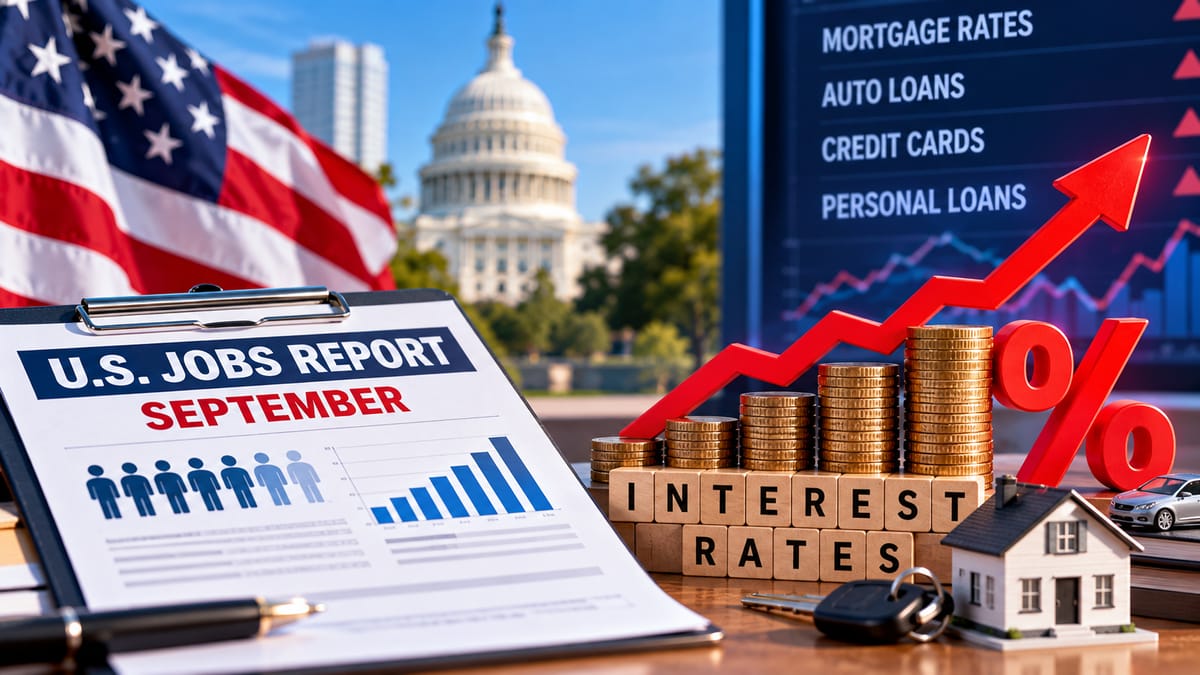
September Jobs Report Could Change the Outlook for Interest Rates and Household Borrowing Costs
The September U.S. jobs report is set to become one of the most closely watched economic releases of the month as investors, businesses and households look for clues about where interest rates could go next.
The report, due from the Bureau of Labor Statistics on Friday, October 2, arrives at a particularly important moment for the economy. The Federal Reserve raised its benchmark interest-rate target by 25 basis points in September to a range of 3.75% to 4%, while policymakers have indicated that additional increases could still be necessary to bring inflation back toward the central bank’s 2% objective.
That makes the latest employment data especially relevant for consumers. A stronger-than-expected labor market could reinforce the case for keeping borrowing costs elevated for longer, while signs of weaker hiring could give policymakers more reason to wait before making another move.
For households already dealing with expensive credit cards, auto loans, mortgages and other forms of borrowing, the distinction could matter.
September Hiring Is Expected to Slow After August’s Surprise Gain
Economists surveyed by Reuters expect U.S. nonfarm payrolls to increase by about 90,000 in September, considerably below the 162,000 jobs added in August. The unemployment rate is expected to remain at 4.1% for a third consecutive month.
The August number was unexpectedly strong, although economists have questioned how much of that increase reflected seasonal-adjustment effects. Some analysts expect August’s gain to be revised lower when September’s data are incorporated into the government’s calculations.
That means the headline payroll number may not tell the entire story.
Investors will also be watching wage growth, labor-force participation, revisions to previous months and the distribution of job gains across industries. Reuters reported that economists expected annual wage growth of roughly 3.2% in September, following a 3.1% increase in August.
The broader labor market has increasingly taken on a “low-hire, low-fire” character, with businesses adding workers cautiously while layoffs remain relatively limited. That combination can produce a labor market that appears stable even when underlying hiring momentum is weaker than during earlier periods of economic expansion.
For readers looking at the bigger economic picture, The Global Economy Explained provides useful context for understanding how employment, inflation, interest rates and financial conditions interact.
Why the Jobs Report Matters to the Federal Reserve
The Federal Reserve has to balance two competing risks.
If inflation remains too high, policymakers can use higher interest rates to restrain demand and reduce price pressures. But if monetary policy becomes too restrictive while employment is weakening, higher borrowing costs can put additional pressure on businesses and households.
The September employment report therefore gives policymakers another piece of evidence about whether the economy is still generating enough jobs to withstand higher rates.
The Fed’s September decision lifted the federal funds target range to 3.75%-4.00%.
More recently, however, Federal Reserve officials have signaled that they want additional economic data before deciding whether another increase is appropriate. New York Fed President John Williams said there was no need for urgency in changing monetary policy, while Fed Vice Chair Philip Jefferson emphasized the importance of examining economic trends and the balance of risks.
That has reduced market expectations for an October rate increase. Reuters reported that traders were pricing roughly a 25% chance of a hike at the October 27-28 meeting as of October 1, down sharply from earlier in the week.
The jobs report could therefore help determine whether those expectations move again.
A Strong Report Could Keep Borrowing Costs Elevated
If September payroll growth significantly exceeds expectations and wage growth remains firm, markets could interpret the report as evidence that the economy still has enough momentum to tolerate tighter monetary policy.
That would not automatically mean the Federal Reserve raises rates at its next meeting. The central bank also considers inflation, consumer spending, financial conditions and other economic indicators.
But stronger employment data could make a rapid decline in interest rates less likely.
For consumers, that matters because the cost of borrowing does not depend exclusively on the Fed’s policy rate. Banks and lenders also consider funding costs, credit risk and market interest rates when setting prices for loans.
Credit-card borrowers can feel the impact particularly quickly because many credit-card rates are variable and linked to broader interest-rate benchmarks. Consumers carrying balances may therefore continue paying substantial interest even if the Fed eventually pauses its rate increases.
Treasury Yields Add Another Layer of Pressure
The relationship between the Federal Reserve and household borrowing costs has also become more complicated because longer-term Treasury yields have risen sharply.
The 10-year Treasury yield moved above 5% in late September and reached its highest level since 2007, according to Reuters.
Long-term government bond yields influence pricing for a range of financial products, particularly mortgages and other longer-duration loans.
This is why Treasury Yields Above 5% Could Raise Borrowing Costs for Households is an important part of the broader household-finance picture.
Even if the Fed eventually stops raising its short-term policy rate, consumers may not immediately see borrowing costs fall if longer-term market yields remain elevated.
That distinction is particularly important for prospective homebuyers. Mortgage rates can move independently of the federal funds rate because they are heavily influenced by longer-term Treasury yields, mortgage-backed securities and investor demand.
A Weak Jobs Report Could Change the Conversation
The opposite scenario would be a September report showing considerably weaker hiring than expected, a rising unemployment rate or a combination of slowing payroll growth and softer wages.
Such a result could strengthen the argument for allowing the effects of existing monetary tightening to work through the economy before raising rates again.
It could also alter expectations in financial markets.
However, a weak employment report would not necessarily guarantee lower interest rates. The Fed still has to consider inflation, and policymakers could remain concerned about price pressures even if hiring slows.
That is particularly relevant because inflation has remained above the central bank’s target. The August personal consumption expenditures price index, one of the Fed’s preferred inflation measures, increased 3.4% from a year earlier, according to Reuters.
The Fed is therefore navigating an economy in which inflation remains elevated while labor-market momentum is more moderate.
Consumers Could Feel the Effects in Several Ways
The jobs report may sound like a Wall Street event, but its implications extend directly into household budgets.
Credit cards
People carrying revolving credit-card balances could remain exposed to high interest charges if monetary policy stays restrictive.
Even a small change in the expected path of interest rates can influence how quickly consumers expect financing costs to decline.
Mortgages
Mortgage rates are particularly sensitive to longer-term bond yields. If Treasury yields remain elevated, mortgage rates can stay high even during periods when expectations for the Fed’s policy rate are changing.
For buyers, that can translate into higher monthly payments and a larger amount of interest paid over the life of a loan.
Auto loans
Higher financing costs can make new vehicles more expensive to finance. Borrowers may respond by choosing less expensive vehicles, making larger down payments or extending loan terms.
Personal loans
Personal-loan rates are influenced by broader financial conditions as well as borrower creditworthiness. A prolonged period of higher rates can therefore increase the cost of borrowing for household purchases, debt consolidation and other expenses.
The result is that monetary policy can affect household finances long after a Federal Reserve announcement has faded from the headlines.
The Labor Market May Matter More Than the Headline Number
One of the biggest risks in interpreting the September report will be focusing too heavily on the payroll headline.
Economists are also watching whether employment gains are broad-based, whether wages are accelerating and whether revisions change the picture from previous months.
The latest ADP data showed private-sector employment increasing by 90,000 in September, after a downwardly revised 36,000 gain in August. Reuters noted, however, that the ADP report has historically been a poor gauge of the BLS private-payroll estimate.
That means the official employment report could still deliver a materially different picture.
Job openings have also declined. BLS data showed about 1.01 job openings for every unemployed person in August, down from 1.06 in July. Reuters described economists as viewing the labor market as stable.
Taken together, those figures suggest an economy that is neither experiencing a broad hiring boom nor showing the kind of rapid deterioration associated with a severe downturn.
What Households Should Watch After the Report
The immediate market reaction to the September jobs report could be dramatic, but consumers do not need to make financial decisions based on a single economic release.
Instead, households can watch several indicators over the coming weeks:
- The unemployment rate: A sustained increase would signal that labor-market conditions are weakening.
- Wage growth: Faster wage gains could complicate the Fed’s efforts to bring inflation lower, while slower gains could reduce inflationary pressure.
- Payroll revisions: Revisions can materially change the interpretation of previous employment reports.
- Treasury yields: Longer-term yields are important for mortgage and other borrowing costs.
- Inflation data: The Fed’s interest-rate decisions will depend on inflation as well as employment.
- Consumer spending: Strong spending can support economic growth but can also keep demand-related price pressures elevated.
Consumers can also review the broader implications of the Fed’s recent policy change in What the Fed’s September Rate Decision Means for Your Money.
Why This Jobs Report Could Have an Outsized Impact
The September employment report arrives at a moment when the direction of monetary policy is unusually dependent on incoming economic data.
The Federal Reserve has already raised rates to 3.75%-4.00%, while several officials have signaled that another increase could still be appropriate later in the year. At the same time, other policymakers have emphasized patience and the need to assess additional evidence before making the next move.
Against that backdrop, a report showing stronger-than-expected employment could reinforce concerns that demand remains resilient. A weaker report could instead strengthen the case for waiting.
Neither outcome would determine household borrowing costs by itself. Inflation, Treasury yields, credit conditions and future economic data will all continue to matter.
But the September jobs report could provide an important new signal about whether Americans should expect today’s elevated borrowing costs to persist or whether the economic environment is beginning to create room for a different interest-rate path.





2 Comments
Micle harison
June 7, 2019Lorem ipsum dolor sit amet, usu ut perfecto postulant deterruisset, libris causae volutpat at est, ius id modus laoreet urbanitas. Mel ei delenit dolores.
John Doe
June 7, 2019Some consultants are employed indirectly by the client via a consultancy staffing company.