
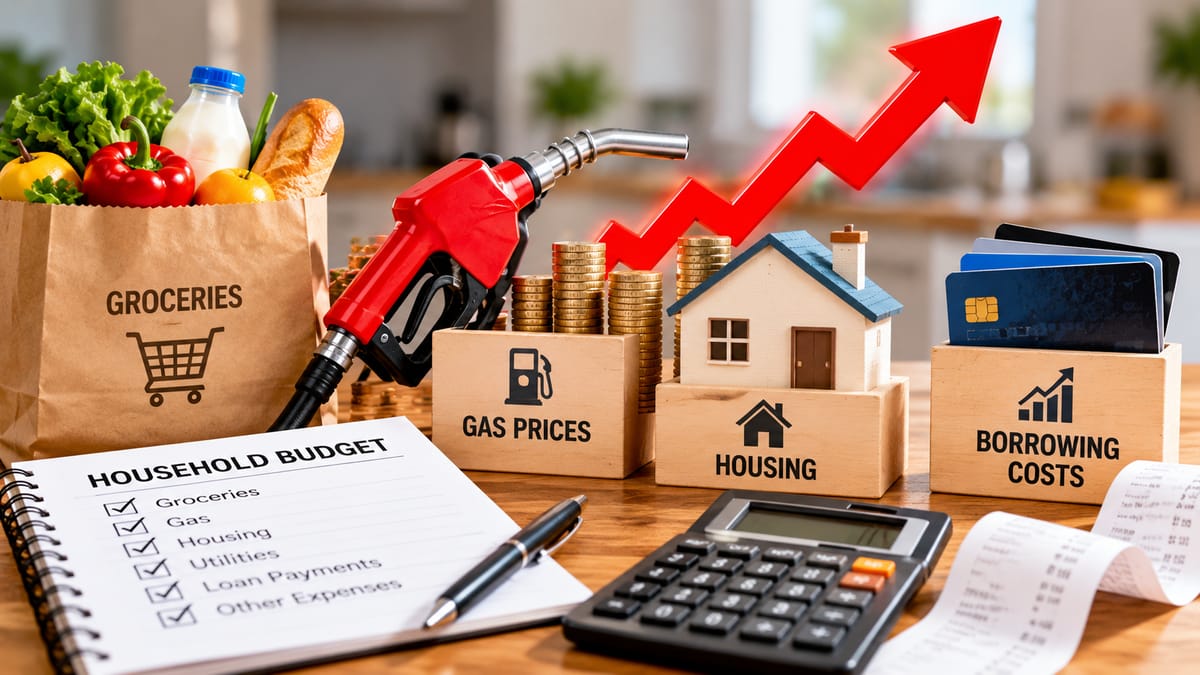
Household Finances Face Pressure as Inflation, Gas Prices and Borrowing Costs Stay High
Household budgets are facing renewed pressure as elevated inflation, higher gasoline prices and borrowing costs continue to affect the everyday cost of living.
The latest U.S. inflation data show that consumer prices increased 3.4% over the 12 months through August 2026, while gasoline prices rose 27.4% over the same period. The Federal Reserve has also kept monetary policy restrictive, raising its target federal funds rate to 3.75%–4.00% in September as inflation remained above its 2% objective.
For households, the combination creates a difficult financial environment. Consumers may be paying more for transportation, food, housing and other necessities at the same time that credit cards, loans and other forms of borrowing remain expensive.
Inflation Continues to Affect Everyday Spending
The Consumer Price Index increased 0.4% in August on a seasonally adjusted basis, following a 0.1% increase in July. Over the year, consumer prices were up 3.4%.
Core inflation, which excludes food and energy, increased 2.4% over the 12 months through August. Food prices increased 2.7% over the same period, while food purchased for consumption at home increased 2.2%. Food away from home rose 3.4%.
That distinction matters for household finances because inflation does not affect every expense equally.
A family that spends a large portion of its income on groceries may experience price increases differently from a household that spends more on commuting, rent, utilities or debt payments.
The broader effects are explored in How Inflation Is Affecting Household Budgets, particularly the way persistent price increases can gradually change spending power.
Gasoline Prices Are Adding Another Layer of Pressure
Fuel has become one of the more visible sources of household financial pressure.
The BLS reported that the gasoline index increased 3.9% in August alone and was 27.4% higher than a year earlier. The broader energy index rose 16.3% over the same period.
For drivers, higher gasoline prices can have an immediate effect on monthly expenses.
A household cannot necessarily reduce fuel consumption quickly if commuting, school transportation, medical appointments or other essential travel require regular driving. Even small increases at the pump can therefore translate into meaningful additional spending over the course of a month.
Higher fuel costs can also affect household budgets indirectly.
Transportation is embedded throughout the economy. Businesses use fuel to transport products, deliver goods and provide services, meaning sustained energy-price increases can eventually affect other consumer expenses.
The potential connection between energy costs and household spending is examined in Higher Energy Prices Could Push Household Costs Higher.
Borrowing Costs Remain an Important Budget Constraint
The other side of the household-finance equation is borrowing.
The Federal Reserve raised the federal funds target range by a quarter percentage point in September to 3.75%–4.00%. The central bank said inflation remained elevated and that its latest action was intended to support a return toward its 2% inflation goal.
Changes in the federal funds rate do not automatically translate into an identical increase for every consumer loan. However, interest rates throughout the financial system can be influenced by the broader monetary-policy environment.
That matters for consumers carrying variable-rate debt, applying for new loans or refinancing existing obligations.
Credit-card borrowing can be particularly sensitive because consumers generally cannot eliminate interest costs simply by reducing the amount they charge in a given month if they are already carrying a balance.
The latest household debt data illustrate the scale of borrowing. The Federal Reserve Bank of New York reported that U.S. credit-card balances increased by $21 billion in the second quarter of 2026 to $1.26 trillion. Total household debt stood at approximately $18.8 trillion.
For households already managing significant debt, higher borrowing costs can leave less room in the monthly budget for saving or discretionary spending.
Household Budgets Can Be Squeezed From Several Directions
The challenge for many households is not necessarily one unusually expensive category. It is the combined effect of several costs moving higher.
Consider a household managing:
- A mortgage or rent payment
- Credit-card balances
- An auto loan
- Grocery expenses
- Fuel costs
- Electricity and other utilities
- Insurance premiums
- Childcare or education expenses
- Medical bills
- Regular savings contributions
An increase in one category may be manageable. Several increases occurring together can be considerably harder to absorb.
This is why Consumers Feel Pressure as High Interest Rates Affect Household Budgets provides useful context for understanding how borrowing costs can interact with everyday household expenses.
Income Growth Is Not Telling the Whole Story
Household financial pressure also depends on whether incomes are keeping pace with prices.
Average hourly earnings for private-sector workers increased 3.1% over the year through August, according to preliminary BLS data. After adjusting for consumer-price changes, real average hourly earnings were down 0.3% over the same period. Real average weekly earnings, however, were up 0.3% year over year.
The figures highlight why nominal wage growth alone does not necessarily tell households whether their purchasing power is improving.
Someone receiving a pay increase may still feel financially stretched if groceries, transportation, housing and other expenses are rising at the same time.
The effect can be especially noticeable when higher-income and lower-income households face very different spending patterns.
A household that spends most of its income on necessities has less flexibility to absorb price increases than one with substantial discretionary spending.
Higher Rates Can Change Household Decisions
Elevated interest rates can influence more than the cost of carrying existing debt.
They can also affect decisions about buying a home, financing a vehicle, taking out a personal loan or using credit to cover a large expense.
When borrowing becomes more expensive, households may postpone purchases, reduce the amount they borrow or increase the amount they need to save before making a major purchase.
Businesses can also respond to higher financing costs, potentially affecting investment, hiring and prices.
The result is a financial environment in which households may become more cautious even when the broader economy continues to expand.
Recent economic data show that U.S. economic activity remained solid in the second quarter, with consumer spending and business investment contributing to growth.
That means elevated household pressure does not necessarily indicate that the entire economy is contracting. Different parts of the economy can experience very different conditions at the same time.
Why Energy Prices Matter Beyond the Gas Pump
Energy costs have an unusually broad influence on household finances.
Gasoline is the most obvious example, but households also pay for electricity, natural gas and other forms of energy.
The August CPI data showed the broader energy index rising 2.1% in a single month and 16.3% over the previous year.
Energy can also affect other prices because businesses must pay for transportation, heating, cooling, manufacturing and distribution.
When those costs rise, some companies may absorb them, while others may pass part of the increase to customers.
That can create a secondary effect in which an energy shock becomes visible in categories that do not appear to be directly connected to fuel.
Savings Can Become Harder to Maintain
When essential expenses consume more of a household’s income, savings are often one of the first areas to come under pressure.
A household might reduce monthly contributions to an emergency fund, retirement account or other savings goal simply because less disposable income remains after paying essential bills.
The problem is that reducing savings during an uncertain economic period can leave households with less protection against unexpected expenses.
At the same time, attempting to maintain the same savings rate by relying heavily on credit can create another problem if borrowing costs are high.
This creates a difficult balancing act: households need liquidity and emergency savings, but they may also need to manage expensive debt and rising everyday expenses.
The Global Economy Still Matters
Household finances are affected not only by domestic conditions but also by developments in the wider global economy.
Energy markets, international trade, supply chains, currency movements and geopolitical developments can influence prices in the United States.
The broader relationship between these forces is explored in The Global Economy Explained.
For consumers, global economic developments can sometimes appear in everyday life through changes in gasoline prices, imported goods, travel costs or the price of products that rely on internationally sourced materials.
That makes household budgeting increasingly connected to forces that individual consumers cannot control.
What Households Are Watching Next
Several economic indicators will remain important for household finances over the coming months.
Inflation readings will help show whether price pressures are easing or becoming more persistent. Energy prices will remain important because of their direct and indirect effects on consumers. Interest-rate decisions will influence borrowing conditions, while wage and employment data will provide information about household income.
The Federal Reserve’s September decision also does not mean future interest-rate decisions are predetermined. The central bank continues to assess incoming economic information, and its September statement noted elevated uncertainty alongside resilient domestic spending.
Meanwhile, the latest inflation data provide a more mixed picture than a simple “prices are rising” headline suggests. Some categories are increasing faster than others, and real household purchasing power depends on the relationship between prices, wages, debt payments and individual spending patterns.
Turning a Tight Budget Into a More Flexible One
For households feeling pressure, the most important financial questions are often practical rather than purely economic.
Which expenses are essential? Which costs have increased the most? How much debt is carrying the highest interest rate? How much cash is available for unexpected expenses? And which recurring expenses can realistically be reduced without creating larger costs elsewhere?
Tracking those categories can make inflation easier to manage at the household level.
A budget cannot control gasoline prices, inflation or Federal Reserve policy. But it can help a household identify where rising costs are having the greatest impact and determine where adjustments may be possible.
The broader economic environment remains difficult to predict. What is clearer is that households are navigating several pressures simultaneously, from higher energy costs and persistent inflation to elevated borrowing costs.
For many consumers, maintaining financial flexibility may depend less on predicting the next economic move and more on understanding how changes in prices, income, debt and savings interact with their own monthly budget.




2 Comments
Micle harison
June 7, 2019Lorem ipsum dolor sit amet, usu ut perfecto postulant deterruisset, libris causae volutpat at est, ius id modus laoreet urbanitas. Mel ei delenit dolores.
John Doe
June 7, 2019Some consultants are employed indirectly by the client via a consultancy staffing company.