
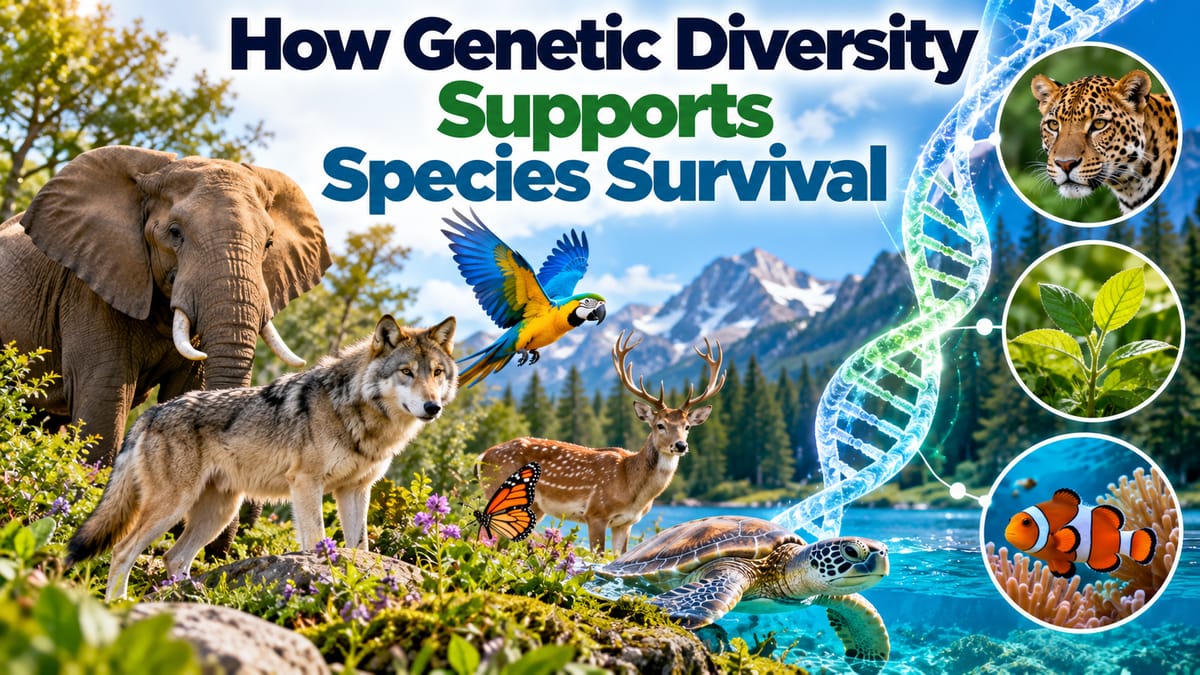
How Genetic Diversity Supports Species Survival
A species may appear uniform when viewed from a distance, but individuals within the same species are rarely genetically identical. Differences in genes help create variation in characteristics such as size, coloration, disease resistance, behavior, growth patterns, and tolerance to environmental conditions.
This variation is known as genetic diversity, and it is one of the foundations of biodiversity.
Genetic diversity gives populations a wider range of characteristics that can help them respond to changing conditions. When environments shift because of disease, climate, habitat changes, food shortages, or other pressures, some individuals may possess traits that allow them to survive and reproduce more successfully.
Over generations, those traits can become more common within the population.
This is one of the reasons genetic diversity is important for the long-term survival and adaptability of species.
What Is Genetic Diversity?
Genetic diversity refers to the variety of genes and genetic characteristics found among individuals within a population or species.
Individuals belonging to the same species share many genetic features, but they can also carry different versions of genes called alleles.
These differences contribute to variation among individuals.
For example, members of a plant species may differ in their ability to tolerate drought. Some may require more water, while others may continue growing under relatively dry conditions.
If a drought affects the population, plants with greater drought tolerance may have a better chance of surviving and producing offspring.
Where Genetic Diversity Comes From
Genetic diversity can arise through several biological processes.
Important sources include:
- Mutation
- Sexual reproduction
- Genetic recombination
- Gene flow between populations
- Random changes in genetic composition
Mutations introduce changes into DNA. Some have little noticeable effect, while others can influence characteristics that affect survival or reproduction.
Sexual reproduction and genetic recombination also produce new combinations of genetic material in offspring.
A broader explanation of the relationship between DNA, genes, and inherited characteristics is available in How DNA, Genes and Heredity Work in Living Organisms.
Genetic Diversity and Natural Selection
Natural selection depends on variation.
If individuals in a population differ in traits that influence their ability to survive and reproduce, environmental pressures can cause some traits to become more common over generations.
For example, imagine a population of insects containing individuals with different levels of resistance to a particular disease.
If the disease spreads through the population, insects with greater resistance may survive at higher rates and produce more offspring. Their genetic characteristics may therefore become more common in subsequent generations.
This process is part of how populations change over time.
For a broader explanation, see How Evolution Works Through Natural Selection.
Genetic Diversity Provides Options When Conditions Change
One of the most important benefits of genetic diversity is that it gives a population more biological variation to work with when conditions change.
Environmental changes can include:
- Temperature shifts
- Changes in rainfall
- New diseases
- Emerging predators
- Changes in food availability
- Habitat alteration
- New competitors
- Pollution
- Changes in seasonal patterns
A population with greater genetic variation may contain individuals that are better suited to some of these conditions.
A population with very little variation may have fewer characteristics capable of responding to a new environmental challenge.
Genetic Diversity and Disease Resistance
Disease can place significant pressure on populations.
If every individual in a population has nearly identical genetic characteristics, a pathogen capable of exploiting those characteristics could potentially affect a large proportion of the population.
Greater genetic variation can create differences in susceptibility.
Some individuals may have immune-system characteristics that make them more resistant to a particular pathogen.
Those individuals may survive an outbreak and reproduce, allowing associated genetic characteristics to remain in the population.
This does not mean genetic diversity makes a species immune to disease. Instead, it can increase the range of biological responses available within a population.
Genetic Diversity Helps Populations Adapt
Adaptation occurs when inherited characteristics that improve reproductive success become more common within a population over generations.
Genetic diversity provides the variation upon which evolutionary processes can act.
If an environmental pressure changes, some existing genetic variants may prove more advantageous than others.
Over time, this can alter the genetic composition of a population.
Adaptation is therefore not an individual organism deliberately changing its genes because it needs to survive. Instead, populations change across generations as genetic variation and evolutionary processes interact.
Genetic Diversity and Changing Climate Conditions
Environmental conditions are constantly changing, and climate-related changes can alter the conditions under which organisms live.
Changes in:
- Temperature
- Rainfall
- Drought frequency
- Seasonal timing
- Snow cover
- Ocean conditions
- Wildfire patterns
can affect survival and reproduction.
Populations with genetic characteristics suited to new conditions may have greater opportunities to persist.
For example, plants containing genetic variation in heat or drought tolerance may respond differently as growing conditions become warmer or drier.
However, adaptation has limits. Environmental change can occur faster than populations can respond, particularly when populations are small or already genetically depleted.
Genetic Diversity and Small Populations
Small populations often face particular genetic challenges.
When only a limited number of individuals remain, fewer genetic variants may be represented in the population.
This can make the population more vulnerable to random changes in genetic composition and can increase the likelihood of inbreeding.
Small populations can also be more vulnerable to environmental disturbances because losing even a relatively small number of individuals may remove important genetic variation.
What Is Genetic Bottlenecking?
A genetic bottleneck occurs when a population experiences a dramatic reduction in size.
The surviving population may contain only a portion of the genetic diversity that existed before the population decline.
For example, a species could experience a severe population reduction because of:
- Habitat destruction
- Disease
- Hunting
- Natural disasters
- Pollution
- Extreme environmental conditions
Even if population numbers later recover, some genetic diversity may have been permanently lost.
A larger population is not necessarily genetically identical to the original population if many genetic variants disappeared during the bottleneck.
The Founder Effect
The founder effect can also reduce genetic diversity.
It occurs when a new population is established by a relatively small number of individuals.
Because the founders carry only a fraction of the genetic variation present in the original population, the new population may have a different genetic composition.
This can be particularly important when populations become geographically isolated.
Genetic Drift and Population Survival
Genetic drift refers to random changes in the frequency of genetic variants within populations.
Its effects can be particularly strong in small populations.
Unlike natural selection, genetic drift does not necessarily favor traits because they improve survival or reproduction. A genetic variant can become more or less common simply because of random reproductive outcomes.
Over time, genetic drift can reduce genetic diversity.
This is one reason maintaining sufficiently large and connected populations is important for conservation.
Gene Flow Can Increase Genetic Diversity
Gene flow occurs when genetic material moves between populations through the movement and reproduction of organisms.
For example, animals may move between neighboring populations and reproduce with individuals from another group.
Plants can experience gene flow when pollen or seeds move between populations.
Gene flow can introduce genetic variants into populations that previously lacked them.
This can increase genetic diversity and sometimes reduce the genetic effects associated with prolonged isolation.
Habitat Fragmentation Can Disrupt Gene Flow
When continuous habitat is divided into isolated fragments, populations can become separated.
Roads, cities, agriculture, dams, and other forms of land-use change can create barriers to movement.
If organisms can no longer move between populations, opportunities for gene flow may decline.
Over time, isolated populations may become genetically different from one another.
Fragmentation can therefore affect species not only by reducing available habitat but also by changing how genetic material moves through landscapes.
Wildlife Corridors and Genetic Connectivity
Conservation corridors can help reconnect fragmented habitats.
A corridor may allow animals to move between otherwise separated populations.
This movement can provide access to:
- Food
- Mates
- Seasonal habitats
- Water
- Shelter
- New territories
It can also allow genes to move between populations when individuals reproduce after dispersing.
Maintaining genetic connectivity can therefore be an important part of conservation planning.
Genetic Diversity and Reproductive Success
Genetic diversity can influence reproduction in several ways.
Some populations require sufficient genetic variation for successful mate selection, fertility, or healthy offspring development.
Inbreeding can increase the likelihood that harmful recessive genetic variants will occur in pairs.
This can contribute to inbreeding depression, in which a population experiences reduced survival or reproductive success.
The effects vary among species, but avoiding excessive genetic isolation is an important consideration in conservation biology.
What Is Inbreeding?
Inbreeding occurs when closely related individuals reproduce with one another more often than would normally occur in a larger, genetically connected population.
Because relatives share more genetic material, their offspring have a greater chance of inheriting identical copies of certain genetic variants.
If a harmful recessive variant is present, this can increase the likelihood that it will be expressed.
Inbreeding does not always produce immediate population collapse, but persistent inbreeding can reduce genetic health in some populations.
Genetic Diversity and Ecosystem Stability
Genetic diversity exists at one level of biodiversity, but it is connected to diversity at other levels.
Biodiversity is commonly discussed across three broad levels:
- Genetic diversity
- Species diversity
- Ecosystem diversity
Together, these levels help describe the variety of life and biological systems on Earth.
The wider relationship between these forms of biological variety is explored in Biodiversity Explained.
Genetic Diversity Within Plants
Plants can have substantial genetic variation within a species.
Different varieties may vary in their:
- Drought tolerance
- Disease resistance
- Growth rates
- Temperature tolerance
- Flowering times
- Nutrient requirements
- Pest resistance
This variation can be valuable in natural ecosystems as well as agriculture.
When environmental conditions change, some varieties may be better suited to the new circumstances than others.
Genetic Diversity and Agriculture
Agriculture depends heavily on genetic diversity.
Farmers and plant breeders have historically used variation within crops to develop varieties with desirable characteristics.
These characteristics can include:
- Disease resistance
- Drought tolerance
- Improved yields
- Pest resistance
- Heat tolerance
- Different maturation times
- Improved nutritional characteristics
Maintaining genetic diversity among crops can provide options for responding to future agricultural challenges.
Genetic Diversity in Wild Animals
Wild animal populations also contain genetic differences that can influence survival.
Individuals within a species may vary in:
- Body size
- Coat or skin coloration
- Disease resistance
- Temperature tolerance
- Feeding behavior
- Reproductive timing
- Ability to exploit different habitats
These differences may become particularly important when environmental conditions change.
Genetic Diversity and Species Interactions
Species do not exist independently.
Animals, plants, fungi, microorganisms, and other organisms interact through relationships such as:
- Predation
- Competition
- Herbivory
- Pollination
- Parasitism
- Mutualism
- Decomposition
Genetic differences can affect how organisms participate in these interactions.
For example, genetic variation in plants can influence which herbivores feed on them, how effectively they resist pests, or which pollinators they attract.
These relationships can influence wider ecological processes.
The broader role of relationships among organisms is explored in How Species Interactions Shape Ecosystems.
Genetic Diversity Can Influence Food Webs
Changes within one species can sometimes affect other species.
Suppose a plant population contains genetic variation in defenses against herbivores. Different plants may experience different levels of grazing.
Those differences can affect herbivore populations, predators that feed on the herbivores, and other organisms connected through the food web.
Genetic diversity can therefore influence ecological processes beyond the individual population.
Genetic Diversity and Changing Food Sources
Changes in food availability can create strong selection pressures.
An animal population may contain individuals with different abilities to process or locate particular food resources.
If one food source becomes scarce while another becomes more abundant, some traits may become more useful than they previously were.
Genetic diversity can provide variation that allows populations to respond to these changes.
Genetic Diversity and Environmental Extremes
Extreme environmental events can create sudden challenges.
Examples include:
- Severe droughts
- Floods
- Heat waves
- Cold events
- Wildfires
- Storms
- Disease outbreaks
A genetically diverse population may contain individuals with different tolerances to these conditions.
However, genetic diversity cannot guarantee survival during extreme events. If an event is sufficiently severe or affects an entire habitat, even genetically diverse populations can decline dramatically.
Genetic Diversity and Population Recovery
Genetic diversity can influence a population’s ability to recover after a decline.
When surviving individuals reproduce, they pass their genetic characteristics to future generations.
If sufficient genetic variation remains, the recovering population may retain a broader range of traits.
If a population has lost substantial genetic diversity, recovery can occur with a narrower genetic foundation.
This is why conservation programs often consider genetic information alongside population size.
Conservation Genetics
Conservation genetics is the study and application of genetic principles to species and population conservation.
Researchers may examine:
- Genetic diversity
- Population structure
- Gene flow
- Inbreeding
- Genetic bottlenecks
- Relationships between populations
- Genetic differences among isolated groups
These data can help conservationists understand whether populations are genetically connected and whether management actions could improve long-term viability.
Captive Breeding and Genetic Diversity
Captive breeding programs can play a role in conservation when wild populations become severely threatened.
However, maintaining genetic diversity can be challenging when only a small number of animals are available for breeding.
Conservation programs may therefore carefully manage breeding decisions to reduce excessive relatedness and preserve as much genetic variation as possible.
In some circumstances, individuals from different populations may be considered for managed breeding when appropriate.
Seed Banks and Genetic Conservation
Genetic diversity can also be preserved outside living populations.
Seed banks store seeds from many plant varieties under controlled conditions.
These collections can preserve genetic material that might otherwise disappear from agricultural or wild populations.
Other conservation approaches can preserve genetic material through:
- Cryopreservation
- Tissue collections
- Pollen storage
- Germplasm collections
These resources can provide genetic material for future research, breeding, restoration, or conservation programs.
Genetic Diversity and Species Restoration
When conservationists restore a declining population, simply increasing the number of individuals may not be enough.
The genetic composition of the restored population can also matter.
If restoration involves only a small number of genetically similar individuals, the resulting population may remain vulnerable to genetic problems.
Conservation planning may therefore consider the origin and genetic diversity of individuals used in restoration efforts.
Why Genetic Diversity Can Be Difficult to See
Genetic diversity is often invisible.
Two animals may look nearly identical while carrying different genetic variants. Similarly, two plants that appear similar can differ in their resistance to disease or tolerance of drought.
Modern genetic tools allow scientists to examine variation at the DNA level and identify differences that cannot be determined from appearance alone.
This makes genetic diversity an important but less visible component of biodiversity.
Genetic Diversity Does Not Mean Every Trait Is Beneficial
Genetic variation should not be understood as a collection of universally beneficial characteristics.
A trait that is advantageous in one environment may be neutral or disadvantageous in another.
For example, a characteristic that helps an organism conserve water during drought might become less useful in an environment where water is abundant.
The value of a genetic characteristic depends partly on environmental conditions.
Diversity Creates Flexibility, Not Certainty
Genetic diversity gives populations a broader range of biological possibilities, but it does not guarantee adaptation.
Evolutionary change depends on several factors, including:
- Existing genetic variation
- Mutation
- Natural selection
- Genetic drift
- Gene flow
- Population size
- Reproductive rates
- Environmental conditions
If environmental change happens too quickly, a population may decline before adaptive traits become sufficiently common.
Genetic Diversity and Rapid Environmental Change
Rapid environmental change can be particularly challenging.
Evolution generally operates across generations rather than instantly within individual organisms.
If temperatures, disease conditions, habitat availability, or food resources change faster than a population can respond, genetic diversity may not provide enough time for adaptation.
This is one reason conservation efforts often focus on maintaining populations before they become critically small.
Protecting Genetic Diversity in Nature
Protecting genetic diversity begins with protecting populations and their habitats.
Important conservation approaches can include:
- Protecting large habitats
- Maintaining wildlife corridors
- Preventing unnecessary population fragmentation
- Supporting healthy population sizes
- Protecting breeding populations
- Reducing unnecessary mortality
- Restoring degraded habitats
- Monitoring genetic diversity
Conservation strategies work best when they consider ecological, genetic, and population-level factors together.
Why Population Size Matters
Larger populations generally contain more individuals and therefore have greater opportunities to retain genetic variants.
Large populations can also be less strongly affected by random genetic drift than very small populations.
However, population size alone does not determine genetic health.
A large population that is divided into isolated groups may still experience restricted gene flow.
Maintaining both population size and connectivity can therefore be important.
Genetic Diversity and Human Activity
Human activities can influence genetic diversity in many ways.
Habitat destruction, overharvesting, pollution, invasive species, climate change, and infrastructure development can reduce populations or fragment their habitats.
When populations decline, genetic diversity can decline as well.
Protecting ecosystems therefore contributes not only to preserving individual species but also to preserving the genetic variation within those species.
The Importance of Monitoring Genetic Diversity
Conservationists can monitor genetic diversity using genetic sampling and analysis.
Researchers may compare DNA from individuals collected at different locations or times.
Monitoring can reveal:
- Population separation
- Loss of genetic variation
- Gene flow
- Inbreeding
- Changes in population structure
- Relationships between populations
These findings can help identify conservation problems that might not be obvious from population counts alone.
Genetic Diversity and Long-Term Species Survival
Species survival is ultimately influenced by many interacting factors.
A species needs suitable habitat, access to resources, successful reproduction, functioning ecosystems, and the ability to respond to environmental pressures.
Genetic diversity contributes to this larger picture by maintaining variation within populations.
When conditions change, that variation can provide the biological material upon which evolutionary processes operate.
Protecting Variation Before It Is Lost
Once a genetic variant disappears from a population, recovering it naturally may be difficult or impossible.
This makes prevention particularly important.
Maintaining healthy, connected populations can help preserve genetic variation before a species reaches a critical level of decline.
Protecting genetic diversity is therefore not simply about helping species survive today. It is about maintaining their capacity to respond to conditions that may exist generations from now.
The Genetic Foundation of Adaptability
Genetic diversity is one of the less visible foundations of life on Earth.
Individuals within a species may differ in ways that become critically important when environments change. Disease, drought, temperature shifts, habitat changes, predators, food availability, and other pressures can favor different characteristics at different times.
A genetically diverse population has a broader range of inherited variation available to future generations. That variation can support natural selection, reduce some risks associated with genetic isolation, and provide populations with greater evolutionary flexibility.
Protecting genetic diversity therefore means protecting more than individual organisms. It means preserving the biological variation that gives species the capacity to adapt, recover, and continue evolving as their environments change.


2 Comments
Micle harison
June 7, 2019Lorem ipsum dolor sit amet, usu ut perfecto postulant deterruisset, libris causae volutpat at est, ius id modus laoreet urbanitas. Mel ei delenit dolores.
John Doe
June 7, 2019Some consultants are employed indirectly by the client via a consultancy staffing company.