
How Human Land Use Changes Ecosystems
Land is one of Earth’s most important resources. It provides space for forests, farms, wetlands, cities, roads, industries, and countless other human activities. At the same time, land supports habitats, stores carbon, filters water, cycles nutrients, and provides the physical foundation for ecosystems.
When people change how land is used, they can also change how ecosystems function.
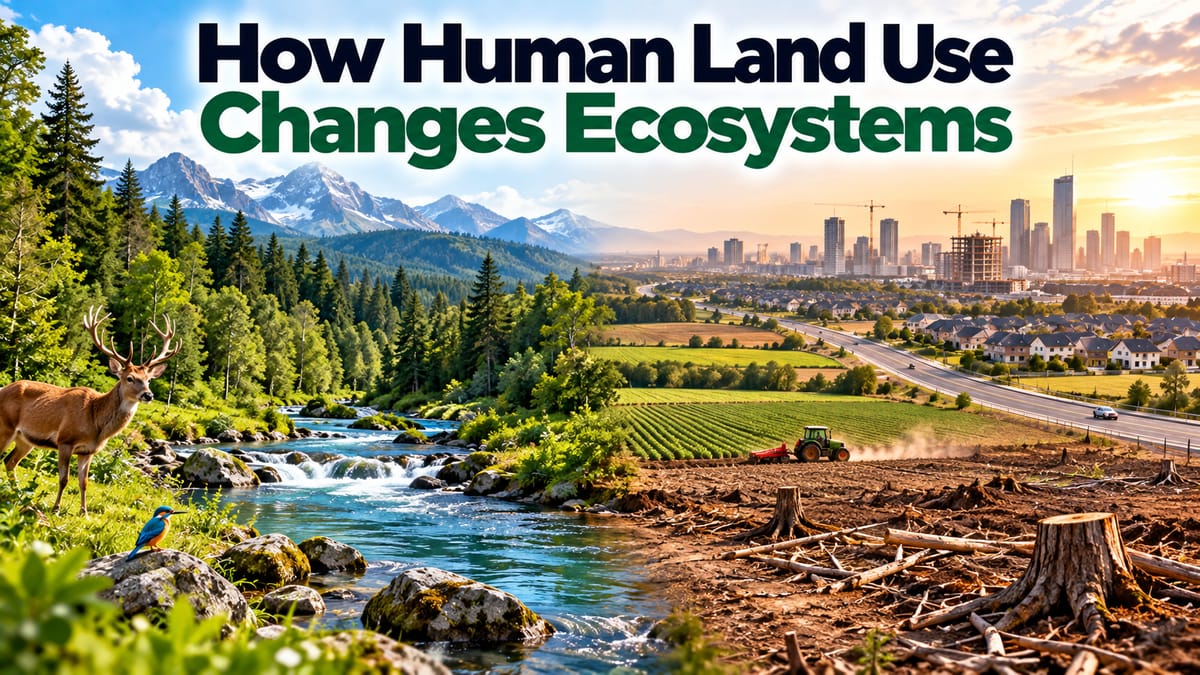
Clearing forests for agriculture, expanding cities, draining wetlands, building roads, extracting resources, and converting natural areas into developed landscapes can alter habitats and the relationships between organisms and their environment. Some changes are relatively small, while others can transform entire landscapes.
Understanding these effects helps explain why land-use decisions are an important part of environmental science and conservation.
What Is Land Use?
Land use refers to how people use and manage land for different purposes.
Common forms of human land use include:
- Agriculture
- Residential development
- Commercial development
- Industrial facilities
- Roads and transportation
- Mining
- Forestry
- Recreation
- Energy infrastructure
- Grazing
- Waste management
Land can also be managed for conservation, restoration, or protected natural areas.
A single landscape may contain several types of land use. For example, a region might include farmland, forests, residential neighborhoods, rivers, wetlands, and industrial areas.
The way these different uses are arranged can influence how ecosystems operate.
What Is an Ecosystem?
An ecosystem is a community of living organisms interacting with one another and with their physical environment.
It includes both biotic components, such as plants, animals, fungi, and microorganisms, and abiotic components, such as:
- Water
- Soil
- Air
- Sunlight
- Temperature
- Minerals
- Climate
- Physical landscape
The How Ecosystems Work and Stay Balanced guide provides a broader explanation of these relationships.
Ecosystems are not static. They constantly change as organisms reproduce, migrate, compete, decompose, and respond to environmental conditions.
Human land use can accelerate or redirect some of these changes.
How Land Conversion Changes Habitats
One of the most direct effects of land-use change is habitat conversion.
Habitat conversion occurs when a natural environment is transformed into another type of landscape.
Examples include:
- Forest converted to farmland
- Wetlands converted to development
- Grasslands converted to cropland
- Natural areas converted to roads
- Coastal habitats converted to urban infrastructure
When a habitat is converted, organisms may lose food sources, shelter, breeding areas, or access to other parts of their environment.
Some species adapt to the new conditions, while others may relocate or decline.
Deforestation and Forest Ecosystems
Forests support complex communities of plants, animals, fungi, and microorganisms.
When forests are cleared, the physical structure of the ecosystem changes.
Removing trees can affect:
- Wildlife habitat
- Soil stability
- Water movement
- Local temperature
- Humidity
- Carbon storage
- Nutrient cycling
- Plant communities
The effects depend on the size, location, and nature of the clearing.
Small areas of selective disturbance may have different consequences from widespread forest conversion.
Agriculture Transforms Landscapes
Agriculture provides food, animal feed, fiber, and other resources, but farming can significantly change natural ecosystems.
Agricultural land often replaces diverse natural vegetation with a smaller number of crops or managed plants.
Agricultural activities can influence:
- Soil composition
- Water availability
- Nutrient cycles
- Wildlife habitat
- Pollinator communities
- Carbon storage
- Erosion
- Water quality
The effects depend heavily on farming methods.
Practices such as crop rotation, conservation tillage, agroforestry, cover cropping, and maintaining natural habitat can influence how agricultural landscapes interact with surrounding ecosystems.
Urbanization Changes Ecosystem Structure
Cities and towns replace portions of natural landscapes with buildings, roads, parking areas, drainage systems, and other infrastructure.
Urbanization can alter:
- Soil
- Vegetation
- Water flow
- Temperature
- Wildlife movement
- Air quality
- Habitat availability
Urban areas can also create new environments.
Some species adapt surprisingly well to cities, particularly species that can use gardens, parks, buildings, or human-provided food sources.
Other species require specialized habitats and may be unable to survive substantial urban development.
Roads Divide Natural Habitats
Roads are important for transportation, but they can divide previously connected habitats.
This process is often called habitat fragmentation.
A continuous forest, grassland, or wetland may become separated into smaller patches.
Fragmentation can make it harder for animals to:
- Find food
- Find mates
- Reach breeding areas
- Move between seasonal habitats
- Escape predators
- Respond to environmental changes
Roads can also create direct mortality risks for animals attempting to cross them.
What Is Habitat Fragmentation?
Habitat fragmentation occurs when a large, relatively continuous habitat is divided into smaller, isolated, or semi-isolated areas.
Fragmentation can result from:
- Roads
- Urban development
- Agricultural expansion
- Mining
- Pipelines
- Infrastructure projects
- Utility corridors
The effects are not determined solely by the amount of habitat lost.
The arrangement of the remaining habitat also matters.
Two landscapes may contain the same total area of natural habitat but have very different ecological outcomes depending on whether that habitat forms one connected area or many small fragments.
Edge Effects Change Habitat Conditions
When natural habitat is divided, more of the remaining area may become exposed to the edges of the habitat.
These boundaries can experience conditions different from those found deeper inside.
For example, a forest edge may have:
- More sunlight
- Higher wind exposure
- Different humidity
- Greater temperature variation
- Different plant communities
- Increased access for certain predators or invasive species
These changes are known as edge effects.
They can influence which organisms are able to survive in fragmented habitats.
Land Use Can Alter Water Cycles
Changing land cover can dramatically influence how water moves.
Natural vegetation and soils can absorb and store water. In contrast, surfaces such as concrete, asphalt, and rooftops generally allow less water to infiltrate the ground.
Urban development can therefore increase surface runoff.
Changes in land use can affect:
- Flooding
- Groundwater recharge
- Stream flow
- Soil moisture
- Erosion
- Sediment transport
- Water quality
Wetland removal can be particularly significant because wetlands can store water and provide important habitat.
Wetlands and Development
Wetlands include environments such as marshes, swamps, and other areas where water strongly influences soil and biological processes.
They can provide important ecosystem functions, including:
- Water storage
- Flood reduction
- Habitat
- Nutrient cycling
- Carbon storage
- Water filtration
When wetlands are drained or filled for development or agriculture, these functions can be reduced or altered.
The consequences may extend beyond the immediate area because water and ecological processes move across landscape boundaries.
Soil Is Also an Ecosystem
Soil is more than an inert material beneath our feet.
It contains bacteria, fungi, insects, worms, plant roots, organic matter, minerals, air, and water.
Land-use changes can alter soil through:
- Tillage
- Compaction
- Erosion
- Chemical inputs
- Construction
- Removal of vegetation
- Changes in organic matter
- Irrigation
Healthy soils support plant growth and participate in nutrient and carbon cycles.
When soil structure is degraded, water infiltration and biological activity can also change.
Agriculture and Soil Erosion
Removing vegetation and disturbing soil can increase erosion.
Water and wind can carry exposed soil away, particularly when protective vegetation is absent.
Erosion can remove nutrient-rich topsoil and transport sediment into rivers and lakes.
Agricultural practices that maintain soil cover and reduce unnecessary disturbance can help limit erosion.
Land management therefore affects not only the productivity of farmland but also surrounding ecosystems.
Human Land Use Can Affect Species Interactions
Ecosystems depend on relationships among organisms.
Plants compete for sunlight and nutrients. Predators consume prey. Pollinators interact with flowering plants. Decomposers break down organic matter.
The How Species Interactions Shape Ecosystems guide explores these relationships in greater detail.
When land use changes habitat conditions, these interactions can change as well.
For example, removing flowering plants may reduce food sources for pollinators. Removing predators may alter prey populations. Introducing roads or buildings may give some adaptable species advantages over species that require undisturbed habitat.
Pollinators and Land-Use Change
Bees, butterflies, moths, birds, bats, and other organisms can pollinate plants.
Agricultural and urban landscapes can affect pollinators in different ways.
Large areas dominated by a single crop may provide abundant food during a limited period but fewer resources at other times. Urban gardens and natural vegetation can sometimes provide additional sources of flowers.
Maintaining diverse plant communities can therefore support a wider range of pollinating organisms.
Land Use Can Encourage Invasive Species
Human activities can help species move beyond their natural ranges.
Transportation networks, trade, agriculture, gardening, and other activities can introduce organisms to new environments.
Some introduced species become invasive and can disrupt established ecosystems.
Disturbed landscapes can sometimes provide favorable conditions for invasive species because native communities may already be under pressure.
Invasive plants, animals, or pathogens can alter competition, food availability, habitat structure, and nutrient cycling.
Mining Changes Physical Landscapes
Mining can have substantial effects on land.
Depending on the type of mining, activities can involve:
- Removing vegetation
- Excavating soil and rock
- Creating pits
- Constructing roads
- Moving large quantities of material
- Altering drainage
- Generating waste materials
Mining can therefore change both the physical structure of landscapes and the ecosystems that depend on them.
Environmental management and site restoration can help reduce some long-term effects, although restoration outcomes vary according to the location, ecosystem, and techniques used.
Land Use and Carbon Storage
Vegetation and soils store carbon.
Forests, grasslands, wetlands, and other ecosystems can hold carbon in living organisms, dead organic matter, and soils.
When natural vegetation is removed or soils are significantly disturbed, some stored carbon can be released into the atmosphere.
Land-use change is therefore connected to the broader carbon cycle.
The Climate Change Explained guide provides broader context on how Earth’s climate system works and how changes in greenhouse gas concentrations relate to climate.
Land management is one part of the wider climate system, alongside energy production, transportation, industry, and other human activities.
Land Use Can Influence Local Climate
Changing vegetation and surface materials can affect local environmental conditions.
Trees provide shade and release water through transpiration. Removing vegetation can change surface temperatures and moisture conditions.
Cities can also experience higher temperatures than surrounding areas because buildings and paved surfaces absorb and retain heat.
This phenomenon is commonly known as the urban heat island effect.
Planting and maintaining vegetation can influence local conditions, although the effects depend on the type and arrangement of vegetation and the surrounding environment.
Coastal Land Use Can Change Marine Ecosystems
Human development is not limited to inland environments.
Coastal areas often contain highly productive ecosystems such as:
- Mangroves
- Estuaries
- Salt marshes
- Seagrass meadows
- Coral reef environments
- Coastal forests
Construction, dredging, pollution, shoreline modification, and other activities can alter these ecosystems.
Coastal development can also change sediment movement and water circulation, affecting habitats beyond the immediate construction site.
Land Use and Freshwater Ecosystems
Rivers, lakes, and streams are strongly connected to surrounding landscapes.
Activities upstream can influence downstream ecosystems.
For example, land clearing can increase sediment runoff, while excessive nutrient inputs can contribute to changes in water quality.
Urban areas can introduce stormwater runoff containing pollutants from roads and other surfaces.
Agricultural landscapes can also influence waterways through soil erosion and nutrient movement.
This illustrates why ecosystems cannot always be managed effectively by looking at individual sites in isolation.
Human Land Use Can Change Food Webs
A food web represents the interconnected feeding relationships among organisms.
When land use changes one species or habitat, the effects can spread through the food web.
For example, if habitat loss reduces an important plant species, herbivores that depend on that plant may decline. Predators that depend on those herbivores could then be affected.
Alternatively, a disturbance may favor a particular species, allowing its population to increase and changing pressure on other organisms.
These indirect effects can sometimes be difficult to predict because ecosystems contain many interconnected relationships.
Land Use and Biodiversity
Biodiversity refers to the variety of life at different levels, including genetic diversity, species diversity, and ecosystem diversity.
Land-use change is one of the major pressures affecting biodiversity.
Habitat destruction and fragmentation can reduce the number of species that can survive in an area.
However, the relationship is not always simple.
Some managed landscapes can support considerable biodiversity, particularly when they contain diverse vegetation, natural habitat patches, waterways, and ecological corridors.
The quality and arrangement of habitat matter alongside the total amount of land available.
Ecological Corridors Can Improve Connectivity
An ecological corridor is an area that helps connect otherwise separated habitats.
Corridors can allow organisms to move between habitat patches.
They may include:
- Forest strips
- River corridors
- Hedgerows
- Vegetated pathways
- Wildlife crossings
- Protected landscape connections
Connectivity can be particularly important for species that need large territories or seasonal movement routes.
Maintaining connections between habitats can help reduce some effects of fragmentation.
How Conservation Can Work Within Human Landscapes
Conservation does not always require removing people from a landscape.
In many places, conservation and human land use occur together.
Examples include:
- Sustainable forestry
- Agroforestry
- Wildlife-friendly farming
- Urban green spaces
- Protected wetlands
- Riparian buffers
- Conservation corridors
- Sustainable grazing
- Ecological restoration
The appropriate approach depends on the ecosystem and the needs of local communities.
Restoration Can Help Recover Damaged Ecosystems
Ecosystem restoration involves assisting the recovery of degraded, damaged, or destroyed ecosystems.
Restoration projects may involve:
- Replanting native vegetation
- Removing invasive species
- Restoring wetlands
- Reconnecting rivers
- Rebuilding habitat
- Improving soil conditions
- Reestablishing ecological corridors
Restoration does not necessarily recreate the exact ecosystem that existed before disturbance.
Instead, the goal may be to recover important ecological functions and create conditions that allow native communities to develop again.
Sustainable Land Management
Sustainable land management seeks to meet human needs while maintaining the long-term health and productivity of land and associated ecosystems.
Approaches can include:
- Protecting natural habitats
- Reducing unnecessary soil disturbance
- Preventing excessive erosion
- Maintaining vegetation
- Improving water management
- Protecting biodiversity
- Using resources efficiently
- Restoring degraded land
The broader How Human Activities Affect Environmental Sustainability guide explores the relationship between human activity and environmental sustainability.
Sustainability is not simply about preventing all land-use change. Human societies need land for homes, food, transportation, energy, and economic activity.
The challenge is managing those needs while limiting avoidable ecological damage.
Cities Can Include Nature
Urban development does not necessarily mean eliminating all ecological functions.
Cities can incorporate:
- Parks
- Urban forests
- Community gardens
- Green roofs
- Wetlands
- Street trees
- Wildlife habitat
- Rain gardens
- Green corridors
These features can provide habitat while also offering benefits to people.
Urban green spaces can provide shade, recreational opportunities, and areas where people can experience nature.
Land Use Planning Can Reduce Environmental Pressure
Planning decisions can influence how much ecological disruption occurs.
For example, concentrating development in already modified areas may sometimes reduce pressure to convert intact natural habitat elsewhere.
Planning can also consider:
- Flood-prone areas
- Wildlife corridors
- Agricultural land
- Wetlands
- Forests
- Water resources
- Soil conditions
- Existing infrastructure
Good planning requires understanding the physical and biological characteristics of the landscape before making development decisions.
Why Land-Use Effects Can Spread Beyond One Property
An important characteristic of ecosystems is that boundaries created by property lines or administrative borders do not necessarily correspond to ecological boundaries.
A development project may affect a stream that flows into another area.
A road may divide habitat used by animals across a large region.
Agricultural runoff may move downstream.
Changes in vegetation can influence erosion or water movement beyond the original site.
This is why land-use decisions often need to consider the broader landscape.
Technology Helps Monitor Land-Use Change
Scientists increasingly use technology to observe how landscapes change.
Tools include:
- Satellite imagery
- Geographic information systems
- Drones
- Aerial photography
- GPS
- Environmental sensors
- Computer models
- Field surveys
Satellite imagery can reveal changes in forest cover, urban expansion, agricultural patterns, wetlands, and other land characteristics over time.
Combining remote sensing with field observations can provide a more detailed understanding of ecological change.
Land-Use Change Is Not Always Permanent
Some landscapes can recover after human use changes.
Abandoned agricultural land, for example, may gradually develop new vegetation.
A restored wetland can regain some ecological functions.
A forest may regenerate naturally under suitable conditions.
However, recovery can take years, decades, or longer, and some ecological changes may be difficult or impossible to reverse completely.
The ability of an ecosystem to recover depends on factors such as:
- Severity of disturbance
- Soil condition
- Remaining vegetation
- Seed sources
- Nearby habitat
- Climate
- Invasive species
- Water availability
- Continued human pressure
Why Land-Use Decisions Matter
Every landscape represents a collection of ecological relationships.
When people build, farm, extract resources, or modify vegetation, they change some of those relationships.
The effects may include habitat loss, fragmentation, altered water movement, soil degradation, biodiversity changes, and shifts in species interactions.
But human land use does not automatically have the same effect everywhere. Farming methods, development patterns, conservation measures, ecosystem characteristics, and restoration efforts can all influence the outcome.
Understanding these differences is essential for making informed environmental decisions.
Building Landscapes That Work for People and Nature
Human societies will continue to need land for homes, food production, transportation, businesses, energy, and infrastructure.
The question is not simply whether humans should change landscapes. Humans have been modifying environments for thousands of years.
The more useful question is how those changes can be managed with a clearer understanding of ecological consequences.
Protecting important habitats, maintaining connections between natural areas, improving agricultural practices, restoring degraded ecosystems, incorporating nature into cities, and considering entire watersheds and landscapes can help reduce unnecessary ecological disruption.
Land is where many of Earth’s systems meet. The way it is used can influence soil, water, climate, biodiversity, and the relationships among living organisms. Understanding those connections makes it easier to see that land-use decisions are not only about what happens on the ground—they can shape the functioning of ecosystems far beyond the immediate site.


2 Comments
Micle harison
June 7, 2019Lorem ipsum dolor sit amet, usu ut perfecto postulant deterruisset, libris causae volutpat at est, ius id modus laoreet urbanitas. Mel ei delenit dolores.
John Doe
June 7, 2019Some consultants are employed indirectly by the client via a consultancy staffing company.