
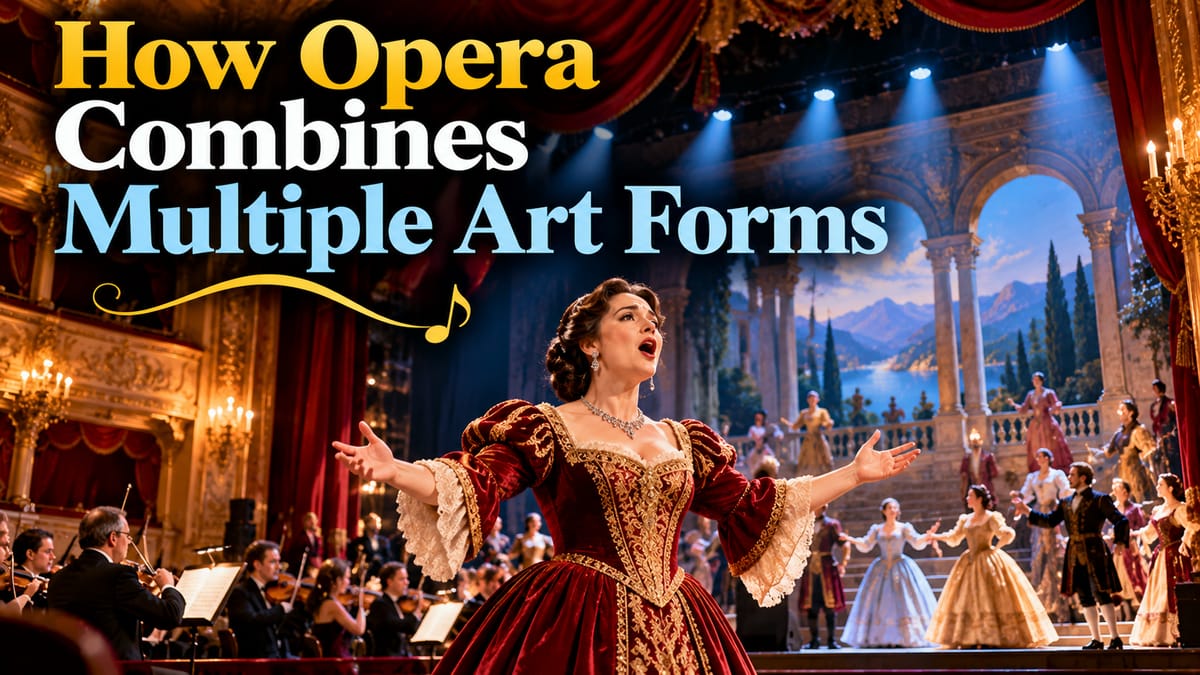
How Opera Combines Multiple Art Forms
Opera is one of the most ambitious forms of entertainment ever created. A single performance can bring together music, theater, poetry, visual art, costume design, choreography, architecture, lighting, and storytelling. Rather than treating these disciplines as separate experiences, opera combines them into one production in which each art form contributes to the overall effect.
This combination is what makes opera distinctive. The audience does not simply listen to music or watch actors perform. Instead, viewers experience a complete theatrical world in which the score, voices, movement, scenery, costumes, and dramatic narrative work together.
Understanding how these elements interact also provides a useful perspective on the broader development of entertainment. As explained in Evolution of Modern Entertainment Media, entertainment has continually evolved by combining existing artistic forms with new methods of presentation. Opera is an especially powerful example of this principle.
What Makes Opera Different From Other Performing Arts?
Opera is often described simply as musical theater, but that definition does not fully capture its complexity.
In a typical opera, much of the dialogue and dramatic action is communicated through singing. The orchestra provides the musical foundation while performers use their voices, acting, gestures, and movement to develop the characters and story.
At the same time, designers create a visual environment that supports the dramatic world. Sets establish locations, costumes communicate identity and social status, lighting influences atmosphere, and choreography can reinforce emotional or narrative moments.
The result is an art form built from several interconnected disciplines.
Opera can therefore be understood as a form of multimedia storytelling before modern multimedia existed.
Music Provides the Foundation
Music is at the center of opera.
Unlike a traditional play, where music may appear only during selected moments, opera uses music as one of its primary storytelling mechanisms. The orchestra can establish mood, introduce themes, create tension, support characters, and signal important changes in the story.
Composers can also give characters distinctive musical identities. A particular melody, rhythm, instrument, or vocal style may become associated with a character or idea.
The human voice is equally important. Opera singers must combine musical accuracy with dramatic expression. Their performances can communicate emotions that ordinary spoken dialogue might not fully convey.
The relationship between opera and the wider musical world can be explored through a broader understanding of Complete Guide to Music and the Music Industry, where music functions not only as entertainment but also as a cultural and creative medium.
Singing Becomes a Form of Acting
Opera demonstrates that singing can perform many of the same functions as conventional acting.
An operatic performer does not simply sing beautiful melodies. The singer must portray a character, communicate relationships, respond to other performers, and advance the story.
This requires control over several skills at once.
A performer may need to:
- Convey emotion through vocal expression
- Use physical gestures to communicate meaning
- React naturally to other characters
- Maintain musical accuracy
- Deliver words clearly
- Move appropriately around the stage
- Express changes in character or circumstance
The challenge is particularly demanding because the singer must maintain vocal technique while portraying dramatic situations.
In this sense, opera turns the voice into both a musical instrument and an acting tool.
Storytelling Connects the Different Art Forms
All of these elements need a common purpose, and that purpose is usually storytelling.
Opera can explore themes such as love, betrayal, ambition, jealousy, political conflict, family, sacrifice, identity, and mortality. The story gives the music and visual elements a framework in which they can operate.
A powerful musical passage may become more meaningful because of what is happening dramatically at the same moment. Likewise, a dramatic event can become more powerful because the music changes with it.
This relationship between narrative and entertainment is also central to Storytelling Explained: How Entertainment Creates Meaning. Stories give audiences a reason to interpret characters, emotions, conflicts, and symbols rather than simply experiencing isolated artistic moments.
Visual Art Creates the World of the Opera
Opera is also a visual experience.
Set designers create the physical environment in which the story takes place. Depending on the production, audiences might see royal palaces, city streets, forests, battlefields, mythical landscapes, or highly abstract environments.
The set does more than establish location. It can influence how audiences understand the characters and the story.
A dark and confined stage can create a sense of danger or psychological pressure. An enormous open space can communicate isolation, freedom, power, or uncertainty.
Modern productions can also use projections, digital screens, moving scenery, and sophisticated stage technology to transform the performance environment.
Costume Design Communicates Character
Costumes provide another layer of storytelling.
Clothing can indicate a character’s profession, social position, historical period, personality, or relationships with other characters.
A change in costume can also signal a major development in the narrative.
For example, a character who begins the story in formal clothing may later appear in simpler or damaged clothing after experiencing a major transformation. The audience can recognize this change visually before the character even speaks or sings.
Costume design therefore operates as a form of visual language.
Color, material, shape, and historical style can all communicate information to the audience.
Choreography Adds Movement
Although opera is primarily associated with singing, movement is another important component.
Some productions include elaborate dance sequences, while others use carefully choreographed stage movement rather than traditional dance.
Movement can establish relationships between characters, emphasize musical rhythms, create large-scale visual scenes, or guide the audience’s attention toward important moments.
Ensemble scenes can be particularly complex because dozens of performers may need to move, sing, and interact while remaining coordinated with the orchestra.
This is one reason opera production requires extensive rehearsal. The performance must function as a unified system rather than a collection of independent artistic contributions.
Lighting Shapes Emotion
Lighting design can dramatically alter how an audience experiences an opera.
Bright lighting can create an atmosphere of celebration or openness, while shadows and limited illumination can produce mystery, tension, or intimacy.
Lighting can also focus attention on individual performers. During an important aria, for example, the lighting may isolate a singer from the rest of the stage.
Modern lighting systems give directors and designers far more control over color, intensity, timing, movement, and visual transitions.
As a result, lighting has become an important storytelling tool rather than simply a way to make the stage visible.
The Orchestra and Stage Must Work Together
One of opera’s defining characteristics is the relationship between performers and orchestra.
The orchestra does not simply provide background music. It is an active participant in the drama.
Instrumental passages can create anticipation before an event occurs. Musical themes can return when characters or ideas reappear. Changes in tempo and dynamics can alter the emotional intensity of a scene.
The conductor plays a critical role in coordinating these elements.
The conductor must balance the orchestra with the singers while ensuring that the musical interpretation supports the dramatic action. A performance can therefore depend on precise communication between the conductor, musicians, singers, director, and technical team.
Opera Is a Large-Scale Collaborative Production
The complexity of opera becomes particularly clear when considering how many people are involved behind the scenes.
A major production may require:
- Composers and musical arrangers
- Singers
- Conductors
- Instrumental musicians
- Stage directors
- Choreographers
- Set designers
- Costume designers
- Lighting designers
- Sound engineers
- Stage managers
- Makeup and hair teams
- Scenic artists
- Technical crews
- Props specialists
Every department contributes to the final performance.
This collaborative structure is shared by many other forms of live entertainment. Understanding How Live Performing Arts Productions Are Created and Performed helps illustrate how artistic ideas eventually become coordinated live experiences in front of an audience.
The Architecture of the Opera House Matters
Even the building itself can become part of the experience.
Traditional opera houses were designed to accommodate large audiences while providing excellent sightlines and acoustics. Many also became architectural landmarks in their own right.
The relationship between the stage, orchestra pit, audience seating, balconies, and decorative elements affects how the performance is experienced.
Acoustics are especially important.
Opera singers must project their voices across large spaces, sometimes without relying heavily on amplification. The architecture of the venue can therefore influence how naturally voices and instruments reach the audience.
The opera house is not simply a container for the performance. Its physical design contributes to the artistic experience.
Technology Has Expanded Opera’s Possibilities
Although opera has centuries of history, it has not remained technologically static.
Modern productions can use automated scenery, digital projections, advanced microphones, computerized lighting, special effects, and sophisticated stage machinery.
These technologies can create environments that would have been difficult or impossible for earlier productions to achieve.
Digital technology has also expanded access to opera beyond the traditional theater. Performances can be recorded, streamed, broadcast, or distributed through digital platforms.
This reflects a much broader transformation in entertainment, where physical performances increasingly coexist with digital forms of distribution.
Why Opera Still Matters
Opera remains relevant because its fundamental idea is remarkably durable: different art forms can become more powerful when they work together.
Music can intensify storytelling. Acting can give music emotional context. Visual design can establish a world. Movement can reinforce character and rhythm. Lighting can shape atmosphere. Architecture can influence how everything reaches the audience.
None of these elements has to exist independently.
Together, they create an experience that is larger than any single component.
That combination also explains why opera continues to influence modern entertainment. Contemporary musical theater, film, television, concerts, music videos, immersive experiences, and other forms of performance frequently combine music, acting, visual design, technology, and narrative in ways that reflect principles opera has explored for centuries.
The Continuing Evolution of Opera
Opera has changed significantly since its earliest forms, but its central creative principle has remained remarkably consistent.
It brings multiple artistic disciplines into the same space and asks them to serve a shared dramatic purpose.
That makes opera more than a form of music and more than a form of theater. It is a collaborative art form in which sound, performance, movement, imagery, design, architecture, and storytelling interact continuously.
As entertainment continues to evolve, that same principle remains visible across new formats. The technologies may change, audiences may consume performances differently, and production techniques may become increasingly sophisticated, but the fundamental goal remains familiar: combine different forms of creative expression to tell a story and create an experience that audiences can remember.




2 Comments
Micle harison
June 7, 2019Lorem ipsum dolor sit amet, usu ut perfecto postulant deterruisset, libris causae volutpat at est, ius id modus laoreet urbanitas. Mel ei delenit dolores.
John Doe
June 7, 2019Some consultants are employed indirectly by the client via a consultancy staffing company.