
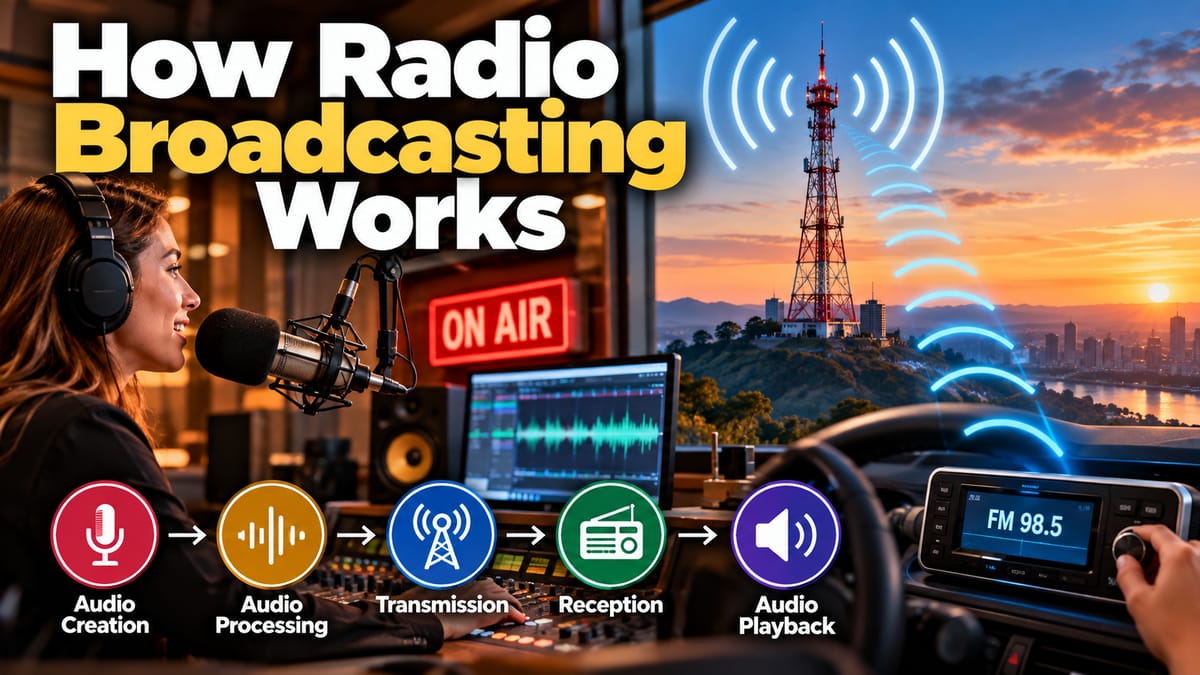
How Radio Broadcasting Works
Radio remains one of the most accessible forms of mass entertainment and communication, connecting broadcasters with audiences through music, news, talk shows, sports coverage and cultural programming.
Although modern radio has evolved significantly since the first commercial broadcasts, its basic purpose remains remarkably simple: capture or create audio, convert it into a signal, transmit that signal, and turn it back into sound for listeners.
What happens between the microphone in a studio and the speaker in a listener’s car, home or phone, however, involves a sophisticated combination of audio production, electronics, radio-frequency transmission and broadcasting infrastructure.
What Is Radio Broadcasting?
Radio broadcasting is the process of transmitting audio programming from a broadcasting station to listeners using radio-frequency signals.
A typical broadcast begins with content produced inside a studio. Voices, music, advertisements and other audio sources are combined into a program. That program is then processed and sent to a transmitter, which converts the audio information into a radio signal.
The transmitter sends the signal through an antenna. A receiving antenna, such as the one inside a car radio, television tuner or portable radio, captures the signal and passes it to electronic circuits that recover the original audio.
The result is the sound heard by the listener.
This basic process applies to traditional terrestrial radio, although modern stations increasingly combine it with internet streaming, mobile applications, podcasts and digital distribution.
The Basic Radio Broadcasting Process
Radio broadcasting can be understood as a sequence of several major stages:
- Content creation
- Audio production
- Signal processing
- Modulation
- Transmission
- Reception
- Demodulation
- Audio playback
Each stage performs a different function.
A broadcaster may start with a live presenter speaking into a microphone, a recorded song, an interview or another audio source. Production equipment then shapes those sounds into a consistent program.
The finished audio is converted into a form suitable for transmission, placed onto a radio-frequency carrier and transmitted through an antenna.
At the receiving end, the radio extracts the audio information from the signal and converts it back into electrical energy that can drive speakers.
How Radio Stations Create Their Programs
Before a radio signal ever reaches an antenna, broadcasters have to create the programming listeners hear.
A station may produce content in a studio using microphones, mixing consoles, computers, digital audio workstations, telephone systems and other production equipment.
Different stations use different programming models.
A music station may combine songs with presenter commentary, advertisements, news updates and station promotions. A talk station may rely heavily on live hosts, interviews and listener calls. News stations can combine reporters, recorded packages, live correspondents and breaking-news updates.
Sports broadcasters may add commentary from venues while simultaneously integrating studio analysis and advertising.
Music itself is a major part of the broadcasting ecosystem. The Complete Guide to Music and the Music Industry provides broader context on how recorded music is created, distributed and monetized.
The Role of the Radio Studio
The studio is effectively the production center of a traditional radio station.
A microphone converts a presenter’s voice into an electrical audio signal. Other equipment can supply music, prerecorded segments, advertisements and sound effects.
A mixing console or software-based mixer allows producers to combine these sources.
For example, a presenter might speak over background music while a producer prepares an advertisement to play next. Automated systems can also schedule music and prerecorded programming without requiring someone to manually operate every part of the broadcast.
Modern studios are heavily dependent on computers and digital audio systems. Audio can be recorded, edited, stored and transmitted using digital technology even when the final broadcast uses a traditional analog radio signal.
How Radio Signals Carry Sound
Sound itself cannot simply travel from a broadcasting studio to a radio receiver over long distances.
Instead, the audio information is used to modify a much higher-frequency radio signal called a carrier wave.
This process is known as modulation.
The carrier wave is generated at a specific radio frequency. The audio information is then encoded onto that carrier in a way that allows a receiver to recover it.
Different types of radio broadcasting use different modulation techniques.
The two most familiar forms of traditional terrestrial radio are AM and FM.
How AM Radio Works
AM stands for amplitude modulation.
In AM broadcasting, the strength, or amplitude, of the carrier wave is varied according to the audio signal.
The carrier’s frequency remains essentially constant while its amplitude changes.
An AM receiver detects those changes and reconstructs the audio information.
One of the historical advantages of AM broadcasting is that AM signals can travel considerable distances, particularly under certain atmospheric conditions. This helped make AM radio especially important for news, talk radio and long-distance broadcasting.
However, AM is generally more susceptible to certain types of electrical interference and noise.
How FM Radio Works
FM stands for frequency modulation.
Instead of changing the amplitude of the carrier, FM broadcasting changes its frequency according to the audio signal.
The amplitude remains relatively constant while the instantaneous frequency varies.
FM became particularly popular for music because it can provide higher audio fidelity and is generally more resistant to certain forms of noise than AM.
FM signals, however, generally depend more heavily on line-of-sight propagation than lower-frequency AM signals. Terrain, buildings and the Earth’s curvature can therefore affect coverage.
What a Radio Transmitter Does
Once a station has produced its program, the audio has to be transmitted.
The transmitter is responsible for converting the station’s processed audio into a powerful radio-frequency signal.
A simplified transmission chain looks like this:
Studio audio → processing → modulation → radio-frequency amplification → antenna → broadcast area
The transmitter increases the power of the radio-frequency signal sufficiently for it to cover the station’s intended service area.
Broadcasting power is carefully regulated because radio frequencies are shared resources. Stations operate on assigned frequencies and under technical requirements established by the relevant regulatory authority.
Why the Antenna Matters
The antenna is the component that actually radiates the radio-frequency energy into the surrounding area.
Different broadcasting frequencies and antenna designs produce different propagation characteristics.
The location of a transmitter can also have a major effect on coverage. A high antenna can improve the ability of a signal to reach surrounding areas, particularly for FM broadcasting.
This is why radio towers are often placed on tall structures, hills or other elevated locations.
The surrounding landscape also matters. Mountains, buildings and other obstacles can affect signal strength and coverage.
How a Radio Receiver Works
The listener’s radio performs the reverse of much of the broadcasting process.
A simplified receiver does several things:
- Captures radio-frequency signals through an antenna.
- Selects the desired station.
- Extracts the audio information from the carrier.
- Amplifies the recovered audio.
- Sends the electrical signal to a speaker.
The antenna can receive many radio signals simultaneously. The receiver therefore needs a tuning system that selects the desired frequency.
Once selected, the receiver uses a process called demodulation to recover the audio.
The resulting electrical audio signal is amplified and sent to a speaker, which converts it into physical vibrations that create the sound heard by the listener.
What Happens Inside an FM Radio?
An FM receiver contains several important stages.
The antenna captures radio-frequency energy, while tuning circuits select the desired station.
The receiver then processes the selected signal and separates the frequency variations associated with the broadcast audio.
A demodulator converts those frequency changes back into an audio signal.
Additional processing may then be applied before the signal reaches the amplifier and speakers.
Modern radios perform many of these tasks using digital electronics, even when receiving traditional analog FM broadcasts.
How Stereo Radio Works
FM radio can transmit stereo audio, allowing listeners to hear separate left and right channels.
Stereo broadcasting adds additional information to the FM signal that allows compatible receivers to reconstruct two audio channels.
This helped make FM particularly attractive for music broadcasting.
Stereo sound creates a wider and more immersive listening experience than traditional mono broadcasting because different information can be reproduced through the left and right speakers.
Radio Broadcasting Has Become Highly Automated
Modern radio stations are very different from early broadcasting operations.
Automation systems can manage large portions of a station’s programming schedule. Songs, advertisements, station IDs, prerecorded programs and other content can be stored digitally and played according to a predefined schedule.
Automation can also help stations operate overnight or maintain programming when live presenters are unavailable.
However, live broadcasting remains important for news, sports, talk programming, emergencies and other events where real-time interaction matters.
A station can combine automation with live production, creating a hybrid workflow.
How Advertising Fits Into Radio
Advertising is one of the primary ways commercial radio stations generate revenue.
A station may sell advertising spots that are inserted between programs, songs or other segments.
Advertisers can target audiences based on factors such as geography, demographics, listening habits and the type of programming being broadcast.
Modern broadcast systems can automate the scheduling and insertion of advertisements, making it easier for stations to manage large numbers of campaigns.
Radio advertising can also be combined with sponsorships, presenter endorsements, promotions and live events.
How News Is Produced for Radio
Radio is particularly well suited to rapidly changing news because audio can be produced and transmitted quickly.
A radio news operation may include reporters, producers, editors, presenters and technical staff.
Reporters can record interviews and field reports before sending them back to the station. Producers then edit or organize the material into a broadcast package.
For breaking news, stations can interrupt scheduled programming with live updates.
The immediacy of radio has historically made it an important medium during emergencies, severe weather events and major public events.
Radio and Podcasts Are Increasingly Connected
The distinction between traditional radio and digital audio has become less rigid.
Many radio stations now publish programs and individual segments as podcasts, allowing audiences to listen after the original broadcast.
Podcasts can also be produced independently without a traditional radio station or terrestrial transmitter.
The production process shares many similarities with radio, including recording, editing, mixing and distribution. How Podcasts Are Produced, Distributed and Monetized explores how this digital audio ecosystem works.
This relationship has allowed broadcasters to extend the life of their programming beyond a station’s traditional broadcast schedule.
Digital Radio Changes the Technology
Traditional AM and FM broadcasting use analog modulation, but radio can also be transmitted digitally.
Digital radio converts audio into digital data before transmission.
Digital broadcasting can potentially support additional information and services, including program information, text and multiple audio channels depending on the standard being used.
Digital radio standards vary between regions, so the exact technology and consumer experience differ from country to country.
The transition to digital broadcasting has therefore not occurred uniformly around the world.
Internet Radio Removes the Traditional Coverage Boundary
Internet radio operates differently from terrestrial broadcasting.
Instead of sending radio-frequency signals from a physical transmitter to antennas across a geographic area, an internet radio station sends audio as digital data over an internet connection.
The basic chain becomes:
Studio → audio server → internet → listener’s device → audio playback
This means an internet radio station can potentially reach listeners far beyond the geographical coverage of a conventional transmitter.
It also allows listeners to use computers, smartphones, smart speakers and connected vehicles to access audio programming.
Radio Is Becoming Part of a Larger Digital Entertainment System
Modern audiences rarely consume entertainment through only one medium.
A radio presenter may host a live broadcast, publish clips on social media, produce a podcast, appear on a streaming platform and interact with listeners through a mobile application.
This reflects the broader transformation of entertainment distribution.
Traditional broadcast signals remain important, but digital platforms have created additional ways for audiences to discover and consume content. How Digital Distribution Works for Entertainment explains how digital technologies have changed the way entertainment reaches audiences.
For broadcasters, this means the radio station is increasingly becoming more than a transmitter and a studio. It can function as a multimedia content operation.
Why Radio Still Matters
Despite the rise of streaming services, social media and podcasts, radio continues to offer several advantages.
It is relatively easy to access, can reach large geographic areas and can provide live programming without requiring listeners to choose individual pieces of content.
Radio is also useful when people are driving, working, exercising or performing other activities where looking at a screen is inconvenient.
Local radio can provide another important advantage: geographic relevance.
Local stations can cover community events, weather, traffic, local sports and regional issues that may receive less attention from national media organizations.
The Future of Radio Broadcasting
Radio broadcasting is unlikely to disappear simply because audiences have more digital alternatives.
Instead, the medium is continuing to evolve.
Traditional terrestrial broadcasting remains important, while internet streaming, podcasts, smart speakers, connected vehicles and mobile applications are expanding how audiences access radio content.
Artificial intelligence and automation are also beginning to influence audio production, from content organization and transcription to recommendation systems and production workflows.
The underlying principle, however, remains unchanged: radio takes audio content, encodes it into a signal, transmits that signal and enables a receiver to convert it back into sound.
What has changed is the number of ways that signal and its accompanying content can reach an audience.
From the first studio microphone to today’s connected cars and streaming applications, radio broadcasting has evolved from a single transmission technology into a much broader audio ecosystem that continues to adapt alongside the entertainment industry.





2 Comments
Micle harison
June 7, 2019Lorem ipsum dolor sit amet, usu ut perfecto postulant deterruisset, libris causae volutpat at est, ius id modus laoreet urbanitas. Mel ei delenit dolores.
John Doe
June 7, 2019Some consultants are employed indirectly by the client via a consultancy staffing company.