
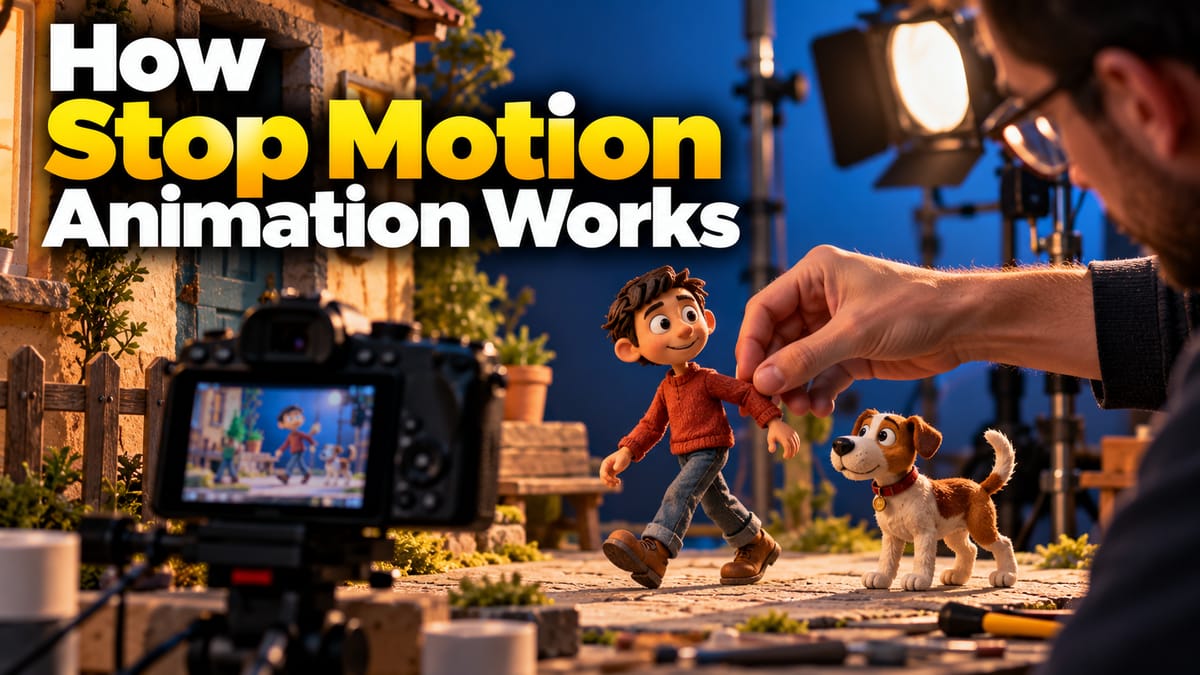
How Stop Motion Animation Works
Stop motion animation is one of the most distinctive techniques in filmmaking. Instead of creating movement entirely through drawings or computer-generated images, stop motion brings physical objects to life by photographing them one frame at a time and making tiny adjustments between each photograph.
When the individual frames are played in sequence, the object appears to move on its own.
The technique is deceptively simple. A filmmaker moves a puppet, model, object, or other physical subject a small amount, takes a photograph, moves it again, takes another photograph, and continues the process until the scene is complete.
What the audience eventually sees is a seamless moving image created from hundreds, thousands, or even tens of thousands of individual photographs.
Stop motion combines animation, photography, sculpture, acting, set design, lighting, cinematography, and filmmaking into one highly collaborative process.
What Is Stop Motion Animation?
Stop motion is an animation technique in which physical objects are photographed in a series of slightly different positions.
When those images are displayed rapidly one after another, the human visual system perceives continuous movement.
The objects themselves do not actually move while the camera is recording. Instead, movement is created through the difference between individual frames.
For example, imagine a small puppet standing beside a table.
A filmmaker might photograph the puppet in its starting position. The puppet is then moved forward by a few millimeters and photographed again. This process continues until the puppet has crossed the room.
When all of the photographs are played back at the appropriate speed, the puppet appears to walk.
The basic principle has remained remarkably consistent for more than a century, even though cameras, lighting equipment, editing software, materials, and production techniques have changed dramatically.
How Frame-by-Frame Animation Creates Movement
The foundation of stop motion is frame-by-frame photography.
Film and video are made up of individual images called frames. When enough frames are displayed rapidly, viewers perceive motion rather than a sequence of separate pictures.
A typical animation might use 24 frames per second for final playback. However, stop motion filmmakers do not necessarily need to create 24 completely different poses every second.
A technique called shooting on twos can display each photographed frame twice. This means the animator may photograph 12 unique poses for one second of footage while each image remains on screen for two frames.
Other scenes may use different timing depending on the desired movement.
Fast movements might require more frames and smaller changes between poses. Slower movements can use fewer frames or larger intervals.
The animator therefore controls not only where an object is positioned but also how quickly the audience perceives it moving.
Building the Characters
One of the defining characteristics of stop motion is the physical construction of its characters.
Traditional stop-motion puppets are often carefully engineered objects rather than ordinary dolls.
A character may contain an internal armature made from metal or another durable material. The armature acts as the skeleton of the puppet and allows animators to position its arms, legs, head, and body precisely.
Around the armature, artists can build layers of foam, silicone, fabric, clay, or other materials.
The exterior has to look convincing while also being flexible enough to survive thousands of tiny movements.
Some productions create multiple versions of the same character.
One puppet may be used for normal scenes, while another may be prepared for a particular facial expression or physical action.
Facial Expressions Require Extraordinary Precision
Faces are among the most difficult elements to animate convincingly.
Small changes in a character’s mouth, eyes, eyebrows, or cheeks can dramatically alter the emotion communicated to the audience.
There are several ways filmmakers approach this problem.
Some puppets have replaceable facial components. An animator can swap one mouth shape for another between frames.
Other characters use mechanical systems that allow facial features to be adjusted directly.
Modern productions may also combine physical puppets with digital techniques to refine facial animation or remove visible mechanisms.
Regardless of the method, the objective is the same: make the character appear to think, react, speak, and feel.
Clay Animation Is One Form of Stop Motion
Clay animation is one of the best-known forms of stop motion.
Characters are sculpted from clay or another moldable material and physically reshaped between frames.
This allows animators to create exaggerated facial expressions and body movements.
Because the material can be manipulated directly, clay animation can have a distinctive visual quality. Characters may appear soft, elastic, exaggerated, or intentionally imperfect.
However, clay animation can also be technically demanding.
Repeated handling can damage the surface of a character, while heat and lighting can affect certain materials. Productions therefore have to carefully control their environments.
Other Materials Can Become Characters
Stop motion does not require clay or traditional puppets.
Almost any physical object can potentially become an animated subject.
Filmmakers have used:
- Paper
- Fabric
- Wood
- Plastic
- Household objects
- Food
- Metal
- Found objects
- Toys
- Cutouts
- Miniature vehicles
- Sculpted figures
The choice of material can become part of the artistic identity of the production.
A film made from handmade paper figures will have a very different visual character from one featuring highly detailed silicone puppets.
This flexibility is one reason stop motion remains attractive to independent filmmakers, artists, commercials, music videos, and feature-film studios.
Creating the Miniature Sets
Stop motion productions frequently use miniature environments.
A living room, street, forest, spaceship, restaurant, or entire city may be constructed at a reduced scale.
These sets need to look convincing when photographed.
Artists carefully design walls, floors, furniture, windows, doors, props, signs, vegetation, and background elements.
Scale is particularly important.
If a character is supposed to be standing beside a table, the table must have the appropriate proportions relative to the character.
Small inconsistencies can become surprisingly noticeable once the animation is photographed frame by frame.
Props Have to Move Too
Objects within the scene can be just as important as the characters.
A cup might need to rise from a table. A door might open. A car might drive down a miniature road. A book might turn its pages.
Every moving prop has to be manipulated between frames.
This creates an enormous amount of work.
A short sequence that lasts only a few seconds on screen may require hundreds of individual adjustments.
That is why stop motion is often described as a slow and highly detailed filmmaking process.
Lighting Must Remain Consistent
Lighting presents a major technical challenge.
In conventional filmmaking, a camera records continuous movement while lights illuminate the scene.
In stop motion, the camera may remain in place for hours or days while the animator captures individual frames.
If the lighting changes between photographs, the resulting footage can flicker.
Clouds moving across the sun, changing daylight, shifting artificial lights, or even someone accidentally blocking a lamp can create unwanted changes between frames.
Professional productions therefore tend to use carefully controlled artificial lighting and controlled shooting environments.
Once a lighting setup is established, it needs to remain stable throughout the sequence.
Camera Movement Is Carefully Planned
The camera itself can move in stop motion, but doing so requires exceptional precision.
A small camera movement between frames can create a smooth tracking shot when repeated consistently.
However, an accidental shift of only a few millimeters can make the final footage appear shaky.
Motion-control systems can help filmmakers program precise camera movements.
The camera might slowly move toward a character while the character simultaneously changes position. When the frames are combined, the result can resemble a conventional cinematic camera move.
This is where stop motion intersects closely with traditional cinematography.
The principles discussed in How Cinematography Shapes a Film remain relevant to stop motion because framing, camera movement, lens selection, lighting, composition, and visual perspective all influence how the audience experiences a scene.
Animators Think Like Actors
A skilled stop-motion animator is effectively performing through a physical character.
They have to determine how a character would stand, walk, react, hesitate, turn, breathe, or express an emotion.
The animator then translates those decisions into a sequence of tiny physical movements.
This is similar to acting, except the performance is constructed one frame at a time.
For a simple walk, the animator must consider the position of the feet, knees, hips, torso, arms, head, and hands.
The timing of every movement matters.
A character who moves too quickly may look nervous or energetic. Slower movement may communicate sadness, exhaustion, caution, or confidence.
Animation therefore involves both mechanical precision and performance.
Timing Creates Personality
Two characters can perform the same physical action but appear completely different because of timing.
Imagine two characters picking up the same object.
One might reach for it quickly, grab it, and pull it toward the body.
Another might slowly look at the object, hesitate, extend a hand, touch it cautiously, and finally pick it up.
The physical action is similar, but the emotional meaning is different.
Stop motion gives animators control over these details.
Every frame becomes part of the character’s performance.
Storyboarding Comes Before Animation
Like many forms of filmmaking, stop motion generally begins long before the camera starts taking final photographs.
The production team develops the story, screenplay, characters, sets, visual concepts, and shot plans.
Storyboards help establish how each scene will unfold.
They can show camera angles, character positions, major actions, and transitions.
Some productions also create animatics, which are rough moving versions of the storyboard.
An animatic can help filmmakers determine whether the timing and composition work before they spend enormous amounts of time animating the final puppets.
This planning is essential because stop motion is expensive in terms of time and labor.
A mistake discovered after hundreds of frames have been captured can require an entire sequence to be repeated.
The Relationship Between Stop Motion and Filmmaking
Stop motion may look different from live-action cinema, but the two disciplines share many fundamental principles.
Both rely on:
- Scripts
- Storyboards
- Directors
- Cinematographers
- Production designers
- Costume and prop teams
- Lighting
- Camera composition
- Sound
- Editing
- Performance
- Visual storytelling
The production process described in The Complete Guide to Filmmaking therefore provides useful context for understanding how stop motion fits into the larger world of cinema.
The major difference is that live-action filmmakers record actors and environments as they exist in real time, while stop-motion filmmakers construct movement through individual photographs.
Sound Is Added Separately
The camera captures the visual component of stop motion, but sound is usually handled separately.
Dialogue may be recorded before animation begins.
This can actually help animators because they can listen to the recorded performance and match the character’s movements to the dialogue.
Sound designers later add effects such as footsteps, doors closing, objects falling, vehicles moving, environmental sounds, and other details.
Music can then reinforce the emotional tone of the sequence.
The final result combines these elements during post-production.
Voice Acting Influences Animation
Voice performances can have a significant impact on how a stop-motion character moves.
An animator can listen to the rhythm and emotional delivery of an actor’s performance and then determine how the puppet should react.
A character speaking slowly might use broader pauses and slower gestures.
A character speaking rapidly might have quicker movements and more frequent changes in expression.
This relationship between voice and physical performance helps prevent the character from feeling like an object being mechanically manipulated.
Instead, the puppet appears to be responding naturally.
Editing Brings the Frames Together
Once individual frames have been photographed, they are imported into editing or animation software.
The frames are placed in sequence and played at the intended frame rate.
At this stage, filmmakers can evaluate the movement.
If a character appears to move too quickly, frames can sometimes be held longer. If a movement feels too slow, frames may be adjusted or additional animation may be created.
Editing also allows the production team to assemble individual shots into complete scenes.
This is where the thousands of isolated photographs begin to become a finished film.
The broader process described in How Movies Are Made From Start to Finish illustrates why animation, like live-action filmmaking, depends on many stages of production rather than a single creative process.
Digital Tools Have Changed Stop Motion
Modern stop motion increasingly combines physical and digital techniques.
Digital cameras have replaced much of the traditional film photography used in earlier productions.
Animation software makes it easier to capture frames, organize shots, review movement, and identify inconsistencies.
Digital compositing can also combine physical sets with computer-generated backgrounds or effects.
Some unwanted elements can be removed digitally during post-production.
For example, wires supporting a puppet may be visible during filming but removed later.
This does not eliminate the physical work involved in animation.
Instead, digital technology gives filmmakers additional tools for refining what was captured in the real world.
Stop Motion Can Work With CGI
Modern productions do not always have to choose between stop motion and computer-generated imagery.
The two techniques can coexist.
A physical puppet might be photographed on a miniature set while a digital background is added later.
Computer-generated effects can create smoke, fire, water, particles, crowds, or environments that would be difficult to construct physically.
Likewise, physical stop-motion elements can give a production a tactile quality that is difficult to reproduce entirely through computer graphics.
The combination allows filmmakers to choose the most appropriate technique for each shot.
Why Stop Motion Looks Different
One of the most appealing qualities of stop motion is its physicality.
Viewers can often sense that the objects on screen actually existed in a physical environment.
They have real surfaces, textures, shadows, imperfections, and dimensions.
That physical presence can create a visual warmth that audiences associate with handcrafted filmmaking.
Even when digital tools are used extensively, preserving physical materials and practical sets can help maintain that distinctive aesthetic.
The result is an art form that can feel both old-fashioned and technologically sophisticated at the same time.
Stop Motion and the Wider World of Animation
Stop motion is only one branch of animation.
Animation also includes hand-drawn techniques, 2D digital animation, 3D computer animation, motion graphics, cutout animation, and many hybrid approaches.
A broader look at the medium can be found in the Complete Guide to Animation and Anime, which explores how different animation traditions use movement, design, characters, and storytelling.
What connects these techniques is the ability to create movement that does not necessarily exist in the same way as ordinary filmed reality.
Stop motion achieves this through physical objects and incremental changes.
Why Stop Motion Takes So Long
The amount of labor involved is one of the defining characteristics of stop motion.
A filmmaker might spend hours creating only a few seconds of usable footage.
Every movement has to be planned.
Every object has to be positioned.
Every frame has to be photographed.
The camera must remain stable.
Lighting must remain consistent.
The animator must constantly check the sequence to ensure that the movement looks natural.
A feature-length stop-motion film can therefore require years of work involving large teams of artists and technicians.
The finished product may appear effortless, but that apparent simplicity often hides enormous amounts of craftsmanship.
The Enduring Appeal of Handmade Animation
Stop motion has survived the rise of television, computer animation, digital filmmaking, and increasingly sophisticated visual effects because it offers something uniquely tangible.
Its characters are physical.
Its sets are physical.
Its movement is constructed by hand.
Its imperfections can become part of its personality.
At the same time, modern technology has expanded what filmmakers can accomplish with the technique.
Digital cameras, animation software, motion-control systems, computer-generated effects, and digital compositing can all work alongside traditional puppets and miniature sets.
That combination gives stop motion an unusual position within modern entertainment.
It is a filmmaking technique rooted in physical craftsmanship but capable of embracing contemporary technology.
From Tiny Movements to Complete Worlds
The fundamental idea behind stop motion remains remarkably simple: move something a little, photograph it, move it again, and repeat.
Yet that simple process can produce remarkably complex results.
Characters can develop personalities. Miniature sets can become entire worlds. Objects can appear to think and move. Ordinary materials can become actors. And thousands of individual photographs can eventually become a feature film.
That is the enduring magic of stop motion.
It turns physical objects into performers through patience, precision, timing, photography, and storytelling. Behind every apparently effortless movement is a carefully constructed chain of decisions that brings an otherwise motionless world to life.




2 Comments
Micle harison
June 7, 2019Lorem ipsum dolor sit amet, usu ut perfecto postulant deterruisset, libris causae volutpat at est, ius id modus laoreet urbanitas. Mel ei delenit dolores.
John Doe
June 7, 2019Some consultants are employed indirectly by the client via a consultancy staffing company.