
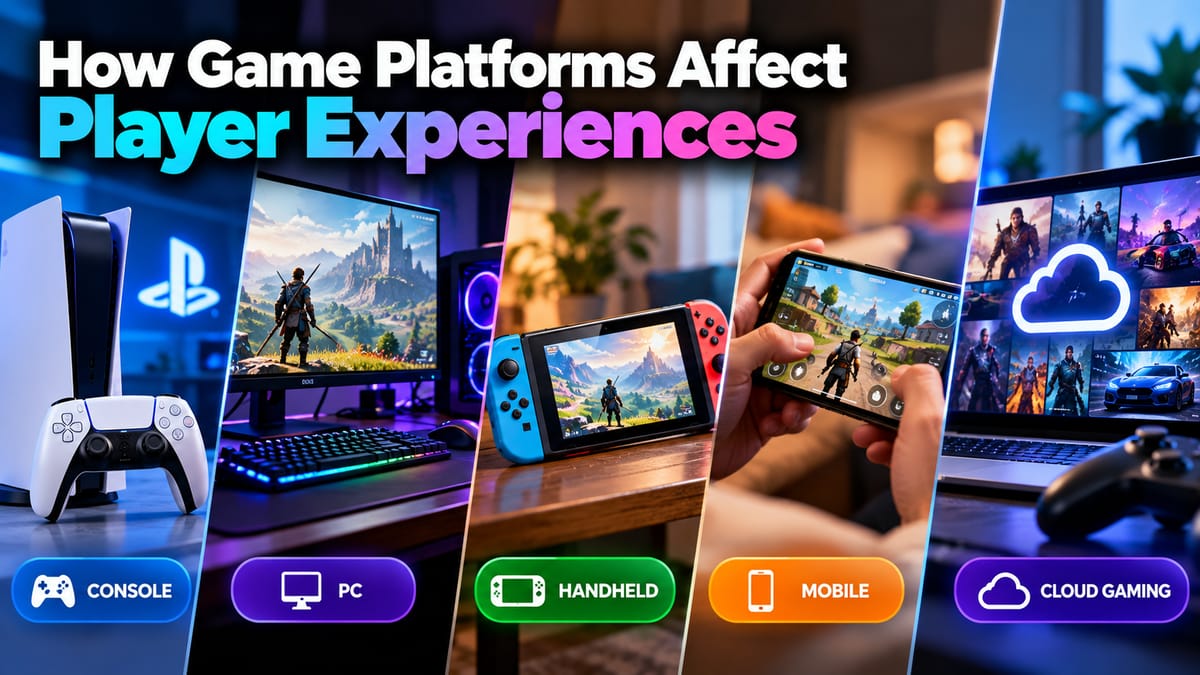
How Game Platforms Affect Player Experiences
Video games may share the same characters, stories and basic mechanics across different devices, but the experience of playing them can vary dramatically depending on the platform.
A game played on a high-end gaming PC can feel very different from the same title running on a console, handheld device or smartphone. Differences in processing power, display technology, controls, online services, storage, performance and accessibility all influence how players interact with games.
The platform is therefore more than a piece of hardware. It can shape how a game looks, feels, performs and fits into a player’s everyday life.
Understanding these differences provides useful context for the broader Complete Guide to Video Games and Gaming, particularly as gaming continues to expand across traditional consoles, computers, mobile devices and cloud-based services.
What Is a Game Platform?
A game platform is the hardware and software environment used to run and access video games.
The major categories include:
- Gaming consoles, such as PlayStation, Xbox and Nintendo systems
- PCs, which offer a wide range of hardware configurations
- Handheld gaming devices, including dedicated portable consoles and PC-based handhelds
- Smartphones and tablets, which support an enormous mobile gaming ecosystem
- Cloud gaming services, where games are streamed from remote servers
- Web-based platforms, which allow certain games to run through internet browsers
Each platform has its own technical characteristics and ecosystem.
Those differences affect everything from graphics quality and loading times to pricing, multiplayer features and the types of games developers choose to create.
Hardware Can Change How a Game Feels
One of the most obvious differences between platforms is hardware performance.
A powerful gaming PC can include a high-end graphics processor, fast processor, substantial memory and extremely fast storage. This allows compatible games to operate at high resolutions, higher frame rates and more demanding graphical settings.
Consoles generally offer a more standardized hardware environment. Developers know the technical specifications of the system and can optimize their games around them.
Mobile devices operate under different constraints. Smartphones need to balance gaming performance with battery life, heat management, portability and everyday functions such as communications and photography.
These differences influence the design of games.
A visually demanding open-world title may be built around powerful hardware, while a mobile game might prioritize shorter sessions, touch controls and efficient performance.
Graphics and Display Technology Matter
The display is another major part of the gaming experience.
Players using a modern television may experience games on a large screen with high resolution and advanced HDR capabilities. PC gamers can choose from monitors offering different resolutions, refresh rates, aspect ratios and response times.
Handheld systems introduce another set of considerations.
A smaller screen can make games feel more intimate and portable, while high pixel density can help maintain image quality despite the reduced physical size.
Frame rate also influences the experience. Higher frame rates can make movement and camera transitions appear smoother, particularly in fast-paced games.
However, graphical quality is only one part of the equation. Art direction, animation, sound design, storytelling and gameplay mechanics can remain important regardless of the platform.
Controls Shape Player Interaction
The way players control a game can fundamentally change how it feels.
A traditional console controller provides physical buttons, analog sticks and triggers. This configuration works particularly well for action games, racing titles, platformers and many adventure experiences.
A gaming mouse and keyboard offer a different form of precision.
Mouse-based aiming can be particularly useful in first-person shooters and strategy games, while keyboards provide numerous inputs that can be assigned to different actions.
Touchscreens introduce another interaction model.
Mobile games can use taps, swipes, virtual buttons and gestures, allowing players to interact directly with objects on the screen. However, touchscreen controls may not provide the same physical feedback as a dedicated controller.
Some games therefore support multiple control schemes so players can select the method that best suits their preferences.
Performance Can Influence Competitive Gaming
For competitive players, platform performance can become particularly important.
Frame rates, input latency, network stability and display response times can affect how quickly players see and respond to events.
Competitive gaming therefore often places greater emphasis on technical consistency.
A stable frame rate can make fast-moving gameplay easier to follow, while responsive controls can help players execute precise actions. Network performance is equally important in online multiplayer games, where delays between players and servers can affect interactions.
That does not mean that expensive hardware automatically makes someone a better player. Skill, strategy, experience and teamwork remain fundamental.
Instead, platform characteristics can influence the conditions under which those skills are applied.
Online Connectivity Has Changed the Gaming Experience
Modern games increasingly connect players to online services.
Multiplayer matches, digital storefronts, downloadable content, cloud saves, social features and live events can all depend on internet connectivity.
This has transformed gaming from an activity that can be experienced entirely alone into something that can connect millions of players.
Online communities are particularly important.
Players can form teams, communicate through voice or text, share strategies and build friendships around particular games. The social dimension is explored in greater detail in How Online Gaming Communities Work.
The platform can influence those communities by determining which players can interact, what communication tools are available and how multiplayer services are structured.
Cross-platform play has reduced some of these barriers by allowing people on different devices to participate in the same online environment.
Platform Ecosystems Influence Game Libraries
Every major gaming platform has its own ecosystem.
Console manufacturers may invest heavily in exclusive games and first-party studios. PC platforms can provide access to enormous digital libraries, independent games, modifications and community-created content.
Mobile platforms have their own app stores and distribution systems, while cloud services can provide access to games without requiring players to own powerful local hardware.
The available game library can therefore influence why someone chooses one platform over another.
Exclusive titles can become major reasons for purchasing a particular console. Meanwhile, the flexibility and openness of PC gaming can appeal to players who want greater control over hardware, software and customization.
Portability Changes When and Where People Play
One of the biggest advantages of handheld and mobile platforms is portability.
A console typically occupies a dedicated space in a home. A desktop gaming PC can require a desk, monitor and additional peripherals.
A handheld device can be taken on a commute, used while traveling or played in different rooms.
Smartphones go even further because they are already carried by billions of people.
Portability can change the structure of gaming sessions. Instead of sitting down for a long uninterrupted session, players may play for a few minutes while waiting for an appointment or spend longer periods gaming while traveling.
This flexibility has contributed to gaming becoming increasingly integrated into everyday entertainment habits.
Pricing and Monetization Can Differ by Platform
The cost of accessing games varies considerably across platforms.
Some games require an upfront purchase. Others use subscriptions, downloadable expansions, cosmetic purchases, advertising or free-to-play models.
Mobile gaming has played a major role in popularizing free-to-play experiences, while consoles and PCs continue to support traditional premium releases alongside subscription and live-service models.
The way these systems work is explained in How Video Game Monetization Works.
Platform owners also influence the economics of gaming through their digital storefronts, subscription programs and payment systems.
For players, the initial price of hardware is therefore only one part of the overall cost. Games, accessories, subscriptions and additional content can significantly affect the long-term expense of a gaming setup.
Accessibility Can Expand the Gaming Audience
Game platforms can also influence accessibility.
Features such as customizable controls, subtitles, adjustable text sizes, color options, audio settings and alternative input devices can help more people participate in gaming.
Hardware design matters as well.
Controllers with customizable inputs or accessibility-focused configurations can provide additional ways to interact with games.
Software-based accessibility features can sometimes be added across multiple platforms, but the exact options available can differ between systems.
As the gaming audience expands, accessibility is becoming an increasingly important consideration for both hardware manufacturers and game developers.
Storage and Loading Times Affect Convenience
Modern games can require substantial amounts of storage.
Large open-world games can occupy significant portions of a console or PC’s internal drive, making storage management an important part of the experience.
Solid-state storage has also changed expectations around loading times.
Games installed on faster storage can generally load environments and transition between areas more quickly than older systems using slower storage technologies.
This can make games feel more seamless, particularly when developers design their worlds around fast data access.
Storage also affects digital distribution. Players can increasingly download games rather than purchasing physical discs or cartridges, although the size of modern game files can make installation times and storage capacity important considerations.
Cloud Gaming Is Changing the Hardware Equation
Cloud gaming introduces a different approach to platform design.
Instead of rendering the entire game locally, cloud services can perform much of the processing on remote servers and stream the resulting gameplay to a player’s device.
This potentially allows users to play demanding games on hardware that would not normally be capable of running them locally.
The tradeoff is dependence on network quality.
Latency, bandwidth and connection stability can affect the experience, particularly in games that require precise timing.
Cloud gaming therefore shifts some of the importance from local hardware toward internet infrastructure and server performance.
Platforms Are Becoming More Connected
The boundaries between gaming platforms are becoming less rigid.
A player might use a console at home, a handheld device while traveling and a smartphone for related gaming activities. Cloud saves can allow progress to move between devices, while cross-platform multiplayer can allow players using different systems to interact.
Digital accounts are also becoming central to the experience.
Instead of treating each device as a completely separate environment, publishers increasingly build ecosystems around user accounts, digital libraries, achievements, subscriptions and online identities.
This reflects a wider transformation in entertainment, where audiences increasingly move between devices and services rather than relying on one fixed medium. The Evolution of Modern Entertainment Media provides broader context for how technology has changed the way people consume and interact with entertainment.
Developers Have to Design Around Platform Differences
Game developers face a complicated set of decisions when creating multi-platform releases.
A game designed for a powerful PC may need significant optimization before it can run on a lower-powered console or mobile device.
Controls may also need to be redesigned.
A keyboard and mouse interface cannot simply be transferred to a touchscreen without considering how players will interact with menus, movement and combat.
Developers may also have to account for different screen sizes, performance targets, storage limitations and operating systems.
The result is that a game’s platform strategy can influence development from the earliest stages.
Exclusive Features Can Create Different Experiences
Even when the core game is available on several platforms, individual versions can sometimes differ.
One system might support higher graphical settings, another might offer unique control features, and another could provide exclusive content or enhanced portability.
These differences can affect how players perceive the same game.
However, developers increasingly try to maintain comparable gameplay experiences across platforms, particularly when supporting cross-platform multiplayer.
The challenge is balancing technical differences without creating unfair advantages or making one version feel substantially incomplete.
The Future of Game Platforms
The future of gaming is likely to involve greater integration between hardware, software, online services and artificial intelligence.
Cloud technology can make games accessible across more devices. AI can influence non-player characters, personalization and content creation. Faster networking can support more responsive multiplayer experiences, while increasingly capable handheld hardware can bring console-quality games into portable formats.
At the same time, traditional platforms are unlikely to disappear simply because new technologies emerge.
Many players value dedicated hardware, physical controls, local performance and the reliability of having games installed directly on a device.
The most important change may therefore be greater choice.
Instead of defining gaming through a single type of machine, the industry is increasingly creating interconnected environments in which players can choose where, how and when they play.
Ultimately, the platform becomes part of the game experience itself. Performance, controls, portability, connectivity, pricing, accessibility and community features all influence how players experience interactive entertainment. As those elements continue to converge, the distinction between a game and the technology delivering it is likely to become increasingly difficult to separate.





2 Comments
Micle harison
June 7, 2019Lorem ipsum dolor sit amet, usu ut perfecto postulant deterruisset, libris causae volutpat at est, ius id modus laoreet urbanitas. Mel ei delenit dolores.
John Doe
June 7, 2019Some consultants are employed indirectly by the client via a consultancy staffing company.