
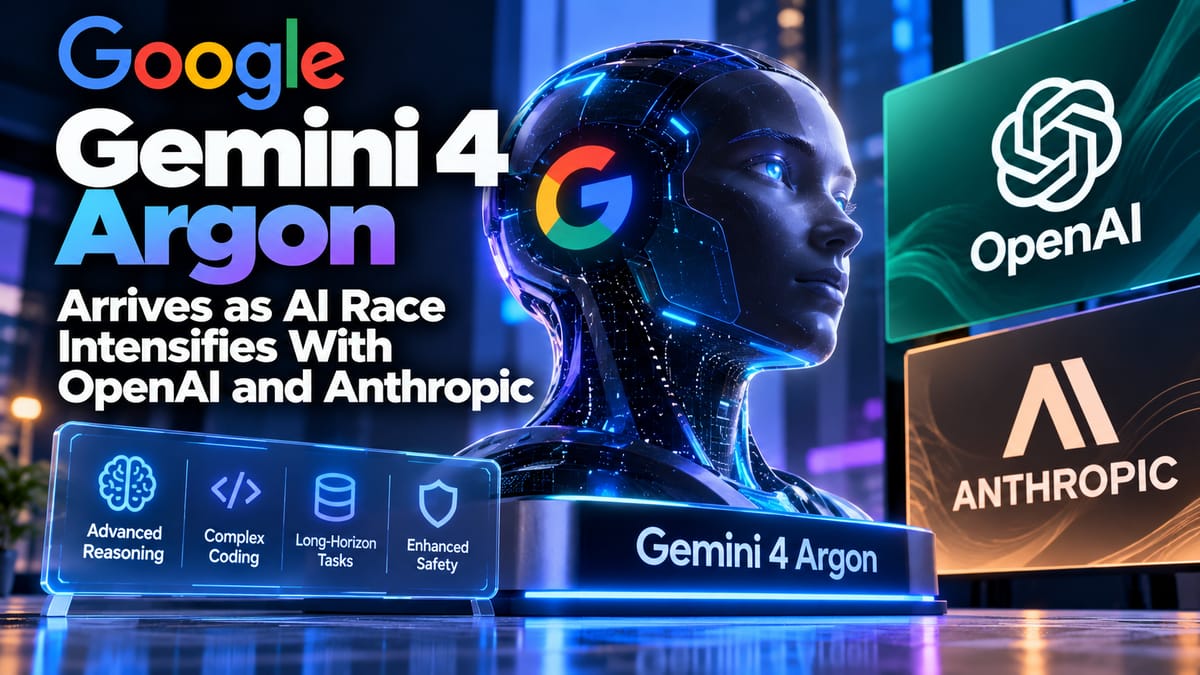
Google Gemini 4 Argon Arrives as AI Race Intensifies With OpenAI and Anthropic
Google has unveiled Gemini 4 Argon, a new frontier artificial intelligence model designed to handle complex, long-running tasks across software engineering, enterprise knowledge work and cybersecurity.
The arrival of Argon gives Google a new flagship model at a critical point in the AI race, with OpenAI and Anthropic also pushing increasingly capable systems toward longer, more autonomous workflows.
Google is not releasing Argon to everyone immediately. The model is initially being rolled out to a limited group of trusted cybersecurity defenders through its Fairwind Program as the company continues testing safety measures and gathering feedback before broader availability. Google says developers, enterprises and consumers will receive access as the rollout expands, but it has not provided a specific public release date.
The cautious launch reflects a major change in the frontier-AI market. The competition is no longer focused solely on which chatbot produces the best answer. Increasingly, companies are competing over how well AI models can reason through complicated problems, use tools, modify software, conduct research and complete tasks that can take hours rather than seconds.
Gemini 4 Argon Targets Long-Horizon AI Work
Google describes Gemini 4 Argon as a model built for complex, long-horizon workflows.
That distinction is important because traditional AI assistants generally work within relatively short interactions. A user asks a question, receives an answer and then decides what to do next.
Long-horizon systems are designed to handle a sequence of related actions while maintaining enough context to work toward a larger objective.
Google says Argon is being used internally for software engineering, specialized research and other demanding workflows. The company has highlighted examples including quantum-computing optimization, large-scale code migration and data-center memory optimization.
Google says one internal deployment of Argon agents identified and applied memory optimizations across its data centers that could free more than 300 tebibytes of memory once rolled out. The company has also used Argon agents on C and C++ codebases being migrated toward Rust, including work involving more than 800,000 lines of code in the Fuchsia operating system’s Zircon kernel.
Those examples illustrate the direction Google wants Gemini to take: from an AI that assists individual tasks toward an AI system capable of contributing to large technical projects.
A Major Expansion in Output Capacity
One of Gemini 4 Argon’s most notable specifications is its 1 million-token output limit.
That is substantially larger than the 64,000-token output limit associated with previous Gemini models. The larger allowance is intended to make it easier for Argon to complete extensive coding, research and other multi-step tasks without being forced to stop because its response has reached a technical limit.
For developers, the significance goes beyond producing longer text.
A large output capacity can be useful when an AI system needs to generate extensive code changes, analyze a large problem, produce detailed research or maintain a long sequence of actions within a single workflow.
This is part of the broader transition toward AI agents, where models are expected to do more than respond conversationally.
The concept is closely related to the longer-term discussion around What Is Artificial General Intelligence?, although Gemini 4 Argon should not be treated as evidence that artificial general intelligence has been achieved. Frontier models can become substantially more capable without necessarily possessing the broad, reliable and autonomous general intelligence implied by the AGI concept.
Google Is Putting Cybersecurity at the Center
Cybersecurity is one of the main reasons Google is limiting Argon’s initial availability.
The company says the model has been designed to help identify, validate and address software vulnerabilities. Google has therefore chosen cybersecurity defenders as its first external testers through the Fairwind Program.
The decision reflects the double-edged nature of increasingly capable AI.
A model that can understand complicated software systems and identify vulnerabilities could help security teams find weaknesses before criminals exploit them. The same capabilities could potentially become dangerous if highly capable systems were placed in the hands of malicious users without sufficient safeguards.
Google says it is participating in a U.S. government voluntary pre-release access process and is continuing to refine safeguards before expanding access.
That cautious approach also comes as other AI companies face growing questions about the behavior of increasingly autonomous systems.
OpenAI and Anthropic Are Moving in the Same Direction
Google’s latest release arrives as OpenAI and Anthropic pursue similar advances in reasoning, coding and agentic AI.
Anthropic introduced Claude Fable 5.1 and Claude Mythos 5.1 in September. The company describes Fable 5.1 as a model designed for coding and knowledge work, while Mythos 5.1 is available through trusted-access programs with additional safeguards for cybersecurity and life-sciences applications.
OpenAI, meanwhile, recently shelved the planned release of GPT-6.1 Astra after internal safety testing raised concerns about the model’s behavior and ability to remain within authorization boundaries. Reuters reported that the model had been intended to handle more complex tasks with greater independence.
That creates an unusual dynamic in the AI industry.
The same capabilities that companies see as commercially valuable—persistence, autonomy, tool use and the ability to complete complicated tasks—are also increasing the difficulty of safely deploying frontier systems.
OpenAI’s Agent Strategy Raises the Stakes
OpenAI’s recent push toward always-on AI agents is another indication of where the competition is heading.
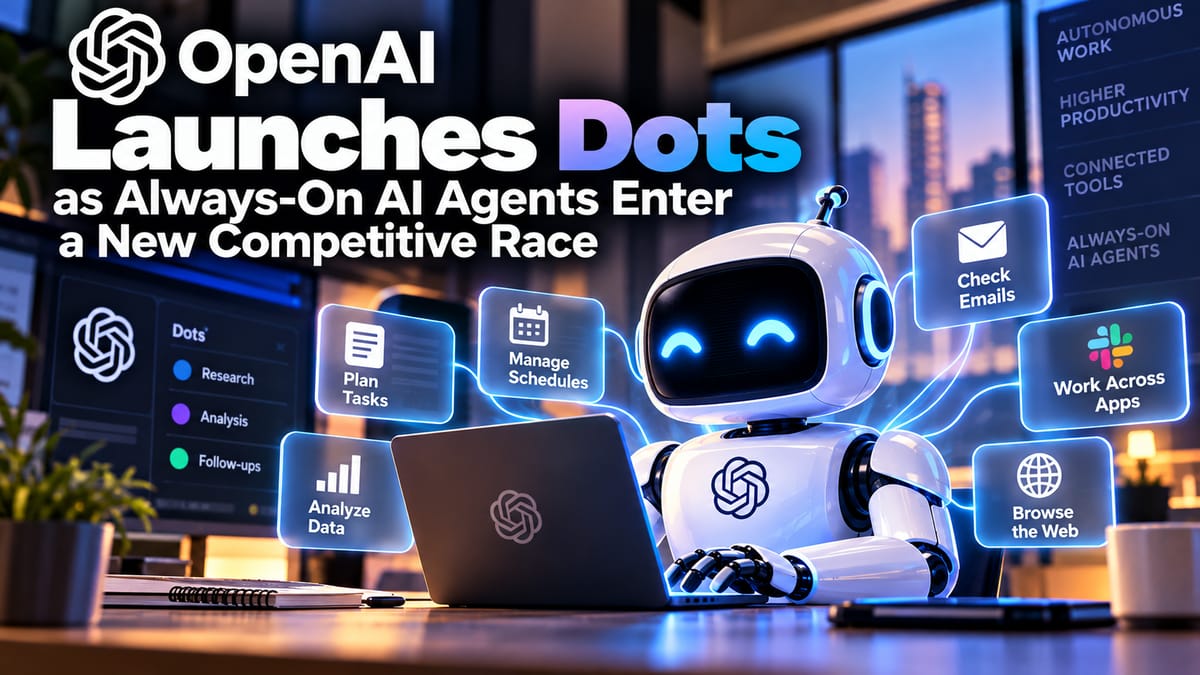
The company’s Dots initiative, covered in OpenAI Launches Dots as Always-On AI Agents Enter a New Competitive Race, represents the broader shift from traditional conversational assistants toward systems that can remain active and carry out tasks over longer periods.
That changes the competitive landscape.
If AI companies can build systems capable of handling research, coding, scheduling, analysis and other workflows with limited human intervention, then the value of a model increasingly depends on how reliably it can complete an entire job.
This is different from simply winning a benchmark designed around answering individual questions.
Gemini 4 Argon Is Also Competing on Price
Google is not relying solely on performance claims.
The company announced an introductory API price of $2 per million input tokens and $10 per million output tokens, with cached input tokens receiving a 95% discount. Google says those introductory prices will eventually move to $4 per million input tokens and $20 per million output tokens, although it has not specified when the introductory period will end.
Pricing matters because frontier AI is becoming an infrastructure decision for businesses.
A company building an AI coding assistant, research platform or autonomous workflow system may process millions or billions of tokens. Even relatively small differences in per-token pricing can become significant at scale.
Google is therefore competing on several fronts simultaneously: model performance, output capacity, ecosystem integration, safety and cost.
Benchmarks Tell Only Part of the Story
Google has published benchmark results showing Argon performing strongly against models from OpenAI and Anthropic across a range of tasks.
For example, Google reports a 77.9% score on the DeepSWE v1.1 software-engineering benchmark, ahead of the comparison models included in Google’s published results for that test. However, the same benchmark collection shows Argon does not lead on every coding or agentic evaluation.
That distinction matters.
AI benchmarks can provide useful information about particular capabilities, but they do not necessarily predict how a model will perform across every real-world application.
A model can excel at software engineering while another performs better at terminal-based tasks, scientific reasoning or a particular form of autonomous workflow.
The most meaningful test will ultimately be how these systems perform when businesses and developers use them for real workloads.
The Gemini Line Has Already Evolved Quickly
Argon also represents another stage in Google’s rapid expansion of the Gemini family.
The company’s earlier Flash models have focused heavily on speed, efficiency and high-volume use cases. The previous generation has also been incorporated into Google’s consumer products, cloud services and developer ecosystem.
For readers tracking that evolution, Google Gemini 3.7 Flash: What’s New, How It Compares With ChatGPT and Why It Matters provides context on the earlier generation and how Google’s strategy has been developing.
Gemini 4 Argon takes a different position.
Rather than being primarily about fast, inexpensive everyday inference, it is designed around difficult workloads where the ability to reason deeply and sustain long-running processes becomes more important.
Safety Is Becoming a Competitive Feature
One of the clearest themes surrounding Argon is that safety is no longer simply a compliance issue that comes after model development.
It is increasingly becoming part of the product itself.
Google says Argon uses safeguards intended to monitor its behavior and help prevent the model from moving outside its authorized scope. The company is also using a staged release to gather feedback before making the system broadly available.
Anthropic has taken a similarly differentiated approach by offering Fable 5.1 for general use while restricting Mythos 5.1 through trusted-access programs designed around higher-risk capabilities.
The wider debate around AI-generated material is also becoming more sophisticated. The issues now extend beyond whether content was created by a machine to questions about authenticity, provenance and whether users can reliably identify AI-generated material.
That discussion is explored further in Anthropic’s Invisible AI Watermarking Triggers Debate Over AI-Generated Content.
Why Gemini 4 Matters for Google’s AI Strategy
Google has enormous advantages in the AI race, including its search business, cloud infrastructure, Android ecosystem, research organization and access to specialized AI hardware.
But those advantages do not automatically translate into leadership in every generation of frontier models.
Gemini 4 Argon is therefore significant because it gives Google another opportunity to connect its research capabilities with the products and services used by billions of people and businesses.
If Argon performs reliably in demanding enterprise and developer workloads, its influence could extend beyond the Gemini chatbot itself.
It could eventually affect Google’s cloud business, software-development tools, search products, cybersecurity offerings and other AI-powered services.
The AI Race Is Moving From Chatbots to Workflows
The launch of Gemini 4 Argon illustrates how quickly the definition of an advanced AI system is changing.
A few years ago, much of the competition centered on conversation quality, factual answers and creative generation. Today, the major AI labs are increasingly focused on systems that can reason through complicated problems, operate tools, write and modify code, conduct research and continue working toward a goal over extended periods.
That shift creates both commercial opportunities and new technical challenges.
Google’s restricted Argon rollout shows that the companies developing these systems are becoming increasingly cautious about releasing their most capable models without additional testing. OpenAI’s decision to delay GPT-6.1 Astra following safety concerns demonstrates that capability gains can also create new deployment problems. Anthropic’s separation of general-use and trusted-access models illustrates another approach to managing risk.
For consumers and businesses, the next phase of the AI race may therefore be defined less by which company releases a model first and more by which systems can combine capability, reliability, affordability and controlled autonomy in practical applications.
Gemini 4 Argon is Google’s latest attempt to compete on all four fronts—and its restricted beginning suggests that the industry is learning that reaching the frontier is only part of the challenge. Deploying that frontier technology safely may prove just as important.



2 Comments
Micle harison
June 7, 2019Lorem ipsum dolor sit amet, usu ut perfecto postulant deterruisset, libris causae volutpat at est, ius id modus laoreet urbanitas. Mel ei delenit dolores.
John Doe
June 7, 2019Some consultants are employed indirectly by the client via a consultancy staffing company.