
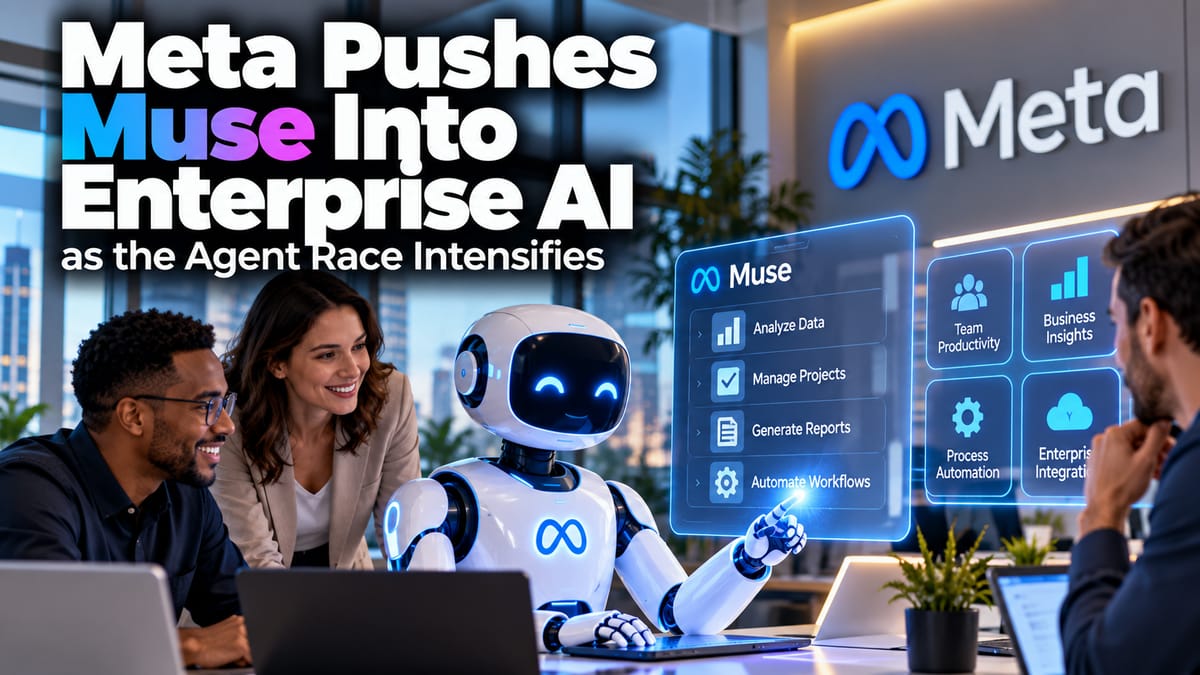
Meta Pushes Muse Into Enterprise AI as the Agent Race Intensifies
Meta is taking its AI ambitions into a new phase, moving its Muse agent beyond personal productivity and into the enterprise market as technology companies increasingly compete to build AI systems that can do work rather than simply answer questions.
The company’s September 28 launch of the Meta Enterprise Platform brings together Muse, Meta Business Agent, Muse API, Muse Code, and other components of its AI stack for businesses and developers. Meta says the platform is intended to help organizations use its AI technology to grow, transform operations, and build new applications.
The timing is significant.
The enterprise AI market is shifting from experimental chatbots toward systems that can interact with software, access business information, coordinate tasks, and operate with varying degrees of autonomy. Meta’s move places Muse directly into that transition, while rivals including OpenAI are also introducing increasingly persistent AI agents.
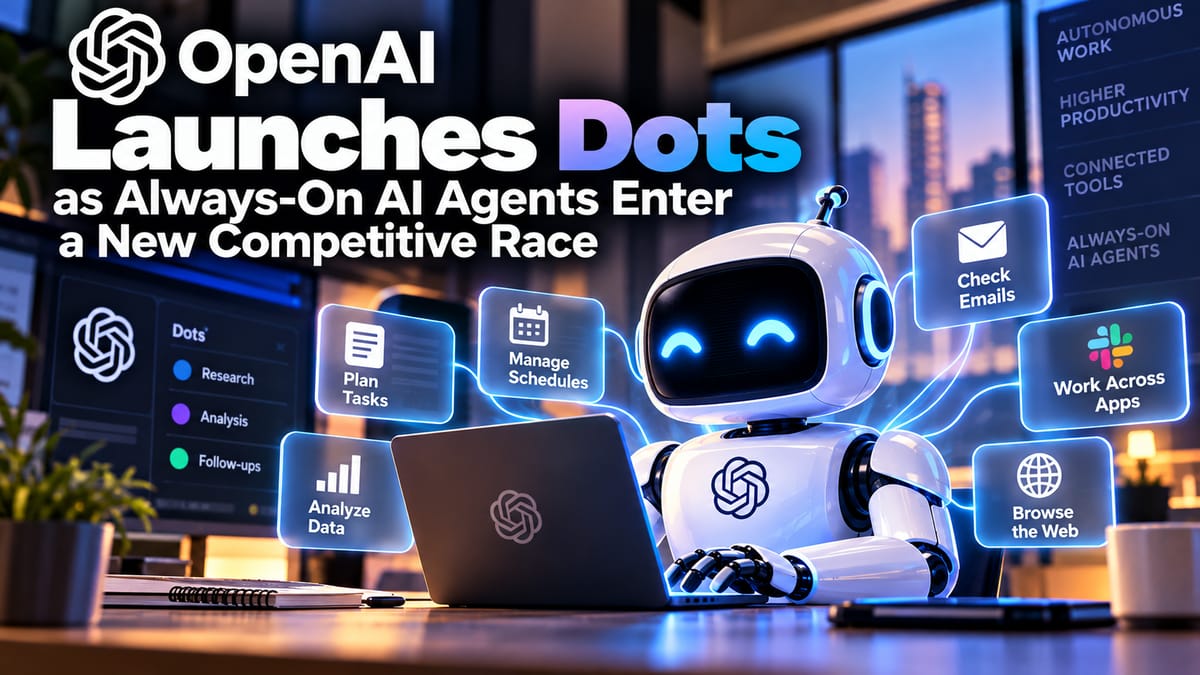
OpenAI launched its dots agents on September 29, describing them as always-on systems designed to work toward users’ goals across applications.
The result is a rapidly developing competition over what could become the next major interface between people and business software.
From AI Assistant to AI Agent
Traditional AI assistants generally wait for a user to ask a question.
An agent is designed to take a more active role.
Instead of simply responding to a prompt, an agent can potentially break a goal into multiple steps, use connected tools, browse websites, retrieve information, create documents, interact with software, and return when additional input is required.
Meta introduced Muse in September as a personal AI agent designed to work on users’ behalf. The company says Muse can operate through a dedicated cloud computer and browser, continue working after a person closes the application, and request approval for sensitive actions such as sending an email or making a purchase.
That represents a significant change in how AI can interact with software.
The question is no longer simply whether AI can understand a company’s information.
It is whether AI can act on that information safely and repeatedly.
Meta Turns Muse Into an Enterprise Platform
Meta’s enterprise announcement broadens that concept considerably.
The new Meta Enterprise Platform combines several components of the company’s AI ecosystem. Meta specifically identified the Muse agent, Meta Business Agent, Muse API, and Muse Code as part of the initial platform.
That means Meta is not positioning Muse as a standalone chatbot for employees.
Instead, it is attempting to create a broader technology stack that businesses and developers can build around.
For enterprises, that distinction matters.
Companies typically have dozens or hundreds of software systems handling customer relationships, accounting, communication, project management, analytics, marketing, sales, human resources, and internal operations.
An AI system that can interact with those tools can potentially become a new layer connecting them.
Muse for Small Businesses Shows the Strategy
Meta is also moving quickly to connect Muse with the software that businesses already use.
Its Muse for Small Business rollout added connectors for applications and services including Asana, Box, Canva, Dropbox, Figma, QuickBooks, Klaviyo, Notion, Shopify, Slack, Stripe, Zoom, and Meta’s own business accounts.
The company says businesses can give Muse goals such as analyzing sales, improving campaigns, identifying issues in financial performance, or finding new customers.
This is a different proposition from asking an AI chatbot to draft an email.
The agent is being positioned as something that can operate across a company’s existing software environment.
That makes integrations one of the most important parts of the emerging agent economy.
The Enterprise AI Shift Is About Action
The growth of enterprise AI has already moved beyond basic text generation.
Companies have increasingly experimented with AI for customer support, document analysis, coding, research, marketing, data analysis, and knowledge management.
The next stage is more autonomous.
An employee might tell an agent to investigate a sales decline. Instead of returning a list of suggestions, the agent could potentially examine sales data, compare advertising performance, inspect customer feedback, identify changes, prepare a report, and ask for approval before taking an action.
That is the fundamental difference between an assistant and an agent.
The assistant helps the employee perform the work.
The agent increasingly performs portions of the work itself.
The broader trend is reflected in Enterprise AI Adoption Accelerates Following Strong Tech Earnings, where enterprise AI is becoming increasingly connected to actual business operations rather than remaining confined to demonstrations.
Meta’s Business Agent Expands the Picture
Muse is not Meta’s only enterprise-oriented AI effort.
Meta Business Agent was introduced as a system designed to help businesses interact with customers through AI. Meta says businesses can use it to engage with customers at scale and connect it with existing enterprise infrastructure.
Together, Business Agent and Muse point toward two different but connected sides of enterprise AI.
One focuses on the relationship between businesses and their customers.
The other focuses more heavily on work performed inside the organization.
That creates the possibility of an AI stack that extends from customer acquisition and service through internal operations.
Why Artificial General Intelligence Matters to the Conversation
The rise of increasingly capable agents also raises broader questions about the direction of artificial intelligence.
The concept discussed in What Is Artificial General Intelligence? is relevant because modern AI development increasingly focuses on systems that can perform a wider range of tasks rather than being restricted to a single narrow function.
Enterprise agents do not need to represent artificial general intelligence to be useful.
They can be highly specialized systems that perform defined tasks across connected applications.
But as agents gain stronger reasoning, memory, computer-use capabilities, and the ability to coordinate multiple steps, the distinction between a traditional software tool and an adaptable AI system becomes less obvious.
The Computer Becomes the Agent’s Workplace
One of the most important technical developments behind the agent race is the use of dedicated computing environments.
Meta says Muse runs within a dedicated cloud environment called Muse Secure VM. The environment contains the agent and the user’s connected data, while a separate Sentinel system controls whether Muse can reach the internet.
This architecture is important because an AI agent needs somewhere to work.
A chatbot can generate text inside a conversation.
An agent that needs to open a website, fill out a form, manipulate files, or interact with business software needs a computer environment in which those actions can happen.
That is why cloud computers, browsers, virtual machines, tool access, permissions, and monitoring are becoming central components of modern AI infrastructure.
Infrastructure Is Becoming a Competitive Advantage
The move toward autonomous agents is also increasing demand for computing resources.
Agents can require more than a single inference request.
They may reason through a problem, call multiple tools, inspect the results, perform additional actions, monitor changes, and repeat the process.
That can create substantially different computing requirements from a conventional chatbot interaction.
The broader relationship between AI models and computing investment is explored in How AI Infrastructure Spending Is Reshaping the Technology Industry.
The companies building agent platforms therefore need more than capable models.
They need infrastructure capable of supporting persistent workloads at scale.
Muse Glimmer Points Toward Smaller AI Agents
Meta’s work is also extending beyond large cloud-based systems.
The company’s Muse model family includes Muse Glimmer, which is designed around local and always-on AI applications. Meta’s model platform currently describes Muse Glimmer as a model built to enable always-on local agents.
That direction connects with the ideas explored in Meta’s New Muse Glimmer AI Model Can Run on a Laptop.
Local AI could become important for tasks where latency, privacy, offline functionality, or device-level processing matters.
Enterprise AI is therefore likely to involve multiple layers.
Some tasks may run in the cloud using large models. Others could increasingly be handled on employee devices or specialized hardware.
Security Becomes More Important as Agents Gain Access
The greater an agent’s access, the greater the potential consequences of mistakes.
An AI system that only generates a draft has limited ability to cause direct operational damage.
An agent that can send emails, modify files, access financial systems, publish content, or make purchases has a much larger action surface.
Meta says Muse is designed with permissions and approval mechanisms. The company says users control which applications are connected and what actions the agent can perform. It also says sensitive actions require approval and that Muse provides an audit trail of its activity.
These controls are likely to become standard requirements for enterprise agents.
Businesses need to know not only what an AI system can do, but also what it actually did.
Human Approval Remains a Critical Boundary
One of the most important design questions for enterprise AI is determining which tasks should be autonomous and which should require human approval.
For example, an agent might be allowed to:
- Read internal reports
- Summarize customer feedback
- Organize documents
- Analyze sales data
- Draft communications
- Identify potential problems
But a company may want human approval before the agent:
- Sends an external message
- Publishes content
- Approves a payment
- Changes financial information
- Deletes data
- Modifies production systems
- Signs a contract
Meta’s approach with Muse reflects this distinction. The company says users remain in control and that actions such as sending messages or spending money require approval.
For enterprises, permission design could become just as important as model quality.
AI Agents Could Change Software Interfaces
The agent race could eventually change how employees interact with business software.
Today, employees often learn how to use dozens of applications.
They navigate dashboards, menus, spreadsheets, forms, reports, and specialized interfaces.
An AI agent could provide another layer.
Instead of manually opening several systems, an employee might describe an objective and allow the agent to coordinate the required applications.
The software itself would remain underneath.
But the user experience could shift from application-driven work toward goal-driven work.
That would represent a significant change in enterprise computing.
Meta Is Building Around Its Existing Business Ecosystem
Meta has an unusual position in the enterprise AI race because its existing business relationships are heavily connected to advertising and customer engagement.
The company says it already works with hundreds of millions of businesses and is using that experience as part of its enterprise strategy.
Muse can therefore potentially benefit from connections to Facebook, Instagram, business messaging, advertising systems, and external productivity tools.
For a business already operating extensively across Meta’s platforms, the attraction is obvious.
An AI agent that understands a company’s existing presence could potentially reduce the friction involved in connecting AI to business operations.
OpenAI Is Moving in a Similar Direction
Meta’s enterprise push comes at almost exactly the same moment that OpenAI is expanding its own agent strategy.
OpenAI introduced dots on September 29, describing them as always-on agents designed to pursue goals and work across applications. The company also highlighted its broader developer ecosystem at DevDay, including new agent tools and infrastructure.
That makes the timing of Meta’s enterprise platform especially significant.
Both companies are moving beyond the idea of an AI assistant that waits for instructions.
They are developing systems intended to remain active, use tools, and perform multi-step work.
The competition is increasingly about who can build the most useful combination of models, agents, applications, infrastructure, integrations, and trust controls.
The Race Is Bigger Than Meta and OpenAI
The competition does not stop with two companies.
Microsoft, Google, Amazon, Anthropic, Salesforce, Nvidia, and numerous enterprise software companies are also investing heavily in AI agents, infrastructure, and automation.
Different companies have different advantages.
Some control cloud infrastructure.
Others control enterprise software.
Some have massive consumer platforms.
Others have established relationships with developers or corporate customers.
The result is likely to be a fragmented but increasingly interconnected agent ecosystem.
Businesses may eventually use multiple agents from different providers rather than choosing a single AI system for every task.
Enterprise Customers Will Care About Reliability
The novelty of an AI agent may attract attention, but enterprise adoption depends on reliability.
A company cannot easily deploy an autonomous system into a critical workflow if it frequently misunderstands instructions or performs unpredictable actions.
Businesses need systems that can:
- Follow instructions consistently
- Handle ambiguous information
- Recover from errors
- Respect permissions
- Maintain context
- Explain important actions
- Protect confidential data
- Work with existing software
- Operate reliably over long periods
This creates a different evaluation standard from consumer chatbots.
An impressive demonstration is not enough.
The system has to work repeatedly under real-world conditions.
Data Governance Will Shape Enterprise Deployment
Businesses also have to consider what happens to their data when an AI agent is connected to internal systems.
Enterprise information can include customer records, financial information, intellectual property, employee information, strategic plans, and confidential communications.
That makes data governance a central part of AI adoption.
Meta says its enterprise products are being built with security and privacy as core considerations.
But companies will still need their own policies governing access, retention, auditing, model usage, and employee permissions.
An agent can be powerful precisely because it has access to information.
That makes controlling that access essential.
The Economics of AI Agents Could Be Different
Traditional software is generally purchased because it provides employees with tools.
Agentic software could increasingly be evaluated according to the amount of work it performs.
That could change how businesses think about software spending.
A company might compare the cost of an AI agent with the time required for employees to complete repetitive research, reporting, customer-service, administrative, or analytical tasks.
This does not necessarily mean AI will replace entire departments.
In many cases, the first stage may involve augmenting employees and allowing them to spend more time on tasks requiring judgment, relationships, creativity, or specialized expertise.
But the economic calculation becomes more direct when AI systems can perform actual workflows rather than simply assist with individual tasks.
AI Infrastructure and Enterprise Software Are Converging
The emergence of agent platforms is also blurring the traditional boundaries between infrastructure companies and software companies.
A company building an agent needs:
- Advanced AI models
- Cloud computing
- Data storage
- Security systems
- Identity management
- Browser and computer-use capabilities
- Tool integrations
- APIs
- Monitoring
- Enterprise administration
That means successful AI platforms increasingly need to operate across the entire technology stack.
Meta’s Enterprise Platform announcement explicitly reflects this strategy by combining models, agents, APIs, coding tools, and infrastructure.
The Meaning of an AI Coworker Is Changing
The phrase “AI coworker” has often been used loosely.
But persistent agents make the concept more concrete.
An AI coworker does not necessarily need to look or communicate like a person.
Instead, it can function as a persistent software entity with a defined role.
One agent might monitor marketing campaigns.
Another could analyze customer feedback.
A third might organize research.
Another could assist developers with code.
The important shift is that these systems can remain available and continue working instead of disappearing when the chat window closes.
The Next Competitive Battle May Be About Trust
Model intelligence remains important, but increasingly capable agents create another competitive dimension: trust.
Businesses need to know that an AI system will do what it is authorized to do and nothing more.
That requires technical safeguards, clear permissions, audit trails, secure computing environments, identity controls, and human approval mechanisms.
Meta’s Muse architecture reflects this direction through its dedicated environment, Sentinel controls, permissions, and approval mechanisms.
The companies that succeed in enterprise AI will therefore have to solve two problems simultaneously.
They need to make agents capable enough to perform meaningful work.
And they need to make those agents predictable enough for organizations to trust them with meaningful work.
What Comes Next for Enterprise AI
Meta’s move into enterprise AI marks another step in the transformation of AI from a conversational technology into an operational layer for businesses.
Muse began as a personal agent capable of taking action on behalf of individuals. Meta is now extending that concept to small businesses, developers, and larger organizations through a broader enterprise platform.
At the same time, OpenAI’s launch of dots shows how quickly competing AI companies are adopting the always-on agent model.
The emerging competition is therefore no longer simply about which company has the most impressive chatbot.
It is increasingly about who can build the most useful AI workforce infrastructure — combining intelligent models with secure computers, business data, software integrations, persistent memory, developer tools, and carefully controlled autonomy.
If that architecture works as intended, the next generation of enterprise software may feel very different from today’s applications.
Instead of opening a program and figuring out how to complete a task, employees could increasingly describe the outcome they want and allow an AI agent to coordinate the work.
The technology is still developing, and reliability, security, privacy, cost, and organizational acceptance remain significant challenges. But Meta’s enterprise push shows that the race to turn AI from a tool people use into a system that can perform work alongside them is accelerating.


2 Comments
Micle harison
June 7, 2019Lorem ipsum dolor sit amet, usu ut perfecto postulant deterruisset, libris causae volutpat at est, ius id modus laoreet urbanitas. Mel ei delenit dolores.
John Doe
June 7, 2019Some consultants are employed indirectly by the client via a consultancy staffing company.