
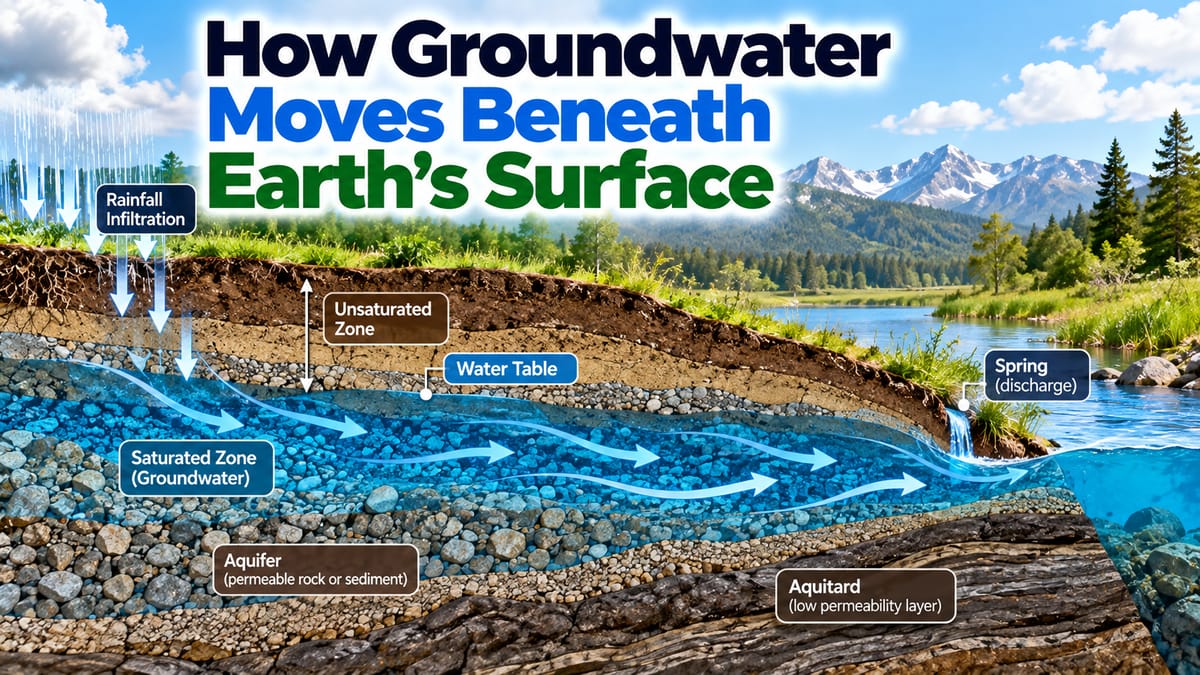
How Groundwater Moves Beneath Earth’s Surface
Water is constantly moving through Earth, even when there is no visible river, lake, or stream nearby. Beneath the ground, enormous quantities of water occupy tiny spaces and fractures within soil, sediment, and rock. This underground water is known as groundwater, and its movement is an essential part of the water cycle.
Groundwater supplies wells, supports rivers and wetlands, helps sustain ecosystems, and provides water for homes, agriculture, and industry in many parts of the world. Although it may appear to sit underground like water stored in a giant underground lake, groundwater usually moves slowly through pores and cracks in geological materials.
Understanding how groundwater moves requires looking at the relationship between rainfall, soil, rock, gravity, pressure, geology, and the underground structures that store and transmit water.
What Is Groundwater?
Groundwater is water found beneath Earth’s surface within spaces in soil, sediment, and rock.
It originates largely from precipitation that reaches the ground and infiltrates downward. Some of the water is absorbed by plants, some evaporates, and some flows across the land surface. Another portion moves downward through the ground and eventually reaches areas where the available spaces are completely filled with water.
Groundwater can occur at relatively shallow depths or much deeper underground.
It is not necessarily found in large open underground cavities. In many geological formations, water occupies:
- Tiny spaces between sediment grains
- Pores within porous rock
- Cracks and fractures
- Cavities within certain types of rock
- Channels created through dissolution
- Weathered zones near the surface
The geological environment largely determines how easily water can enter, move through, and leave an underground formation.
For a broader introduction to the physical processes shaping Earth’s solid surface, the Earth Science and Geology Complete Guide provides useful background on geology, rocks, minerals, and Earth’s changing systems.
How Water Gets Into the Ground
Groundwater movement often begins with precipitation.
When rain or melting snow reaches the land surface, several things can happen.
Some water runs downhill as surface runoff. Some is temporarily stored in vegetation or shallow soil. Some returns to the atmosphere through evaporation and plant transpiration.
Another portion infiltrates into the ground.
Infiltration
Infiltration is the process by which water enters the soil from the land surface.
The rate at which infiltration occurs depends on several factors, including:
- Soil type
- Vegetation
- Ground cover
- Rainfall intensity
- Soil moisture
- Slope
- Compaction
- Temperature
- Geological conditions
Sandy or highly permeable soils may allow water to infiltrate relatively quickly. Dense clay-rich soils can slow infiltration substantially.
Urban surfaces such as roads, sidewalks, and buildings can also reduce the amount of water that reaches the soil directly.
From Infiltration to Groundwater Recharge
Water that infiltrates the soil can move downward through the unsaturated zone, where soil and rock spaces contain both air and water.
Eventually, some water may reach the water table.
The water table is the boundary below which the ground is generally saturated with water.
Water entering the saturated zone contributes to groundwater recharge.
Recharge can occur naturally through:
- Rainfall
- Snowmelt
- Infiltration from rivers
- Infiltration from lakes
- Floodwater
- Irrigation
- Other sources of water reaching permeable ground
The amount of recharge varies significantly between locations and seasons.
A region with heavy rainfall and permeable ground may receive substantial recharge, while an arid region with little precipitation may receive relatively little.
What Is the Water Table?
The water table represents the upper surface of the saturated zone in an unconfined groundwater system.
It is not necessarily flat.
The water table can rise and fall depending on groundwater recharge, pumping, seasonal conditions, and interactions with surface water.
For example, heavy rainfall may increase groundwater levels after enough water infiltrates into the subsurface. During a prolonged dry period, groundwater levels may decline as recharge decreases while water continues to leave the system.
Wells provide one way to observe groundwater levels.
The depth to groundwater can range from only a few centimeters or meters below the surface in some locations to hundreds of meters in others.
Groundwater Does Not Usually Flow Like an Underground River
One of the most common misconceptions about groundwater is that it generally moves through large underground rivers.
While underground channels and caves can contain flowing water, particularly in limestone landscapes, most groundwater moves through pores, fractures, and other small pathways.
Imagine a sponge filled with water.
The water occupies interconnected spaces within the material. If pressure differences exist, water can move through those spaces.
Many aquifers work in a similar broad sense, although the geological structures involved can be considerably more complex.
What Is an Aquifer?
An aquifer is a geological formation or group of formations that can store and transmit enough groundwater to be useful.
Aquifers can consist of:
- Sand
- Gravel
- Sandstone
- Limestone
- Fractured volcanic rock
- Other permeable geological materials
An aquifer needs more than simply containing water. The water must be able to move through the material at a meaningful rate.
This is why geology plays such an important role in groundwater systems.
Porosity and Groundwater Storage
Porosity describes the amount of open space within a material.
A highly porous material can contain considerable water, but that does not automatically mean water can move easily through it.
For example, some materials may contain many small pores that hold water tightly.
Porosity therefore helps explain groundwater storage, but another property is needed to understand groundwater movement.
That property is permeability.
Permeability Controls How Easily Water Moves
Permeability describes how readily water can move through interconnected spaces in a material.
Sand and gravel can have relatively high permeability because their spaces may be interconnected.
Clay can contain significant pore space but often has very low permeability because its tiny pores restrict water movement.
Rock permeability can also depend heavily on fractures.
A solid-looking rock may allow substantial groundwater movement if it contains interconnected cracks, while a porous-looking material may transmit water slowly if its pores are poorly connected.
What Is an Aquitard?
Not every underground layer allows water to move easily.
An aquitard is a relatively low-permeability geological layer that restricts groundwater movement.
Clay-rich sediments are common examples.
Aquitards can separate groundwater systems and slow the vertical movement of water between them.
This geological layering can create complex groundwater systems in which water at different depths has different movement patterns, ages, chemical characteristics, and pressures.
Confined and Unconfined Aquifers
Groundwater systems are often described as either unconfined or confined.
Unconfined Aquifers
An unconfined aquifer has a water table that forms its upper boundary.
Water can generally recharge the aquifer from above as precipitation infiltrates through the ground.
Because the water table is exposed to changes in recharge and discharge, levels in an unconfined aquifer can fluctuate.
Confined Aquifers
A confined aquifer is bounded by relatively low-permeability layers that restrict water movement.
Water within a confined aquifer can exist under pressure.
If a well penetrates a confined aquifer, groundwater may rise inside the well to a level above the top of the aquifer. In some circumstances, water can reach the surface naturally, creating what is known as an artesian flow.
How Gravity Moves Groundwater
Gravity is one of the fundamental forces influencing groundwater movement.
Water generally moves from areas of higher hydraulic energy toward areas of lower hydraulic energy.
However, groundwater does not simply move vertically downward forever.
Once underground, it can move laterally as well as vertically.
The direction and speed of groundwater movement depend on the underground hydraulic gradient and the permeability of the materials through which the water travels.
Hydraulic Head and Groundwater Flow
Scientists use the concept of hydraulic head to understand groundwater movement.
Hydraulic head represents the amount of energy available to drive groundwater movement at a particular location.
Differences in hydraulic head create a hydraulic gradient.
Groundwater tends to move from areas of higher hydraulic head toward areas of lower hydraulic head.
This explains why groundwater can travel from elevated recharge areas toward valleys, rivers, springs, wetlands, or coastal environments.
Groundwater Can Feed Rivers
Groundwater and surface water are closely connected.
A river may receive water from groundwater flowing into its channel. This contribution is sometimes called baseflow.
During periods without rainfall, groundwater can help maintain flow in some streams and rivers.
The relationship can also work in the opposite direction.
A river can lose water to the surrounding groundwater system when the hydraulic conditions favor movement away from the river.
This means that groundwater and surface water should not always be treated as completely separate resources.
The How Earth’s Freshwater Systems Work guide provides broader context on the connections among freshwater stored in rivers, lakes, groundwater, glaciers, and other parts of Earth’s water system.
Springs Are Natural Groundwater Outlets
A spring occurs when groundwater reaches the land surface naturally.
This can happen when:
- The water table intersects the ground surface
- An impermeable layer redirects groundwater toward the surface
- A geological fracture creates a pathway
- A hillside intersects a groundwater flow system
- Underground pressure forces water upward
Springs can range from small seepage areas to substantial sources of flowing water.
They are visible evidence that groundwater is moving through the subsurface.
Groundwater Movement Through Fractured Rock
Groundwater behavior can be particularly complex in solid rock.
Water may move through fractures, faults, joints, and weathered zones.
In some rocks, these pathways dominate groundwater movement because the rock itself has relatively little primary pore space.
Fractured-rock aquifers can therefore behave very differently from porous sedimentary aquifers.
Two wells located relatively close together can sometimes produce very different amounts of water because they intersect different fractures.
Limestone Creates Unique Groundwater Systems
Limestone is particularly important in groundwater science because it can dissolve in slightly acidic water over long periods.
This process can create:
- Caves
- Sinkholes
- Underground channels
- Enlarged fractures
- Karst landscapes
In karst environments, groundwater can move relatively quickly through enlarged underground pathways.
This can make groundwater especially vulnerable to contamination because pollutants entering the system may travel rapidly with little natural filtration.
How Fast Does Groundwater Move?
Groundwater movement is generally much slower than the movement of water in rivers.
The exact rate can vary dramatically.
Factors affecting groundwater velocity include:
- Hydraulic gradient
- Permeability
- Porosity
- Fracturing
- Geological structure
- Water pressure
- Depth
- Aquifer characteristics
In some porous aquifers, groundwater may move only a few centimeters or meters per day. In other systems, particularly highly fractured or karst environments, water can travel much faster.
There is therefore no single speed that applies to all groundwater.
Why Groundwater Can Be Very Old
Some groundwater has been underground for days, months, or years.
Other groundwater may have been stored below Earth’s surface for decades, centuries, thousands of years, or longer.
The age of groundwater depends on the rate of recharge and movement, the depth of the aquifer, geological conditions, and whether the system is actively replenished.
Deep groundwater can sometimes be isolated from modern recharge for extremely long periods.
This is one reason groundwater should not automatically be treated as an unlimited resource.
Groundwater Discharge
Groundwater eventually leaves underground storage through discharge.
Discharge can occur through:
- Springs
- Rivers
- Lakes
- Wetlands
- Coastal areas
- Evaporation
- Plant uptake
- Wells
- Subsurface flow into other groundwater systems
The balance between recharge and discharge influences groundwater levels over time.
If withdrawals consistently exceed recharge, groundwater levels can decline.
How Wells Interact With Groundwater
A well provides an artificial pathway into an aquifer.
When water is pumped from a well, the groundwater level near the well can decline, producing a cone of depression around the pumping location.
The size and shape of this effect depend on factors such as:
- Pumping rate
- Aquifer properties
- Duration of pumping
- Nearby wells
- Recharge
- Boundaries of the groundwater system
If pumping is temporary or relatively small compared with recharge, groundwater levels may recover.
Persistent over-pumping can produce longer-term declines.
Groundwater and Human Water Supplies
Groundwater is an important source of water for households, farms, industries, and communities around the world.
People may access groundwater through:
- Household wells
- Community wells
- Municipal wells
- Agricultural wells
- Industrial wells
Groundwater can be particularly important in areas where surface water is limited or unreliable.
However, accessibility does not mean that groundwater is unlimited.
Aquifers can be depleted when water is withdrawn faster than the system can replenish it.
What Happens When Groundwater Is Overused?
Long-term groundwater depletion can cause several environmental and economic problems.
Potential consequences include:
- Falling water tables
- Wells becoming less productive
- Increased pumping costs
- Reduced spring flows
- Reduced streamflow
- Wetland changes
- Land subsidence
- Saltwater intrusion in coastal areas
The effects depend heavily on local geology, climate, pumping patterns, and groundwater management.
Groundwater and Land Subsidence
In some geological settings, excessive groundwater withdrawal can contribute to land subsidence.
When groundwater pressure declines, fine-grained sediments can compact.
If the resulting compaction is significant, the land surface can gradually sink.
Subsidence can damage:
- Roads
- Buildings
- Bridges
- Pipelines
- Drainage systems
- Other infrastructure
The process can be difficult to reverse, particularly when geological compaction becomes permanent.
Saltwater Intrusion in Coastal Aquifers
Coastal groundwater systems face another challenge.
Fresh groundwater can interact with salty ocean water beneath and near coastal areas.
Heavy groundwater pumping can alter the balance between freshwater and saltwater.
In some circumstances, seawater can move farther inland into freshwater portions of an aquifer.
This process is known as saltwater intrusion.
Once an aquifer becomes significantly contaminated with saltwater, restoring freshwater quality can be extremely difficult.
Groundwater Quality and Natural Filtration
As groundwater moves through soil and rock, some substances can be filtered, trapped, diluted, or chemically transformed.
This natural filtration can improve water quality.
However, it does not make groundwater automatically safe.
Contaminants can enter groundwater from sources such as:
- Agricultural chemicals
- Industrial activities
- Leaking fuel
- Poorly managed waste
- Septic systems
- Mining
- Contaminated surface water
Some pollutants can persist underground for long periods.
Groundwater Contamination Can Be Difficult to Detect
Surface pollution can sometimes be visible.
Groundwater contamination is often less obvious.
Water underground can look clear while containing dissolved contaminants.
Because groundwater may move slowly and remain underground for extended periods, contamination can also persist after the original pollution source has been removed.
This makes prevention, monitoring, and responsible land and water management particularly important.
How Geology Shapes Groundwater Movement
The movement of groundwater is fundamentally connected to Earth’s geological structure.
Rock type, sediment layers, fractures, faults, folds, and weathering all influence where water can travel.
A geological layer may store large amounts of water but transmit it slowly. Another layer may contain less water but allow rapid movement.
Understanding these relationships is a major part of hydrogeology, the study of groundwater.
For readers interested in the larger geological systems that shape Earth’s surface and interior, What Is the Geosphere and How Does It Work? provides additional context.
Groundwater and Natural Hazards
Groundwater can also interact with geological and environmental hazards.
Changes in groundwater pressure can influence slope stability in certain settings. Water movement can contribute to erosion, landslides, sinkhole development, and other geological processes.
Flooding can also alter groundwater levels and recharge patterns.
Understanding underground water movement can therefore contribute to the broader study of natural hazards. The article How Earth Science Helps Explain Natural Hazards explores how geological and Earth-system processes help explain hazards affecting communities.
How Scientists Study Groundwater
Because groundwater is hidden beneath the surface, scientists use multiple techniques to understand it.
These can include:
- Monitoring wells
- Water-level measurements
- Geological mapping
- Geophysical surveys
- Water-quality sampling
- Tracer studies
- Computer models
- Satellite observations
- Pumping tests
Monitoring wells can reveal changes in groundwater levels over time.
Water samples can provide information about chemical composition and potential contamination.
Geophysical techniques can help scientists investigate underground structures without directly drilling into every part of an aquifer.
Groundwater Models
Scientists and water managers can use mathematical models to simulate groundwater systems.
A groundwater model may incorporate information about:
- Aquifer geometry
- Recharge
- Pumping
- Hydraulic properties
- Groundwater levels
- Surface-water connections
- Geological boundaries
Models can help explore possible scenarios.
For example, researchers might estimate how groundwater levels could respond if pumping increases, rainfall patterns change, or a new well is installed.
Models are not perfect representations of reality. Their accuracy depends on the quality of the information used to construct them.
Climate and Groundwater
Changes in precipitation patterns can affect groundwater recharge.
A shift toward longer droughts may reduce recharge in some regions. More intense rainfall does not necessarily compensate for reduced recharge because intense storms can produce more surface runoff instead of allowing water to infiltrate deeply.
Higher temperatures can also increase evaporation and plant water use, influencing the amount of water available for groundwater recharge.
The effects vary considerably by climate, geology, vegetation, land use, and groundwater system.
Protecting Groundwater Resources
Protecting groundwater starts with understanding how water enters and moves through an aquifer.
Useful management practices can include:
- Monitoring groundwater levels
- Controlling excessive pumping
- Protecting recharge areas
- Preventing contamination
- Managing agricultural chemicals carefully
- Maintaining safe waste systems
- Protecting wetlands and surface-water connections
- Planning wells according to local geological conditions
- Using groundwater data in land-use decisions
Groundwater protection is often more effective when pollution prevention and sustainable withdrawal are addressed together.
Why Groundwater Movement Matters
Groundwater may be invisible, but it is an active part of Earth’s water system.
Water enters the ground through recharge, moves through pores and fractures under the influence of hydraulic gradients, interacts with rocks and sediments, and eventually emerges through springs, rivers, wetlands, wells, or other discharge points.
The process can happen slowly over years or rapidly through highly permeable underground pathways.
Understanding this hidden movement helps explain why wells produce water, why rivers can continue flowing during dry periods, why pollution can persist underground, and why excessive pumping can change entire landscapes.
Beneath Earth’s surface, groundwater is not simply stored water. It is part of a constantly interacting geological and hydrological system whose movement connects rainfall, rocks, rivers, ecosystems, and human communities.




2 Comments
Micle harison
June 7, 2019Lorem ipsum dolor sit amet, usu ut perfecto postulant deterruisset, libris causae volutpat at est, ius id modus laoreet urbanitas. Mel ei delenit dolores.
John Doe
June 7, 2019Some consultants are employed indirectly by the client via a consultancy staffing company.