
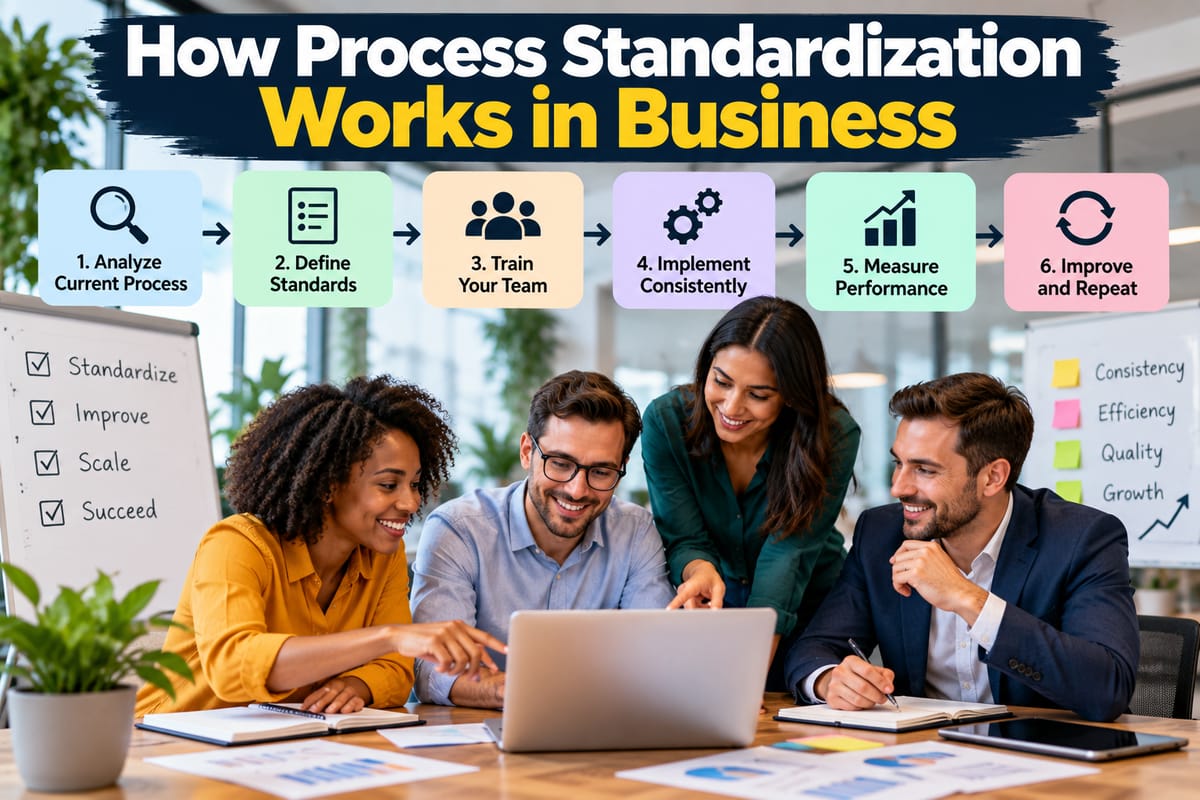
How Process Standardization Works in Business
Businesses rely on processes to turn ideas, resources, and employee effort into consistent results. Whether a company is processing customer orders, onboarding employees, manufacturing products, handling invoices, or responding to support requests, people usually follow a sequence of activities to get the work done.
As businesses grow, however, informal processes can become difficult to manage. Employees may complete the same task in different ways, important steps can be forgotten, and managers may struggle to determine why results vary from one department, location, or employee to another.
Process standardization addresses this problem by establishing a consistent way of performing recurring activities while still allowing appropriate flexibility when circumstances require it.
Standardization does not necessarily mean forcing every employee to work identically in every situation. Instead, it creates a reliable baseline for how important processes should operate, clarifies responsibilities, reduces unnecessary variation, and makes performance easier to measure.
For businesses seeking greater efficiency and consistency, understanding how process standardization works can be an important part of building scalable operations.
What Is Process Standardization?
Process standardization is the practice of defining and documenting a consistent method for completing a recurring business activity.
A standardized process typically establishes:
- What needs to be done
- Who is responsible for each step
- When each step should occur
- Which tools or systems should be used
- What information is required
- What standards the completed work must meet
- What happens when something goes wrong
- How performance will be monitored
For example, imagine a company receives customer orders through several sales channels.
Without a standardized process, one employee might check inventory before confirming an order, another might confirm it immediately, and another might manually enter information into multiple systems. These differences can create delays, errors, and inconsistent customer experiences.
A standardized order process could specify that employees must verify payment, confirm inventory, record the order in the company’s system, prepare fulfillment information, and send a customer confirmation.
The process provides a common operating framework while leaving room for employees to handle legitimate exceptions.
Why Businesses Standardize Processes
The main reason businesses standardize processes is to make recurring work more predictable.
When the same type of task is performed differently every time, it becomes difficult to determine whether differences in results come from employee decisions, customer circumstances, system problems, or weaknesses in the process itself.
Standardization can help businesses:
- Reduce unnecessary variation
- Improve efficiency
- Reduce avoidable errors
- Clarify employee responsibilities
- Improve training
- Maintain consistent quality
- Make performance easier to measure
- Identify operational problems
- Support business growth
- Make automation easier
- Improve accountability
The objective is not simply to create more rules. Effective standardization should make important work easier to understand and repeat.
Standardization Starts With Understanding the Existing Process
Businesses should generally understand how work is currently performed before attempting to standardize it.
A company may discover that its official procedure and actual employee behavior are very different.
For example, management might believe that customer complaints follow five documented steps. Employees may actually use several informal workarounds because the official process is slow or does not address common situations.
Mapping the existing process can reveal:
- Where the process begins
- What triggers it
- Which employees participate
- What information moves between people or systems
- Where approvals occur
- Where delays commonly happen
- Where errors occur
- Where decisions vary
- What the final output looks like
This creates a factual starting point for improvement.
Businesses should avoid standardizing a process simply because it is the way things have always been done. The goal is to create a better and more reliable way of working, not merely document inefficient habits.
Identify Which Processes Actually Need Standardization
Not every activity requires a detailed standardized procedure.
Some work is highly repetitive and predictable. Other work depends heavily on judgment, creativity, or changing circumstances.
Processes are particularly suitable for standardization when they:
- Occur frequently
- Have repeatable steps
- Produce measurable outputs
- Affect customers
- Carry compliance or safety requirements
- Generate significant costs
- Experience frequent errors
- Involve multiple employees or departments
- Need to be performed consistently across locations
For example, invoice processing may benefit greatly from standardization, while brainstorming a new advertising campaign may require considerably more flexibility.
Businesses need to distinguish between standardizing the process and eliminating professional judgment. The two are not the same.
Create a Clear Standard Operating Procedure
Once a process has been analyzed, the business can create a documented standard.
A standard operating procedure, often called an SOP, can describe the sequence employees should follow.
A useful SOP may include:
Purpose
Explain why the process exists and what outcome it is intended to produce.
Scope
Clarify when the procedure applies and which situations are outside its scope.
Responsibilities
Identify who performs each task and who approves important decisions.
Required Inputs
List the information, materials, documents, or systems needed to begin.
Process Steps
Describe the work in a logical sequence.
Quality Requirements
Explain what acceptable output looks like.
Exceptions
Describe what employees should do when normal conditions do not apply.
Escalation
Explain when an issue should be transferred to a manager or specialist.
Records
Identify what information needs to be documented.
Good documentation should be detailed enough to support consistency without becoming so complicated that employees stop using it.
Standardization and Business Operations
Process standardization is closely connected to the broader management of business operations.
Companies must coordinate people, resources, technology, suppliers, information, and workflows. When each component operates differently without clear coordination, inefficiencies can develop.
Businesses looking at this broader relationship can explore How Businesses Manage Operations, Processes, Resources and Efficiency.
Process standardization can support operational management by creating predictable connections between activities.
For example:
Customer order → Payment verification → Inventory confirmation → Fulfillment → Delivery → Customer notification
Each stage has a defined responsibility and expected output. This makes it easier to identify where a problem occurred when an order is delayed.
Standardization Can Improve Employee Training
New employees often struggle when important procedures exist only in the experience of long-serving workers.
If employees have to learn primarily through observation, training quality can vary depending on who teaches them.
Standardized processes create a common training foundation.
A new employee can learn:
- What the process is intended to accomplish
- Which steps must be followed
- Which systems to use
- Which mistakes to avoid
- When to ask for help
- How completed work is evaluated
This does not eliminate mentoring. Instead, it allows mentors to spend more time explaining judgment, context, and exceptions rather than repeatedly teaching basic procedural steps.
Process Standardization Can Improve Quality
Consistency is particularly important when customers expect the same level of quality every time they interact with a business.
Consider a company that manufactures a product or prepares food for customers. If employees follow dramatically different procedures, the final result can vary.
Standardization can establish:
- Required measurements
- Inspection points
- Approved materials
- Processing steps
- Packaging requirements
- Testing procedures
- Documentation requirements
Businesses interested in the quality dimension can explore How Businesses Maintain Consistent Product Quality.
The relationship between standardization and quality is straightforward: when the process is more consistent, it becomes easier to identify whether the process itself is producing the expected result.
Standardization Does Not Mean Zero Flexibility
One of the biggest misconceptions about process standardization is that employees must follow rigid instructions regardless of circumstances.
That can create new problems.
Real businesses encounter unusual customers, supply disruptions, equipment failures, urgent requests, unexpected technical issues, and other situations that do not fit neatly into a standard procedure.
A strong process therefore distinguishes between:
- Required steps
- Recommended practices
- Decision points
- Permitted variations
- Exceptions requiring approval
For example, a customer service representative might be required to verify a customer’s identity before changing account information. However, the representative may have several approved options for resolving the customer’s underlying problem.
This approach provides control without unnecessarily restricting judgment.
Define Process Ownership
Every important standardized process should have clear ownership.
A process owner is responsible for ensuring that the process remains useful and performs as intended.
The owner may be responsible for:
- Reviewing performance
- Updating documentation
- Coordinating improvements
- Gathering employee feedback
- Investigating recurring problems
- Ensuring training materials remain accurate
- Reviewing changes in technology or regulations
Without ownership, standardized processes can become outdated.
A document might continue to instruct employees to use a system that the business replaced months earlier. Once that happens, the process may become an obstacle rather than a useful management tool.
Connect Standardized Processes to Management Systems
Processes do not operate independently.
They form part of larger management systems involving planning, decision-making, accountability, measurement, and resource allocation.
A standardized purchasing process, for example, may connect procurement employees with finance, inventory management, department managers, and suppliers.
This is why process documentation works best when it fits into a broader management structure.
Businesses developing this broader structure can examine How to Build Effective Management Systems.
A management system provides the framework around individual processes, helping the organization determine who makes decisions, how information moves, and how performance is reviewed.
Measure Whether Standardization Is Actually Working
Creating a standardized process is not the same as proving that the process is effective.
Businesses need measurements that show whether the process is producing the intended results.
Depending on the activity, useful measurements may include:
- Processing time
- Error rate
- Customer complaints
- Rework
- Cost per transaction
- Employee productivity
- Completion rate
- On-time delivery
- Defect rate
- Customer satisfaction
For example, if a company standardizes an invoice approval process, it could compare average approval time before and after implementation.
If the process becomes more consistent but takes twice as long, management may need to investigate whether the new procedure introduced unnecessary steps.
For a broader look at this relationship, How Businesses Measure Operational Performance explores how organizations use performance measures to understand how operations are functioning.
Standardization Makes Problems Easier to Diagnose
One advantage of having a consistent process is that deviations become easier to identify.
Suppose ten employees perform the same task using the same documented procedure. Nine achieve the expected result while one repeatedly encounters problems.
Management can investigate whether:
- The employee needs additional training
- The process is unclear
- A tool is malfunctioning
- The employee is skipping a required step
- The employee faces an unusual type of case
Without a common process, comparison becomes much harder.
Standardization therefore creates a baseline against which variations can be investigated.
Use Technology Where It Adds Value
Technology can strengthen standardized processes, but software should not automatically be considered the solution.
Businesses can use technology to:
- Automate repetitive tasks
- Route approvals
- Validate information
- Generate notifications
- Track deadlines
- Store process documentation
- Record transactions
- Create performance reports
- Prevent incomplete submissions
For example, an expense management system can require employees to enter specific information before submitting a reimbursement request.
However, automating a poorly designed process can simply make an inefficient process operate faster.
Businesses should first understand and improve the workflow before deciding what should be automated.
Standardization Can Support Business Growth
Small businesses can often rely on informal knowledge because a few people handle most activities.
As the organization grows, this becomes increasingly difficult.
More employees, locations, customers, products, and transactions create more opportunities for inconsistency.
A standardized process can make it easier to replicate successful operations.
For example, a growing company may need to open several new locations. If every location develops its own approach to purchasing, customer service, inventory management, and reporting, management may struggle to maintain consistency.
A common operating framework allows each location to follow the same fundamental processes while still adapting to legitimate local differences.
Avoid Over-Standardization
Standardization has limits.
A business can create so many rules and procedures that employees spend excessive time following administrative requirements instead of serving customers or completing productive work.
Over-standardization can result in:
- Excessive paperwork
- Slow decision-making
- Reduced employee autonomy
- Unnecessary approvals
- Difficulty handling unusual situations
- Frustration among experienced employees
- Processes that become outdated quickly
The solution is not to abandon standardization but to standardize selectively.
Businesses should focus on the parts of a process where consistency actually creates value.
Let Employees Help Design the Process
Employees who perform a process every day often understand its practical problems better than managers who only review reports.
Their experience can reveal:
- Repetitive steps
- Confusing instructions
- Unnecessary approvals
- Software limitations
- Common customer questions
- Frequent exceptions
- Sources of delays
- Workarounds employees have created
Including employees in process design can therefore improve both the quality of the procedure and its adoption.
It can also make employees more likely to follow the final process because they understand why changes were made.
Train Employees on the Reason Behind the Process
Employees are more likely to use a standard effectively when they understand its purpose.
Instead of saying only:
“Follow these seven steps.”
A manager can explain:
“These steps ensure that every customer order is verified before fulfillment, which reduces incorrect shipments and delays.”
Understanding the reason behind a procedure helps employees recognize which steps are critical.
It also makes it easier for them to identify when an unusual situation requires escalation rather than blindly following an instruction that does not fit.
Review and Improve Standardized Processes
A standardized process should not be treated as permanent.
Businesses change. Customers change. Technology changes. Suppliers change. Regulations change. Products change.
A process that worked well two years ago may now contain unnecessary steps.
Regular reviews can ask:
- Is the process still achieving its objective?
- Are employees following it?
- Where are exceptions occurring?
- Which steps create delays?
- Are customers experiencing problems?
- Has technology changed?
- Can unnecessary steps be removed?
- Have quality requirements changed?
This creates a continuous improvement cycle:
Observe → Standardize → Measure → Review → Improve → Standardize Again
The purpose is to maintain consistency while allowing the organization to evolve.
A Simple Example of Process Standardization
Consider a growing online retailer that receives hundreds of customer orders each day.
Before standardization, employees handle orders differently. Some check inventory first, others process payments first, and some manually update customer records after fulfillment.
Management identifies recurring errors and maps the current process.
The company then establishes a standard workflow:
- Receive the order.
- Verify payment status.
- Confirm inventory.
- Record the order in the fulfillment system.
- Generate the picking information.
- Inspect the package.
- Confirm shipment.
- Send the customer notification.
- Record the completed transaction.
The company also creates procedures for exceptions, such as insufficient inventory or failed payments.
After implementation, management measures processing time, fulfillment errors, customer complaints, and delayed shipments.
The results show that some steps can be automated while others need clarification.
The process is then revised.
This illustrates an important point: process standardization is not a one-time documentation exercise. It is an ongoing management practice.
The Difference Between Standardization and Uniformity
Standardization does not mean every employee, department, or location must operate in exactly the same way.
The more useful objective is consistent outcomes supported by reliable core processes.
For example, a restaurant chain may standardize food safety procedures, ingredient measurements, and preparation requirements while allowing locations to adapt certain offerings to local customers.
A customer service organization may standardize identity verification and complaint documentation while allowing representatives some discretion when resolving legitimate customer problems.
The standard defines what must remain consistent. Flexibility defines where variation is acceptable.
Signs That a Process Needs Standardization
A business may benefit from reviewing a process when it notices:
- Employees repeatedly ask the same procedural questions.
- Different employees produce inconsistent results.
- Customers receive different experiences.
- Errors occur frequently.
- Tasks are regularly duplicated.
- New employees take too long to become productive.
- Managers cannot easily explain how work is performed.
- Employees rely heavily on informal knowledge.
- Processes vary significantly between locations.
- Important steps are frequently missed.
- Management cannot identify where delays originate.
These signals do not automatically mean that a rigid SOP is required. They indicate that the underlying workflow deserves closer examination.
Building a Practical Standardization Framework
A business can approach process standardization through a straightforward sequence:
1. Select the Process
Choose a recurring activity where inconsistency creates meaningful problems or costs.
2. Map the Current Workflow
Document how the process actually works rather than how management assumes it works.
3. Identify Problems
Look for delays, errors, unnecessary steps, duplication, unclear responsibilities, and inconsistent decisions.
4. Design the Desired Process
Create a simpler and more reliable workflow.
5. Define Responsibilities
Assign ownership for each major activity and decision.
6. Document the Standard
Create practical instructions that employees can actually use.
7. Train the Team
Explain both the procedure and the reason behind it.
8. Measure Performance
Track the indicators that demonstrate whether the process is working.
9. Gather Feedback
Ask employees and customers where problems remain.
10. Improve the Standard
Update the process when evidence shows that changes are needed.
Making Standardization Useful Instead of Bureaucratic
The best standardized processes are usually clear, practical, measurable, and adaptable.
They answer important questions without attempting to control every minor decision.
A strong standard should make good work easier to repeat. It should reduce uncertainty rather than create additional complexity.
For management, the value comes from having a reliable operating baseline. For employees, the value comes from knowing what is expected and where they have discretion. For customers, the benefit can appear as more consistent service and product quality.
When these elements work together, process standardization becomes more than documentation. It becomes a way for a business to turn successful ways of working into repeatable organizational capabilities.
That repeatability can become particularly valuable as a company adds employees, customers, products, locations, and technology. Instead of relying entirely on individual memory or informal habits, the organization develops processes that can be taught, measured, improved, and scaled.





2 Comments
Micle harison
June 7, 2019Lorem ipsum dolor sit amet, usu ut perfecto postulant deterruisset, libris causae volutpat at est, ius id modus laoreet urbanitas. Mel ei delenit dolores.
John Doe
June 7, 2019Some consultants are employed indirectly by the client via a consultancy staffing company.