
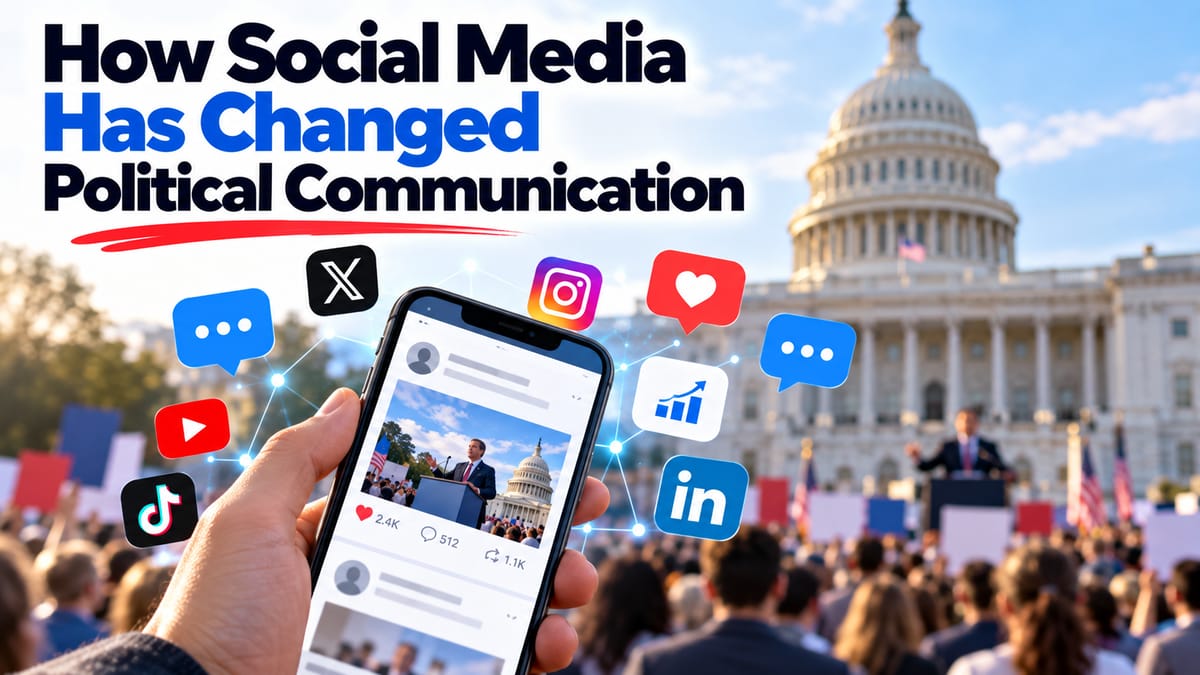
How Social Media Has Changed Political Communication
Political communication once depended heavily on newspapers, radio, television, public meetings, campaign events, and formal statements. Political candidates and public officials generally had to work through established media organizations to reach large audiences.
Social media changed that relationship.
Platforms now allow politicians, parties, governments, journalists, organizations, activists, and ordinary citizens to publish information directly to large audiences. A political statement can be posted in seconds, discussed publicly, reshared by thousands of people, and incorporated into news coverage without first passing through a traditional newsroom.
This has created new opportunities for political participation and public communication, but it has also introduced challenges involving misinformation, polarization, privacy, harassment, and the rapid spread of unverified claims.
In 2026, these effects are visible across many countries. A Pew Research Center survey of 37 countries found that a median of 77% of respondents said internet and social media access has made people more informed about current events, while 60% said it has increased people’s ability to have a meaningful voice in politics. At the same time, 79% said these technologies have made it easier to manipulate people with false information, and 68% said they have made people more politically divided.
Understanding these competing effects helps explain how political communication has evolved.
What Is Political Communication?
Political communication is the exchange of information, ideas, arguments, and messages about politics and government.
It can involve:
- Political candidates
- Elected officials
- Political parties
- Governments
- Journalists
- Advocacy organizations
- Interest groups
- Researchers
- Activists
- Citizens
- Online communities
Political communication can take many forms, including speeches, debates, advertisements, interviews, press releases, campaign materials, social media posts, videos, podcasts, and public discussions.
The purpose can also vary.
A politician may communicate to explain a policy, respond to criticism, announce a decision, mobilize supporters, address constituents, or shape public discussion. Citizens may communicate to express opinions, organize around issues, challenge officials, share information, or participate in political debate.
Social media has expanded the number of people who can perform these roles publicly.
Political Communication Before Social Media
Before social media became widespread, political communication was largely controlled by a relatively small number of communication channels.
Candidates could speak directly at rallies, distribute campaign literature, purchase advertising, or communicate through their own websites. But reaching a mass audience often depended on newspapers, radio stations, television networks, and other established media organizations.
This created an important filtering process.
Editors and journalists decided which statements became news stories and which political events received coverage.
Social media did not eliminate traditional media, but it created another path.
Political actors can now publish directly to followers without waiting for journalists to decide whether a statement deserves coverage.
Politicians Can Communicate Directly With the Public
One of the most significant changes is the move from indirect to direct communication.
A political figure can post a statement, photograph, video, policy announcement, or response to an event and reach followers immediately.
This can make political communication faster.
It also gives politicians greater control over the wording and presentation of their messages.
Research by Pew Research Center found that social media had become central to U.S. presidential campaigns by 2016, with campaign websites increasingly serving as information hubs while campaigns used social platforms to reach the public directly.
The result is a communication environment in which politicians can sometimes bypass traditional media organizations altogether.
The Relationship Between Politicians and Journalists Has Changed
Social media has also changed how journalists receive political information.
A politician’s post can become the starting point for a news story. Journalists may monitor accounts belonging to candidates, government officials, political parties, and other public figures for announcements and reactions.
At the same time, politicians can respond directly to news coverage.
This creates a much faster communication cycle:
Political statement → Social media post → Public reaction → News coverage → Political response → Further online discussion
The boundaries between political communication, journalism, and public reaction can therefore become less distinct.
Social Media Has Made Political Messages More Immediate
Traditional political communication often involved delays.
A politician might issue a statement, hold a press conference, or give an interview, after which journalists would report the information.
Social media can compress that process into minutes.
A politician can respond to a developing event while it is still unfolding.
This speed can be useful during emergencies, breaking political developments, or rapidly changing public debates.
It can also create pressure to respond immediately, sometimes before all relevant information is available.
The result is a political environment where speed has become an important part of communication.
Political Campaigns Can Build Their Own Audiences
Campaigns no longer have to rely exclusively on purchased advertising or news coverage to build an audience.
They can maintain accounts across multiple platforms and develop direct relationships with followers.
Campaign communication can include:
- Candidate videos
- Policy explanations
- Event announcements
- Fundraising appeals
- Volunteer requests
- Endorsements
- Responses to opponents
- Behind-the-scenes material
- Live broadcasts
- Short-form videos
- Graphics and infographics
This makes social media an important component of modern campaign operations.
For a broader explanation of campaign strategy and voter communication, How Political Campaigns Work and Persuade Voters provides additional context.
Political Messages Can Be Tailored to Different Audiences
Social platforms allow political campaigns and organizations to communicate differently with different groups.
A campaign may publish a detailed policy explanation for one audience and a short video addressing the same issue for another.
Different platforms can also encourage different communication styles.
For example, a platform emphasizing short posts may reward concise statements, while a video-oriented platform allows politicians to communicate through speeches, interviews, demonstrations, or short-form videos.
This can make political communication more segmented.
Instead of one message being designed for an entire population, organizations can produce multiple versions of a message for different audiences.
Political Rhetoric Has Become More Visual
Political communication is no longer dominated by written speeches and traditional broadcast appearances.
Images, videos, graphics, memes, short clips, livestreams, and other visual formats have become important ways to communicate political ideas.
This changes how messages are constructed.
A politician may have only a few seconds to capture attention in a scrolling feed.
That can encourage:
- Shorter statements
- Strong visual imagery
- Memorable phrases
- Emotional storytelling
- Simple explanations
- Highly shareable content
The underlying principles of persuasion have not disappeared. They have adapted to new communication formats.
The How Political Rhetoric Persuades Audiences article explores how political language and persuasive techniques influence the way audiences interpret political messages.
Citizens Can Respond Immediately
Traditional political communication often moved primarily in one direction.
Politicians spoke, journalists reported, and audiences listened or read.
Social media creates more opportunities for immediate responses.
Users can:
- Comment
- Share
- Repost
- Create response videos
- Ask questions
- Criticize statements
- Correct information
- Organize discussions
- Contact political representatives
This creates a more interactive communication environment.
However, interaction does not necessarily mean that politicians respond to every individual or that online discussion represents the views of the broader population.
People who post frequently online are not necessarily representative of everyone who follows politics.
Social Media Has Expanded Political Participation
Political participation includes more than voting.
People can participate by attending meetings, contacting representatives, joining organizations, volunteering, donating, discussing issues, protesting, campaigning, and engaging in community activities.
Social media has added new forms of participation.
People can now organize events, circulate petitions, share political information, recruit volunteers, promote causes, and communicate with political organizations without relying entirely on traditional institutions.
The Political Participation Explained: How Citizens Engage guide examines the broader ways citizens can participate in political life.
Political Organizing Can Happen More Quickly
Social platforms can reduce some of the logistical barriers involved in organizing.
A group can create an event, share information, coordinate participants, and communicate updates through digital channels.
This can be especially useful when organizations need to respond quickly to an emerging issue.
However, online coordination does not automatically translate into long-term political organization.
Sustained political activity may still require leadership, resources, institutions, volunteers, and offline relationships.
Hashtags Can Turn Issues Into Public Conversations
Hashtags can connect posts around a common topic.
When many people use the same hashtag, individual posts can become part of a larger public conversation.
This can help bring attention to issues that might otherwise receive limited coverage.
Hashtags can also be used by campaigns, advocacy groups, journalists, and ordinary users to organize discussions.
Their influence varies by platform and context, and high online visibility does not necessarily indicate broad public agreement.
Social Media Can Give Less-Established Voices More Visibility
Traditional media organizations have limited space and airtime.
Social platforms can create opportunities for people and organizations that might not otherwise receive extensive media coverage.
Community groups, local activists, independent commentators, and smaller political organizations can publish directly to audiences.
This can broaden the range of voices participating in political discussions.
At the same time, visibility on a platform depends on many factors, including audience size, user behavior, platform design, and how content is distributed.
Algorithms Influence What People See
Social media platforms generally do not present every available post to every user in chronological order.
Recommendation and ranking systems can determine which content appears more prominently.
These systems can use signals related to engagement, interests, relationships, viewing behavior, and other factors.
This means political communication is influenced not only by what politicians and citizens publish but also by how platforms distribute that material.
A political message can reach a much larger audience if it is widely shared or recommended.
Another message may receive little visibility even if it is accurate or important.
Engagement Can Shape Political Communication
Likes, shares, comments, views, and other forms of engagement provide immediate feedback.
Political organizations can see which messages receive attention and which generate limited responses.
This creates a feedback loop.
A campaign may publish content, observe the response, and adjust subsequent communication accordingly.
Academic research has examined social media as a source of information about public opinion because online activity can provide additional signals beyond traditional polling, although social media activity should not automatically be treated as a representative measure of public opinion.
Political Communication Has Become More Personalized
Social media often combines political content with personal communication.
Users may encounter a political statement while scrolling through photographs from friends, entertainment content, advertisements, and other everyday material.
This can make politics feel more personal and integrated into ordinary social life.
Pew Research found that political content on social platforms can create tension because users may encounter strong disagreements from friends, family members, and acquaintances within the same networks.
The result is that political communication increasingly occurs in spaces that were not originally designed exclusively for politics.
Political Messages Can Spread Without Traditional Gatekeepers
A political claim does not necessarily need to appear in a newspaper or television broadcast before it can reach a large audience.
A single post can be shared repeatedly and become widely known.
This can help legitimate information spread quickly.
It can also allow inaccurate or misleading claims to circulate before they have been independently checked.
That distinction is important because social media distribution is not the same thing as verification.
Misinformation Creates New Communication Challenges
The speed and scale of social media can make misinformation particularly difficult to manage.
A misleading claim may be copied, edited, translated, reposted, or transformed into a video or graphic.
By the time a correction is published, the original claim may already have reached a large audience.
Recent international survey data illustrates the concern. In Pew Research Center’s 2026 survey across 37 countries, a median of 79% of respondents said internet and social media access had made it easier to manipulate people with false information.
This does not mean that every political claim on social media is unreliable. It means that users have to distinguish between communication and verification.
Political Polarization Can Be Amplified Online
Social media can expose people to a wide range of political perspectives, but users do not necessarily encounter a balanced mixture of views.
People may follow politicians, commentators, organizations, and friends who share similar positions.
Research has examined the relationship between social media and polarization, with systematic reviews finding evidence that exposure to ideologically aligned media can contribute to polarization, while also noting important limitations and variation across studies and contexts.
The issue is therefore more complicated than simply saying that social media causes political polarization.
Platform design, user choices, political environments, media systems, and existing social divisions can all influence what people encounter online.
Political Discussions Can Become More Emotional
Political communication has always involved emotion, but social media can give emotionally charged messages a particularly visible role.
Anger, fear, enthusiasm, humor, outrage, and hope can all be communicated through short messages and visual content.
Emotion can make a political message memorable and encourage people to share it.
However, highly emotional communication can also make constructive discussion more difficult when disagreement becomes personal.
Pew’s research has found that many social media users have experienced political discussion as frustrating or disrespectful, while others view these platforms as useful spaces for political engagement.
Political Figures Can Respond to Critics Directly
Social media allows politicians to address criticism without waiting for a press conference or interview.
A public official can respond to a journalist, opponent, constituent, or organization directly.
This can make political communication more transparent in some circumstances because audiences can observe exchanges that might previously have happened privately.
It can also make political disputes more public and immediate.
A disagreement that once might have resulted in a private letter or statement can now become a widely shared online exchange.
Social Media Has Changed Political Accountability
Direct communication can create additional opportunities for citizens to scrutinize politicians.
Posts can be archived, quoted, shared, and compared with previous statements.
Politicians can therefore face questions about changes in their positions or inconsistencies between statements.
At the same time, the sheer volume of online content can make it difficult for citizens to distinguish important policy information from short-lived political disputes.
Accountability therefore depends not simply on having more information, but on having reliable ways to evaluate it.
Governments Also Use Social Media
Social media is not limited to election campaigns.
Government agencies and public officials can use digital platforms to communicate:
- Public announcements
- Emergency information
- Policy explanations
- Service updates
- Public consultations
- Health information
- Transportation updates
- Community notices
This can make government communication faster and more accessible.
However, governments still need to consider accessibility, accuracy, recordkeeping, privacy, and the needs of citizens who do not use social media.
Political Representation Has a Digital Dimension
Social media has also affected the relationship between elected representatives and constituents.
A representative can publish updates about legislative activity and receive comments from people in their district or constituency.
Citizens can use social platforms to ask questions, raise concerns, and draw attention to local issues.
This does not replace formal institutions such as legislatures, elections, committees, or constituency offices.
Instead, it adds another communication channel around those institutions.
The How Political Representation Works in Legislatures and Governments guide provides broader context on how elected representatives connect citizens with government institutions.
Social Media Has Changed Political News Distribution
Political news increasingly moves through a mixture of traditional journalism and social platforms.
A news organization may publish an article on its website, distribute it through social media, receive comments from readers, and then update its coverage as political figures respond.
Political figures may also distribute links to news stories directly to their followers.
This creates a more interconnected information environment.
The public may encounter the same political development through a newspaper website, a politician’s account, a friend’s post, a video platform, or an online discussion.
Short-Form Content Has Changed the Pace of Political Messaging
Short-form video and concise posts encourage political communicators to make complex ideas understandable within limited attention spans.
A long policy proposal may be summarized in a short video.
A legislative development may be represented through a graphic.
A political speech may be reduced to a short clip.
This can make political information more accessible.
It can also remove context.
A short excerpt from a longer speech may not communicate the full argument. A simplified graphic may leave out important qualifications.
Short-form communication therefore creates a trade-off between accessibility and completeness.
Political Communication Is Increasingly Multimedia
Modern political communication can combine:
- Text
- Video
- Audio
- Photography
- Infographics
- Livestreams
- Podcasts
- Memes
- Interactive content
This gives political communicators more ways to present ideas.
It also means citizens need to evaluate different forms of evidence.
A polished video can be persuasive without proving the claims it contains. A viral graphic can communicate a statistic without explaining its source or context.
The format of a message and the reliability of its content are separate questions.
Social Media Has Not Replaced Traditional Media
Despite the growth of social platforms, traditional journalism remains important.
News organizations continue to investigate stories, interview sources, analyze documents, attend government meetings, and provide context.
Social media often works alongside traditional media rather than replacing it.
Political figures may publish statements directly while journalists independently report on those statements.
Citizens may encounter a political claim on social media and then seek additional information from news organizations or other sources.
The relationship between the two forms of communication continues to evolve.
The Political Communication Cycle Is Faster
Perhaps the clearest overall change is speed.
A political development can move through several stages within a short period:
Announcement → Social media reaction → Public discussion → News coverage → Response → Further discussion
This creates opportunities for rapid engagement.
It also increases the possibility of errors, misunderstandings, and premature reactions.
Political communicators therefore operate in an environment where messages can become public before there has been much time for reflection.
Social Media Has Created Both Opportunities and Challenges
The effects of social media on political communication are not uniformly positive or negative.
Its benefits can include:
- Faster access to political information
- Direct communication between officials and citizens
- New opportunities for political participation
- Greater visibility for less-established voices
- Faster organization
- More opportunities for public feedback
- New formats for explaining political issues
Its challenges can include:
- Misinformation
- Harassment
- Political polarization
- Manipulative content
- Reduced context
- Information overload
- Privacy concerns
- Unequal access to digital platforms
- Rapid spread of unverified claims
Recent global survey findings illustrate this tension: people across 37 countries simultaneously report that social media can inform citizens and give them a stronger political voice while also making manipulation and political division easier.
What Social Media Means for Political Communication Today
Social media has changed political communication from a system dominated by relatively few broadcasters and publishers into a much more distributed environment.
Politicians can speak directly to citizens. Citizens can respond publicly. Campaigns can build their own audiences. Journalists can monitor political accounts in real time. Organizations can mobilize supporters quickly. And information can travel across borders within minutes.
But greater communication does not automatically produce greater understanding.
Political information still requires context, verification, comparison, and careful interpretation. A message being popular does not establish that it is accurate, and a message receiving little attention does not necessarily mean it is unimportant.
The central change brought by social media is therefore not simply that politics has moved online. It is that political communication has become faster, more interactive, more visual, more personalized, and more decentralized—creating new ways for citizens and political actors to participate while also making the information environment more complicated to navigate.


2 Comments
Micle harison
June 7, 2019Lorem ipsum dolor sit amet, usu ut perfecto postulant deterruisset, libris causae volutpat at est, ius id modus laoreet urbanitas. Mel ei delenit dolores.
John Doe
June 7, 2019Some consultants are employed indirectly by the client via a consultancy staffing company.