
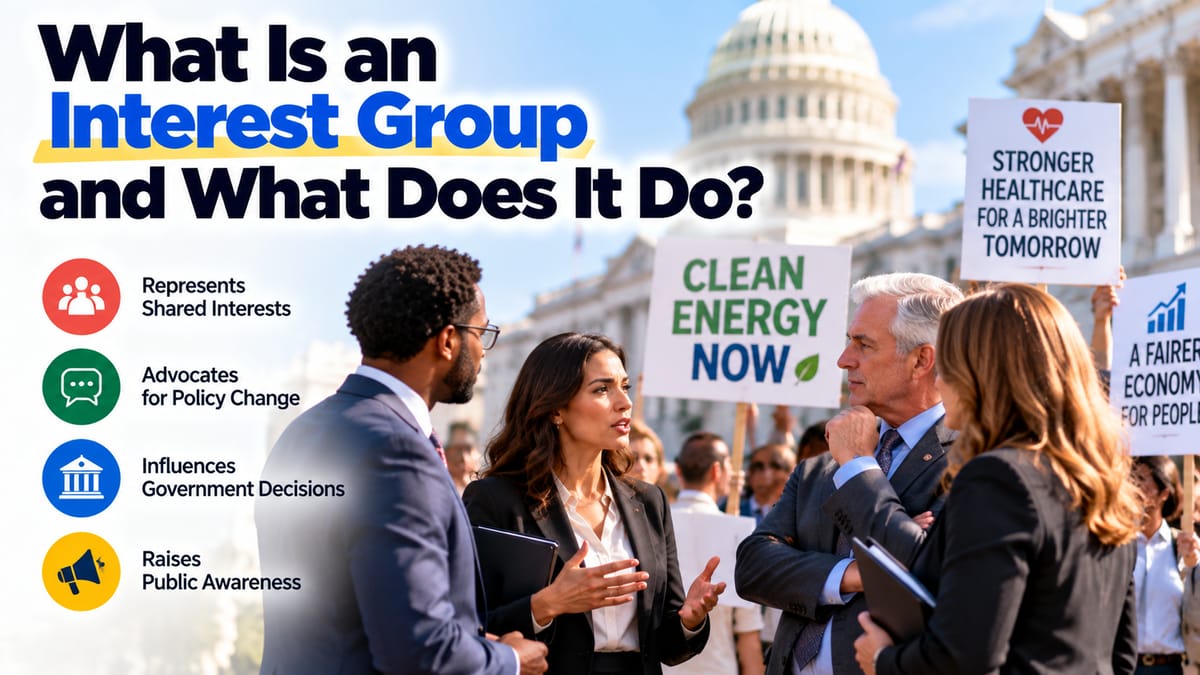
What Is an Interest Group and What Does It Do?
Interest groups are an important part of political life. They represent people, businesses, professions, causes, industries, and other shared interests and attempt to influence government decisions without necessarily seeking to take control of government themselves.
They can participate in politics by lobbying officials, providing research, organizing members, communicating with the public, participating in policy debates, and encouraging citizens to contact their representatives.
Interest groups are different from political parties, although the two can interact. Political parties generally seek to win elections and gain control of government, while interest groups typically concentrate on influencing particular policies, issues, or government decisions.
What Is an Interest Group?
An interest group is an organized association of people or organizations that shares a common interest and seeks to influence political outcomes or public policy.
The interest may involve almost any area of public life, including:
- Business and taxation
- Labor and employment
- Agriculture
- Healthcare
- Education
- Environmental protection
- Civil rights
- Consumer protection
- Professional regulation
- Foreign policy
- Transportation
- Housing
- Technology
- Religious or ideological concerns
Some groups focus on a single issue, while others represent broad sets of related interests.
The central characteristic is not simply that members share an opinion. An interest group organizes around that shared concern and takes action to influence government or the policy process.
How Interest Groups Differ From Political Parties
Interest groups and political parties can both attempt to influence government, but their primary objectives are different.
Political parties generally seek political power by participating in elections and supporting candidates who run under their party label. Interest groups usually do not seek to control government directly. Instead, they attempt to influence decisions made by people who hold public office.
For example, a political party may develop a broad platform covering taxation, healthcare, education, national security, and economic policy. An interest group might concentrate primarily on one of those subjects.
This distinction is important when examining the broader political system. The Complete Guide to Political Parties and Party Systems explains how political parties organize, compete in elections, and operate within different party systems.
Interest groups can nevertheless support political candidates, communicate with voters, or work alongside political parties when their objectives overlap.
What Do Interest Groups Want?
Interest groups generally seek changes in government policy or decisions that advance the interests they represent.
Their objectives can include:
- Supporting a proposed law
- Opposing legislation
- Changing existing regulations
- Increasing government funding for a particular area
- Reducing regulatory requirements
- Protecting existing benefits or programs
- Changing tax policies
- Promoting environmental standards
- Influencing government spending
- Raising public awareness of an issue
- Encouraging officials to investigate a problem
The specific objective depends on the group.
A professional association may seek changes to licensing rules. A business association may advocate for changes affecting an industry. A public-interest organization may campaign for environmental or consumer protections.
This means there is no single policy position shared by all interest groups.
Major Types of Interest Groups
Political scientists commonly classify interest groups according to the interests they represent.
Business and Corporate Groups
Businesses and corporations can organize to advocate for policies affecting their operations.
Their concerns may include taxation, trade, labor regulations, environmental rules, competition policy, government procurement, and industry-specific regulation.
Individual companies can engage directly in advocacy, while companies in the same industry may participate through trade associations.
Labor Groups
Labor organizations represent workers and employment-related interests.
Their activities can involve issues such as wages, workplace safety, employment protections, collective bargaining, pensions, and labor legislation.
Labor groups may communicate with policymakers, mobilize members, participate in public campaigns, and advocate for particular legislation.
Professional Associations
Doctors, lawyers, teachers, engineers, accountants, and other professionals may belong to organizations that advocate on issues affecting their professions.
These groups can provide policymakers with technical information about proposed regulations and legislation.
Their activities may involve professional standards, licensing requirements, education, working conditions, and regulations governing specific occupations.
Agricultural Groups
Farmers and agricultural businesses may organize around policies involving land use, food production, trade, subsidies, environmental regulations, water, transportation, and rural development.
Because agricultural policy can involve multiple government departments and levels of government, agricultural associations may engage with policymakers on a wide range of issues.
Public-Interest Groups
Public-interest groups generally frame their objectives around benefits they believe should apply broadly across society.
Examples can include organizations focused on environmental protection, consumer rights, civil liberties, public health, or government transparency.
Their campaigns may combine direct engagement with officials and efforts to mobilize members or the broader public.
Single-Issue Groups
Some organizations concentrate heavily on one particular issue.
Their members may have different political views on unrelated subjects but share a strong position on the specific issue around which the organization is organized.
Single-issue groups can devote substantial resources to legislation, regulation, elections, public education, and grassroots campaigns involving that issue.
Ideological Groups
Ideological groups promote broader sets of political or social principles.
Their advocacy can cover multiple policy areas connected to a particular worldview or philosophy.
Because their interests extend across several subjects, they may participate in debates over taxation, government spending, civil rights, social policy, economic regulation, or other areas simultaneously.
OpenStax identifies economic groups such as business, labor, agricultural, and professional organizations alongside noneconomic groups such as public-interest, civil-rights, ideological, and single-issue organizations.
How Do Interest Groups Influence Government?
Interest groups use many different methods to pursue their objectives.
The most recognizable is lobbying, but lobbying is only one part of a much broader set of political activities.
Groups may:
- Meet with legislators
- Provide information to government officials
- Submit comments on proposed regulations
- Give testimony at hearings
- Conduct research
- Publish policy reports
- Organize public campaigns
- Encourage members to contact officials
- Run educational campaigns
- Build coalitions
- Use traditional media
- Use social media
- Participate in public consultations
- Communicate with regulatory agencies
The exact methods available to an organization depend on the country’s political system and applicable laws.
What Is Lobbying?
Lobbying is an attempt to influence political decisions or public policy.
It can involve direct communication with policymakers, government officials, legislators, regulators, or their staff.
An interest group may present arguments supporting a particular bill, provide technical information, explain how a proposed regulation could affect an industry, or recommend changes to policy.
Lobbying does not necessarily mean that a government official agrees with the group. Officials can receive information and arguments from multiple organizations with competing interests before making a decision.
The How Lobbying and Advocacy Influence Government Decisions explores these activities in greater detail.
Inside Lobbying and Outside Lobbying
Interest groups can use both direct and indirect forms of lobbying.
Inside Lobbying
Inside lobbying involves direct engagement with government officials and institutions.
Examples include:
- Meetings with legislators
- Policy briefings
- Testimony at hearings
- Written submissions
- Meetings with government agencies
- Providing technical research
- Suggesting legislative language
This approach allows organizations to communicate directly with people involved in policymaking.
Outside or Grassroots Lobbying
Outside lobbying seeks to influence policymakers by mobilizing people outside government.
An organization may encourage supporters to:
- Contact elected representatives
- Sign petitions
- Attend public meetings
- Participate in demonstrations
- Share information
- Contact journalists
- Participate in public campaigns
OpenStax describes grassroots or outside lobbying as using public pressure to encourage government action.
Digital platforms have expanded the potential reach of these campaigns, allowing organizations to communicate with large audiences quickly.
Interest Groups and Public Policy
Interest groups can become involved at multiple stages of policymaking.
They may become active before a proposal is formally introduced, while legislation is being debated, during regulatory development, or after a policy has been adopted.
For example, an organization might identify a policy problem, publish research describing the issue, propose possible solutions, and then communicate with policymakers about the proposed approach.
After a law is passed, the same organization might focus on how government agencies implement it.
This means interest-group activity can extend well beyond legislative voting.
The Complete Guide to Public Policy and Policymaking provides a broader explanation of how governments identify problems, develop policy options, make decisions, and implement policies.
Why Do Policymakers Listen to Interest Groups?
Interest groups can provide information that policymakers may not have themselves.
A professional organization may understand technical aspects of an industry. A labor organization may have information about workplace conditions. An environmental organization may provide research concerning ecosystems. A business association may have data about how proposed regulations could affect companies.
The OECD notes that lobbying and influence can provide governments with expertise, evidence, and information about policy problems and possible solutions. It also emphasizes that lobbying can create risks of undue influence when transparency and integrity safeguards are inadequate.
Policymakers can therefore receive information from interest groups while still having to weigh competing evidence, public concerns, political priorities, legal requirements, and other considerations.
Interest Groups and Political Participation
Interest groups also provide a way for people to participate in politics between elections.
A person does not have to run for office or belong to a political party to become involved with an organization advocating for an issue they care about.
Participation can include:
- Joining an organization
- Paying membership dues
- Volunteering
- Attending meetings
- Contacting representatives
- Signing petitions
- Participating in public campaigns
- Donating to an organization
- Sharing information
- Attending demonstrations
This connects interest groups with the broader concept of political participation.
The Political Participation Explained — How Citizens Engage examines the different ways citizens can participate in political life beyond simply voting.
Why Interest Groups Can Be Important in a Democracy
One argument in favor of interest groups is that they allow different sections of society to organize and communicate their concerns to government.
A policymaker dealing with a complicated issue may hear from businesses, workers, professional organizations, nonprofit groups, researchers, and members of the public.
This can introduce competing perspectives into the policy process.
Interest groups can also help individuals coordinate their political activity. Instead of every person independently researching legislation and contacting government officials, an organization can gather information, develop policy proposals, and organize collective action.
Political science literature often associates this idea with pluralism: the notion that different organized interests compete to influence government decisions.
Concerns About Interest-Group Influence
Interest groups can also raise questions about political equality and representation.
Not every organization has the same financial resources, membership base, access to policymakers, research capacity, or ability to maintain sustained advocacy campaigns.
OpenStax notes that business and professional interests can sometimes be better resourced than groups representing less affluent populations, creating concerns about unequal participation and influence.
The existence of unequal resources does not automatically mean that a particular policy outcome was improperly influenced. It does, however, help explain why transparency and accountability are recurring issues in discussions about lobbying.
The OECD similarly identifies risks including undue influence, covert or deceptive evidence, manipulation of public opinion, and situations where particular interests can gain disproportionate influence over policymaking.
Interest Groups and Transparency
Many political systems have rules governing lobbying, campaign activity, political donations, conflicts of interest, or disclosure requirements.
The details vary considerably between countries.
Some jurisdictions maintain lobbying registers that provide information about organizations or individuals attempting to influence government. Other systems require disclosures concerning meetings, political contributions, or lobbying activities.
Transparency allows citizens and public officials to better understand who is attempting to influence decisions and what interests they represent.
The OECD reported in its 2026 Anti-Corruption and Integrity Outlook that lobbying registers and other transparency measures still provide only limited effective transparency in many countries, reflecting continuing implementation challenges.
This is particularly relevant as advocacy increasingly occurs through digital platforms and public communication campaigns rather than only through traditional meetings with officials.
How Social Media Has Changed Interest-Group Advocacy
The internet has changed how interest groups organize and communicate.
An organization can now publish research, explain a policy proposal, mobilize supporters, and communicate with policymakers through digital channels.
Social media can make grassroots campaigns easier to organize because supporters can receive information and coordinate activities quickly.
At the same time, digital advocacy creates challenges. Information can spread rapidly without clear identification of its source, and campaigns can use emotionally powerful messages or targeted communications to shape public perceptions.
The OECD has highlighted the growing role of social media and digital communication in lobbying and influence activities, while also identifying the risks of deceptive information and manipulation.
Do Interest Groups Only Influence Legislatures?
No.
Interest groups can interact with different parts of government.
Depending on the political system, they may communicate with:
- Legislatures
- Government ministries
- Regulatory agencies
- Executive officials
- Local governments
- Administrative bodies
- Advisory committees
This matters because many government decisions are made through regulations and administrative processes rather than through legislation alone.
An organization interested in environmental policy, for example, may engage with lawmakers when legislation is being considered and later communicate with a regulatory agency when the law is being implemented.
Interest Groups Can Represent Competing Positions
Interest-group politics rarely involves only one organization.
A proposed policy may affect several groups differently, creating competing advocacy campaigns.
For example, a change to an environmental regulation might lead environmental organizations to argue for stronger protections while some businesses or industry associations argue that the proposed requirements could increase costs.
Workers, consumers, local communities, researchers, and government agencies could have additional perspectives.
Policymakers therefore often face a political environment in which multiple organized interests are presenting different evidence, priorities, and policy proposals.
The presence of competing groups does not guarantee that every interest receives equal attention, but it is an important feature of pluralist political systems.
Interest Groups Are Not the Same as Public Opinion
An interest group should also be distinguished from public opinion.
Millions of people may hold similar views about an issue without belonging to an organization advocating for those views.
An interest group represents an organized effort to influence political outcomes.
This distinction matters because an organization may have a relatively small membership while dedicating substantial resources to advocacy. Conversely, an issue may have broad public support without being represented by a single organized group.
Interest groups are therefore one part of a larger political environment that also includes voters, political parties, media organizations, governments, businesses, civil society organizations, and other institutions.
How Interest Groups Shape the Policy Debate
Interest groups can influence policymaking without directly determining the final decision.
Their influence may occur by:
- Bringing an issue to policymakers’ attention.
- Providing research or technical information.
- Proposing specific policy changes.
- Mobilizing members and supporters.
- Responding to proposed legislation.
- Participating in public consultations.
- Communicating with journalists and the public.
- Building coalitions with other organizations.
- Monitoring implementation of existing policies.
- Advocating for future changes.
The ultimate policy decision remains with the relevant public institutions and officials under the applicable political and legal system.
Interest Groups Are a Permanent Feature of Political Life
Interest groups exist because people and organizations have different interests, priorities, experiences, and policy preferences.
Some represent industries. Others represent workers, professionals, consumers, communities, environmental causes, civil rights, or particular policy concerns.
Their methods also continue to evolve. Traditional lobbying remains important, but digital communication, grassroots organizing, research, public campaigns, and coalition-building have expanded the ways organizations can participate in policymaking.
Understanding interest groups therefore requires looking beyond the image of a lobbyist meeting a politician. They are part of a much larger system through which organized interests communicate with government, mobilize citizens, provide information, compete over policy priorities, and attempt to shape public decisions. Their role can create opportunities for representation and expertise while also raising questions about unequal resources, transparency, accountability, and the balance of competing interests.





2 Comments
Micle harison
June 7, 2019Lorem ipsum dolor sit amet, usu ut perfecto postulant deterruisset, libris causae volutpat at est, ius id modus laoreet urbanitas. Mel ei delenit dolores.
John Doe
June 7, 2019Some consultants are employed indirectly by the client via a consultancy staffing company.