
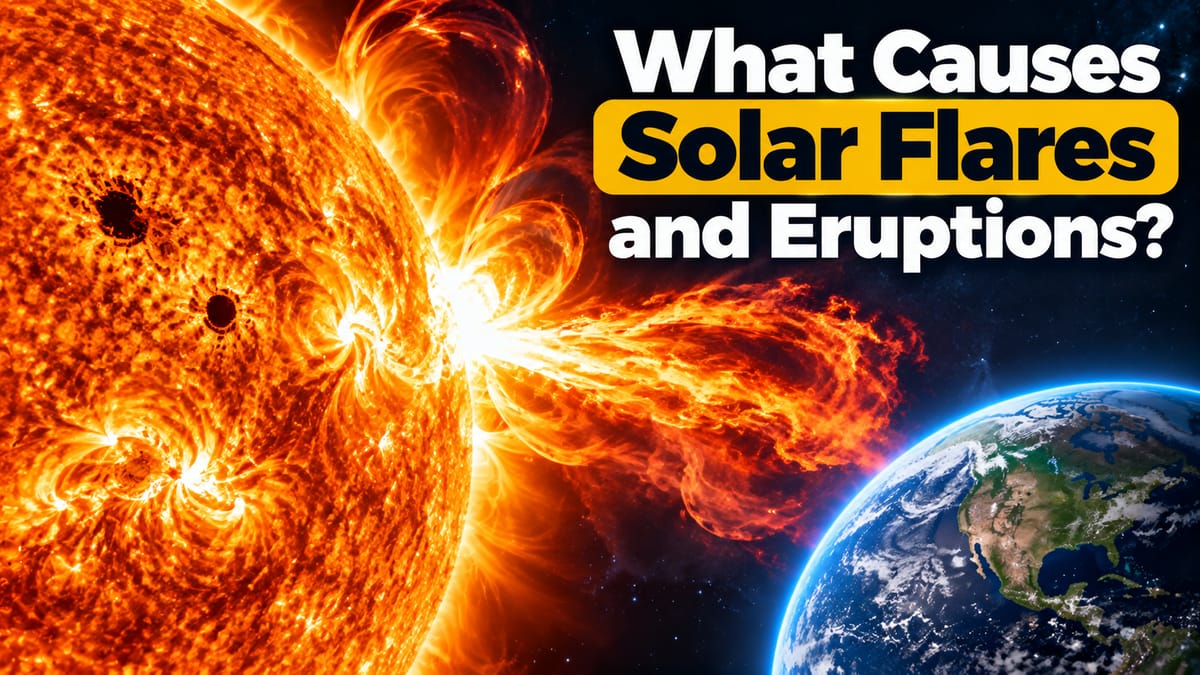
What Causes Solar Flares and Eruptions?
The Sun may appear calm from Earth, but its surface and atmosphere are constantly changing. Enormous streams of electrically charged plasma move through its atmosphere, while powerful magnetic fields twist, stretch, and reorganize. Under the right conditions, these processes can release tremendous amounts of energy in events known as solar flares and solar eruptions.
Solar flares are sudden bursts of electromagnetic radiation. Solar eruptions can involve enormous quantities of plasma and magnetic field being launched away from the Sun. Some of the most dramatic eruptions are called coronal mass ejections, or CMEs.
These events are closely connected to the Sun’s magnetic activity. They can produce radiation across a broad range of wavelengths and, when directed toward Earth, can affect satellites, spacecraft, radio communications, navigation systems, and electrical infrastructure.
Understanding what causes solar flares and eruptions requires looking beneath the Sun’s bright surface and into the complex behavior of its magnetic fields.
What Is a Solar Flare?
A solar flare is a sudden release of energy in the Sun’s atmosphere.
The energy is released primarily as electromagnetic radiation, including:
- Visible light
- Ultraviolet radiation
- X-rays
- Radio emissions
Flares can occur over relatively short periods, although their effects can continue to be observed for longer.
They frequently occur in regions where the Sun’s magnetic field is especially complex.
A flare can release an enormous amount of energy as magnetic energy is rapidly converted into other forms of energy.
Solar flares are therefore not explosions caused by combustion. The Sun does not burn like a conventional fire. Instead, flares are fundamentally magnetic phenomena occurring in electrically conducting plasma.
What Is a Solar Eruption?
The term solar eruption describes a broader category of events in which energy, plasma, magnetic fields, or combinations of these are expelled from the Sun.
One of the most important types is a coronal mass ejection.
A CME can propel billions of tons of magnetized plasma into space.
Not every solar eruption travels toward Earth, and many have little or no direct effect on our planet.
The direction, speed, magnetic structure, and size of an eruption all influence what happens after it leaves the Sun.
For a broader look at the Sun’s activity, Complete Guide to the Sun and Solar Activity provides additional background on the processes occurring on and around our star.
The Sun Is a Giant Ball of Plasma
To understand solar flares, it helps to understand the material that makes up the Sun.
The Sun consists primarily of extremely hot plasma.
Plasma is an electrically charged state of matter containing free electrons and ions. Because these charged particles interact strongly with magnetic fields, the movement of plasma can influence the Sun’s magnetic environment.
At the same time, magnetic fields can influence how plasma moves.
This interaction between plasma and magnetic fields is central to solar activity.
The Sun is therefore not simply a glowing sphere. It is a dynamic magnetic environment in which enormous amounts of energy can be stored and released.
Where Does the Sun’s Magnetic Field Come From?
The Sun’s magnetic field is generated by movements inside the star.
The Sun rotates, but it does not rotate as a solid body. Different regions rotate at different rates, a phenomenon known as differential rotation.
The equatorial regions generally rotate faster than regions closer to the poles.
Inside the Sun, convection also moves hot plasma upward and cooler material downward.
These motions interact with the Sun’s magnetic field and contribute to the complex magnetic structures observed at the surface and in the atmosphere.
Over time, magnetic fields can become twisted, stretched, and concentrated.
This stored magnetic energy can eventually be released in powerful events.
The broader physical behavior of stars provides important context, and Everything You Need to Know About Stars explores how stars function and evolve.
Sunspots Reveal Strong Magnetic Activity
Solar flares and eruptions frequently occur near sunspots.
Sunspots are darker-looking regions on the visible surface of the Sun where strong magnetic fields emerge from the interior.
They appear darker because they are cooler than the surrounding photosphere, although they are still extremely hot.
Sunspots can occur individually or as groups.
Some groups contain complicated magnetic configurations in which magnetic field lines become highly stressed.
These regions can become particularly active sources of solar flares and eruptions.
Why Do Sunspots Look Dark?
The darkness of a sunspot is relative.
A sunspot is still much hotter than anything humans encounter on Earth’s surface.
It appears dark because its temperature is lower than that of the surrounding photosphere.
Strong magnetic fields suppress some of the convective movement that transports heat toward the surface.
As a result, the affected region can appear darker against the brighter surrounding photosphere.
Sunspots therefore provide visible evidence of the magnetic processes occurring beneath and above the solar surface.
Magnetic Fields Store Enormous Amounts of Energy
Magnetic fields are not simply invisible lines drawn around the Sun.
They are associated with energy.
When magnetic fields become twisted or compressed, energy can accumulate within the solar atmosphere.
The Sun’s constantly moving plasma can distort these fields.
Imagine elastic bands being twisted and stretched.
The analogy is imperfect, but it helps illustrate how a magnetic configuration can store energy before suddenly changing.
When the magnetic structure reorganizes, some of that stored energy can be released.
Magnetic Reconnection Drives Solar Flares
One of the most important processes involved in solar flares is magnetic reconnection.
Magnetic reconnection occurs when magnetic field structures change their connectivity and reorganize.
During this process, magnetic energy can be rapidly converted into:
- Particle acceleration
- Heat
- Electromagnetic radiation
- Plasma motion
The resulting energy release can produce a solar flare.
The process is complicated because the Sun’s plasma and magnetic fields interact as a coupled system.
Scientists use observations and theoretical models to study how magnetic energy accumulates and how reconnection begins.
What Happens During Magnetic Reconnection?
In a simplified picture, magnetic field lines that have become stressed can be brought into a configuration where they reconnect.
The magnetic topology changes.
Energy stored in the magnetic field is released and transferred to the surrounding plasma.
Particles can be accelerated to extremely high energies.
Some of the resulting radiation can reach Earth in minutes because electromagnetic radiation travels at the speed of light.
This is one reason the electromagnetic effects of a solar flare can be observed relatively soon after the flare occurs.
Why Solar Flares Produce Radiation
When magnetic energy is released, charged particles can be accelerated and heated.
These energetic particles and hot plasma can produce radiation across multiple wavelengths.
X-rays and ultraviolet radiation are particularly important when considering the effects of powerful flares on Earth’s upper atmosphere.
Scientists can observe these emissions using instruments designed to monitor different wavelengths of solar radiation.
Different wavelengths reveal different physical conditions in the Sun’s atmosphere.
Solar Flares Are Classified by Strength
Solar flares are commonly classified according to their peak X-ray intensity.
The main classes are:
- A-class
- B-class
- C-class
- M-class
- X-class
Each class represents an increase in the measured peak X-ray intensity.
Within each category, a numerical multiplier indicates the relative strength.
For example, an M5 flare is stronger than an M2 flare, while an X2 flare is stronger than an X1 flare.
The classification describes the measured X-ray output, not every aspect of the physical size or potential consequences of the event.
What Is a Coronal Mass Ejection?
A coronal mass ejection, or CME, is a large eruption of magnetized plasma from the Sun’s outer atmosphere.
Unlike a solar flare, which is primarily an electromagnetic radiation event, a CME involves the movement of substantial quantities of matter.
A CME can travel through interplanetary space at hundreds or even thousands of kilometers per second, depending on the event.
If a CME is directed toward Earth, it can eventually interact with Earth’s magnetic field.
That interaction can produce a geomagnetic storm.
Solar Flares and CMEs Are Related but Different
Solar flares and CMEs can occur together, but they are not the same phenomenon.
A flare is primarily a sudden release of electromagnetic energy.
A CME is a large-scale expulsion of magnetized plasma.
A single active region can produce both.
However, not every flare produces a major CME, and not every CME is necessarily accompanied by a prominent flare.
Scientists therefore monitor several different indicators when assessing solar activity.
Why Does the Sun Have Solar Eruptions?
The fundamental driver is the Sun’s magnetic activity.
The Sun’s plasma is constantly moving.
These movements can distort magnetic fields, creating complex structures with stored magnetic energy.
Eventually, a magnetic configuration can become unstable or undergo reconnection.
The resulting release of energy can produce a flare, while a larger restructuring of the magnetic field can help launch a CME or another eruption.
The exact trigger varies between events.
Solar physicists continue studying how magnetic structures evolve from relatively stable configurations into eruptive ones.
Magnetic Flux Emergence
Another important process is magnetic flux emergence.
Magnetic fields generated within the Sun can rise through the solar interior and emerge at the surface.
When these magnetic structures appear in the photosphere, they can create new sunspots and active regions.
Newly emerging magnetic fields can interact with existing fields.
These interactions can increase magnetic complexity and create conditions favorable for flares and eruptions.
The Sun’s Magnetic Cycle
Solar activity changes over an approximately 11-year cycle.
During periods of lower activity, the Sun generally has fewer sunspots and fewer major solar eruptions.
As activity increases toward solar maximum, sunspot numbers tend to rise and active regions become more common.
Activity then declines toward solar minimum.
The magnetic cycle is actually more complex than a simple repeating pattern, and individual solar cycles can vary in strength and duration.
The cycle is closely connected to changes in the Sun’s magnetic field.
Why Solar Maximum Produces More Flares
Solar maximum does not cause every flare directly.
Instead, it is a period when the Sun generally develops more sunspots and magnetically complex active regions.
More active regions create more opportunities for magnetic energy to accumulate and be released.
Consequently, periods of high solar activity tend to produce more frequent solar flares and CMEs than quieter periods.
This does not mean that major solar events cannot occur during other phases of the solar cycle.
What Happens After a Solar Flare?
The effects of a solar flare depend on its strength, location, and radiation output.
High-energy radiation can reach Earth relatively quickly.
When powerful ultraviolet and X-ray radiation interacts with Earth’s upper atmosphere, it can temporarily increase ionization in parts of the ionosphere.
This can affect certain forms of radio communication.
The impact is generally strongest on the side of Earth facing the Sun at the time of the event.
How Solar Eruptions Reach Earth
A CME can take considerably longer to reach Earth than the radiation from a flare.
Its travel time depends largely on its speed.
A fast CME can arrive within a relatively short period, while slower events take longer.
Scientists track CMEs using observations from multiple solar-observing spacecraft.
The speed and direction of the CME help determine whether it is likely to interact significantly with Earth.
What Happens When a CME Reaches Earth?
When a CME reaches Earth, its embedded magnetic field interacts with Earth’s magnetosphere.
If the conditions are favorable for strong energy transfer, the interaction can produce a geomagnetic storm.
Possible effects include:
- Bright auroras
- Changes in the ionosphere
- Disruptions to some radio communications
- Satellite operational challenges
- Increased atmospheric drag on low-Earth-orbit satellites
- Changes in some navigation and communication systems
- Currents induced in long conductors on the ground
The severity depends on the characteristics of the solar event and Earth’s response.
How Solar Storms Create Auroras
Auroras are among the most visually striking effects associated with strong solar activity.
When energetic particles and disturbances associated with solar activity interact with Earth’s magnetosphere, some charged particles can be guided toward the upper atmosphere.
There, they interact with atmospheric gases.
These interactions produce light.
The resulting auroras can appear in different colors depending on the atmospheric gases involved, the altitude of the emissions, and the energy of the incoming particles.
Auroras are therefore a visible reminder that Earth’s environment is connected to activity on the Sun.
Why Earth’s Magnetic Field Matters
Earth’s magnetic field acts as a protective environment around the planet.
It deflects and redirects many charged particles from the solar wind.
When a major solar disturbance reaches Earth, the magnetosphere can become compressed and disturbed.
The magnetic field does not block every particle or every form of solar radiation, but it plays a major role in shaping how solar activity interacts with our planet.
The physics of magnetic fields also connects to broader principles governing motion throughout the universe, including those described in How Gravity Controls Motion and Orbits in Space.
Solar Flares Can Affect Technology
Modern technology depends heavily on systems that can be affected by space weather.
Power grids, satellites, navigation systems, aviation communications, radio systems, and spacecraft can all be sensitive to different aspects of solar activity.
For example, strong solar radiation can disturb Earth’s ionosphere and affect high-frequency radio communication.
Geomagnetic storms can also produce electrical currents in long conducting systems.
This does not mean every solar flare creates a technological crisis.
Most solar events have limited practical consequences for people on the ground.
The concern is primarily associated with sufficiently strong events and favorable conditions for interaction with Earth’s environment.
Spacecraft Face Greater Risks
Spacecraft outside Earth’s protective atmosphere and magnetosphere can be exposed to a more challenging radiation environment.
High-energy solar particles can pose hazards to:
- Spacecraft electronics
- Scientific instruments
- Solar panels
- Communications systems
- Astronauts
Space agencies therefore monitor solar activity closely when planning and conducting missions.
Spacecraft can also be designed with radiation protection and operational procedures intended to reduce exposure during significant solar events.
Solar Flares Do Not Heat Earth Like a Giant Fireball
A common misconception is that a large solar flare sends a wave of heat directly toward Earth that dramatically raises surface temperatures.
That is not how most solar flare effects work.
The radiation from a flare can alter Earth’s upper atmosphere and ionosphere, but the energy involved is not equivalent to a giant heating pulse capable of dramatically warming Earth’s surface.
The atmosphere, magnetic field, and distance between the Sun and Earth all influence how solar energy reaches our planet.
Earth already receives a continuous flow of solar energy, which is fundamental to the planet’s climate and life.
How Scientists Observe Solar Flares
Scientists monitor the Sun using both ground-based observatories and spacecraft.
Different instruments observe different parts of the electromagnetic spectrum.
Researchers can examine:
- Visible light
- Ultraviolet radiation
- Extreme ultraviolet radiation
- X-rays
- Radio waves
- Magnetic fields
Combining observations from multiple wavelengths can reveal how an active region changes before, during, and after an eruption.
This helps scientists study the physical processes that produce solar activity.
The Sun’s Corona Plays a Major Role
The corona is the Sun’s outer atmosphere.
It extends millions of kilometers into space and reaches temperatures far higher than the visible surface of the Sun.
The corona is also where many important structures associated with solar eruptions can be observed.
Magnetic loops, plasma streams, and eruptive structures can become visible through specialized solar observations.
Because the corona is dominated by magnetic fields and extremely hot plasma, it is central to understanding solar flares and CMEs.
Why Is the Corona So Hot?
The Sun’s visible surface is roughly thousands of degrees in temperature, while parts of the corona can reach temperatures of millions of degrees.
This surprising temperature difference is known as the coronal heating problem.
Scientists have proposed several mechanisms that may contribute to coronal heating, including magnetic waves and small-scale magnetic reconnection events.
The exact combination of processes remains an active area of research.
Understanding coronal heating may also help explain how the magnetic energy that drives solar eruptions is stored and released.
Prominences and Filaments
Solar prominences are large structures of relatively cool, dense plasma suspended in the Sun’s hot corona by magnetic fields.
When viewed against the bright solar disk, similar structures can appear as dark filaments.
These structures can remain stable for extended periods, but they can also become unstable.
When a prominence erupts, it can be associated with a large-scale solar eruption and, in some circumstances, a CME.
Their behavior provides another example of how magnetic fields control the movement of solar plasma.
What Triggers a Solar Eruption?
There is no single trigger that explains every solar eruption.
Researchers study several possible pathways, including:
- Magnetic flux emergence
- Magnetic field shearing
- Twisting magnetic structures
- Magnetic reconnection
- Loss of magnetic stability
- Changes in coronal magnetic configurations
An active region can accumulate magnetic energy for days or even longer before an eruption occurs.
Eventually, the magnetic structure can reach a point where it rapidly reorganizes.
The challenge is determining exactly when and how that transition will occur.
Can Scientists Predict Solar Flares?
Scientists can identify regions of the Sun that appear more likely to produce flares based on characteristics such as magnetic complexity.
However, predicting the exact time, size, and consequences of an individual solar flare remains difficult.
Space-weather forecasting therefore often involves assessing probabilities and monitoring developing conditions rather than making precise long-term predictions for every event.
Continuous solar observation is essential because active regions can change rapidly.
Why Solar Flares Matter to Astronomy
Solar flares provide scientists with an opportunity to study plasma physics and magnetic processes under conditions that cannot easily be reproduced on Earth.
The Sun is close enough for detailed observation while being energetic enough to display phenomena occurring throughout astrophysical systems.
Studying solar activity can therefore contribute to broader questions about:
- Stellar magnetic fields
- Plasma behavior
- Particle acceleration
- Magnetic reconnection
- Space weather
- Stellar atmospheres
- Radiation environments
These subjects form part of the wider field described in The Complete Guide to Astronomy.
Do Other Stars Have Flares?
Yes.
The Sun is a star, and many other stars also experience magnetic activity.
Some stars can produce flares considerably more powerful than typical solar flares.
Studying stellar flares helps scientists understand how magnetic activity changes with stellar age, rotation, composition, and other properties.
It also provides insight into the environments surrounding planets orbiting active stars.
The Sun is therefore a particularly accessible example of a much broader astrophysical phenomenon.
Solar Activity and Space Exploration
Solar eruptions are particularly important for human and robotic exploration beyond Earth.
Spacecraft traveling beyond Earth’s magnetic environment can encounter greater exposure to energetic particles.
For future crewed missions to the Moon, Mars, or other destinations, understanding solar activity will be an important component of mission planning.
A powerful solar particle event could pose radiation risks to astronauts who are not protected by Earth’s atmosphere and magnetosphere.
Monitoring the Sun can therefore be important not only for understanding astronomy but also for operating safely in space.
The Difference Between Solar Wind and Solar Eruptions
The solar wind is a continuous flow of charged particles streaming outward from the Sun.
A CME is a much larger and more sudden eruption of magnetized plasma.
The two phenomena are related because both originate from the Sun’s outer atmosphere and magnetic environment, but they are not interchangeable.
The solar wind provides a persistent flow of particles throughout the solar system.
A CME is an episodic, large-scale disturbance moving through that environment.
Solar Activity Is Part of a Larger System
The Sun does not exist in isolation.
Its magnetic activity influences the space environment throughout the solar system.
Solar wind, flares, CMEs, energetic particles, and magnetic fields interact with planets, moons, spacecraft, and other objects.
Earth is particularly interesting because its atmosphere and magnetic field provide substantial protection against many aspects of solar activity.
Understanding these connections helps astronomers study the Sun as part of the broader dynamic system that makes up our cosmic neighborhood.
Following the Sun’s Magnetic Energy
Solar flares and eruptions ultimately trace back to the same fundamental source: the Sun’s dynamic magnetic environment.
Plasma movements inside the Sun generate and reshape magnetic fields. Those fields can become concentrated, twisted, and stressed in active regions. When magnetic structures become unstable or reconnect, stored energy can be released rapidly, producing powerful radiation and sometimes launching enormous clouds of magnetized plasma into space.
The details of each eruption can be different, which is why solar physicists continue monitoring the Sun closely. By studying sunspots, magnetic fields, the corona, flares, CMEs, and the solar cycle together, scientists can better understand how our star releases energy and how those events propagate through the space environment surrounding Earth.


2 Comments
Micle harison
June 7, 2019Lorem ipsum dolor sit amet, usu ut perfecto postulant deterruisset, libris causae volutpat at est, ius id modus laoreet urbanitas. Mel ei delenit dolores.
John Doe
June 7, 2019Some consultants are employed indirectly by the client via a consultancy staffing company.