
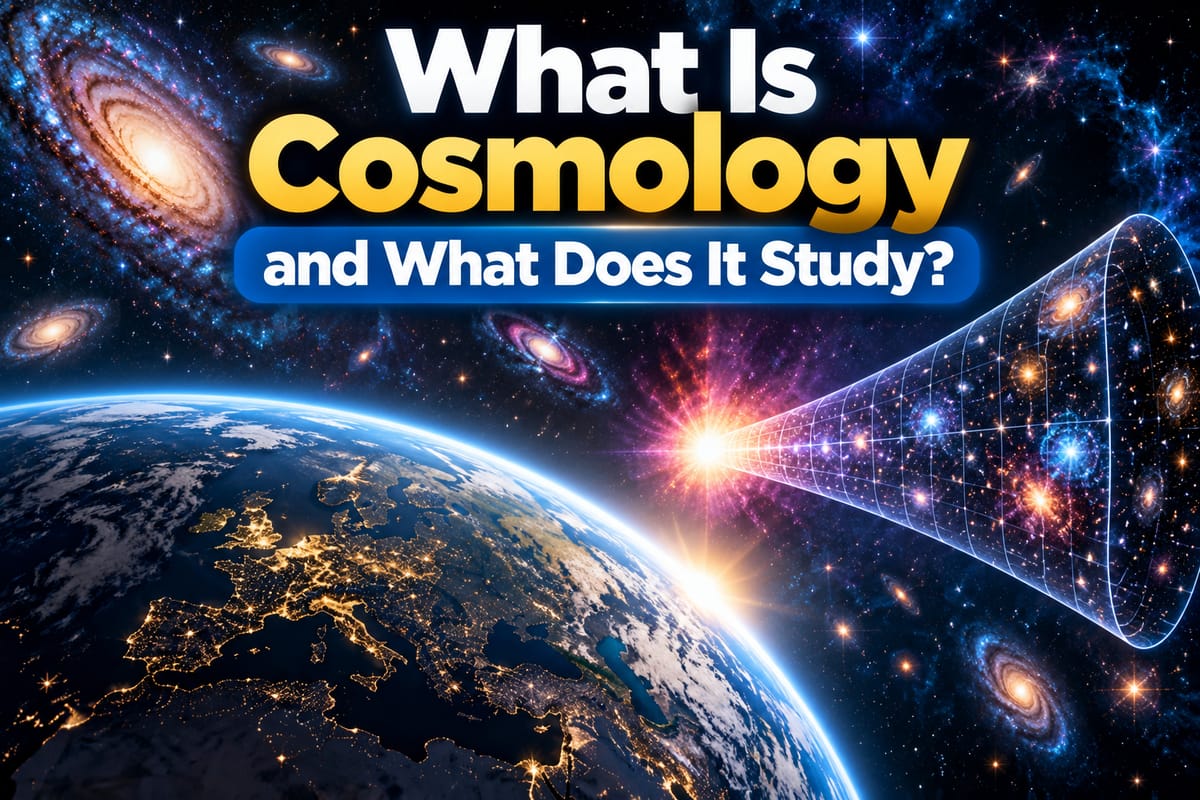
What Is Cosmology and What Does It Study?
Cosmology is the branch of science that studies the universe as a whole. Rather than focusing on one planet, star, galaxy, or other individual object, cosmology asks some of the biggest questions in science: How did the universe begin? How has it changed over time? What is it made of? How large is it? How might it evolve in the distant future?
These questions place cosmology at the intersection of astronomy, physics, mathematics, and other scientific disciplines. Cosmologists use observations of distant galaxies, measurements of radiation traveling across space, theoretical models, computer simulations, and fundamental physics to build explanations for the history and structure of the universe.
Understanding cosmology also helps put individual discoveries into a much larger context. The stars in our galaxy, the distribution of galaxies across enormous distances, invisible dark matter, and the mysterious effects associated with dark energy are all pieces of a much bigger cosmic story.
What Is Cosmology?
Cosmology is the scientific study of the origin, evolution, structure, contents, and eventual fate of the universe.
The word itself comes from the Greek kosmos, meaning world or universe, and logia, meaning study. In modern science, cosmology is concerned with questions that involve the universe on its largest scales.
Astronomy often investigates individual celestial objects and systems, while cosmology focuses on the universe considered as a connected whole. The two fields overlap extensively, however. Astronomical observations provide much of the evidence cosmologists use to develop and test theories about the universe.
For readers who want to understand the broader field, The Complete Guide to Astronomy provides a useful foundation for exploring the study of stars, planets, galaxies, and other objects in space.
What Does Cosmology Study?
Cosmology covers an enormous range of subjects, but several major questions sit at the heart of the field.
The Origin of the Universe
One of cosmology’s central questions is how the universe began.
The leading scientific model describes an early universe that was extremely hot, dense, and rapidly expanding. This model is commonly known as the Big Bang theory.
The Big Bang was not simply an explosion occurring at one particular location in pre-existing space. Instead, the model describes the expansion of space itself from an extremely hot and dense early state.
Scientists continue to investigate what happened during the earliest moments of cosmic history and whether current theories can adequately describe conditions at the beginning of the universe.
The history of this early period is explored in greater detail in How Did the Universe Begin and What Happened After the Big Bang?.
The Expansion of the Universe
Another fundamental subject in cosmology is cosmic expansion.
Scientists discovered that distant galaxies generally appear to be moving away from one another as space expands. More distant galaxies tend to show greater recession, providing evidence that the universe has been expanding over cosmic time.
Importantly, this does not necessarily mean galaxies are flying through a static universe away from one central point. On sufficiently large scales, the distances between regions of space increase as space itself expands.
The expansion of the universe can be studied through observations such as galaxy redshifts and measurements of the cosmic microwave background.
The Age of the Universe
Cosmology also seeks to determine how long the universe has existed.
Scientists estimate the universe’s age by combining observations and theoretical models. Measurements of cosmic expansion, the cosmic microwave background, the distribution of matter, and other evidence can be used to constrain the age of the cosmos.
Determining the age of the universe is more complicated than simply finding the oldest visible object. Astronomers must account for how the universe has expanded and changed over billions of years.
The resulting estimate provides an important framework for understanding when major cosmic events occurred, including the formation of the first stars and galaxies.
How Cosmologists Study the Universe
Cosmologists cannot observe the entire universe from an outside vantage point. We exist within the universe and observe it from a particular location in space and time.
Instead, scientists combine many different forms of evidence.
Observing Distant Galaxies
Galaxies are among the most important sources of information for cosmology.
Because light travels at a finite speed, observing a distant galaxy means observing it as it appeared in the past. The farther away an object is, the longer its light has generally been traveling before reaching Earth.
This makes powerful telescopes valuable tools for cosmology. By observing galaxies at different distances, scientists can study how the universe looked during different stages of its history.
Astronomers can measure galaxy positions, distances, compositions, motion, and other characteristics. When enormous numbers of galaxies are studied together, patterns begin to emerge on scales far larger than individual galaxies.
Studying the Cosmic Microwave Background
One of the most important sources of evidence in modern cosmology is the cosmic microwave background, often abbreviated as CMB.
The CMB is faint electromagnetic radiation that fills space. It originated when the early universe had cooled enough for electrons and atomic nuclei to combine into neutral atoms, allowing light to travel much more freely through space.
Today, that ancient radiation has been stretched by cosmic expansion and is observed primarily as microwave radiation.
Tiny variations in the temperature and distribution of the CMB contain information about conditions in the early universe. Cosmologists use these patterns to investigate the universe’s composition, geometry, expansion history, and large-scale structure.
Measuring Cosmic Redshift
Light can provide information about how the universe is expanding.
When light from a distant object is shifted toward longer, redder wavelengths, scientists can measure this change and use it as part of their analysis of the object’s motion and the expansion of space.
Redshift measurements have become a fundamental part of observational cosmology. When combined with distance measurements, they allow scientists to study how cosmic expansion has changed across different periods of the universe’s history.
Using Computer Models and Simulations
Modern cosmology also relies heavily on mathematics and computing.
The universe contains enormous numbers of particles, galaxies, gas clouds, and other structures interacting through gravity and other physical processes. Scientists use simulations to model how these structures might develop over billions of years.
A simulation can begin with conditions representing the early universe and calculate how matter evolves under known physical laws.
Researchers can then compare the resulting simulated universe with astronomical observations. If a model produces structures that differ significantly from what telescopes observe, scientists can investigate which assumptions may need to be reconsidered.
What Is the Big Bang Theory?
The Big Bang theory is the leading scientific framework for describing the evolution of the universe from an extremely hot, dense early state.
The name can sometimes create a misleading picture of a conventional explosion. Cosmologically, the important concept is expansion: the universe has been expanding and cooling over time.
As the universe expanded, its temperature decreased. Fundamental particles formed and interacted, followed by the formation of atomic nuclei and eventually atoms. Much later, gravity brought matter together into increasingly complex structures, including stars, galaxies, and galaxy clusters.
The Big Bang model does not necessarily answer every question about an ultimate beginning. Scientists continue to investigate what, if anything, can meaningfully be said about conditions before the earliest period that current physical theories can describe.
How Did the First Stars and Galaxies Form?
The early universe was not filled with the mature galaxies and stars seen today.
After the universe cooled sufficiently for atoms to form, matter was distributed relatively smoothly, but tiny differences in density existed. Over enormous periods of time, gravity amplified these differences.
Regions containing slightly more matter exerted stronger gravitational attraction. As matter accumulated, increasingly dense structures formed.
Eventually, clouds of gas collapsed under gravity and produced the first stars. Stars then contributed to the development of more complex structures, while groups of stars and other matter became the building blocks of early galaxies.
The evolution of galaxies is therefore closely connected to cosmology because their distribution and properties preserve information about how the universe developed.
What Is Dark Matter?
One of the major mysteries studied by cosmologists is dark matter.
Dark matter is the name scientists give to an unseen form of matter inferred from its gravitational effects. It does not appear to interact with light in the same way as ordinary matter, making it difficult to observe directly.
Its presence is inferred from observations involving galaxies, galaxy clusters, gravitational effects, and the large-scale structure of the universe.
Dark matter appears to play an important role in the formation and evolution of cosmic structures. Without accounting for additional gravitational effects beyond those produced by visible matter, many observations are difficult to explain within standard cosmological models.
For a closer examination of the evidence and why scientists care about this mysterious component, see What Dark Matter Is and Why It Matters.
What Is Dark Energy?
Dark energy is another major subject in modern cosmology.
Observations indicate that the expansion of the universe has been accelerating rather than simply continuing at a constant rate or gradually slowing under gravity.
Scientists use the term dark energy to describe whatever is responsible for this observed behavior within the standard cosmological framework.
Dark energy is not simply another form of ordinary matter. Its nature remains one of the major unanswered questions in physics.
Several explanations have been proposed, including the possibility that dark energy represents a property of space itself. Other ideas involve modifications to our understanding of gravity or additional physical fields.
The evidence and major scientific questions surrounding this phenomenon are discussed in What Is Dark Energy and What Does It Do?.
What Is the Large-Scale Structure of the Universe?
Cosmology is not only concerned with the universe’s history. It also investigates how matter is arranged across enormous distances.
Galaxies are not distributed randomly. They form patterns that include groups, clusters, superclusters, filaments, and vast regions with relatively few galaxies.
On the largest scales, these structures form an enormous network often called the cosmic web.
Gravity plays a central role in creating this structure. Tiny density variations in the early universe grew over time as matter was pulled toward regions with greater concentrations of mass.
Studying the cosmic web allows scientists to investigate how matter evolved and how different components of the universe influenced its development.
What Is the Observable Universe?
The observable universe is the portion of the universe from which information has had enough time to reach us since the universe became transparent to light.
This distinction is important because the observable universe is not necessarily the same thing as the entire universe.
The universe could extend far beyond the region we can currently observe. Depending on the overall geometry and history of the cosmos, there may be regions that are permanently inaccessible to us because their light cannot reach Earth.
Cosmology therefore has to distinguish between what scientists can observe and what theoretical models suggest may exist beyond our observational horizon.
Why Is the Universe So Difficult to Study?
The sheer scale of the universe creates extraordinary challenges.
Cosmic events often occur over millions or billions of years, while human scientific observations typically cover much shorter periods. Scientists therefore cannot watch an entire galaxy evolve from formation to its eventual fate.
Instead, they use observations of many different objects at different distances and ages.
This approach allows cosmologists to construct a kind of cosmic timeline. Nearby objects generally provide information about more recent conditions, while extremely distant objects can reveal what the universe looked like much earlier.
Another challenge is that much of the universe cannot be observed directly. Scientists often have to infer the presence or properties of something from its effects on visible matter, radiation, or cosmic expansion.
How Physics and Cosmology Work Together
Cosmology depends heavily on fundamental physics.
Gravity determines how matter and energy influence the structure and motion of the universe. Thermodynamics helps scientists understand how energy and temperature changed as the universe expanded. Particle physics provides models for the behavior of matter under extreme conditions.
Einstein’s theory of general relativity is particularly important because it provides a framework for describing gravity and the large-scale structure of spacetime.
At smaller scales, quantum physics becomes essential for understanding fundamental particles and interactions.
One of the major long-term challenges in science is developing a more complete understanding of how these descriptions fit together under the extreme conditions associated with the earliest universe and other extraordinary environments.
What Is the Standard Model of Cosmology?
Modern cosmology often uses a framework commonly referred to as the standard cosmological model.
It describes a universe that began in a hot, dense state and has expanded over time. It incorporates ordinary matter, dark matter, radiation, and dark energy, along with the effects of gravity and cosmic expansion.
The model has successfully explained many observations and provides a common framework for interpreting large-scale astronomical data.
However, a scientific model is not the same thing as a claim that every question has been solved.
Important mysteries remain. Scientists continue to investigate the nature of dark matter and dark energy, the earliest moments of cosmic history, the origin of certain large-scale structures, and possible tensions between different measurements of cosmic properties.
What Questions Are Cosmologists Still Trying to Answer?
Cosmology remains an active area of research because many fundamental questions are unresolved.
Among the major questions are:
- What happened during the earliest moments of the universe?
- What physical processes drove the universe’s earliest expansion?
- What is dark matter made of?
- What is dark energy?
- Why does the universe contain more matter than antimatter?
- How did the first stars and galaxies form?
- What determines the overall geometry of the universe?
- Is the observable universe only a small part of a much larger cosmos?
- Will cosmic expansion continue indefinitely?
- Could our understanding of gravity need to change on the largest scales?
Some of these questions may be answered through improved observations, while others may require new theories in physics.
What Could Happen to the Universe in the Future?
Cosmology does not only look backward. It also considers possible futures for the universe.
The ultimate fate of the cosmos depends heavily on how its expansion develops and on the nature of dark energy.
One possible scenario involves continued expansion, with galaxies becoming increasingly separated over extremely long periods. As stars exhaust their available fuel and cosmic structures change, the universe could gradually become darker and colder.
Other theoretical possibilities depend on different properties of dark energy or changes in the behavior of cosmic expansion.
Because the nature of dark energy is not fully understood, scientists cannot simply observe the future directly. Instead, they use physical models to explore possible outcomes and compare those models with current observations.
Why Cosmology Matters
Cosmology provides a framework for understanding where everything we observe fits into the history of the universe.
A study of a single star can reveal how stars work. A study of a galaxy can reveal how large collections of stars and matter interact. Cosmology takes those observations and asks how such objects fit into the evolution of the universe itself.
It also demonstrates how different scientific fields can work together.
Astronomical observations provide data. Physics supplies theories about matter, energy, gravity, and radiation. Mathematics allows scientists to describe relationships between these components. Computing makes it possible to simulate complex cosmic processes and analyze enormous datasets.
Together, these tools allow researchers to investigate questions that were once primarily philosophical.
Cosmology and Humanity’s Place in the Universe
Perhaps the most profound aspect of cosmology is the perspective it provides.
Earth is part of a solar system, which is located within the Milky Way galaxy. The Milky Way is one galaxy among an enormous population of galaxies spread across the observable universe.
The elements that make up planets, stars, and living organisms were produced through cosmic processes that unfolded over immense periods of time.
Studying cosmology does not reduce the importance of our local environment. Instead, it reveals how Earth fits into a much larger physical history.
The universe is not simply a collection of isolated objects. It is an evolving system in which matter, energy, space, and time are interconnected.
The Continuing Search for a Cosmic Picture
Cosmology has transformed our understanding of the universe, but the field remains far from finished.
Scientists now have substantial evidence for an expanding universe, an early hot and dense state, the existence of large-scale cosmic structure, and phenomena associated with dark matter and dark energy. Yet some of the most basic questions remain open.
Future telescopes, increasingly precise measurements, improved simulations, and advances in fundamental physics may reveal new clues about these mysteries.
For now, cosmology remains one of science’s broadest investigations: an effort to understand not just what exists in space, but how the universe came to have the structure we observe today and how that vast cosmic story may continue unfolding.




2 Comments
Micle harison
June 7, 2019Lorem ipsum dolor sit amet, usu ut perfecto postulant deterruisset, libris causae volutpat at est, ius id modus laoreet urbanitas. Mel ei delenit dolores.
John Doe
June 7, 2019Some consultants are employed indirectly by the client via a consultancy staffing company.