
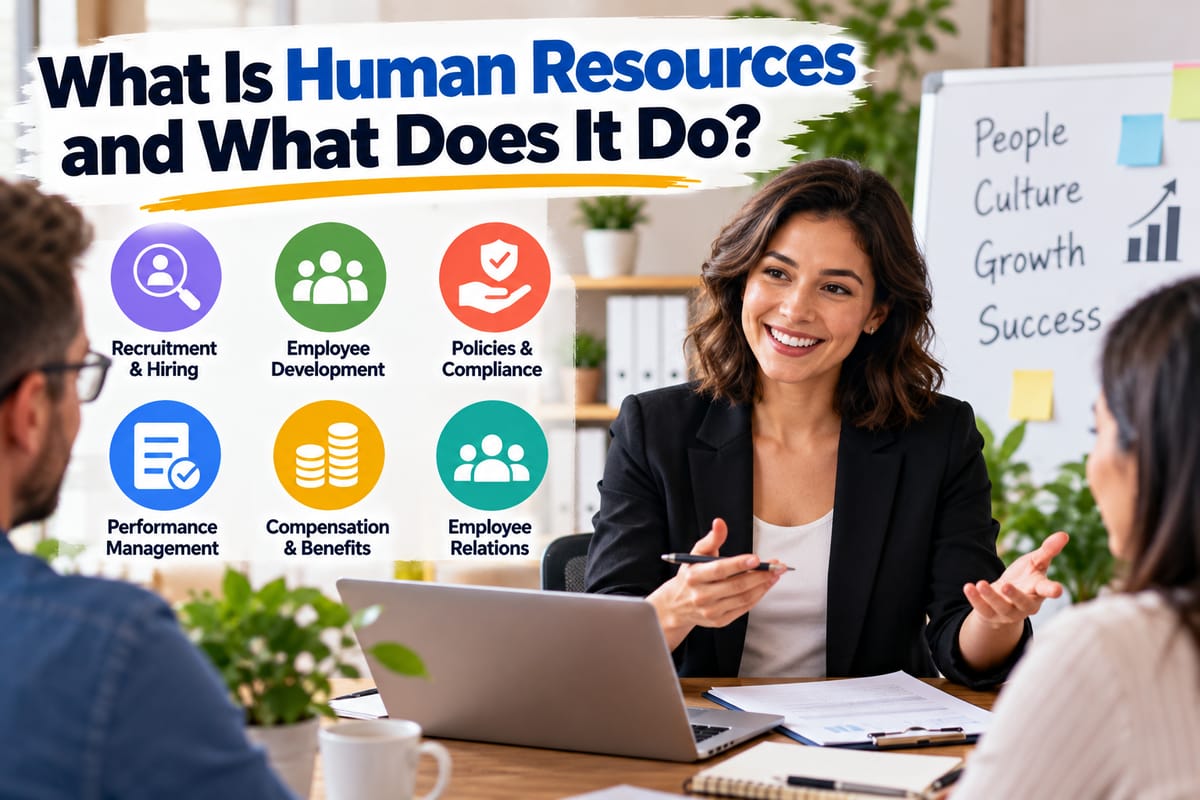
What Is Human Resources and What Does It Do?
Human resources, commonly called HR, is the business function responsible for managing many of the people-related activities that help an organization operate effectively. While HR is often associated with hiring and employee paperwork, its role is much broader. Human resources can influence recruitment, onboarding, employee development, workplace policies, compensation, performance management, employee relations, compliance, and workforce planning.
Every organization that employs people has to address human-resource issues in some form. A small business owner may handle these responsibilities personally, while a larger company may have an HR department with recruiters, HR managers, payroll specialists, learning and development professionals, and employee-relations specialists.
Understanding what HR does provides a clearer picture of how businesses attract people, organize their workforce, support employees, and align individual contributions with organizational objectives.
What Is Human Resources?
Human resources refers both to the people who work for an organization and to the business function responsible for managing the employment relationship.
In a practical business setting, HR focuses on how an organization finds, hires, develops, supports, and retains employees. It also helps establish policies and processes that define expectations for employees and managers.
HR can therefore be viewed as a bridge between an organization’s business requirements and the people responsible for carrying out its work.
For example, a company planning to expand into a new market may need additional employees with specific skills. HR can help determine what positions are needed, develop job descriptions, recruit candidates, coordinate hiring, and support the new employees after they join.
This means HR is not simply an administrative department. It can contribute to workforce planning and broader organizational decision-making.
What Does the HR Department Do?
The exact responsibilities of an HR department vary according to the organization’s size, industry, structure, and workforce. However, several responsibilities are common across many businesses.
Recruitment and Hiring
One of the most visible HR responsibilities is helping businesses find and hire employees.
Recruitment can include:
- Identifying workforce needs
- Creating job descriptions
- Advertising open positions
- Reviewing applications
- Coordinating interviews
- Communicating with candidates
- Supporting hiring decisions
- Conducting background or reference checks where appropriate
- Preparing employment documentation
Effective recruitment involves more than filling an empty position. Businesses generally want employees whose skills, experience, and expectations align with the requirements of the role.
HR may work closely with managers because managers often understand the technical and operational requirements of a particular position, while HR can provide expertise in recruitment processes and employment practices.
Employee Onboarding
Hiring someone is only the beginning of the employment relationship.
Onboarding is the process of helping new employees understand their role, the organization, its systems, workplace expectations, and the resources available to them.
An onboarding process might include:
- Completing employment documentation
- Introducing the employee to colleagues
- Explaining company policies
- Setting up accounts and equipment
- Providing role-specific training
- Establishing early performance expectations
- Introducing organizational culture and workplace practices
Good onboarding can help employees understand what is expected of them and how their work connects with the rest of the organization.
It can also reduce confusion during the first weeks and months of employment.
Employee Training and Development
Businesses often need employees to develop new skills as technology, customer expectations, regulations, and business strategies change.
HR may coordinate or support training programs covering areas such as:
- Technical skills
- Leadership
- Communication
- Workplace safety
- Compliance
- Management
- Customer service
- Software and technology
- Professional development
Employee development can also involve career planning, mentoring, coaching, leadership programs, and opportunities to take on greater responsibilities.
This connects closely with the broader challenge of creating effective teams. Businesses can explore the relationship between workforce development and organizational performance through their approach to How Businesses Build Strong, Productive Teams.
Compensation and Benefits
HR often plays an important role in managing how employees are compensated and what benefits they receive.
Compensation can include:
- Salaries
- Hourly wages
- Bonuses
- Commissions
- Incentive programs
- Other forms of employee compensation
Benefits may include:
- Health-related benefits
- Retirement programs
- Paid leave
- Insurance
- Flexible working arrangements
- Employee assistance programs
The exact benefits available vary considerably between employers and jurisdictions.
HR may also help businesses establish compensation structures that are consistent across comparable positions while supporting recruitment and retention objectives.
Employee Performance Management
Performance management is another important HR responsibility.
A performance management system can provide a framework for employees and managers to discuss expectations, results, development needs, and future objectives.
It may include:
- Setting performance goals
- Regular check-ins
- Performance reviews
- Constructive feedback
- Development plans
- Recognition
- Performance improvement processes
Performance management should not necessarily be limited to an annual review. Many organizations use more frequent conversations so employees receive feedback throughout the year.
Managers play a particularly important role because they interact with employees regularly. Understanding How Managers Lead People, Make Decisions and Improve Business Performance helps illustrate why people management is not solely an HR responsibility.
Workplace Policies and Procedures
Organizations need clear rules and procedures to create consistent expectations.
HR may help develop, communicate, and administer policies relating to areas such as:
- Workplace conduct
- Attendance
- Leave
- Remote or hybrid work
- Equal employment practices
- Workplace safety
- Confidentiality
- Employee complaints
- Disciplinary procedures
- Use of company resources
- Conflicts of interest
Policies can help employees understand what is expected and give managers a framework for handling workplace situations consistently.
Policies should also be reviewed periodically because business operations, technology, laws, and workforce expectations can change.
Employee Relations
Employee relations refers to how an organization manages relationships between employees, managers, and the broader organization.
HR may become involved when employees have concerns about:
- Workplace treatment
- Communication
- Conflicts
- Management decisions
- Working conditions
- Policies
- Harassment or inappropriate conduct
- Grievances
The goal is generally to provide structured processes for addressing workplace issues.
HR professionals may investigate complaints, facilitate communication, document relevant information, or help managers respond appropriately.
Maintaining healthy employee relationships can be important because unresolved workplace problems can affect morale, productivity, collaboration, and employee retention.
Legal and Regulatory Compliance
Businesses have obligations concerning employment and the workplace. These obligations vary by country, state, industry, and type of organization.
HR may help businesses understand and implement processes related to areas such as:
- Employment documentation
- Working hours
- Leave requirements
- Workplace safety
- Anti-discrimination requirements
- Employee records
- Compensation rules
- Termination procedures
- Data privacy
- Benefits requirements
HR is not always the organization’s legal department, and complicated employment matters may require qualified legal advice. However, HR commonly works with management and legal professionals to help maintain appropriate employment practices.
Payroll and Employee Records
HR may also have administrative responsibilities involving employee information.
Depending on the organization’s structure, HR may manage or coordinate:
- Employee records
- Payroll information
- Benefits enrollment
- Leave records
- Attendance information
- Employment contracts
- Personnel documentation
- Changes in employee status
Some businesses have separate payroll or finance departments, while others place certain payroll responsibilities within HR.
The objective is to maintain accurate employee information and ensure that administrative processes operate consistently.
Workforce Planning
Human resources can help businesses think about their workforce beyond immediate hiring needs.
Workforce planning involves considering questions such as:
- How many employees will the organization need?
- What skills will be required?
- Which roles are difficult to fill?
- Are current employees prepared for future responsibilities?
- Where could skill gaps emerge?
- Which positions may need succession plans?
- How could changes in technology affect staffing?
Workforce planning becomes especially important when a company is growing, restructuring, entering new markets, or adopting new technology.
It also connects HR with broader business planning. A company’s strategy may establish where the organization wants to go, while workforce planning helps determine whether it has the people and capabilities required to get there. Businesses can examine this relationship through a Complete Guide to Business Strategy and Strategic Planning.
Why Human Resources Matters to Businesses
Employees perform the work that allows most organizations to create products, deliver services, serve customers, develop technology, manage operations, and generate revenue.
As a result, decisions about people can have consequences throughout the business.
For example, hiring too slowly can leave important positions vacant. Hiring without clearly defining a role can create mismatched expectations. Poor onboarding can leave new employees uncertain about their responsibilities. Weak performance management can allow problems to continue without meaningful feedback.
HR provides systems that help businesses address these challenges in a structured way.
However, HR is only one part of effective people management. Senior leaders and managers also influence workplace culture, employee motivation, communication, and performance.
HR and Business Growth
The role of HR often changes as a company grows.
A small business may initially have an owner or manager handling recruitment, payroll coordination, employee records, and workplace policies.
As the workforce expands, these responsibilities can become increasingly difficult to manage informally.
A growing organization may eventually need dedicated HR expertise to handle:
- Higher recruitment volumes
- More complex employee records
- Formal compensation structures
- Employee benefits
- Training programs
- Workplace policies
- Performance systems
- Compliance requirements
- Employee relations
- Workforce planning
The decision to add employees itself should be connected to business needs rather than headcount alone. Factors such as workload, revenue, capacity, customer demand, and the cost of hiring can all matter. Businesses examining this decision can learn more from When Should a Growing Business Hire Employees?.
HR Technology
Technology has changed how many HR departments operate.
Modern HR systems can help businesses manage information and automate repetitive processes.
Common HR technology categories include:
- Human resources information systems
- Applicant tracking systems
- Payroll software
- Benefits administration platforms
- Learning management systems
- Time and attendance systems
- Performance management platforms
- Employee communication tools
These systems can make it easier to maintain records, organize recruitment, distribute information, and generate workforce reports.
Some organizations also use analytics to identify patterns in areas such as employee turnover, recruitment activity, absenteeism, compensation, and workforce demographics.
Technology can improve efficiency, but organizations still need appropriate processes and human judgment. Automating a poorly designed process does not necessarily make the underlying process better.
Human Resources and Company Culture
Company culture refers broadly to the shared behaviors, expectations, values, and working practices that shape how people experience an organization.
HR can influence culture through recruitment, onboarding, policies, training, leadership development, recognition, and employee communication.
For example, if a business says collaboration is important, its hiring practices, performance expectations, management behavior, and reward systems should not consistently encourage employees to work in isolation.
Culture is therefore shaped by what an organization actually rewards and reinforces, not simply by statements written in an employee handbook.
HR and Employee Retention
Recruiting employees is only part of building a stable workforce. Businesses also need to consider why employees remain with an organization and why they leave.
Employee retention can be influenced by factors such as:
- Compensation
- Career development
- Management quality
- Workload
- Recognition
- Workplace relationships
- Flexibility
- Job responsibilities
- Organizational culture
- Opportunities for advancement
HR can gather information through employee surveys, exit interviews, retention data, and other feedback mechanisms.
The purpose is not necessarily to eliminate employee turnover entirely. Some turnover is normal in any organization. Instead, businesses can use workforce information to understand patterns and identify areas where changes may be useful.
The Difference Between HR and Management
HR and management have overlapping responsibilities, but they are not the same thing.
HR typically establishes systems, processes, policies, and programs that support the workforce across the organization.
Managers are generally responsible for leading employees within their particular teams or departments.
For example, HR may establish a performance review framework, while an individual manager conducts performance discussions with team members.
HR may develop a recruitment process, while a department manager explains the technical requirements of an open position and participates in interviews.
This distinction is important because effective people management requires cooperation between HR and operational leadership.
Common HR Challenges
Human resources departments can face many challenges as organizations evolve.
Finding Qualified Employees
Some positions require specialized skills that may be difficult to find. Businesses may need to broaden recruitment efforts, improve job descriptions, develop internal talent, or invest in training.
Managing Workplace Conflict
Disagreements can occur in any workplace. HR may need to help establish fair processes for addressing concerns while protecting confidentiality and maintaining appropriate documentation.
Keeping Policies Current
Workplace policies can become outdated when technology, organizational structures, or employment requirements change.
Supporting Organizational Change
Mergers, restructurings, new technologies, and rapid growth can create uncertainty for employees. HR may help communicate changes and support workforce transitions.
Balancing Employee and Business Needs
Businesses need to meet operational and financial objectives while maintaining a functioning workplace. HR often works at the intersection of these interests, helping develop policies and processes that address organizational requirements and employee considerations.
What Skills Do HR Professionals Need?
Human resources professionals typically need a combination of interpersonal, organizational, analytical, and business skills.
Important capabilities can include:
- Communication
- Active listening
- Organization
- Conflict resolution
- Problem-solving
- Confidentiality
- Data analysis
- Employment policy knowledge
- Recruitment
- Coaching
- Negotiation
- Project management
- Business understanding
Because HR deals with sensitive employee information and complex workplace situations, professionalism and sound judgment are particularly important.
How HR Supports the Employee Life Cycle
One useful way to understand HR is to view employment as a life cycle.
A typical employee journey may look like:
Workforce planning → Recruitment → Selection → Hiring → Onboarding → Development → Performance management → Career progression → Retention or transition
HR can have a role at almost every stage.
For example, workforce planning determines what talent the organization needs. Recruitment attracts candidates. Hiring brings new employees into the organization. Onboarding helps them become productive. Training develops capabilities. Performance management provides feedback. Career development can support progression. Eventually, employees may leave through resignation, retirement, redundancy, or other forms of transition.
Managing these stages systematically can help businesses create a more organized approach to their workforce.
Human Resources Is More Than Hiring
The traditional image of HR often focuses on hiring employees and handling paperwork. Those activities remain important, but modern human resources encompasses a much wider range of responsibilities.
HR can influence how businesses:
- Find talent
- Build teams
- Develop employees
- Establish workplace policies
- Manage performance
- Address employee concerns
- Administer compensation and benefits
- Maintain employment records
- Plan future workforce requirements
- Support organizational change
- Manage employment-related risks
The function ultimately connects people management with the practical requirements of running an organization.
For small businesses, many HR responsibilities may be handled by owners or managers. For larger organizations, specialized HR teams can provide dedicated expertise and systems. Regardless of the structure, the underlying objective is similar: creating practical processes that help an organization manage its workforce effectively while giving employees clear expectations and appropriate support.
As businesses grow and their strategies become more complex, human resources becomes increasingly connected to decisions about organizational structure, leadership, workforce capabilities, and long-term growth. Understanding that connection helps explain why HR is not simply an administrative function, but an important part of how organizations operate and develop.



2 Comments
Micle harison
June 7, 2019Lorem ipsum dolor sit amet, usu ut perfecto postulant deterruisset, libris causae volutpat at est, ius id modus laoreet urbanitas. Mel ei delenit dolores.
John Doe
June 7, 2019Some consultants are employed indirectly by the client via a consultancy staffing company.