
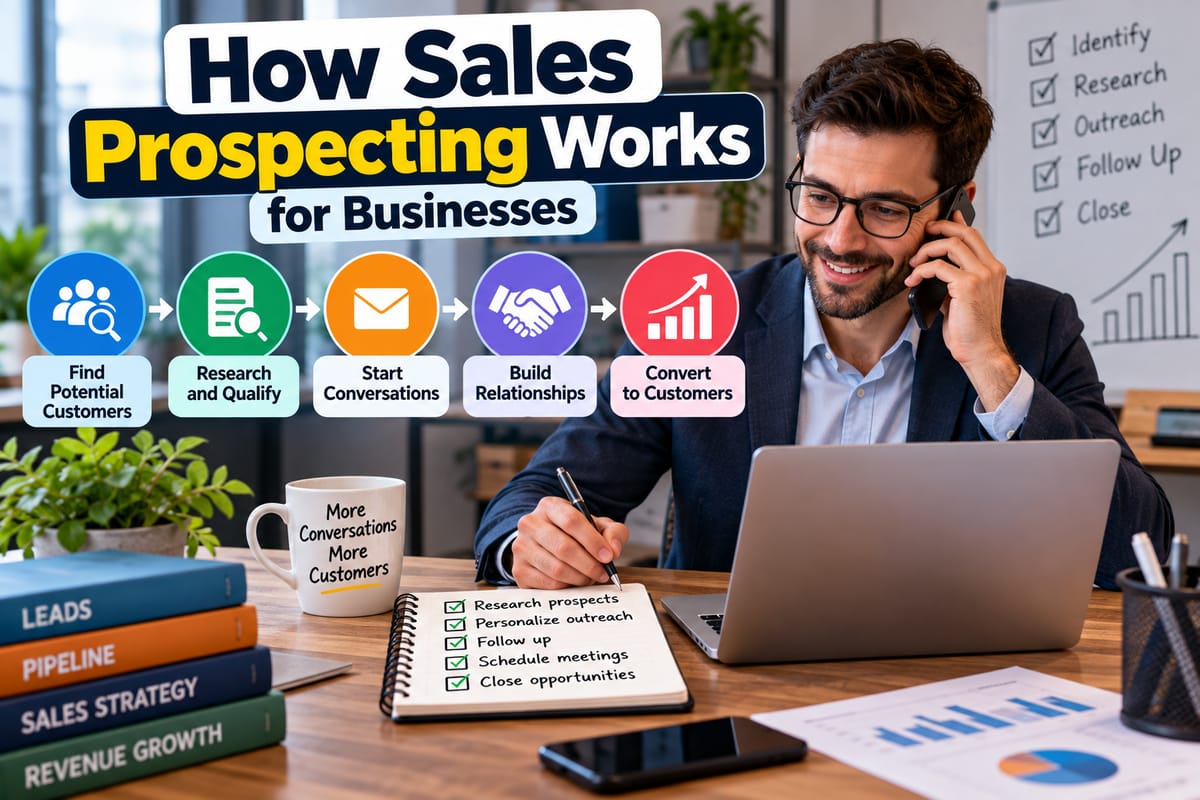
How Sales Prospecting Works for Businesses
Sales prospecting is the process businesses use to identify and research potential customers who may have a need for their products or services. It is one of the earliest stages of the sales process and helps companies build a pool of potential buyers rather than waiting for customers to discover them on their own.
A business can have an excellent product, competitive pricing, and an experienced sales team, but it still needs a reliable way to find organizations or individuals who could become customers.
That is where prospecting comes in.
Sales prospecting involves identifying potential buyers, determining whether they fit the company’s target customer profile, learning about their needs, initiating contact, and deciding whether a sales conversation is worth pursuing.
The process can range from traditional phone calls and email outreach to networking, referrals, social selling, inbound lead qualification, events, and account-based approaches.
Understanding how prospecting works helps businesses create more organized sales operations and build a healthier flow of potential opportunities.
What Is Sales Prospecting?
Sales prospecting is the systematic process of finding and evaluating potential customers for a business.
A person or organization identified during prospecting is commonly called a prospect.
The prospecting process generally involves several activities:
- Defining the ideal customer.
- Finding potential buyers.
- Researching those buyers.
- Assessing whether they are a good fit.
- Identifying potential needs or problems.
- Contacting relevant decision-makers.
- Starting a sales conversation.
- Determining whether a genuine opportunity exists.
- Moving qualified prospects into the appropriate sales stage.
Prospecting is therefore more than simply collecting names and email addresses.
The goal is to identify potential customers who have enough relevance and potential need to justify further sales attention.
Why Sales Prospecting Matters
Businesses need a continuous supply of potential customers because not every sales conversation results in a purchase.
Some prospects will not have a current need. Others may lack budget, authority, or urgency. Some will choose a competitor, while others may simply stop responding.
Prospecting helps create a larger pool from which qualified opportunities can emerge.
Effective prospecting can help businesses:
- Increase the number of potential opportunities
- Reduce dependence on a small number of customers
- Give sales representatives a consistent flow of prospects
- Identify potential buyers earlier
- Improve sales team productivity
- Support revenue growth
- Improve the quality of sales conversations
- Create more predictable sales activity
The broader relationship between prospecting and revenue is explored in Sales and Selling — Complete Guide to Building Revenue.
Prospecting Begins With the Ideal Customer
One of the biggest mistakes businesses can make is trying to sell to everyone.
A company needs to understand who is most likely to benefit from its product or service.
An ideal customer profile can include characteristics such as:
- Industry
- Company size
- Location
- Revenue range
- Business model
- Technology used
- Common operational problems
- Purchasing behavior
- Budget
- Decision-making structure
- Existing solutions
- Business objectives
For consumer products, the profile may instead include:
- Age range
- Location
- Income
- Interests
- Purchasing behavior
- Lifestyle
- Product preferences
- Common problems
- Buying frequency
The more clearly a business understands its target market, the easier it becomes to identify relevant prospects.
Prospecting and Lead Generation Are Not Exactly the Same
Sales prospecting and lead generation are closely related, but they are not identical.
Lead generation focuses on attracting or identifying people who may have an interest in a product or service.
Prospecting generally involves actively researching and evaluating potential customers and initiating sales conversations.
For example, someone who downloads a company’s guide may become a lead.
A salesperson may then research that person’s company, determine whether it fits the target customer profile, identify the appropriate decision-maker, and initiate contact.
That activity moves from general interest toward active sales qualification.
Where Businesses Find Prospects
Businesses can find potential customers through many channels.
Common sources include:
- Existing customer referrals
- Professional networks
- Industry events
- Business directories
- Company websites
- Social media
- Email databases
- Inbound inquiries
- Website forms
- Content marketing
- Partnerships
- Online communities
- Trade associations
- Previous customers
- Cold outreach
The appropriate channel depends heavily on the type of customer a business serves.
A company selling enterprise software may use account research, professional networking, referrals, and targeted outreach. A local service business may depend more heavily on referrals, local visibility, inbound inquiries, and community relationships.
Inbound Prospecting
Inbound prospecting begins with people who have already shown some level of interest in a company.
Examples include someone who:
- Fills out a contact form
- Requests a product demonstration
- Downloads a resource
- Subscribes to a newsletter
- Sends an inquiry
- Requests pricing information
- Attends a webinar
- Contacts the business through social media
Inbound prospects can sometimes require less initial education because they have already interacted with the company.
However, an inbound inquiry does not automatically mean the person is ready to buy.
The sales team still needs to determine whether the prospect has a genuine need and whether the company’s offering is appropriate.
Outbound Prospecting
Outbound prospecting involves proactively contacting potential customers who may not have previously interacted with the business.
Common outbound methods include:
- Cold email
- Cold calling
- Professional networking
- Direct messages
- Personalized outreach
- Account-based campaigns
- Sales events
The quality of outbound prospecting depends heavily on relevance.
Sending the same generic message to thousands of people may generate little useful engagement.
Researching the prospect and explaining why the product may be relevant to their situation can create a more meaningful conversation.
Researching a Prospect
Research is one of the most important parts of prospecting.
Before contacting a potential customer, a salesperson may investigate:
- What the company does
- Its size
- Its products or services
- Its industry
- Recent business developments
- Existing technology
- Likely operational challenges
- The prospect’s role
- The company’s priorities
- Potential reasons the product could be relevant
The purpose is not to collect unnecessary personal information.
The purpose is to understand enough about the prospect to determine whether the business has a legitimate reason to start a sales conversation.
Finding the Right Decision-Maker
In many business-to-business sales situations, the person first identified is not necessarily the person who makes the final purchasing decision.
A purchase may involve:
- Users
- Department managers
- Procurement teams
- Finance
- Executives
- Technical specialists
- Legal teams
- Business owners
A salesperson therefore needs to understand the customer’s buying process.
For example, an employee may use a software product every day, while a department manager controls the budget and an executive approves the contract.
Understanding these roles can prevent sales teams from spending too much time communicating with someone who cannot advance the purchase.
Qualifying Prospects
Not every potential customer deserves the same amount of sales attention.
Qualification helps businesses determine which prospects are most relevant.
A salesperson might evaluate:
- Does the prospect have a problem the product can solve?
- Is the problem significant enough to justify action?
- Does the prospect have a realistic budget?
- Is the person involved in the purchasing decision?
- Is there a reasonable timeframe?
- Does the business meet the customer’s requirements?
- Is there a genuine reason for the prospect to consider the solution?
Qualification should not be treated as an attempt to force every prospect into a sale.
It is primarily a way to determine whether continuing the conversation makes sense for both sides.
Common Qualification Frameworks
Sales teams may use formal frameworks to organize qualification.
One well-known approach evaluates areas such as:
- Budget
- Authority
- Need
- Timing
Other frameworks consider factors such as customer impact, decision criteria, competition, business objectives, and internal stakeholders.
The exact framework matters less than having a consistent method for evaluating opportunities.
Starting the First Conversation
Once a prospect has been identified and researched, the salesperson needs to initiate contact.
The first interaction may occur through:
- Phone
- Video meeting
- Social networking
- In-person networking
- Referral introduction
A strong first conversation generally focuses on relevance rather than immediately delivering a long product presentation.
For example, instead of beginning with a detailed list of product features, a salesperson might explain why they believe the product could be relevant to a specific business problem.
Personalization in Prospecting
Personalization does not necessarily mean writing an entirely different sales message for every prospect.
It means demonstrating that the outreach is relevant.
A personalized message might reference:
- The prospect’s industry
- A known business challenge
- Their role
- A recent company development
- A relevant operational process
- A specific use case
The message should still be concise.
Excessive personalization that does not contribute meaningful value can consume sales time without improving the conversation.
Cold Calling
Cold calling involves contacting potential customers by telephone without a prior sales relationship.
It remains one possible prospecting method, particularly in industries where direct conversation is useful.
A cold call typically works best when the salesperson has a clear reason for contacting the prospect.
A simple structure might be:
- Introduce yourself.
- Explain why you are calling.
- Establish relevance.
- Ask a concise question.
- Listen to the response.
- Determine whether a follow-up conversation makes sense.
The objective of the first call does not always need to be closing a sale.
It may simply be determining whether there is enough relevance for a more detailed conversation.
Email Prospecting
Email is another common prospecting channel.
A useful prospecting email generally has:
- A clear reason for contacting the person
- A concise explanation of relevance
- A specific problem or opportunity
- A simple call to action
Long messages can make it difficult for recipients to understand what the salesperson wants.
A prospecting email might seek a short introductory conversation rather than attempting to explain the entire product.
Social Selling
Social selling uses professional or social networks to develop relationships and identify relevant prospects.
Activities can include:
- Sharing useful information
- Participating in industry discussions
- Connecting with relevant professionals
- Responding to questions
- Building professional relationships
- Identifying potential business needs
Social selling is generally more relationship-oriented than simply sending unsolicited promotional messages.
Referrals
Referrals can be particularly valuable because an introduction from an existing customer, partner, or professional contact can provide context and credibility.
A referral process might look like:
Existing customer → Introduction → New prospect → Qualification → Sales conversation
Businesses can encourage referrals by delivering strong customer experiences and making it easy for satisfied customers to introduce relevant contacts.
However, referrals should still be evaluated for fit. A referred company is not automatically a good prospect.
Prospecting Through Existing Customers
Existing customers can also reveal opportunities for additional sales.
For example, a customer may:
- Need a larger plan
- Require another product
- Expand into another department
- Open additional locations
- Need additional services
- Become eligible for a new solution
This type of prospecting can be easier because the business already has an established relationship.
Sales teams should still focus on genuine customer needs rather than attempting to sell unnecessary products.
Organizing Prospects in a CRM
A customer relationship management system, or CRM, can help sales teams organize prospecting activity.
A CRM may record:
- Prospect names
- Companies
- Contact information
- Job roles
- Communication history
- Qualification information
- Follow-up dates
- Sales stages
- Notes
- Opportunities
- Outcomes
Without a centralized system, sales representatives may lose track of conversations or contact the same prospect multiple times without coordination.
A CRM creates a shared record of sales activity.
Prospecting and the Sales Pipeline
Prospecting feeds the early stages of the sales pipeline.
A simplified process might look like:
Potential customer → Prospect → Qualified prospect → Opportunity → Customer
The exact stages vary between organizations.
The sales pipeline helps managers understand how potential buyers move from initial contact toward a purchase.
For a deeper explanation of this structure, What Is a Sales Pipeline and How Does It Work? examines how businesses organize opportunities throughout the sales process.
Prospecting Metrics
Businesses need measurements to determine whether prospecting activities are producing useful results.
Common metrics include:
- Number of prospects identified
- Number of outreach attempts
- Response rate
- Conversation rate
- Meetings booked
- Qualified opportunities
- Conversion rate
- Cost per qualified lead
- Sales cycle length
- Revenue generated from prospecting
Metrics should be interpreted in context.
A sales representative who contacts fewer prospects but generates highly qualified opportunities may produce a different result from someone making a much larger number of low-quality contacts.
Quantity alone does not determine prospecting effectiveness.
Activity Metrics Versus Outcome Metrics
Sales teams often track two broad categories of measurements.
Activity Metrics
These describe what the sales team does.
Examples include:
- Calls made
- Emails sent
- Messages sent
- Prospects researched
- Meetings requested
Outcome Metrics
These describe what happens as a result.
Examples include:
- Replies
- Meetings booked
- Qualified opportunities
- Proposals
- Closed deals
- Revenue
Both categories can be useful.
Activity metrics help managers understand effort and workflow, while outcome metrics show whether those activities are producing meaningful business results.
The Relationship Between Prospecting and Conversion
Prospecting does not end when someone responds.
The prospect must generally move through additional stages before becoming a customer.
The business may need to:
- Understand the customer’s needs
- Present an appropriate solution
- Demonstrate value
- Address concerns
- Discuss pricing
- Negotiate terms
- Obtain approvals
- Complete the transaction
The relationship between these stages is covered in How Business Sales Processes Convert Leads Into Paying Customers.
Prospecting creates potential opportunities, but subsequent sales activities determine whether those opportunities develop into actual revenue.
Follow-Up Is Part of Prospecting
A single unanswered email does not necessarily mean that a prospect is uninterested.
People may be busy, miss messages, change priorities, or need more time before responding.
Sales teams may therefore establish structured follow-up processes.
A follow-up sequence could involve:
- Initial outreach
- Follow-up message
- Additional relevant information
- Another contact attempt
- A final check-in
The frequency and number of follow-ups should depend on the industry, relationship, communication preferences, and nature of the opportunity.
Persistent outreach should not become unwanted or excessive communication.
Timing Matters
The same prospect may be highly relevant at one point and have little immediate interest at another.
For example, a company preparing to expand may suddenly need a service it previously considered unnecessary.
This means prospecting teams can benefit from tracking timing indicators such as:
- Expansion
- New projects
- Leadership changes
- Product launches
- Business growth
- Technology changes
- New regulatory requirements
- Budget cycles
The purpose is to identify legitimate business circumstances that may create a relevant reason for contact.
Segmenting Prospects
Large prospect lists can become difficult to manage.
Segmentation allows businesses to group prospects based on relevant characteristics.
For example:
| Segment | Example |
|---|---|
| Industry | Healthcare |
| Company size | 100–500 employees |
| Location | Regional market |
| Business stage | Growing companies |
| Need | Workflow automation |
| Engagement | Recently requested information |
| Potential value | Enterprise opportunity |
Segmentation can help sales teams prioritize outreach and tailor their messaging.
Account-Based Prospecting
For businesses selling complex products to large organizations, prospecting may focus on entire accounts rather than individual contacts.
An account-based approach might identify:
- Target companies
- Relevant departments
- Key decision-makers
- Potential users
- Procurement contacts
- Executives
- Business problems
The sales team can then coordinate outreach across the organization.
This can be particularly useful when purchasing decisions involve multiple stakeholders.
Sales Prospecting and Marketing
Sales and marketing often contribute to different parts of the prospecting process.
Marketing may attract potential customers through:
- Content
- Advertising
- Search visibility
- Events
- Webinars
- Social media
- Email campaigns
Sales teams may then research, qualify, and contact relevant prospects.
Strong coordination can help ensure that marketing generates the types of leads sales teams can realistically convert.
Common Sales Prospecting Mistakes
Targeting Everyone
Broad targeting can produce large numbers of irrelevant contacts.
Focusing Only on Quantity
More outreach does not necessarily mean more qualified opportunities.
Failing to Research
Generic messages can make prospects less likely to engage.
Talking Too Much About the Product
Prospecting should establish relevance before delivering an extensive product presentation.
Ignoring Qualification
Not every response represents a valuable sales opportunity.
Poor Follow-Up
Good prospects can be lost when sales teams fail to maintain organized follow-up.
Not Recording Activity
Without accurate records, teams can lose context and duplicate outreach.
Measuring Only Calls and Emails
Activity numbers do not necessarily demonstrate commercial results.
How Businesses Can Improve Prospecting
Improving prospecting usually starts with improving the system rather than simply asking salespeople to make more calls.
A business can:
- Define its ideal customer clearly.
- Build accurate prospect lists.
- Segment prospects appropriately.
- Research before contacting.
- Develop relevant messaging.
- Establish qualification criteria.
- Use a CRM consistently.
- Create sensible follow-up processes.
- Measure both activity and outcomes.
- Review which channels produce qualified opportunities.
- Remove low-value prospecting activities.
- Continuously refine the process based on evidence.
This turns prospecting from an informal activity into a repeatable business process.
Prospecting Technology
Modern sales teams can use software to support many parts of prospecting.
Technology can help with:
- Contact management
- Lead enrichment
- Email sequencing
- Scheduling
- CRM records
- Sales activity tracking
- Reporting
- Lead scoring
- Workflow automation
- Communication history
Automation can reduce repetitive administrative work, allowing salespeople to spend more time on research, conversations, and relationship development.
However, automation should not replace judgment.
A system can identify and organize prospects, but sales teams still need to determine whether the prospect is genuinely relevant.
Using Data Carefully
Sales teams increasingly have access to large amounts of business information.
Data can help identify patterns and potential opportunities, but quality matters.
Incomplete, outdated, or inaccurate information can result in:
- Wrong contact details
- Irrelevant outreach
- Duplicate records
- Poor segmentation
- Wasted sales effort
Businesses should therefore maintain accurate prospect data and respect applicable privacy and communication requirements.
Prospecting and Sales Forecasting
Prospecting also affects a company’s ability to plan future sales.
If a business understands how many prospects typically become qualified opportunities and how many opportunities eventually become customers, it can develop more informed expectations about future revenue.
For example:
1,000 prospects → 200 responses → 80 qualified opportunities → 30 proposals → 10 customers
These numbers are illustrative rather than universal.
Actual conversion rates depend on the industry, product, market, pricing, sales process, customer type, and many other factors.
Businesses can explore How Sales Forecasting Works to understand how sales activity and pipeline information can contribute to revenue planning.
Prospecting in Business-to-Business Sales
B2B prospecting often involves longer buying cycles and multiple stakeholders.
A salesperson may need to understand:
- The company’s business model
- Department-level needs
- Purchasing authority
- Budget processes
- Technical requirements
- Contract requirements
- Implementation concerns
- Decision timelines
The salesperson is therefore often selling into an organization rather than to one individual.
This makes research and qualification particularly important.
Prospecting in Business-to-Consumer Sales
Consumer prospecting can follow different patterns.
Businesses may identify potential buyers through:
- Advertising
- Social media
- Email marketing
- Loyalty programs
- Website activity
- Referrals
- Retail interactions
- Previous purchases
The buying cycle can be shorter, although this varies significantly by product.
Consumer prospecting often emphasizes audience segmentation, customer behavior, timing, and personalized offers.
What Makes a Prospect Valuable?
A valuable prospect is not necessarily the person most likely to buy immediately.
A prospect can be valuable because:
- The business has a genuine problem the product solves.
- The company fits the target customer profile.
- The potential transaction has meaningful value.
- The prospect has a realistic buying process.
- The timing is appropriate.
- The business can serve the customer effectively.
- The relationship could develop over time.
This broader view prevents sales teams from treating every prospect as simply a short-term transaction.
Building a Repeatable Prospecting Process
A mature sales organization can turn prospecting into a repeatable workflow.
A basic process might look like this:
Define Target Customer
↓
Find Potential Prospects
↓
Research Accounts
↓
Identify Relevant Contacts
↓
Qualify Prospects
↓
Personalize Outreach
↓
Start Conversation
↓
Schedule Follow-Up
↓
Create Qualified Opportunity
↓
Move Into Sales Pipeline
Each stage can have its own responsibilities, metrics, and standards.
This makes it easier for managers to identify where the process is working and where improvements are needed.
Creating a Healthy Prospecting Routine
For individual sales representatives, consistency can be more useful than occasional bursts of activity.
A daily routine might include:
- Researching new prospects
- Making targeted outreach
- Following up with existing prospects
- Updating CRM records
- Holding discovery conversations
- Reviewing upcoming opportunities
The exact schedule depends on the sales role and industry.
The broader objective is to maintain a continuous flow of prospecting activity rather than allowing the pipeline to become empty before searching for new customers.
Why Prospect Quality Matters
A large prospect list can create the appearance of strong sales activity without generating meaningful opportunities.
Suppose one salesperson has 5,000 contacts but only a small percentage fit the company’s target customer profile.
Another salesperson may have 500 carefully selected prospects with strong relevance.
The second list may produce fewer total contacts but potentially more useful conversations.
This is why prospecting should be evaluated through both quantity and quality.
Prospecting as an Ongoing Business Activity
Sales prospecting is not something businesses should necessarily perform only when revenue falls.
A healthy sales operation generally needs a continuous process for identifying future customers.
Even when the current pipeline appears strong, existing opportunities can be delayed, lost, reduced, or canceled.
Maintaining prospecting activity gives the business a larger pool of potential future opportunities.
This creates a connection between today’s sales activity and tomorrow’s revenue.
From Potential Customer to Sales Opportunity
The fundamental purpose of prospecting is to create relevant conversations.
A successful process moves logically from:
Potential customer → Researched prospect → Qualified prospect → Sales conversation → Opportunity → Customer
Each stage requires different information and actions.
Prospecting identifies potential fit. Qualification determines whether further investment makes sense. The sales process then develops the relationship and addresses the customer’s needs.
When these stages are connected, sales teams have a clearer view of how individual outreach activities contribute to broader business objectives.
Making Prospecting More Sustainable
Effective prospecting is less about sending the largest possible number of messages and more about building a repeatable system around the right customers.
Businesses can improve the process by defining their ideal customer, maintaining accurate prospect data, researching before outreach, using appropriate communication channels, qualifying consistently, following up systematically, and measuring what happens after initial contact.
A strong prospecting process also recognizes that not every potential customer should become a sales opportunity. Some prospects will not have a current need, some will not fit the company’s offering, and others may simply not be ready.
The purpose of prospecting is to identify where genuine commercial relevance exists and create a clear path toward a useful sales conversation. When that process is organized and connected to the wider sales pipeline, prospecting becomes a repeatable business capability rather than a collection of disconnected outreach activities.




2 Comments
Micle harison
June 7, 2019Lorem ipsum dolor sit amet, usu ut perfecto postulant deterruisset, libris causae volutpat at est, ius id modus laoreet urbanitas. Mel ei delenit dolores.
John Doe
June 7, 2019Some consultants are employed indirectly by the client via a consultancy staffing company.