
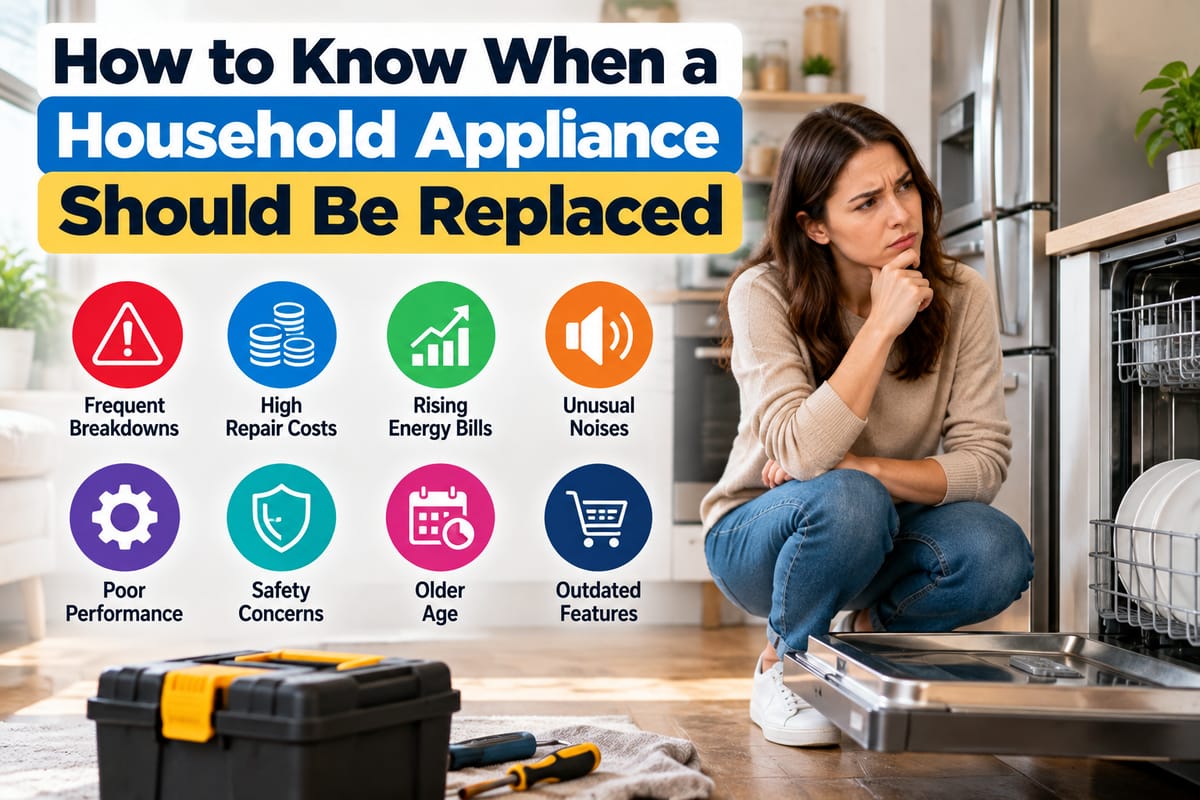
How to Know When a Household Appliance Should Be Replaced
Household appliances are designed to make everyday life easier, but even well-maintained appliances eventually become less reliable, less efficient, or more expensive to operate. Knowing when to repair an appliance and when to replace it can help households avoid unexpected breakdowns and make better use of their budgets.
An appliance does not necessarily need to be replaced simply because it is old. Age is one factor, but performance, repair costs, energy consumption, safety, availability of replacement parts, and the condition of the appliance all matter.
Recognizing the warning signs early can also prevent a minor appliance problem from becoming a larger household disruption.
Why Appliance Replacement Requires More Than an Age Check
Every appliance has a different expected service life, and actual longevity depends on factors such as build quality, frequency of use, maintenance, installation, and operating conditions.
A heavily used appliance may wear out sooner than one that is used occasionally. Likewise, regular maintenance can help some appliances operate reliably for longer.
Instead of relying on age alone, consider several questions:
- Is the appliance still working reliably?
- Has its performance noticeably declined?
- Are repairs becoming more frequent?
- Are replacement parts difficult to find?
- Is it consuming substantially more energy or water?
- Does it present a safety concern?
- Would replacing it cost less over time?
Looking at the entire situation provides a better basis for deciding what to do.
Frequent Breakdowns Are an Important Warning Sign
One of the clearest indications that an appliance may be nearing the end of its useful life is repeated failure.
A single malfunction does not necessarily mean replacement is necessary. Appliances can develop isolated problems that are relatively inexpensive to repair.
However, recurring breakdowns tell a different story. If an appliance repeatedly requires service, the combined cost of repairs, replacement parts, and inconvenience can eventually outweigh the value of keeping it.
A pattern of failures can also indicate that other components are approaching the end of their service life.
Repair Costs Can Change the Calculation
The cost of repairing an appliance should be considered alongside its age and overall condition.
A relatively new appliance with a straightforward repair may be worth fixing. An older appliance requiring an expensive repair may be a different situation.
Consider the total cost rather than looking only at the repair bill. This can include:
- Parts and labor
- Future maintenance
- Energy or water consumption
- Potential additional repairs
- Loss of use during breakdowns
- The cost of a replacement appliance
A repair can make sense when it restores reliable performance at a reasonable cost. Replacement becomes more attractive when repairs are frequent, expensive, or unlikely to provide a lasting solution.
Declining Performance Should Not Be Ignored
Appliances often provide gradual warning signs before they stop working completely.
A refrigerator that struggles to maintain temperature, a washing machine that no longer cleans clothes effectively, or an oven that heats unevenly may still function, but declining performance can indicate underlying wear.
Pay attention when an appliance:
- Takes significantly longer to complete its normal task
- Produces inconsistent results
- Requires repeated cycles
- Struggles to maintain the expected temperature
- Makes unusual noises
- Stops or restarts unexpectedly
- Requires increasingly frequent adjustments
A noticeable change from normal operation is worth investigating before assuming it is simply part of the appliance’s aging process.
Unusual Noises Can Signal Mechanical Problems
Many appliances produce some operating sounds, but a sudden change in noise can indicate a problem.
Grinding, rattling, buzzing, clicking, squealing, or unusually loud vibrations may point to worn components, loose parts, blocked mechanisms, or mechanical failure.
The appropriate response depends on the appliance and the type of noise. Some problems can be repaired relatively easily, while others may indicate more extensive deterioration.
Ignoring a significant change in operating noise can allow a small mechanical problem to become more expensive.
Rising Energy Consumption Can Matter
Older appliances may use more energy than newer models, particularly when technology and efficiency standards have changed significantly since the appliance was purchased.
An appliance that suddenly consumes more electricity than usual may also have a developing mechanical or electrical problem.
Energy costs should therefore be considered when evaluating whether to keep an aging appliance.
The broader principles of creating a healthier and more efficient household are covered in The Complete Guide to Healthy Home Living, including the importance of maintaining a home environment that supports everyday comfort and well-being.
Safety Problems Require Immediate Attention
Safety should receive greater weight than convenience or replacement cost.
An appliance may need urgent attention if it produces smoke, sparks, burning smells, electrical shocks, unusual overheating, or other signs of an electrical or mechanical hazard.
Damaged power cords, exposed wiring, cracked components, leaking appliances, or repeated electrical trips can also indicate a potentially serious problem.
When an appliance presents a safety risk, continuing to use it simply because it technically still works may not be appropriate. Disconnecting it safely and seeking qualified assistance can be more important than deciding whether the appliance is economical to repair.
Outdated Features Can Also Matter
An appliance does not have to be broken to become impractical.
Technology and household needs change over time. An older appliance may lack features that have become useful for managing energy consumption, improving convenience, or integrating with modern household systems.
For example, newer household appliances may offer programmable settings, remote monitoring, automated scheduling, energy-management features, or improved controls.
These features can be especially useful in homes where technology is being used to simplify everyday tasks. How Household Technology Can Improve Everyday Home Management explores how household technology can support organization and routine management.
However, convenience alone does not necessarily justify replacement. The potential benefits should be weighed against the purchase price and the value of the existing appliance.
Replacement Parts May Become Difficult to Find
Another consideration is whether an appliance can still be properly serviced.
Manufacturers may eventually discontinue components for older models. Local repair professionals may also have difficulty sourcing compatible parts.
When essential replacement parts become unavailable or unusually expensive, keeping an aging appliance operational can become increasingly difficult.
Before purchasing a replacement, it can be useful to check whether parts, service information, and qualified technicians are readily available for the new model.
Changes in Household Needs Can Justify Replacement
Sometimes an appliance is still functional but no longer suits the household.
A growing family may need a larger refrigerator or washing machine. Someone moving into a smaller home may prefer a compact appliance. Changes in cooking habits, work schedules, or household routines can also alter what features are useful.
Replacement decisions can therefore be about suitability as well as reliability.
An appliance that worked perfectly five years ago may no longer match the way the household operates today.
Consider How the Appliance Fits Into Daily Routines
Appliances are most valuable when they support the way a household actually functions.
If an appliance frequently interrupts routines, requires complicated workarounds, or creates additional maintenance tasks, replacing it may improve everyday convenience even if it has not completely failed.
At the same time, replacing every inconvenient appliance can become unnecessarily expensive.
A better approach is to identify whether the appliance creates a recurring problem and whether a replacement would provide a meaningful improvement.
Households can also reduce unnecessary friction through better organization. How Household Routines Make Everyday Home Life Easier looks at how consistent routines can simplify everyday responsibilities.
Compare Repair and Replacement Costs
Before making a decision, compare the realistic costs of both options.
For a repair, consider:
- Diagnostic fees
- Parts
- Labor
- Expected remaining service life
- Likelihood of additional failures
For replacement, consider:
- Purchase price
- Installation
- Delivery
- Energy consumption
- Maintenance requirements
- Warranty coverage
- Expected service life
A cheaper appliance may not necessarily provide the lowest long-term cost if it uses significantly more energy or requires frequent repairs.
Look at the Quality of a Potential Replacement
If replacement makes sense, avoid choosing a new appliance based solely on its purchase price.
Consider durability, repairability, maintenance requirements, warranty terms, efficiency, available parts, and the reputation of the product line.
Buying a durable appliance can reduce the frequency with which the household needs to repeat the replacement decision.
How to Choose More Durable Household Products provides additional guidance on evaluating products based on longevity and practical use rather than focusing only on initial cost.
Maintenance Can Extend an Appliance’s Useful Life
Replacement is not always the answer when an appliance begins showing minor problems.
Appropriate maintenance can help appliances operate efficiently and may extend their useful life. Depending on the appliance, maintenance might include cleaning filters, removing accumulated debris, checking seals, keeping ventilation areas clear, or following manufacturer-recommended service schedules.
Proper installation also matters. An appliance that is poorly installed or operated outside its intended conditions may experience unnecessary wear.
Maintenance cannot prevent every failure, but it can help households get more reliable performance from equipment that is still in good overall condition.
Keep Records of Repairs and Maintenance
Keeping basic records can make future replacement decisions easier.
Record the date of major repairs, the parts replaced, recurring problems, and approximate costs. Over time, these records can reveal whether an appliance is experiencing isolated issues or entering a pattern of repeated failures.
This information can also be useful when comparing the total cost of continued ownership with the cost of purchasing a replacement.
When Replacement Makes the Most Sense
There is rarely one universal replacement rule for every appliance. However, replacement becomes increasingly reasonable when several warning signs occur together.
These may include:
- Frequent or increasingly expensive repairs
- Significant declines in performance
- Rising operating costs
- Persistent unusual noises or other problems
- Difficulty obtaining replacement parts
- Serious safety concerns
- A mismatch between the appliance and current household needs
- A replacement offering meaningful improvements in efficiency or functionality
The more of these factors that apply, the more useful it can be to evaluate replacement rather than automatically repairing the same problem again.
Making a Practical Replacement Decision
The best time to replace a household appliance is not necessarily the day it stops working. In many cases, warning signs provide an opportunity to compare options before an emergency occurs.
Start by assessing the appliance’s current condition, repair history, operating costs, safety, and usefulness. Then compare the likely cost of keeping it with the long-term benefits of replacing it.
A thoughtful decision can help households avoid unnecessary spending while also preventing an aging appliance from becoming a recurring source of inconvenience. The objective is not simply to own newer appliances, but to maintain a home filled with equipment that is safe, reliable, efficient, and appropriate for everyday life.





2 Comments
Micle harison
June 7, 2019Lorem ipsum dolor sit amet, usu ut perfecto postulant deterruisset, libris causae volutpat at est, ius id modus laoreet urbanitas. Mel ei delenit dolores.
John Doe
June 7, 2019Some consultants are employed indirectly by the client via a consultancy staffing company.