
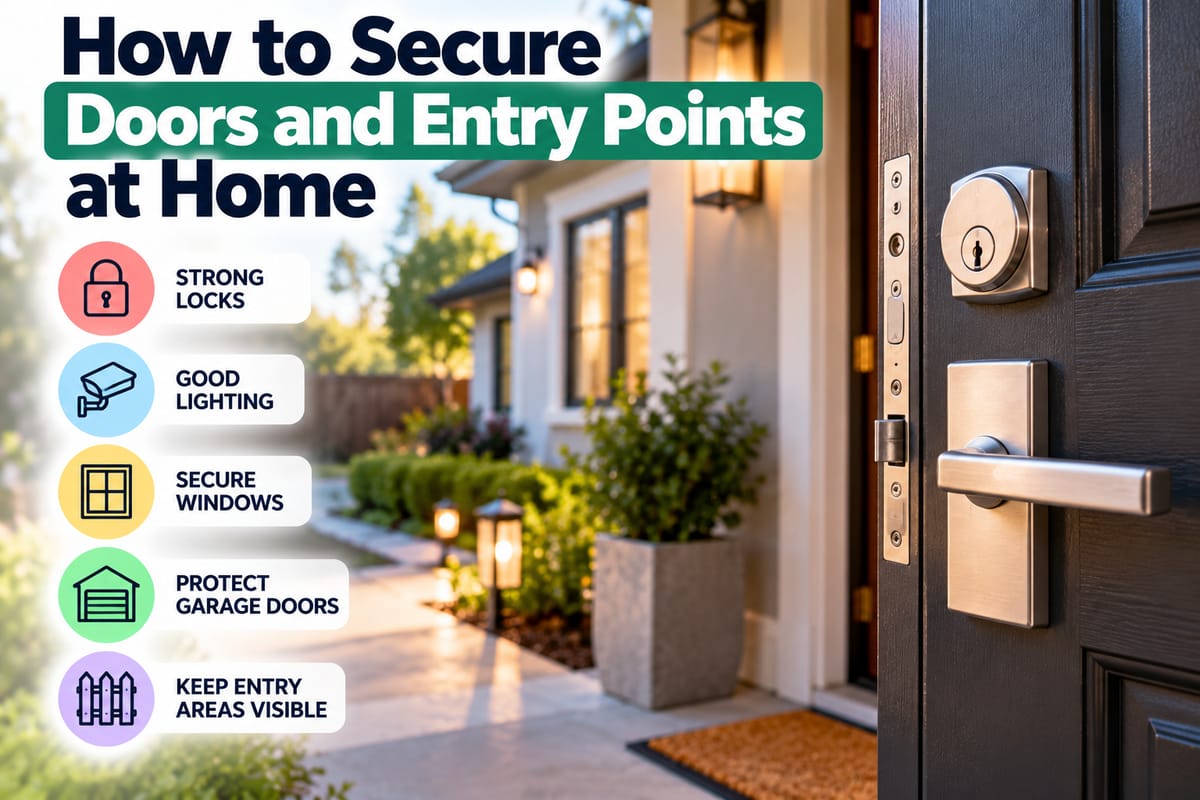
How to Secure Doors and Entry Points at Home
Doors and other entry points are among the most important parts of a home’s security. They provide access between the interior and exterior, making their design, condition, and locking systems important considerations for household safety.
Improving home security does not necessarily require expensive technology or a complete renovation. Simple measures such as strengthening door hardware, improving visibility, securing windows, maintaining locks, and developing consistent household habits can make entry points more difficult to misuse.
A secure home also needs to remain practical. Residents should be able to enter and leave easily during normal circumstances and quickly access exits during an emergency. Good security therefore involves balancing protection, convenience, maintenance, and emergency preparedness.
Why Entry-Point Security Matters
A home’s exterior walls can be difficult to penetrate, but doors and windows are designed to open. That makes them natural points of access that deserve particular attention.
Common weaknesses can include:
- Weak or damaged door frames
- Poor-quality locks
- Loose hinges
- Doors that do not close completely
- Unsecured windows
- Garage doors with inadequate security
- Poor outdoor lighting
- Spare keys stored in obvious locations
- Overgrown vegetation that blocks visibility
Addressing these weaknesses can improve the overall security of a property.
Entry-point security is also part of broader household safety. The Complete Guide to Healthy Home Living covers wider considerations for creating a safer and healthier living environment.
Start With an Entry-Point Inspection
Before buying new security equipment, walk around the property and inspect every potential entry point.
Check front and back doors, side entrances, garage doors, basement doors, accessible windows, and other openings.
For each entry point, consider:
- Does the door or window close completely?
- Is the frame in good condition?
- Are locks functioning correctly?
- Are hinges secure?
- Is the surrounding area adequately visible?
- Could someone reach the lock through a nearby opening?
- Is there an alternative entrance that receives less attention?
- Can household members use the exit quickly during an emergency?
This simple inspection can reveal problems that are easy to overlook during everyday life.
Strengthen Exterior Door Frames
A strong lock is less useful if the surrounding door frame is weak.
Exterior door frames should be securely attached to the structure of the home and should not show significant damage, splitting, or deterioration.
The area around the strike plate—the part of the frame that receives the door’s latch or locking bolt—also deserves attention.
For appropriate doors, stronger hardware and properly installed longer screws can help secure hardware more firmly to the underlying structure. The exact hardware and installation method should be selected according to the door and frame construction.
If a door frame is significantly damaged or poorly installed, replacing or professionally repairing it may be more effective than simply installing a new lock.
Use Reliable Locks
Locks are a fundamental part of door security.
Exterior doors should have properly functioning locks appropriate for the type of door and property. A lock should engage fully and operate smoothly without excessive force.
When evaluating a lock, consider:
- Build quality
- Compatibility with the door
- Resistance to weather and wear
- Ease of use
- Key control
- Availability of replacement components
- Whether household members can operate it reliably
Electronic and smart locks can provide additional features such as temporary access codes, activity notifications, or remote management. However, technology should complement rather than replace basic physical security.
Keep Door Hinges Secure
Hinges allow a door to open and close, making them another important component of a secure entry system.
Inspect exterior-door hinges for loose screws, corrosion, or other damage.
Depending on the door’s design, hinges may be positioned on the interior side where they are less accessible from outside. Where hinges are exposed, appropriate security hardware and professional installation may help reduce vulnerabilities.
Never compromise the ability to open a door safely from inside simply to make it more difficult to open from outside.
Secure Sliding Doors
Sliding glass doors can require additional attention because their construction differs from conventional hinged doors.
Check that the sliding door closes properly and that its locking mechanism works as intended.
Additional measures may include:
- Properly maintained locks
- Security-rated hardware where appropriate
- Shatter-resistant or security window film where suitable
- Keeping the surrounding track clean and functional
- Ensuring the door cannot be easily lifted from its track
Any supplemental security device should still allow occupants to operate the door safely when necessary.
Pay Attention to Garage Doors
Garage doors are sometimes overlooked when homeowners think about security.
An attached garage can provide another route into the home, particularly if an interior door connects the garage to living areas.
Make sure the garage door closes completely and that its automatic opener is maintained properly.
It is also useful to secure the interior door between the garage and the main living space with an appropriate lock.
Avoid leaving garage access devices in vehicles that are routinely parked outside or otherwise unsecured. If a remote or access credential is lost, replace or reprogram it when the system allows.
Secure Accessible Windows
Windows are also entry points and should be included in a home security inspection.
Check that accessible windows have functioning locks and that frames are in good condition.
Windows located near ground level, balconies, porches, or other structures may deserve particular attention because they can be easier to reach.
Depending on the property, additional measures may include:
- Window locks
- Security-rated glazing
- Appropriate window film
- Reinforced frames
- Security screens
- Exterior lighting
Security measures should never prevent occupants from escaping through designated emergency exits.
Avoid Blocking Emergency Exits
Home security and emergency preparedness need to work together.
A door that is extremely difficult to open from inside could create a serious problem during a fire or other emergency.
Every household should know which doors and windows can serve as emergency exits and how to use them.
Locks, security bars, gates, and other devices should be selected and installed so that people can exit quickly when necessary.
This is particularly important in bedrooms and other areas where people may need to evacuate quickly.
Improve Visibility Around Entry Points
Security is not only about locks.
Visibility can also discourage unwanted activity and make it easier for residents to notice unusual situations.
Exterior lighting can be particularly useful around:
- Front doors
- Back doors
- Side entrances
- Garages
- Pathways
- Gates
- Parking areas
Motion-activated lighting can provide illumination when movement is detected, while consistently lit areas can make entry points easier to observe.
Avoid positioning landscaping in ways that create large concealed areas immediately around doors and windows.
Keep Landscaping Under Control
Trees, shrubs, fences, and decorative structures can affect visibility.
Dense vegetation directly beside an entrance can create areas where someone could remain hidden from occupants or neighbors.
Regularly trimming vegetation can improve visibility without requiring major changes to the property.
The goal is not to eliminate landscaping but to make sure plants and structures do not unnecessarily obstruct important sightlines.
Consider a Door Viewer or Video Doorbell
A door viewer allows occupants to see who is outside before opening the door.
Modern video doorbells and cameras can provide additional capabilities such as motion detection, recording, two-way communication, and mobile notifications, depending on the device.
These systems can be useful, but they should be configured carefully.
Homeowners should consider:
- Camera placement
- Privacy
- Password security
- Software updates
- Account security
- Data storage
- Access permissions
A security camera is most useful when it forms part of a broader security system rather than being treated as a substitute for physical security.
Be Careful With Spare Keys
Spare keys can be convenient, but their location matters.
Avoid hiding a key in obvious locations immediately around a door, such as beneath a doormat or inside a nearby decorative object.
Instead, consider giving a spare key to a trusted person or using a properly managed access system.
If keys are lost or there is reason to believe someone unauthorized has obtained one, consider changing or rekeying the affected lock.
Use Smart Locks Carefully
Smart locks can provide useful features, including temporary access codes and the ability to manage access without distributing physical keys.
However, connected devices introduce another layer of security considerations.
Use strong, unique account credentials and enable multi-factor authentication when supported.
Keep the lock’s software and associated applications updated, and understand how the device behaves if its batteries lose power or its network connection becomes unavailable.
A smart lock should still provide a reliable and safe method of accessing the home.
Make Entry Habits Consistent
Even strong physical security can be undermined by everyday habits.
Household members should develop routines such as:
- Locking exterior doors whenever appropriate
- Closing accessible windows
- Checking garage doors
- Keeping keys secure
- Avoiding unnecessary sharing of access codes
- Reporting damaged locks promptly
- Updating access when household circumstances change
Consistency matters because security systems are only effective when they are actually used.
Protect Keys and Access Codes
Keys, keypad codes, smart-lock credentials, garage remotes, and other access methods should be treated as security information.
Avoid sharing access codes unnecessarily.
If several people need access to a smart lock, individual codes can sometimes be preferable to sharing one permanent code, depending on the system.
When a tenant, contractor, household employee, or other authorized person no longer needs access, remove or change their credentials when possible.
Create a Household Safety Checklist
A written checklist can make it easier to identify security weaknesses and keep up with routine maintenance.
A useful checklist might cover:
- Exterior door locks
- Door frames
- Hinges
- Sliding doors
- Garage doors
- Window locks
- Exterior lighting
- Security cameras
- Spare keys
- Smart-lock credentials
- Emergency exits
- Smoke and carbon monoxide alarms
The How to Build a Household Safety Checklist guide provides a broader framework for organizing household safety checks.
A checklist can also make it easier to identify maintenance tasks before they become larger problems.
Understand Common Household Hazards
Security is only one component of keeping a home safe.
Residents should also consider hazards such as falls, fires, electrical problems, dangerous chemicals, carbon monoxide, and other risks.
The What Are Common Household Hazards? guide explores common risks that can affect households and ways to think about them.
A comprehensive safety approach considers both intentional threats and everyday accidents.
Prepare Entry Points for Emergencies
Every household should know how to leave the property if a normal entrance becomes unusable.
Emergency planning can include identifying multiple exit routes, keeping pathways clear, and ensuring doors and windows designated as emergency exits can be opened when necessary.
The How to Prepare for Home Emergencies guide provides additional information about preparing households for unexpected situations.
Security improvements should always preserve safe evacuation.
Maintain Security Equipment
Home security is not a one-time project.
Locks wear out. Batteries lose power. Cameras require updates. Door frames can deteriorate. Outdoor lights can fail. Windows can develop problems.
Schedule periodic inspections of important entry points.
During these checks, look for:
- Loose hardware
- Rust or corrosion
- Damaged frames
- Sticking doors
- Broken locks
- Dead batteries
- Failed lights
- Outdated software
- Forgotten access credentials
Regular maintenance helps keep security measures functioning when they are needed.
Make Security Part of Everyday Home Management
Securing doors and entry points is most effective when it becomes part of normal household maintenance rather than an occasional project.
Start with the basics: inspect doors and windows, repair damaged hardware, use appropriate locks, improve visibility, secure garage access, and protect keys and digital credentials.
Then consider additional measures such as cameras, smart locks, security lighting, and reinforced hardware according to the needs of the property.
The strongest approach is not necessarily the most complicated one. It is a practical combination of physical security, good habits, regular maintenance, emergency planning, and awareness that fits the way the household actually lives.


2 Comments
Micle harison
June 7, 2019Lorem ipsum dolor sit amet, usu ut perfecto postulant deterruisset, libris causae volutpat at est, ius id modus laoreet urbanitas. Mel ei delenit dolores.
John Doe
June 7, 2019Some consultants are employed indirectly by the client via a consultancy staffing company.