
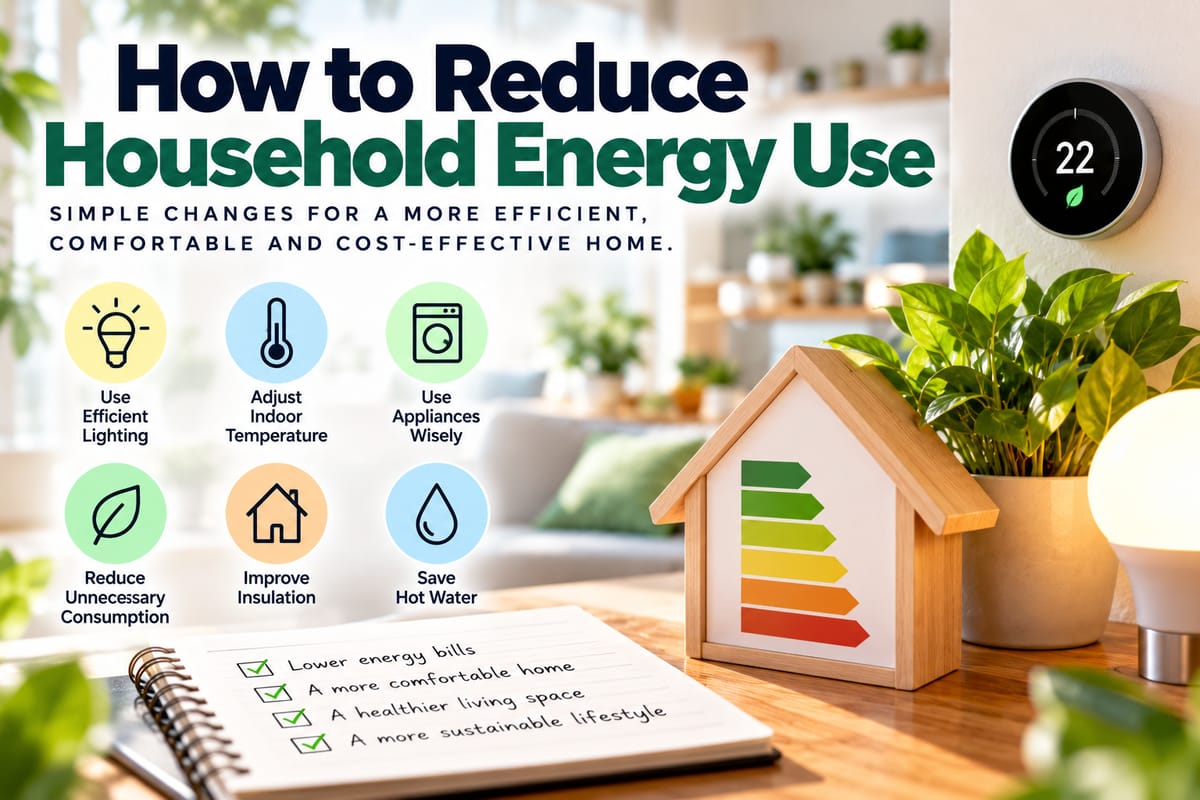
How to Reduce Household Energy Use
Household energy use can add significantly to monthly expenses, particularly when heating, cooling, appliances, lighting, and electronics are used throughout the day. Reducing energy consumption does not necessarily require major renovations or expensive technology. Many savings can come from changing everyday habits and making better use of the equipment already in the home.
A more energy-conscious household can also reduce unnecessary resource use while maintaining comfort and convenience. The most effective approach is usually to identify where the most energy is being consumed and then make practical changes that address those areas.
Understand Where Household Energy Goes
Before reducing energy use, it helps to understand which activities and appliances consume the most energy.
Common sources include:
- Heating and cooling
- Water heating
- Refrigerators and freezers
- Washing machines and dryers
- Ovens and cooking equipment
- Lighting
- Televisions and computers
- Entertainment systems
- Small appliances
- Standby electronics
The exact energy profile varies between households. A home in a hot climate may use more electricity for cooling, while a home in a cold climate may devote considerably more energy to heating.
Understanding the home’s specific pattern makes it easier to focus efforts where they can have the greatest practical effect.
Adjust Heating and Cooling Habits
Heating and cooling systems can account for a significant portion of household energy use.
Small changes to temperature settings can reduce the amount of work required from heating or cooling equipment.
Rather than maintaining an extreme indoor temperature, aim for a comfortable setting that does not require excessive energy to maintain.
Other useful measures include:
- Keeping doors and windows closed when heating or cooling is operating
- Using curtains or blinds to manage sunlight
- Cleaning or replacing filters as recommended
- Keeping vents unobstructed
- Using fans when appropriate
- Checking for drafts around doors and windows
Understanding how indoor temperature affects comfort can help households balance comfort with practical energy use.
Improve Insulation and Seal Air Leaks
Energy can be wasted when conditioned indoor air escapes through gaps and poorly sealed areas.
Common locations for air leakage include:
- Doors
- Windows
- Attics
- Roof spaces
- Utility openings
- Pipe penetrations
- Ventilation openings
Weatherstripping, caulking, insulation improvements, and other appropriate measures can help reduce unwanted heat transfer.
The amount of improvement possible depends on the home’s construction and local climate, so it is useful to identify the largest sources of heat loss or heat gain before making changes.
Use Natural Light When Possible
Lighting accounts for less energy when daylight can provide sufficient illumination.
During daylight hours, open curtains or blinds where appropriate and arrange frequently used areas to take advantage of natural light.
This does not mean keeping lights off regardless of circumstances. Safety, visibility, and comfort should remain priorities.
However, making natural light part of normal daytime routines can reduce unnecessary use of artificial lighting.
Switch to Efficient Lighting
When household bulbs need replacement, energy-efficient lighting can reduce electricity consumption over the useful life of the bulbs.
LED lighting is commonly used because it can provide illumination with relatively low electricity consumption and generally has a long operating life.
Consider using appropriate brightness levels as well. A room does not necessarily need every light fixture operating at maximum brightness at all times.
Motion sensors, timers, and automatic controls can also help prevent lights from remaining on unnecessarily in some areas.
Turn Off Devices When They Are Not Needed
Many household electronics consume electricity while operating, and some may continue drawing a small amount of power when left in standby mode.
Computers, televisions, gaming systems, chargers, entertainment equipment, and other electronics can sometimes be switched off completely when they will not be used for extended periods.
Power strips can make this easier by allowing several related devices to be disconnected at once.
However, not every device needs to be unplugged constantly. Focus on equipment that is used infrequently or that can conveniently be switched off without disrupting necessary functions.
Use Appliances Efficiently
Household appliances can consume substantial amounts of energy over time.
Simple habits can improve efficiency.
For example:
- Run washing machines with appropriately sized loads.
- Avoid repeatedly opening an oven while cooking.
- Keep refrigerator and freezer doors closed as much as practical.
- Use appropriate cooking settings.
- Clean appliance filters and vents as recommended.
- Avoid running appliances unnecessarily.
Efficient use is often more practical than simply replacing every appliance with a newer model.
Pay Attention to Refrigerators and Freezers
Refrigerators and freezers operate continuously, making their energy use particularly relevant.
Keep refrigerator and freezer doors closed as much as possible and avoid placing hot food directly into a refrigerator unless appropriate for the appliance and food-safety requirements.
Allowing sufficient airflow around the appliance can also help it operate properly.
Older refrigerators and freezers may consume considerably more electricity than newer efficient models, so replacement can sometimes make sense when an appliance is very old, inefficient, or nearing the end of its useful life.
Use Washing Machines Efficiently
Laundry can consume energy through both washing and drying.
Where suitable for the clothing and household’s needs, washing with cooler water can reduce the energy required to heat water.
Running full or appropriately sized loads can also make better use of each washing cycle.
Clothing that can safely be air-dried can reduce reliance on electric or gas-powered dryers.
Drying conditions and local climate will determine how practical air-drying is, but even partially air-drying clothes can sometimes reduce dryer use.
Reduce Unnecessary Hot Water Use
Heating water can require substantial energy.
Households can reduce hot water consumption by:
- Taking shorter showers
- Fixing leaking hot-water fixtures
- Using appropriate water temperatures
- Washing clothes with cooler water when suitable
- Avoiding unnecessary hot-water use
- Maintaining water-heating equipment appropriately
If a household uses a water heater, appropriate maintenance and temperature settings can also influence energy consumption.
Cook Efficiently
Cooking methods can affect household energy use.
When practical, use appropriately sized cookware and match cookware to the heating element.
Keeping lids on pots can also help retain heat and reduce cooking time.
For small meals, smaller appliances may sometimes require less energy than heating a large oven, depending on the appliance and task.
However, energy savings should not come at the expense of food safety. Cooking temperatures and safe food-handling practices remain important.
Make Better Use of Fans
Fans can sometimes improve comfort without requiring as much energy as mechanical cooling systems.
Ceiling and portable fans move air across the body, which can make a room feel more comfortable without necessarily lowering the actual air temperature.
Fans do not cool an empty room in the same way an air conditioner does, so switching them off when a room is unoccupied can prevent unnecessary electricity use.
Their effectiveness depends on the climate, humidity, room design, and individual comfort.
Avoid Unnecessary Energy Consumption
Reducing energy use is closely connected to reducing unnecessary consumption more broadly.
Before turning on an appliance or purchasing another device, consider whether it is genuinely needed.
The principles behind how households can reduce unnecessary consumption can help households look beyond energy bills and consider whether resources are being used intentionally in the first place.
For example, avoiding unnecessary purchases can also reduce the energy associated with manufacturing, transportation, storage, and eventual disposal.
Maintain Household Equipment
Poorly maintained equipment can operate less efficiently or develop problems that increase energy consumption.
Regular maintenance may include:
- Cleaning air filters
- Keeping vents clear
- Cleaning appliance components
- Checking seals
- Removing dust from appropriate equipment
- Following manufacturer maintenance recommendations
Maintenance schedules vary by appliance, so follow the relevant instructions rather than applying the same procedure to every device.
Consider Smart Controls
Smart thermostats, timers, sensors, and energy-monitoring systems can help households manage consumption more precisely.
For example, programmable controls can reduce heating or cooling when a home is unoccupied and restore preferred settings around expected arrival times.
Motion sensors can turn lights on when someone enters a room and off after the space becomes inactive.
Smart technology is not necessary for every household, however. A simple timer or manual routine can sometimes achieve a similar result at a lower cost.
Use Energy During Appropriate Times When Relevant
Some electricity systems use different pricing structures depending on the time of day.
Where such tariffs are available, households may be able to reduce costs by shifting flexible activities to lower-cost periods.
Examples could include:
- Running washing machines
- Charging certain devices
- Operating some appliances
- Scheduling other flexible electricity use
The potential savings depend entirely on the household’s electricity provider and tariff structure, so check the applicable pricing arrangement before changing routines.
Consider Renewable Energy Options
Some households may choose to generate part of their electricity through renewable energy systems such as solar panels.
Whether this makes financial or practical sense depends on factors including:
- Local sunlight conditions
- Installation costs
- Roof suitability
- Electricity prices
- Available incentives
- System maintenance
- Expected length of residence
Renewable energy is a larger investment than changing everyday habits, so it should be evaluated based on the household’s circumstances.
Make Energy Efficiency Part of Healthy Home Living
Energy efficiency can fit naturally into broader household habits involving comfort, maintenance, indoor conditions, and resource use.
The Complete Guide to Healthy Home Living provides a wider perspective on creating a home environment that supports everyday well-being.
A comfortable home does not have to consume excessive amounts of energy. Good ventilation, appropriate temperature management, maintenance, natural lighting, and sensible appliance use can all contribute to a more efficient living environment.
Reduce Consumption Without Sacrificing Comfort
Energy reduction works best when changes are realistic.
Turning off lights in unused rooms is simple. Maintaining an uncomfortable indoor temperature all day in an attempt to minimize energy use may be difficult to sustain.
The objective should be to eliminate waste rather than eliminate comfort.
For example, reducing unnecessary heating or cooling while maintaining a reasonable indoor environment is generally more practical than making extreme changes that household members will quickly abandon.
Build Energy-Saving Habits
Long-term reductions often come from small habits repeated consistently.
Useful habits can include:
- Checking lights before leaving a room
- Turning off electronics that are not needed
- Using natural light during the day
- Running full laundry loads when appropriate
- Limiting unnecessary hot-water use
- Maintaining heating and cooling equipment
- Adjusting temperature settings when the home is unoccupied
- Choosing efficient appliances when replacements are necessary
Once these actions become routine, they require little additional effort.
Track Your Energy Use
Energy bills can provide useful information about changes in household consumption.
Compare bills across similar periods and look for significant changes.
If energy use increases unexpectedly, consider whether something has changed, such as:
- A new appliance
- Increased air-conditioning use
- More time spent at home
- Changes in household size
- A malfunctioning appliance
- Seasonal weather changes
An energy monitor can provide additional information for households that want more detailed insight into individual devices or circuits.
Make Improvements Gradually
There is no need to transform an entire home in a single weekend.
Start with the easiest changes and then address larger opportunities when they make financial and practical sense.
For example:
- Turn off unnecessary lights and electronics.
- Adjust everyday heating and cooling habits.
- Improve appliance-use routines.
- Address obvious drafts and insulation problems.
- Replace inefficient equipment when it reaches the end of its useful life.
- Consider larger energy improvements if they fit the household’s budget and circumstances.
This gradual approach can make energy efficiency more manageable.
Think About Energy as Part of Sustainable Living
Reducing household energy use is one component of broader resource management.
A Sustainable Living Guide can provide a wider framework for considering energy, consumption, waste, transportation, and other everyday household choices together.
The goal does not have to be perfection. A household can make meaningful progress by identifying wasteful habits and replacing them with more efficient routines.
Make the Home More Energy Conscious
Reducing household energy use begins with understanding where energy is being consumed and which changes are realistic.
Heating and cooling, water heating, appliances, lighting, and electronics can all provide opportunities for improvement. Simple actions such as adjusting temperature settings, using natural light, maintaining equipment, reducing hot-water use, and switching off unnecessary devices can gradually lower consumption.
Larger measures such as insulation improvements, efficient appliances, smart controls, or renewable energy systems may provide additional opportunities when they make sense for the household.
The most sustainable approach is often the one that can become part of normal life. Small, consistent changes can reduce wasted energy while allowing households to remain comfortable and practical in their everyday routines.




2 Comments
Micle harison
June 7, 2019Lorem ipsum dolor sit amet, usu ut perfecto postulant deterruisset, libris causae volutpat at est, ius id modus laoreet urbanitas. Mel ei delenit dolores.
John Doe
June 7, 2019Some consultants are employed indirectly by the client via a consultancy staffing company.