
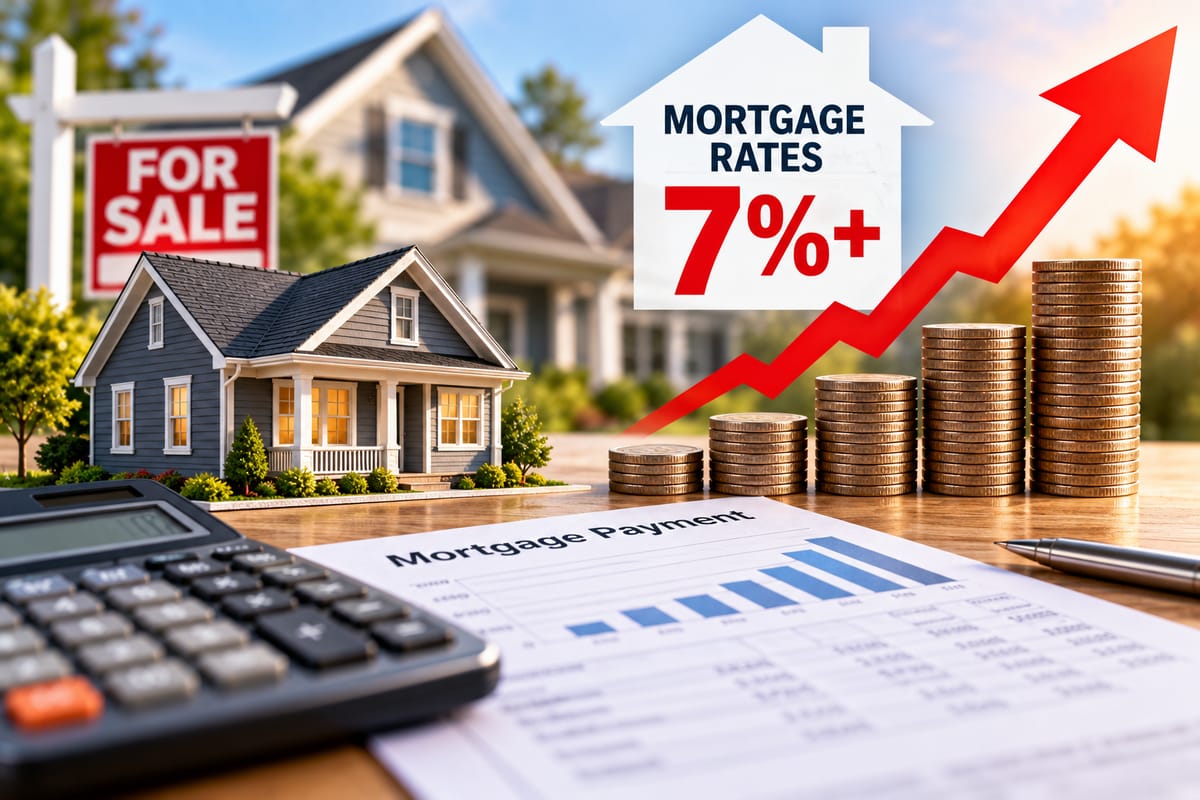
Mortgage Rates Above 7% Keep Homebuyers Under Pressure as Borrowing Costs Rise
Mortgage rates have moved back above the psychologically important 7% threshold, putting another layer of pressure on Americans trying to buy homes while prices remain elevated.
Freddie Mac reported that the average 30-year fixed mortgage rate reached 7.03% for the week ending September 24, 2026, up from 6.95% the previous week and 6.30% a year earlier. The 15-year fixed rate also climbed to 6.42%, compared with 6.26% one week earlier.
The increase comes as longer-term bond yields have risen and the Federal Reserve has maintained a relatively restrictive interest-rate environment. For households already dealing with higher living costs, the combination is making the decision to purchase a home more expensive and more difficult to navigate.
Mortgage Rates Have Crossed Back Above 7%
The latest Freddie Mac reading marks the first time its weekly 30-year fixed mortgage average has exceeded 7% since January 2025.
The move has been relatively rapid. The average rate was 6.76% on September 10 before rising to 6.95% on September 17 and then 7.03% on September 24.
For homebuyers, even seemingly modest changes in mortgage rates can have a significant effect because interest is charged over decades rather than months.
Freddie Mac’s affordability guidance illustrates the difference. On a $300,000 30-year mortgage, principal-and-interest payments are approximately $1,896 at 6.5%, compared with about $1,996 at 7% and roughly $2,098 at 7.5%. Those figures exclude property taxes, homeowners insurance, mortgage insurance and other housing costs.
That means a buyer who qualifies for a particular home at a lower rate may no longer qualify for the same purchase once rates rise, even if the property’s price has not changed.
Why Mortgage Rates Can Rise Even When the Fed Rate Is Different
Mortgage rates and the Federal Reserve’s benchmark interest rate are closely connected, but they are not the same thing.
On September 16, the Federal Reserve raised its federal funds target range by a quarter percentage point to 3.75% to 4%. The central bank said inflation remained elevated and that economic activity was continuing to expand at a solid pace.
However, 30-year mortgage rates are heavily influenced by longer-term financial markets, particularly yields on U.S. Treasury securities and mortgage-backed securities.
That distinction matters because mortgage rates can rise even without a direct increase in the federal funds rate. Conversely, mortgage rates can sometimes decline before the Fed changes its policy rate if investors anticipate weaker inflation or economic growth.
The broader relationship between borrowing costs, monetary policy and economic activity is explored in The Global Economy Explained.
Higher Rates Change the Monthly Payment Equation
The biggest immediate effect for prospective homeowners is the monthly payment.
Consider a hypothetical $300,000 mortgage with a 30-year term. At a 6.5% rate, the principal-and-interest payment would be around $1,896 per month. At 7.03%, the payment rises to roughly $2,002.
That difference is about $106 per month, or more than $1,200 per year, before taxes and insurance are considered.
For larger mortgages, the difference becomes more substantial.
A household borrowing $500,000 faces a principal-and-interest payment of roughly $3,338 at 7.03%, compared with approximately $3,161 at 6.5%. The difference is nearly $177 every month.
These examples also demonstrate why mortgage rates matter beyond the advertised percentage. Buyers have to evaluate the total monthly housing obligation against income, existing debts, savings and other recurring expenses.
Home Prices Are Still Adding to the Affordability Challenge
Higher mortgage rates are only one part of the affordability equation.
The Federal Housing Finance Agency reported that U.S. single-family home prices increased 0.3% in July from June and were up 2.6% from a year earlier. The increase occurred even as housing demand remained relatively weak and inventory increased.
That creates a difficult combination for buyers.
When rates rise, the cost of financing increases. When home prices remain elevated, buyers need to borrow more money or bring more cash to the transaction. When both occur at the same time, the amount of income required to comfortably support a mortgage can rise substantially.
The result is that a household may find that a home that appeared affordable several months earlier now requires a larger down payment, a smaller loan or a higher monthly budget.
Homebuyers Are Already Feeling the Pressure
Housing activity has shown signs of sensitivity to borrowing costs.
The National Association of REALTORS® reported that existing-home sales fell 2% month over month in August and were down 1.2% from a year earlier. The median existing-home price was $429,100, up 1.6% from the previous year, while unsold inventory increased 3.2% to 1.62 million units.
Pending home sales also remained weaker on a year-over-year basis, according to NAR’s September research update.
That does not mean every market is moving in the same direction. Housing conditions vary considerably by region, price range and local employment conditions.
But nationally, the combination of elevated borrowing costs and relatively high home prices is keeping affordability at the center of the housing conversation.
The 7% Threshold Has a Psychological Effect
Mortgage rates are not determined by round numbers, but 7% has become an important psychological reference point for consumers.
Moving from 6.9% to 7% technically represents only a small change. Yet crossing the threshold can influence how buyers perceive the market and whether they decide to move forward with a purchase.
NAR reported that the 30-year mortgage rate’s move above 7% was already changing the financing calculations facing home shoppers.
For buyers who were already close to the limit of what they could afford, another increase can be enough to force a change in strategy.
Some may consider less expensive homes. Others may increase their down payment, postpone their purchase or investigate different loan structures.
Waiting for Lower Rates Carries Its Own Uncertainty
The latest increase has also renewed attention on the question of when mortgage rates might eventually decline.
That question is difficult to answer because mortgage rates depend on inflation, Treasury yields, economic growth, financial-market expectations and monetary policy.
The Federal Reserve’s September projections showed a range of individual views about the appropriate federal funds rate over the coming years rather than a guaranteed path for borrowing costs.
Homebuyers therefore face an uncertain trade-off. Waiting could potentially provide an opportunity to refinance later if borrowing costs decline, but there is no guarantee that rates will move lower within a particular timeframe. Home prices, inventory and household circumstances can also change while a buyer waits.
The broader factors affecting future borrowing costs are discussed in Will Interest Rates Fall Again?.
Refinancing Is Not an Automatic Safety Net
Some buyers may reason that they can purchase now and refinance later if mortgage rates fall.
That strategy can work under the right circumstances, but refinancing is not guaranteed to be beneficial.
A future refinance would depend on mortgage rates at that time, the borrower’s credit profile, the home’s value, closing costs and the amount of principal remaining on the original loan.
There is also a risk in assuming that a future rate decline will happen quickly enough to make a meaningful difference.
For that reason, buyers generally need to assess whether the initial mortgage payment is sustainable on its own rather than relying entirely on the possibility of refinancing later.
Higher Rates Can Affect Sellers Too
Rising mortgage rates do not only affect people purchasing homes.
They can also influence homeowners who might otherwise consider selling.
A homeowner with a relatively low existing mortgage rate may be reluctant to sell and replace that loan with a substantially more expensive mortgage. This can reduce the incentive to move, particularly for households that are comfortable in their current homes.
At the same time, potential sellers may have to compete for buyers whose purchasing power has weakened.
This dynamic can contribute to a housing market in which buyers remain cautious while some existing homeowners remain reluctant to list their properties.
Affordability Is About More Than the Mortgage Payment
A mortgage payment is only one part of the cost of owning a home.
Buyers also have to account for:
- Property taxes
- Homeowners insurance
- Mortgage insurance when applicable
- Utilities
- Maintenance and repairs
- Homeowners association fees
- Closing costs
- Emergency expenses
- Potential changes in income
These costs can make the difference between a mortgage that looks manageable on paper and a housing budget that becomes difficult in practice.
That is why the recent discussion around Mortgage Affordability Remains Under Pressure as High Rates Keep Homebuyers Cautious remains relevant as borrowing costs change.
A Larger Down Payment Can Reduce the Loan, but Not Every Cost
One way buyers can reduce the amount they borrow is by making a larger down payment.
A smaller loan generally means a lower monthly principal-and-interest payment and potentially less total interest paid over the life of the mortgage.
But using more cash for a down payment can also reduce a household’s emergency savings.
That creates another budgeting consideration. A buyer may lower the mortgage payment but leave themselves with less money available for unexpected repairs, job disruptions, medical expenses or other emergencies.
The right balance depends on the household’s income, savings, debt obligations and financial priorities.
Buyers Are Also Comparing Different Mortgage Options
Traditional 30-year fixed mortgages remain a major part of the U.S. mortgage market, but buyers may encounter other structures, including 15-year fixed mortgages and adjustable-rate mortgages.
Freddie Mac’s September 24 data put the average 15-year fixed rate at 6.42%, below the 7.03% average for 30-year loans.
A shorter mortgage can mean a higher monthly payment but less interest over the life of the loan. An adjustable-rate mortgage may initially offer a different payment structure, but its future rate can change according to the terms of the loan.
Those differences make it important to compare the full loan structure rather than focusing exclusively on the initial interest rate.
Mortgage Rates Have Already Changed the Housing Calculation
The latest move above 7% highlights how sensitive household finances can be to changes in borrowing costs.
The difference between 6.5%, 7% and 7.5% may appear small when expressed as percentages. Over a 30-year mortgage, however, those fractions can translate into thousands of dollars in additional interest and meaningful differences in monthly cash flow.
For households already dealing with higher prices for everyday necessities, a larger housing payment can also reduce the amount available for saving, investing, debt repayment and discretionary spending.
This is why a change in mortgage rates can have effects far beyond the housing market.
The Earlier Rate Increase Is Still Visible in Household Budgets
The current increase is part of a broader period of elevated borrowing costs.
The September 24 Freddie Mac reading was more than a percentage point above the 5.98% rate recorded on February 26, 2026.
For a household shopping for a home, that change can materially alter purchasing power.
It also explains why articles such as Mortgage Rates Rise Again as Homebuyers Face Higher Monthly Payments remain closely connected to the current affordability debate.
The important point is that buyers are not simply responding to the headline mortgage rate. They are responding to what that rate does to the entire household budget.
What Homebuyers Are Watching Next
Several factors will remain important for mortgage borrowers in the coming months.
Inflation: Persistent inflation can keep pressure on interest rates and longer-term bond yields.
Treasury yields: Mortgage rates generally respond closely to movements in longer-term Treasury markets.
Federal Reserve policy: Although the Fed does not directly set mortgage rates, its policy decisions can influence financial-market expectations.
Home prices: If prices continue rising, falling mortgage rates could be partly offset by more expensive homes.
Housing inventory: More available homes could provide buyers with greater choice and potentially change negotiating conditions.
Household income: Wage growth and employment conditions ultimately determine how much housing expense many families can absorb.
The Federal Reserve said in September that inflation remained elevated while economic activity was expanding at a solid pace, underscoring why the interest-rate environment remains closely watched.
The Homebuying Decision Is Becoming More Budget-Sensitive
Mortgage rates above 7% do not make homeownership impossible, but they change the financial calculation for many households.
Buyers have to look beyond the sale price and consider the interest rate, loan term, down payment, taxes, insurance, maintenance and their broader financial obligations.
The latest rate increase also shows why mortgage affordability can change even when a home’s asking price remains unchanged. A higher borrowing cost can effectively increase the price of financing the same property.
For prospective buyers, the most important figure may therefore be the complete monthly housing cost rather than the mortgage rate alone.
As the housing market moves through another period of elevated borrowing costs, household budgets will continue to play a central role in determining how much buyers can comfortably afford.




2 Comments
Micle harison
June 7, 2019Lorem ipsum dolor sit amet, usu ut perfecto postulant deterruisset, libris causae volutpat at est, ius id modus laoreet urbanitas. Mel ei delenit dolores.
John Doe
June 7, 2019Some consultants are employed indirectly by the client via a consultancy staffing company.