
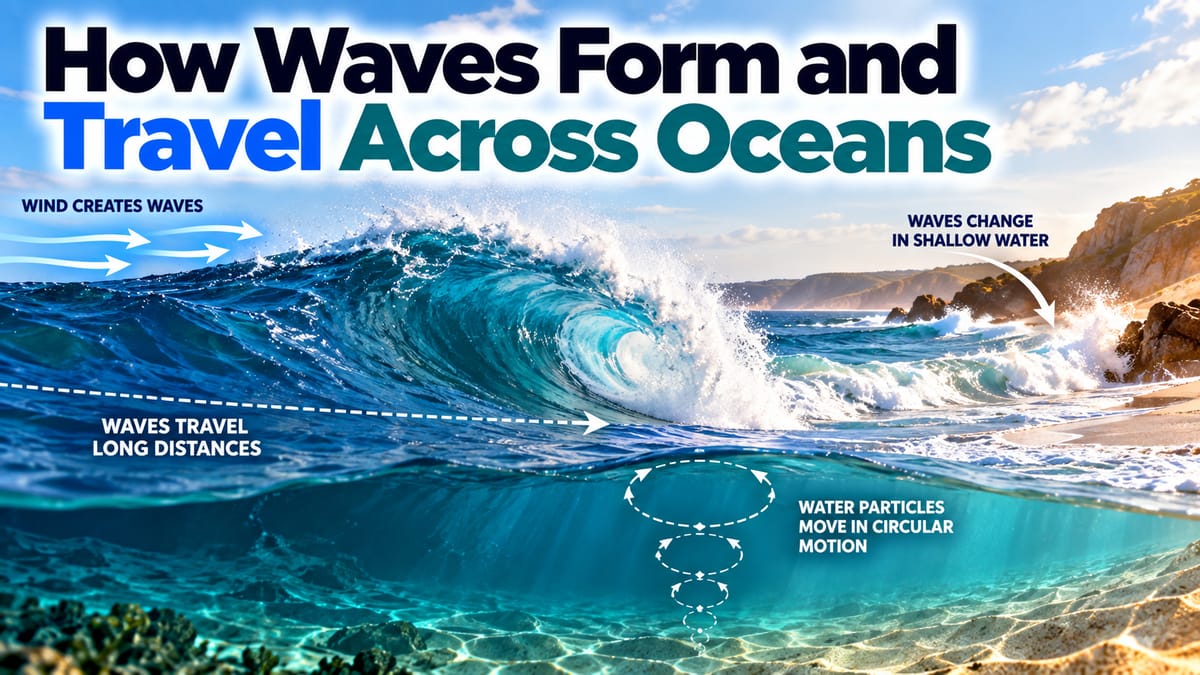
How Waves Form and Travel Across Oceans
Ocean waves are one of the most familiar sights on Earth, yet the physics behind them is surprisingly complex. Waves can travel thousands of kilometers across an ocean, carry enormous amounts of energy, and reshape coastlines without transporting the same body of water from one location to another.
Most surface waves begin when energy is transferred to the ocean surface. Wind is the most common source, but earthquakes, underwater landslides, volcanic activity, and gravitational forces from the Moon and Sun can also generate different types of waves.
Understanding how waves form and travel provides a useful window into oceanography, weather, coastal environments, and Earth’s larger physical systems. It also helps explain why waves behave differently in deep water, shallow coastal areas, enclosed seas, and during severe storms.
What Is an Ocean Wave?
An ocean wave is a moving disturbance that transfers energy through water.
The important distinction is that the wave carries energy much farther than individual water particles travel horizontally. Water particles generally move in orbital or oscillating paths as a wave passes, while the wave’s energy continues forward.
This is why a wave can travel across a large section of ocean without transporting an equivalent volume of seawater from its original location.
Ocean waves can vary dramatically in:
- Height
- Wavelength
- Period
- Direction
- Speed
- Energy
- Shape
These characteristics depend on how the wave was generated and the conditions through which it travels.
Ocean processes are closely connected with the broader physical systems of the planet. The Earth Science and Geology Complete Guide provides broader context for understanding the geological and physical processes that shape Earth’s surface.
How Wind Creates Ocean Waves
Wind-generated waves are the most common waves observed across the open ocean.
The process begins when moving air passes over the water’s surface. Friction between the air and water creates small disturbances. These initial ripples alter the surface enough for the wind to transfer additional energy into the water.
As more energy enters the surface, the ripples become larger waves.
Several factors determine how large those waves can become:
- Wind speed: Stronger winds can transfer more energy to the ocean.
- Wind duration: The longer the wind blows, the more time it has to build waves.
- Fetch: A longer uninterrupted stretch of water gives waves more room to develop.
- Existing wave conditions: Previously generated waves can interact with newly formed waves.
- Water depth: Depth becomes particularly important as waves approach shore.
A short period of gentle wind may create small ripples, while a powerful storm blowing over a large area of ocean for many hours can generate large, organized waves.
What Are Ripples?
The earliest stage of many wind-generated waves begins with tiny ripples on the water surface.
At first, these disturbances may be extremely small. Surface tension plays an important role in maintaining the shape of very small ripples.
As the wind continues to supply energy, the disturbances become larger. Gravity increasingly becomes the dominant force attempting to restore the water surface toward equilibrium.
Once waves become sufficiently large, gravity waves become the familiar ocean waves seen by sailors, swimmers, and coastal communities.
The Role of Wave Energy
A wave is fundamentally a mechanism for transporting energy.
When wind transfers energy to the ocean, that energy can travel away from the original generation area. A wave generated during a distant storm can therefore reach a coastline long after the storm itself has moved away.
Wave energy depends strongly on wave height. Larger waves generally contain substantially more energy than smaller waves.
This energy can eventually interact with:
- Beaches
- Cliffs
- Coral reefs
- Sandbars
- Estuaries
- Sea walls
- Harbors
- Ocean ecosystems
Over long periods, repeated wave action can move sediment and gradually reshape coastal landscapes.
What Is Wavelength?
Wavelength is the horizontal distance between corresponding points on consecutive waves.
For example, it can be measured from one wave crest to the next crest.
Longer wavelengths are generally associated with waves that have traveled farther from their generating area or developed under conditions that allow them to become more organized.
Shorter waves tend to be more closely spaced and can be associated with local wind conditions or developing seas.
Wavelength is one of several characteristics scientists use to describe wave behavior.
What Is Wave Period?
Wave period is the amount of time between successive wave crests passing a fixed point.
A wave with a short period has crests arriving relatively close together in time. A wave with a longer period has more time between successive crests.
Wave period is particularly useful for distinguishing between locally generated wind waves and longer-traveling swell.
For example, a storm may generate a chaotic mixture of waves with different periods. As these waves travel away from the storm, they can separate into more organized groups.
Wind Waves and Ocean Swell
Not every wave reaching a beach is being generated by the wind blowing directly over that beach.
Ocean waves are commonly described in two broad categories: wind waves and swell.
Wind waves are actively influenced by local winds. They often have shorter wavelengths, shorter periods, and a more irregular appearance.
Swell consists of waves that have traveled away from their original generating area. Because different waves travel at different speeds, the wave field can become more organized as it moves across the ocean.
A distant storm can therefore produce swell that reaches a coastline days later and hundreds or even thousands of kilometers away.
How Waves Travel Across the Ocean
As waves move through deep water, energy travels forward while individual water particles primarily undergo orbital motion.
Near the ocean surface, particles follow approximately circular or elliptical paths. The size of these orbital motions decreases with depth.
In deep water, the wave’s influence becomes progressively weaker farther below the surface.
This explains why a large wave can pass over deep ocean water without causing the entire water column to move forward with the wave.
The wave is primarily transporting energy and information about the disturbance, rather than carrying the same water molecules across the ocean.
Why Waves Change as They Approach Shore
Ocean waves behave differently when they encounter shallow water.
As a wave moves from deep water toward a coastline, the seafloor begins to influence its motion. The wave’s lower orbital movement interacts increasingly with the seabed.
As the water becomes shallower:
- Wave speed decreases.
- Wavelength becomes shorter.
- Wave height can increase.
- The wave becomes steeper.
- Eventually, the wave may break.
This transformation is known as wave shoaling.
The process explains why waves that may appear relatively modest in deep water can become much taller and more powerful near shore.
Why Waves Break
A wave eventually becomes unstable when its height becomes too large relative to the water depth.
As the wave approaches shallow water, its lower portion is slowed by interaction with the seabed. The upper portion continues moving differently, causing the wave to become increasingly steep.
Eventually, the crest topples forward.
This is the breaking wave seen along beaches.
The shape and behavior of breaking waves depend on factors such as:
- Seafloor slope
- Water depth
- Wave height
- Wave period
- Beach shape
- Nearshore currents
- Underwater reefs and sandbars
A gently sloping beach may produce spilling breakers, while steeper coastal profiles can produce more plunging or powerful breaking waves.
How Waves Shape Coastlines
Wave energy is one of the major forces responsible for coastal erosion and sediment movement.
When waves strike a rocky shoreline, repeated impacts can contribute to weathering and erosion. Waves can also transport sand and other sediments along the coast.
Over time, wave action can contribute to the formation and modification of:
- Beaches
- Sea cliffs
- Caves
- Arches
- Sandbars
- Spits
- Barrier islands
- Coastal inlets
The effects are not always destructive. Waves also redistribute sediment and help build coastal features.
Storm waves can accelerate these processes dramatically, sometimes changing a beach or shoreline within hours.
Wave Refraction
Waves approaching an irregular coastline do not always break simultaneously along the entire shore.
When different parts of a wave encounter different water depths, they can slow down at different rates. This causes the wave to bend, a process known as wave refraction.
Wave refraction can concentrate wave energy in some coastal areas while reducing it in others.
This helps explain why headlands, bays, beaches, and sheltered coves can experience very different wave conditions even when they are located close together.
Wave Reflection
Waves can also reflect when they encounter solid boundaries.
Cliffs, seawalls, harbor structures, and other hard surfaces can cause wave energy to bounce back toward the sea.
Reflected waves may interact with incoming waves, producing complicated patterns of interference.
In enclosed areas such as harbors, this can create unusual water movements and standing-wave patterns.
Wave Interference
When two or more waves occupy the same area, their effects can combine.
If wave crests align, their heights can reinforce one another. This is called constructive interference.
If a crest meets a trough in certain conditions, the waves can partially cancel each other through destructive interference.
Because oceans contain many waves traveling in different directions and with different periods, interference contributes to the constantly changing appearance of the sea surface.
Storm Waves and Large Seas
Major storms can generate enormous amounts of wave energy.
As strong winds blow across a large area of ocean, they transfer energy into the surface. When the storm lasts long enough and has sufficient fetch, the resulting waves can grow substantially.
A mature storm may produce waves traveling in several directions, while different wave groups can have different heights and periods.
When these waves reach coastal areas, they can contribute to:
- Coastal flooding
- Beach erosion
- Damage to coastal infrastructure
- Dangerous surf
- Sediment redistribution
- Changes to dunes and shorelines
Wave conditions are therefore an important consideration in marine forecasting and coastal planning.
How Tsunamis Differ From Ordinary Ocean Waves
Tsunamis are often called waves, but they are generated differently from ordinary wind-driven waves.
A tsunami can occur when a large volume of seawater is suddenly displaced. Underwater earthquakes are a major cause, but submarine landslides and volcanic activity can also generate tsunamis.
Unlike typical wind waves, tsunamis can involve extremely long wavelengths that extend across large portions of the ocean.
In deep water, a tsunami may have relatively modest surface height while traveling rapidly across an ocean basin. As it approaches shallow coastal water, its speed decreases and its height can increase significantly.
This is one reason tsunamis can become highly destructive near shore.
Tides Are Also Wave-Like Movements
Tides involve large-scale changes in ocean water levels primarily caused by gravitational interactions involving the Moon and Sun, combined with Earth’s rotation and the shape of ocean basins.
Although tides are not ordinary wind-generated surface waves, they represent another form of long-period movement within Earth’s oceans.
Tidal behavior can affect coastal water levels, currents, ecosystems, navigation, and the conditions under which ordinary waves reach shore.
How Waves Affect Marine Ecosystems
Wave action is an important part of many marine environments.
Waves help circulate water, transport nutrients and sediments, influence oxygen exchange, and shape habitats.
Rocky shores, sandy beaches, coral reefs, kelp forests, estuaries, and other coastal environments experience different wave conditions.
Some organisms are adapted to powerful wave action, while others depend on relatively sheltered waters.
Understanding these relationships is part of understanding the wider role of oceans in Earth’s living systems. The How Ocean Ecosystems Support Marine Life explores how marine habitats and organisms interact within ocean ecosystems.
Waves and Earth’s Climate
Ocean waves do more than shape beaches. They are part of the physical processes that connect the ocean and atmosphere.
Breaking waves can contribute to the exchange of gases between the ocean and atmosphere. Wave-driven mixing can also influence the movement of heat and materials near the surface.
The ocean itself stores and redistributes enormous amounts of heat, helping moderate Earth’s climate.
The relationship between ocean circulation, atmospheric conditions, heat storage, and marine environments is explored further in How Oceans Shape Earth’s Climate and Environment.
What Happens to Wave Energy Near the Coast?
Wave energy does not simply disappear when a wave breaks.
Some energy is converted into turbulence and heat, while some contributes to sediment movement and currents.
Breaking waves can stir sand from the seafloor and transport it along beaches or offshore. Wave-generated currents can also move water parallel to the shoreline.
These processes constantly redistribute material within coastal environments.
Over long periods, the balance between wave energy, currents, sediment supply, sea level, and coastal geology helps determine how a shoreline changes.
Can Waves Travel Across an Entire Ocean?
Yes. Under the right conditions, wave energy can travel across enormous distances.
Long-period swell generated by powerful storms can cross ocean basins before reaching distant coastlines.
As waves travel, the wave field changes. Shorter waves may lose energy more quickly or interact with other wave groups, while longer-period waves can travel farther and become more organized.
This means that a beach can experience waves generated by weather systems far beyond the local horizon.
The Connection Between Waves and Freshwater Systems
Although ocean waves belong to the marine environment, waves are part of the larger water system that connects oceans, atmosphere, land, rivers, lakes, groundwater, and ice.
Water continuously moves through the hydrological cycle through evaporation, condensation, precipitation, runoff, infiltration, and other processes.
The How Earth’s Freshwater Systems Work provides broader context for understanding how freshwater moves across and beneath Earth’s surface.
The ocean ultimately receives much of the water delivered by rivers and other freshwater systems, making the world’s water environments interconnected rather than isolated.
Why Understanding Ocean Waves Matters
Ocean waves are more than moving ridges of water. They are one of the clearest examples of how energy moves through Earth’s physical systems.
Wind can create waves far offshore. Those waves can travel long distances as swell, interact with other waves, change direction through refraction, and eventually break when they reach shallow water.
Along the way, wave energy can influence coastlines, transport sediment, affect marine habitats, interact with the atmosphere, and contribute to the constant reshaping of coastal environments.
The next time a wave reaches a beach, the visible breaking crest represents only the final stage of a much longer journey—one that may have begun hundreds or thousands of kilometers away with energy transferred from the atmosphere to the ocean surface.




2 Comments
Micle harison
June 7, 2019Lorem ipsum dolor sit amet, usu ut perfecto postulant deterruisset, libris causae volutpat at est, ius id modus laoreet urbanitas. Mel ei delenit dolores.
John Doe
June 7, 2019Some consultants are employed indirectly by the client via a consultancy staffing company.