
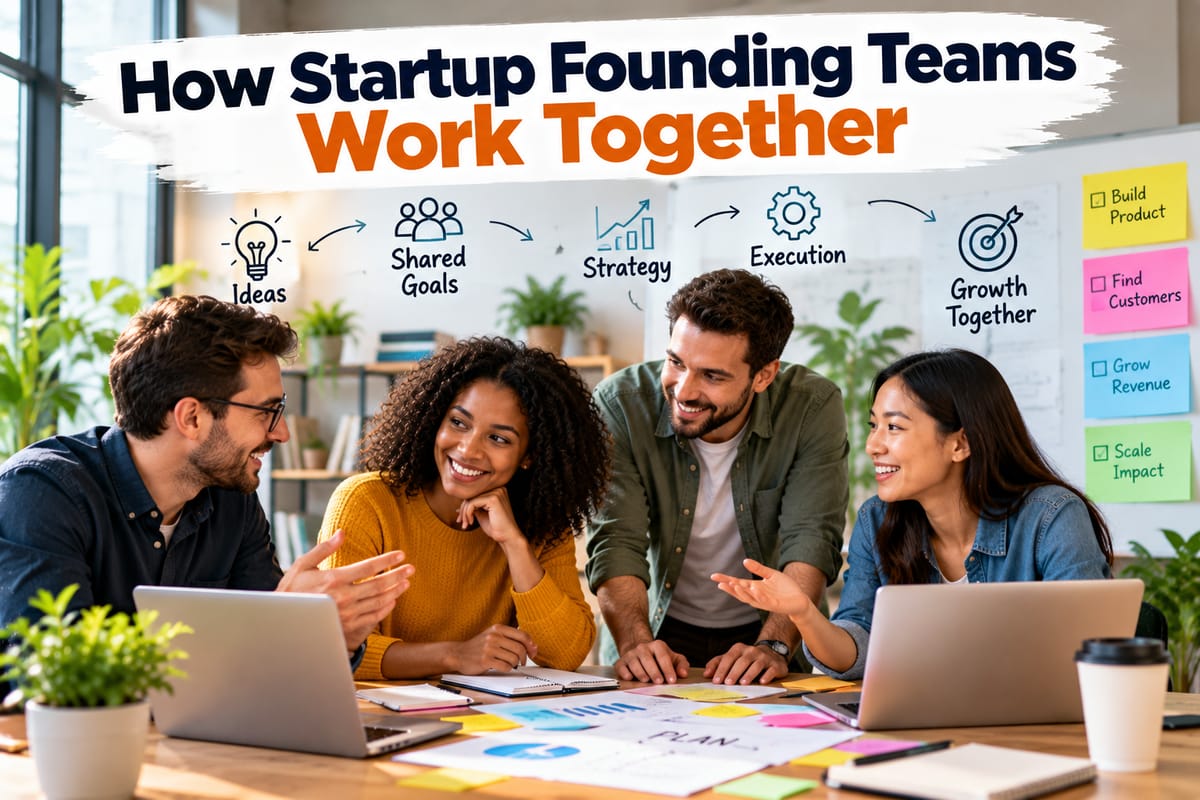
How Startup Founding Teams Work Together
A startup may begin with a simple idea, but turning that idea into a functioning business usually requires more than one person. Founders often bring different skills, experiences, networks, and perspectives to the company, creating a team capable of handling the many responsibilities involved in building a new organization.
A founding team might include two or three people working closely together from the beginning, or a larger group with specialized responsibilities. Regardless of size, founders have to make decisions about roles, ownership, product development, customers, finances, hiring, operations, and the company’s long-term direction.
How those founders work together can significantly influence how quickly the startup learns, adapts, and develops.
What Is a Startup Founding Team?
A startup founding team is the group of people who establish a new company and take primary responsibility for developing its initial product, business model, operations, and strategy.
Founders often begin working together before the company has:
- A large customer base
- Established revenue
- A significant workforce
- Formal departments
- Extensive operating processes
- Mature management structures
This means founding teams frequently have to perform several different jobs at once.
One founder may spend the morning speaking with potential customers, work on product decisions in the afternoon, and review financial information in the evening.
Another founder may focus primarily on technology but still participate in hiring, fundraising, sales discussions, and strategic decisions.
The roles can become more specialized as the company grows.
For readers exploring the broader process of launching a company, The Complete Guide to Starting a Business provides useful context about the activities involved in establishing a new business.
Why Founders Work as a Team
Building a startup requires a wide range of capabilities.
A company may need expertise in:
- Product development
- Technology
- Marketing
- Sales
- Finance
- Operations
- Customer service
- Legal matters
- Hiring
- Business strategy
One person may possess several of these skills, but it is difficult for a single founder to handle everything indefinitely.
A founding team allows responsibilities to be distributed according to individual strengths.
For example:
Founder A: Product and technology
Founder B: Sales and customer relationships
Founder C: Operations and finance
This arrangement does not mean each founder works exclusively in one area. Early-stage startups often require considerable overlap.
The important principle is that the team collectively covers the capabilities needed to move the company forward.
Complementary Skills Matter
Strong founding teams often bring complementary capabilities rather than simply having several people with identical backgrounds.
For example, three software engineers may be highly capable technically but may collectively lack experience in sales, customer research, finance, or operations.
Conversely, founders with strong business backgrounds may benefit from a technical co-founder who can lead product development.
Complementary skills can help reduce blind spots.
A founding team can ask:
- What are we collectively good at?
- What important skills are missing?
- Which responsibilities does each founder naturally handle?
- Where do we need outside expertise?
- Which skills will become more important as the company grows?
The goal is not to create a team in which every founder can do everything. It is to create a combination of capabilities that supports the company’s current needs.
Dividing Founder Responsibilities
Founders need enough clarity about responsibilities to prevent important tasks from being overlooked.
A simple division might look like this:
| Area | Primary Responsibility |
|---|---|
| Product | Founder A |
| Technology | Founder A |
| Sales | Founder B |
| Marketing | Founder B |
| Finance | Founder C |
| Operations | Founder C |
| Hiring | Shared |
| Company Strategy | Shared |
The exact structure will depend on the startup.
Responsibility does not necessarily mean exclusive authority. A founder responsible for product may make routine product decisions while major strategic decisions remain a collective responsibility.
The objective is to establish clear ownership without creating unnecessary silos.
Why Role Clarity Matters
Without clear responsibilities, founding teams can develop overlapping authority.
Two founders may assume the other person is handling a task. Alternatively, both may spend time working on the same issue.
Unclear roles can create:
- Delayed decisions
- Duplicated work
- Missed responsibilities
- Frustration
- Internal conflict
- Confusion among employees
Role clarity does not require rigid job descriptions.
Startup responsibilities change frequently, but everyone should generally understand who owns a particular decision or area of work at any given stage.
How Founders Make Decisions Together
Decision-making is one of the most important parts of working as a founding team.
Founders may need to decide:
- What product to build
- Which customers to target
- How to price the product
- Whether to raise funding
- When to hire employees
- Which markets to enter
- How much money to spend
- Which features to prioritize
Not every decision needs to involve every founder.
A useful distinction is between individual decisions and shared decisions.
Individual Decisions
Routine decisions within a founder’s area of responsibility can often be made independently.
For example, the founder responsible for marketing might decide which campaign format to test.
Shared Decisions
Major decisions affecting the entire company may require broader discussion.
Examples include:
- Changing the business model
- Taking on significant debt
- Selling the company
- Hiring senior executives
- Entering a major new market
- Making substantial changes to ownership
The more consequential the decision, the more important it becomes to establish how founders will reach agreement.
Establishing Decision-Making Rules Early
Founders can reduce confusion by agreeing on decision-making practices before major disagreements arise.
They might establish rules such as:
- Which decisions can be made independently
- Which decisions require group approval
- How disagreements are discussed
- Who has final authority in specific areas
- How urgent decisions are handled
- How major decisions are documented
These arrangements do not need to be complicated.
The objective is to prevent the team from improvising its governance structure every time an important disagreement occurs.
Founder Disagreements Are Normal
Founders will not always agree.
Different perspectives can actually help a startup identify weaknesses in its plans.
One founder may believe a product should launch immediately, while another may want more testing.
One may prioritize rapid growth, while another may focus on profitability.
One may want to hire quickly, while another may prefer to keep the team small.
Disagreement becomes problematic when founders cannot resolve differences constructively.
Healthy disagreement focuses on the issue rather than the individual.
Instead of:
“Your idea won’t work.”
A more productive discussion might be:
“What evidence would tell us whether this approach is working?”
This shifts the conversation from personalities toward assumptions, evidence, and outcomes.
Use Evidence to Resolve Arguments
Startups operate with considerable uncertainty.
Founders rarely have complete information when making decisions.
Customer interviews, sales data, product usage, financial results, experiments, and market research can provide evidence for competing assumptions.
For example, instead of arguing about whether customers will pay $50 per month, founders could test several pricing approaches with potential customers.
The result may not provide a perfect answer, but it can produce better information than an extended internal debate.
This is particularly important in early-stage companies because learning quickly can be more valuable than trying to make every decision perfectly on the first attempt.
How Founders Communicate
Communication becomes the foundation of almost every other aspect of collaboration.
Founders may communicate through:
- Regular meetings
- One-on-one conversations
- Messaging platforms
- Shared documents
- Project management systems
- Informal discussions
The communication method matters less than whether important information reaches the people who need it.
Founders should be able to discuss:
- Progress
- Problems
- Customer feedback
- Financial conditions
- Hiring
- Product decisions
- Strategic changes
- Risks
Open communication also makes it easier to identify problems before they become larger.
Regular Founder Meetings
A regular founder meeting can provide dedicated time for discussing company-level issues.
A simple agenda might include:
- What changed since the last meeting?
- What is working?
- What is not working?
- What decisions need to be made?
- What risks have emerged?
- What are the most important priorities for the next period?
The meeting should not become a long status-reporting exercise.
Its primary purpose is coordination and decision-making.
Communicating Important Decisions
Major decisions should not exist only in someone’s memory.
Founders can document important decisions in a shared system.
A decision record might include:
- The issue
- Options considered
- Information available
- Decision made
- Reason for the decision
- Person responsible
- Date
- Conditions that could trigger reconsideration
This can be particularly useful when the company grows and new employees need to understand why certain choices were made.
Balancing Speed and Deliberation
Startups often need to move quickly.
Long approval processes can prevent a young company from responding to customer feedback or changing market conditions.
However, moving quickly does not mean making every decision impulsively.
Founders can distinguish between decisions that are:
- Easy to reverse
- Difficult to reverse
- Low cost
- High cost
- Limited in impact
- Company-wide
A low-cost, reversible decision may not require extensive discussion.
A decision involving major financial commitments, ownership, legal obligations, or strategic direction deserves greater consideration.
Building Trust Among Founders
Trust allows founders to delegate responsibilities without constantly checking one another’s work.
Trust develops through:
- Consistent communication
- Reliability
- Transparency
- Keeping commitments
- Admitting mistakes
- Sharing information
- Respecting responsibilities
- Giving constructive feedback
Founders do not need to agree on everything to trust each other.
They need confidence that disagreements can be handled honestly and that each person is acting in the company’s broader interest.
Founder Equity and Ownership
Ownership can be one of the most sensitive issues among founding teams.
Founders may need to discuss:
- Equity percentages
- Vesting arrangements
- Contributions
- Future responsibilities
- Intellectual property
- Decision rights
- What happens if someone leaves
These issues should be addressed carefully and documented appropriately.
A founder’s contribution is not necessarily measured only by the amount of money invested.
Other contributions may include:
- Product development
- Technical expertise
- Industry relationships
- Customer access
- Business development
- Full-time commitment
- Intellectual property
- Leadership
Because ownership arrangements can have long-term consequences, founders should obtain appropriate professional advice when establishing formal agreements.
Founder Roles Can Change
Startup responsibilities rarely remain fixed.
A founder who initially handles sales may eventually lead a sales department.
A technical founder may move from writing most of the code to managing an engineering organization.
An operations-focused founder may eventually oversee several departments.
This transition requires founders to recognize when their responsibilities need to change.
Continuing to perform every early-stage task personally can become a bottleneck as the organization grows.
From Founders to Managers
As employees join the company, founders have to transition from doing everything themselves to coordinating other people.
This means learning to:
- Delegate
- Set expectations
- Give feedback
- Build processes
- Manage performance
- Develop employees
- Make decisions through others
The skills required to lead a small founding team are not always identical to those required to manage a larger organization.
Understanding How Managers Lead People, Make Decisions and Improve Business Performance can help illustrate how leadership responsibilities develop as organizations become more structured.
Hiring the First Employees
The first employees can significantly change how founders work together.
Before hiring, founders should identify what problem the new employee is expected to solve.
For example:
Problem: Customer support is consuming too much founder time.
Potential hire: Customer support specialist.
Expected result: Founders regain time for product and business development.
This is more useful than simply hiring because the company feels like it should have more employees.
Founders can also consider whether the work requires a full-time employee or could initially be handled through contractors, consultants, automation, or improved processes.
Creating a Strong Team Beyond the Founders
Founders eventually need to build teams that can operate without constant direct involvement.
That means hiring people who understand their responsibilities and can make appropriate decisions.
The principles discussed in How Businesses Build Strong, Productive Teams become increasingly important as a startup moves beyond its founding stage.
A strong organization does not depend indefinitely on founders making every decision.
Instead, founders gradually create systems, leadership structures, and teams capable of carrying the company forward.
How Founders Handle Product Development
Product development often creates some of the earliest disagreements among founders.
A team may have dozens of ideas but limited time and money.
Founders therefore need to determine:
- Which customer problem matters most
- Which feature is essential
- Which assumptions need testing
- What can be postponed
- What evidence indicates product-market fit
- Which customers should be prioritized
A disciplined product process can prevent founders from building features simply because they personally like them.
Customer conversations and real usage data can help the team understand whether a product is solving a meaningful problem.
Validating Ideas Together
A startup does not need to assume that its original idea is correct.
Founders can test their assumptions through:
- Customer interviews
- Prototypes
- Surveys
- Landing pages
- Small product releases
- Pilot programs
- Pricing experiments
- Sales conversations
The objective is to learn before committing substantial resources.
For a broader look at the process of developing and growing young companies, How Startups Build, Validate and Scale New Businesses explores how startups move from early concepts toward more established operations.
Managing Limited Startup Resources
Founders usually operate under constraints.
These may include:
- Limited capital
- Small teams
- Limited time
- Incomplete information
- Few customers
- Limited brand recognition
Resource constraints force founders to prioritize.
A useful question is:
What activity is most likely to move the company toward its current objective?
For an early-stage startup, that might mean finding customers rather than building internal administrative systems.
At another stage, it could mean hiring employees or improving infrastructure.
Priorities change as the business develops.
Founder Workload and Burnout Risk
Founders often work long hours because they feel personally responsible for the company’s success.
However, excessive workload can eventually affect decision-making, relationships, and productivity.
Founders can reduce unnecessary pressure by:
- Delegating appropriate tasks
- Establishing realistic priorities
- Sharing responsibilities
- Automating repetitive work
- Scheduling focused work
- Taking meaningful breaks
- Communicating workload problems early
A startup cannot depend indefinitely on unsustainable working patterns.
How Founders Maintain Alignment
Alignment means that founders generally understand where the company is going and why.
A founding team can maintain alignment by regularly discussing:
- Company mission
- Current priorities
- Target customers
- Business model
- Financial objectives
- Product direction
- Hiring plans
- Major risks
Founders may disagree about how to achieve a goal while still agreeing about the goal itself.
That distinction can make strategic disagreements much easier to manage.
When Founders Have Different Visions
Sometimes founders discover that they want fundamentally different things from the company.
One person may want to build a rapidly growing venture-backed company.
Another may prefer a smaller, profitable business.
Another may eventually want to sell the company.
These differences should be discussed openly because they can influence major decisions about:
- Funding
- Hiring
- Growth
- Compensation
- Risk
- Ownership
- Time commitment
Ignoring fundamental differences can make future disagreements much more difficult.
Handling a Founder Who Is Not Contributing Equally
Founding teams may encounter situations where one founder’s contribution changes over time.
Perhaps one founder reduces their working hours, takes on another job, or becomes less involved in daily operations.
The team should address the issue directly rather than allowing resentment to build.
Questions may include:
- What was originally agreed?
- What has changed?
- What responsibilities does each founder currently have?
- Does ownership still reflect the arrangement?
- What does the company need going forward?
- Can responsibilities be redistributed?
These discussions can be uncomfortable, but avoiding them may create larger problems.
Preparing for Growth
The founding team’s working style often influences the organization’s early culture.
If founders communicate openly, document important decisions, respect responsibilities, and encourage constructive disagreement, those practices can become part of the wider company.
As the startup grows, founders may need to formalize:
- Organizational roles
- Reporting relationships
- Hiring processes
- Financial controls
- Performance expectations
- Decision-making authority
- Company policies
The objective is not to introduce bureaucracy for its own sake.
Instead, processes should solve real problems created by increasing organizational complexity.
A Practical Founding-Team Operating Model
A simple operating model might look like this:
Weekly
- Review key priorities
- Discuss major obstacles
- Check important metrics
- Assign responsibilities
Monthly
- Review financial performance
- Evaluate product progress
- Discuss customer feedback
- Revisit hiring needs
- Review major risks
Quarterly
- Evaluate strategic direction
- Review company goals
- Reassess roles
- Consider resource allocation
- Set priorities for the next period
The exact schedule can vary, but regular communication prevents founders from drifting apart as the company becomes busier.
What Makes a Founding Team Effective?
There is no single formula for how founders should work together.
However, effective collaboration generally depends on several practical principles:
- Clear responsibilities
- Shared understanding of company goals
- Open communication
- Constructive disagreement
- Evidence-based decision-making
- Mutual accountability
- Appropriate delegation
- Willingness to adapt
- Transparency about problems
- Respect for different strengths
The founders do not need identical personalities or backgrounds.
In many cases, differences can be useful when the team knows how to turn those differences into better decisions.
From Founders to a Functioning Organization
A startup founding team begins with a small group of people carrying an unusually large amount of responsibility. They may develop the product, speak with customers, raise capital, manage finances, recruit employees, and establish the company’s early culture at the same time.
As the business develops, their job gradually changes.
The founders must move from simply doing the work toward creating an organization in which other people can do the work effectively.
That transition requires clearer roles, better communication, thoughtful delegation, and increasingly structured decision-making. It also requires founders to recognize when the company’s needs have changed and adapt their own responsibilities accordingly.
The strongest foundation for a growing startup is not simply a good idea or a group of talented individuals. It is a founding team that can communicate honestly, divide responsibilities clearly, challenge assumptions, resolve disagreements, and keep working toward shared objectives even as the company’s circumstances change.



2 Comments
Micle harison
June 7, 2019Lorem ipsum dolor sit amet, usu ut perfecto postulant deterruisset, libris causae volutpat at est, ius id modus laoreet urbanitas. Mel ei delenit dolores.
John Doe
June 7, 2019Some consultants are employed indirectly by the client via a consultancy staffing company.