
What Are the Basic Rules of Cricket?
Cricket is a bat-and-ball sport built around a simple objective: score more runs than the opposing team while taking wickets and limiting the other side’s scoring opportunities.
Although cricket can appear complicated to newcomers, its fundamental rules are relatively straightforward once the roles of the batters, bowlers, fielders, wickets, and innings are understood.
The game is played in several formats, from long Test matches to shorter limited-overs competitions such as One Day Internationals and Twenty20 cricket. While the formats differ in length and strategy, many of the basic rules remain the same.
Understanding those fundamentals provides a useful starting point for anyone learning how cricket works.
What Is Cricket?
Cricket is a team sport played between two teams, normally consisting of 11 players each.
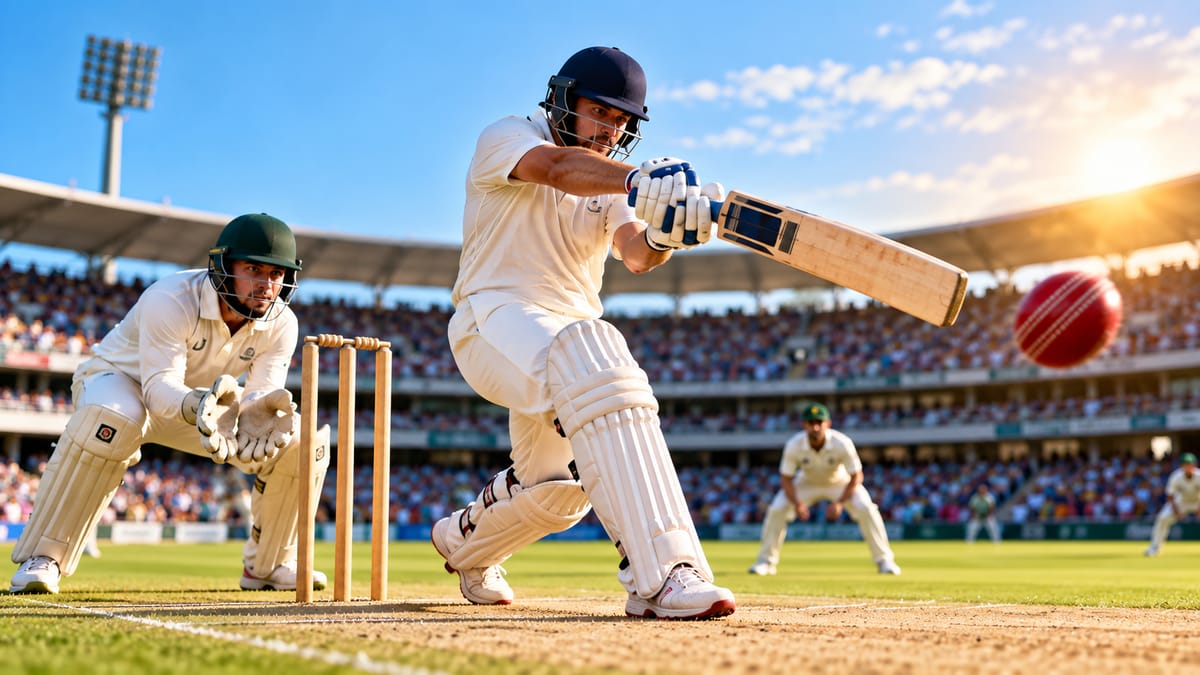
The game takes place on a large oval-shaped field with a rectangular pitch at its center. At each end of the pitch is a wicket consisting of three vertical stumps and two bails.
Two batters from the same team are on the field at a time. One faces the bowler while the other waits at the opposite end of the pitch.
The bowling team attempts to dismiss the batters and prevent them from scoring runs.
The batting team attempts to accumulate as many runs as possible before its innings ends.
Cricket is one of many sports with specialized rules governing scoring, possession, player roles, and competition structure. A broader look at these differences can be found in Different Types of Sports and How They Are Classified.
How Many Players Are on a Cricket Team?
A standard cricket team has 11 players.
Teams typically include a combination of:
- Specialist batters
- Bowlers
- All-rounders
- A wicketkeeper
- Fielding specialists
The wicketkeeper stands behind the batter’s wicket and is responsible for stopping deliveries that the batter does not hit.
Players can have more than one role. An all-rounder, for example, can contribute significantly with both batting and bowling.
During a match, only the players permitted under the particular competition’s rules can participate in different phases of play.
The Basic Objective of Cricket
The basic objective is to score more runs than the opposing team.
One team bats while the other bowls and fields. After the designated innings or period of play, the teams switch roles.
The team with the higher score wins, subject to the specific rules of the format and match.
In some matches, a result can also be a tie or draw depending on the format and circumstances.
Understanding the way scoring differs between sports can make cricket’s system easier to appreciate. The broader principles are explained in How Scoring Rules Work Across Sports.
What Is an Innings?
An innings is the period during which a team bats.
The number of innings depends on the format.
In limited-overs cricket, each team normally has one innings and faces a predetermined number of overs.
In Test cricket, each team can have up to two innings, although the exact sequence and number of innings completed can vary depending on the match situation.
An innings ends when the relevant conditions for that format are met.
These can include:
- The required number of overs being completed
- The batting team losing all or nearly all available wickets
- A target being reached
- A captain declaring an innings closed in formats where declarations are permitted
- The scheduled playing time expiring
What Is an Over?
An over consists of six legal deliveries bowled by one bowler from one end of the pitch.
After six legal deliveries, another bowler generally bowls the next over from the opposite end.
The same bowler cannot normally bowl consecutive overs from the same end.
Overs are particularly important in limited-overs cricket because they establish a fixed limit on how many deliveries a team can face.
For example, a Twenty20 innings is limited to 20 overs, while a One Day International innings is limited to 50 overs under standard playing conditions.
How Do Batters Score Runs?
The simplest way to score is for the batter to hit the ball and run between the two wickets.
When both batters successfully reach the opposite ends, they score one run.
They can continue running if the ball remains in play and time allows, potentially scoring multiple runs from a single delivery.
Batters can also score runs when the ball reaches the boundary.
Four Runs
If the batter hits the ball to the boundary and it reaches the boundary after touching the ground, the batting team normally receives four runs.
Six Runs
If the batter hits the ball over the boundary without it touching the ground inside the field, the batting team normally receives six runs.
Boundaries can therefore produce substantial scoring without requiring the batters to physically run between the wickets.
What Are Extras?
Not every run comes directly from the batter’s shot.
Runs awarded to the batting team without being credited to the batter are called extras.
Common extras include:
- Wides: A delivery that is outside the permitted area for the batter to play normally.
- No-balls: A delivery that violates certain bowling rules.
- Byes: Runs taken when the ball passes the batter without being hit by the bat or body.
- Leg byes: Runs taken when the ball touches the batter’s body under circumstances permitted by the rules.
Extras are added to the team’s total but are generally not added to the individual batter’s score.
How Does a Batter Get Out?
Taking wickets is one of the main objectives of the fielding team.
There are several ways a batter can be dismissed.
Bowled
A batter is bowled when a legal delivery hits the wicket and dislodges at least one bail.
This is one of the most recognizable forms of dismissal.
Caught
A batter is caught when a fielder catches the ball before it touches the ground after the batter has hit it with the bat.
The wicketkeeper can also take catches.
Leg Before Wicket
A batter can be dismissed leg before wicket, commonly called LBW, when the ball strikes the batter’s body rather than the bat and the conditions specified in the LBW laws are satisfied.
LBW decisions can involve several factors, including where the ball pitched, where it struck the batter, and whether it would have gone on to hit the wicket.
Run Out
A batter can be run out when the fielding team breaks the relevant wicket while the batter is outside the crease during a run.
Run outs frequently occur when batters attempt to complete a run quickly.
Stumped
A batter can be stumped when the wicketkeeper legally breaks the wicket while the batter is outside the crease and not attempting a run in the relevant circumstances.
Hit Wicket
A batter can also be dismissed hit wicket if the batter breaks their own wicket under circumstances covered by the laws.
These are only some of the recognized dismissal methods, but they represent many of the situations spectators encounter most often.
What Is the Crease?
The crease is an important set of lines marked around each wicket.
The batter must make their ground by having the required part of their body or bat behind the relevant crease when attempting to complete a run or avoid certain forms of dismissal.
The crease therefore plays a major role in run outs and stumpings.
Modern cricket frequently uses video technology to determine whether a batter has made their ground when a dismissal is close.
What Does the Bowler Try to Do?
The bowler delivers the ball toward the batter with the objective of taking a wicket, restricting scoring, or creating pressure.
Bowlers use different techniques and styles.
Fast bowlers can generate significant pace and movement, while spin bowlers rely more heavily on rotation and changes in trajectory.
A bowler also has to remain within specific legal limits regarding how the ball is delivered.
A delivery that violates certain rules can be called a no-ball or wide, giving the batting team an additional run and, depending on the type of violation, other consequences.
What Does the Fielding Team Do?
The fielding team attempts to stop runs and take wickets.
Players are positioned around the field according to the captain’s strategy and the circumstances of the match.
Fielders may attempt to:
- Catch the batter
- Stop boundaries
- Return the ball quickly to the wicket
- Create run-out opportunities
- Support the wicketkeeper
- Pressure batters into making mistakes
Field placements can change dramatically depending on the bowler, batter, match situation, and number of overs remaining.
What Are Powerplays?
Powerplays are restrictions on field placements used in certain limited-overs formats.
During designated powerplay periods, the fielding team is limited in how many players can be positioned outside the inner fielding circle.
The precise restrictions depend on the format and competition rules.
Powerplays are designed to influence the balance between attacking field placements and defensive protection.
They can encourage aggressive batting early in an innings while forcing captains to make tactical decisions about how they deploy their bowlers and fielders.
How Do Cricket Matches End?
The way a cricket match ends depends heavily on its format.
In a limited-overs match, a team generally has a fixed number of overs available.
If the team batting second reaches the required target, it wins.
If it fails to reach the target before its innings ends, the opposing team can win based on the final score.
In Test cricket, matches can last up to five days and involve potentially two innings per team. A match can finish with a win, loss, draw, or tie depending on the circumstances.
The structure of different cricket competitions is part of the broader world of tournament design. For additional context, How Sports Competitions and Tournament Formats Work explains how different sports organize competitions and determine winners.
What Is a Target in Cricket?
When a team bats second in a limited-overs match, its objective is normally to surpass the score established by the first team.
This creates a target.
For example, if Team A scores 250 runs, Team B generally needs 251 runs to win outright.
If Team B reaches that target before its allotted overs are completed, it wins.
The number of wickets remaining can also matter when describing the result.
What Is the Toss?
Before a cricket match begins, the captains participate in a coin toss.
The captain who wins the toss chooses whether their team will generally bat first or field first, subject to the format and playing conditions.
The decision can depend on factors such as:
- Pitch conditions
- Weather
- Expected changes in the pitch
- Dew
- Team strengths
- Match format
- Day-night conditions
The toss does not determine the winner, but it can influence the tactical approach taken at the beginning of a match.
The Role of Umpires
Umpires are responsible for applying the laws and making decisions during the match.
The on-field umpires make decisions involving deliveries, dismissals, boundaries, runs, and other aspects of play.
At higher levels of cricket, technology can assist officials with certain decisions through systems such as ball tracking, video replays, and other review technologies.
Players and teams are expected to follow the decisions and procedures established by the competition.
Understanding the role of officials is essential to understanding any organized sport, and Complete Guide to Sports Rules and Officiating provides a broader explanation of how rules and officiating shape competitive sports.
What Is the Decision Review System?
The Decision Review System, commonly known as DRS, allows teams to challenge certain on-field decisions under the rules of competitions that use the technology.
Reviews can involve technologies such as ball tracking and video replay.
The exact number of reviews available and the circumstances under which they can be used depend on the competition.
DRS has become an important part of modern international cricket because it provides an additional mechanism for examining close decisions.
Why Cricket Has Different Formats
Cricket’s basic rules remain recognizable across formats, but the structure of the game changes considerably.
Test Cricket
Test matches are the longest format and can last up to five days.
Teams can have two innings each, and there is no fixed number of overs for an innings in the same way there is in limited-overs cricket.
One Day Cricket
One Day cricket provides a shorter format in which each team normally receives a fixed number of overs.
One Day Internationals typically use a 50-over innings for each side.
Twenty20 Cricket
Twenty20 cricket, or T20, is designed to be much shorter.
Each team normally has a maximum of 20 overs.
The limited number of deliveries encourages aggressive batting and creates a faster-paced contest.
Why the Basic Rules Matter
Cricket can involve complex tactics, field settings, bowling strategies and statistical analysis, but its foundation rests on a few central ideas.
Two teams compete with 11 players each. One team bats while the other bowls and fields. Batters try to score runs, while bowlers and fielders attempt to take wickets and restrict scoring.
Overs determine the number of legal deliveries, wickets remove batters from the innings, and the match format determines how long each side has to score.
Once those principles are understood, many of cricket’s more complicated strategies become easier to follow.
The combination of batting, bowling, fielding and tactical decision-making is what gives cricket its distinctive character and allows the same basic sport to work across matches lasting several hours or several days.





2 Comments
Micle harison
June 7, 2019Lorem ipsum dolor sit amet, usu ut perfecto postulant deterruisset, libris causae volutpat at est, ius id modus laoreet urbanitas. Mel ei delenit dolores.
John Doe
June 7, 2019Some consultants are employed indirectly by the client via a consultancy staffing company.