
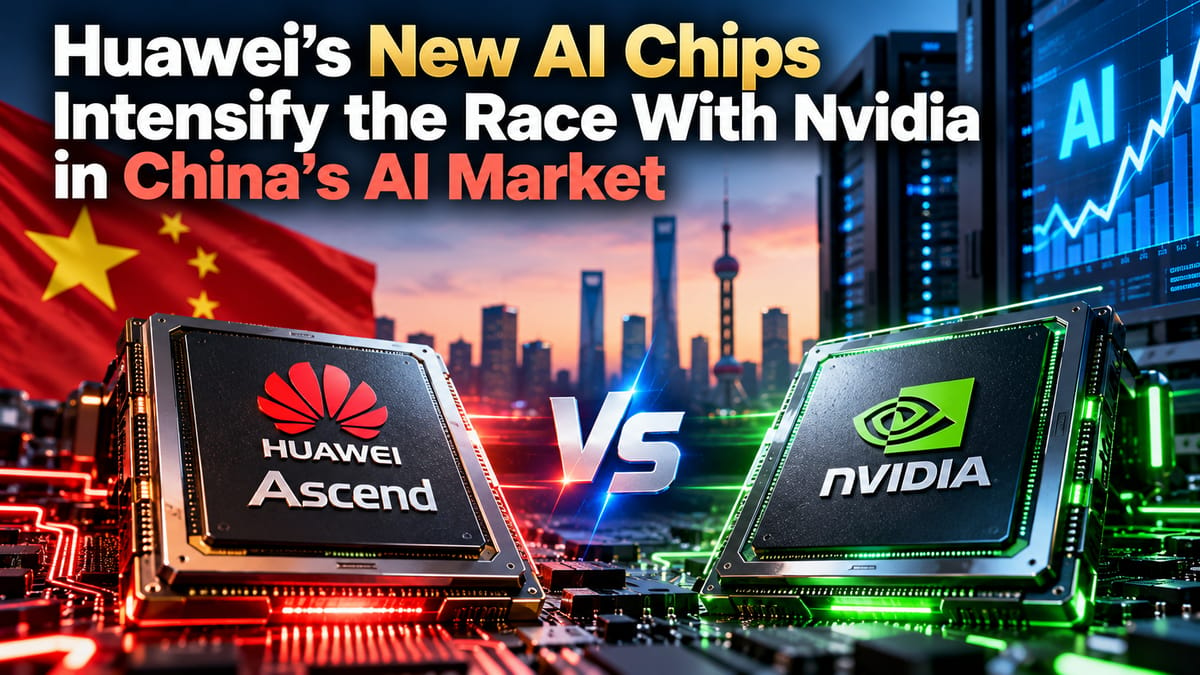
Huawei’s New AI Chips Intensify the Race With Nvidia in China’s AI Market
Huawei is accelerating its artificial intelligence chip roadmap as demand for domestic computing power grows across China, putting additional pressure on Nvidia’s position in one of the world’s most important AI markets.
At Huawei Connect 2026 in Shanghai, the Chinese technology company outlined an accelerated schedule for its next-generation Ascend processors and presented a broader computing architecture designed to connect large numbers of AI chips into massive systems. Huawei says its goal is not simply to improve individual processors, but to build an increasingly complete alternative AI computing ecosystem.
The developments come as Chinese technology companies face continuing restrictions on access to some of Nvidia’s most advanced processors. At the same time, demand for AI computing in China is increasing rapidly, creating an opening for domestic chipmakers.
Huawei’s strategy is therefore becoming an important part of China’s broader effort to develop AI infrastructure with less dependence on foreign technology.
Huawei Accelerates Its Ascend AI Chip Roadmap
Huawei’s latest announcement centers on the Ascend family, which has become the company’s primary AI accelerator platform.
The company said the Ascend 960DT is now expected to become available in the first quarter of 2027, significantly earlier than previously planned. The Ascend 960PR is scheduled for the third quarter of 2027, followed by the Ascend 970 in 2028 and Ascend 980 in 2029. Huawei says it intends to maintain a roughly one-generation-per-year development cycle.
Huawei has also said development of the Ascend 960 has progressed faster than expected, with the company targeting major improvements not only in computing performance but also in memory capacity, memory bandwidth and interconnect capabilities.
The roadmap represents a shift toward building increasingly powerful systems rather than treating an individual AI processor as the entire product.
Huawei’s broader AI chip roadmap provides important context for understanding how the Ascend family fits into China’s longer-term semiconductor strategy.
The Bigger Battle Is About AI Infrastructure
The competition between Huawei and Nvidia is not simply a contest over which company can produce the fastest chip.
Modern AI systems depend on a combination of accelerators, high-bandwidth memory, networking, storage, software and data-center infrastructure. The ability to connect thousands of processors efficiently can be just as important as the performance of an individual chip.
Huawei is increasingly focusing on this system-level approach.
At Huawei Connect, the company described its Peerium architecture and UnifiedBus technology, which are intended to connect large numbers of processors and other components into highly scalable AI computing systems. Huawei says its long-term architecture could connect as many as 1 million AI processors.
That approach is particularly relevant as AI models become larger and inference workloads expand.
For companies building AI services, the question is no longer simply how much computing power one accelerator can deliver. It is also how efficiently thousands of accelerators can work together without creating bottlenecks in networking, memory access or data movement.
This is why AI infrastructure spending is reshaping the technology industry across the semiconductor, cloud-computing and data-center sectors.
Demand for Huawei’s Chips Is Already Outpacing Supply
One of the clearest indications of Huawei’s growing role in China’s AI market is the company’s struggle to produce enough AI computing equipment to satisfy domestic demand.
Huawei rotating chairman Eric Xu said in September that the company did not currently have enough capacity to meet demand inside China, limiting its ability to pursue a major international expansion of its AI chips. Reuters reported that Huawei expects Chinese AI developers to increasingly train models using systems based on the Ascend 950DT.
The situation illustrates an unusual dynamic.
Huawei is trying to establish itself as an alternative to Nvidia, but it is simultaneously dealing with manufacturing constraints that make it difficult to supply even its domestic market at the scale it would like.
That shortage is occurring while Chinese AI developers are demanding more computing capacity for both model training and inference.
The resulting pressure is extending beyond Huawei itself. Chinese AI chipmakers have reportedly raised prices as the cost of high-bandwidth memory has increased. Reuters reported that the indicated price of Huawei’s Ascend 950DT accelerator card had risen above 250,000 yuan, with sources describing increases of roughly 20% to 50% depending on contracts.
Nvidia Still Has a Major Software Advantage
Huawei’s progress does not mean Nvidia’s technological position has disappeared.
One of Nvidia’s biggest advantages is its software ecosystem, particularly CUDA, which has become deeply integrated into AI development workflows. Developers, researchers and companies have spent years building software and applications around Nvidia’s computing platform.
Reuters noted that Nvidia continues to hold a significant software advantage through CUDA even as Huawei expands its Ascend developer ecosystem.
Huawei is attempting to address that challenge by expanding support for its own software stack and making Ascend increasingly compatible with widely used AI development frameworks.
The company said Ascend now supports more than 90 leading open-source projects, including PyTorch, Triton, vLLM and veRL. Huawei also said Ascend has become an officially supported PyTorch accelerator backend.
That development matters because hardware adoption depends heavily on whether developers can move existing workloads onto a new platform without completely rebuilding their software.
China’s AI Chip Race Is Expanding Beyond Huawei
Huawei is not the only Chinese company pursuing greater independence in AI computing.
Alibaba recently unveiled its Zhenwu V900 AI chip and said the processor delivers roughly three times the performance of its predecessor. The company also announced plans for a new AI model with as many as 5 trillion to 10 trillion parameters and said it expects the new chip to enter mass production in early 2027.
Other Chinese semiconductor companies are also working on accelerators and related components.
The result is a broader domestic ecosystem rather than a single Huawei-versus-Nvidia contest. China’s AI industry is increasingly combining chip design, memory development, data centers, cloud services and AI models.
The China AI chip race is therefore becoming a larger industrial effort involving multiple companies and layers of the technology stack.
U.S. Export Controls Have Changed the Competitive Landscape
The Huawei-Nvidia competition is also taking place within a much broader technology and trade dispute.
U.S. export controls have restricted Nvidia’s ability to sell some of its most advanced AI processors to Chinese customers. Nvidia’s own regulatory filings have described the continuing impact of U.S. restrictions on its ability to serve the China market.
At the same time, Nvidia has continued pursuing opportunities in China where permitted. Reuters reported in August that Nvidia had denied a report that it planned to introduce a China-specific language-processing unit before the end of 2026, while the company had also received authorization for limited H200 shipments to certain Chinese customers.
These restrictions have created an unusual market environment.
Chinese AI companies need more computing power, while access to some foreign processors remains constrained. Domestic manufacturers consequently have stronger incentives to improve their own hardware and software ecosystems.
That does not automatically make domestic chips equivalent to Nvidia’s highest-end products, but it can make them strategically valuable to companies that need dependable access to computing resources.
Huawei Is Betting on Scale
Huawei’s response to the performance gap is increasingly centered on scale.
Instead of competing exclusively on the specifications of a single accelerator, the company is developing SuperPoD and SuperCluster systems capable of connecting very large numbers of Ascend processors.
Huawei says its upgraded systems can support thousands of nodes and that its longer-term architecture is designed to scale toward hundreds of thousands or even 1 million processors.
This reflects a broader change in AI infrastructure.
As models become larger and AI agents perform longer and more complicated tasks, computing systems increasingly need massive memory pools and high-speed connections between processors. Huawei argues that its networking and interconnect technologies can help compensate for limitations at the individual-chip level.
The strategy also gives Huawei more control over the complete infrastructure stack.
Rather than selling an accelerator alone, the company can potentially provide processors, networking, servers, storage, cloud services and software as components of a single AI platform.
Manufacturing Remains a Critical Challenge
The rapid expansion of China’s AI-chip industry is not without obstacles.
High-bandwidth memory is one major constraint. AI accelerators require large quantities of extremely fast memory, and shortages can increase the cost of producing domestic alternatives.
The reported price increases for Huawei and other Chinese AI processors illustrate how supply-chain constraints can affect the economics of the domestic AI push.
Manufacturing capacity is another challenge.
Huawei’s own comments indicate that domestic demand is currently greater than its available production capacity. That limits the company’s ability to expand internationally, even as it develops processors intended to compete with global AI hardware providers.
China is simultaneously trying to strengthen other parts of its semiconductor supply chain. For example, Chinese memory manufacturer CXMT recently announced that a new DRAM platform had entered mass production, another indication of the country’s broader effort to reduce reliance on foreign semiconductor technologies.
What Huawei’s Roadmap Means for China’s AI Market
Huawei’s latest announcements suggest that China’s AI hardware strategy is moving beyond simply replacing individual Nvidia GPUs.
The longer-term objective is to create an ecosystem in which Chinese companies can design AI processors, manufacture supporting components, build large-scale computing systems and provide software environments capable of supporting increasingly sophisticated AI applications.
That could make Huawei an increasingly important supplier for Chinese AI developers, cloud providers and enterprises.
At the same time, Nvidia remains deeply established in AI software and infrastructure, and the performance and efficiency of individual processors remain important considerations. Huawei’s success will therefore depend not only on how quickly it releases new chips but also on how effectively developers can use them and how efficiently its systems can operate at scale.
The emergence of other Chinese chipmakers, including Alibaba’s semiconductor operation, adds another layer to the competitive landscape.
The Next Phase of the AI Chip Race
Huawei’s accelerated Ascend roadmap shows that the competition for China’s AI market is entering a new phase.
The company is moving toward annual processor updates, larger AI clusters and a more integrated hardware-and-software ecosystem. At the same time, domestic demand is strong enough to exceed Huawei’s current production capacity, while memory and manufacturing constraints remain significant challenges.
For Nvidia, the Chinese market remains strategically important but increasingly complicated by export restrictions and the rapid development of domestic alternatives.
For China’s AI industry, Huawei’s progress provides another path toward greater control over the computing infrastructure needed to develop increasingly capable AI systems.
The next few years will therefore be shaped not only by which company produces the fastest AI accelerator, but also by which ecosystem can combine chips, memory, networking, software, manufacturing capacity and large-scale computing most effectively.



2 Comments
Micle harison
June 7, 2019Lorem ipsum dolor sit amet, usu ut perfecto postulant deterruisset, libris causae volutpat at est, ius id modus laoreet urbanitas. Mel ei delenit dolores.
John Doe
June 7, 2019Some consultants are employed indirectly by the client via a consultancy staffing company.