
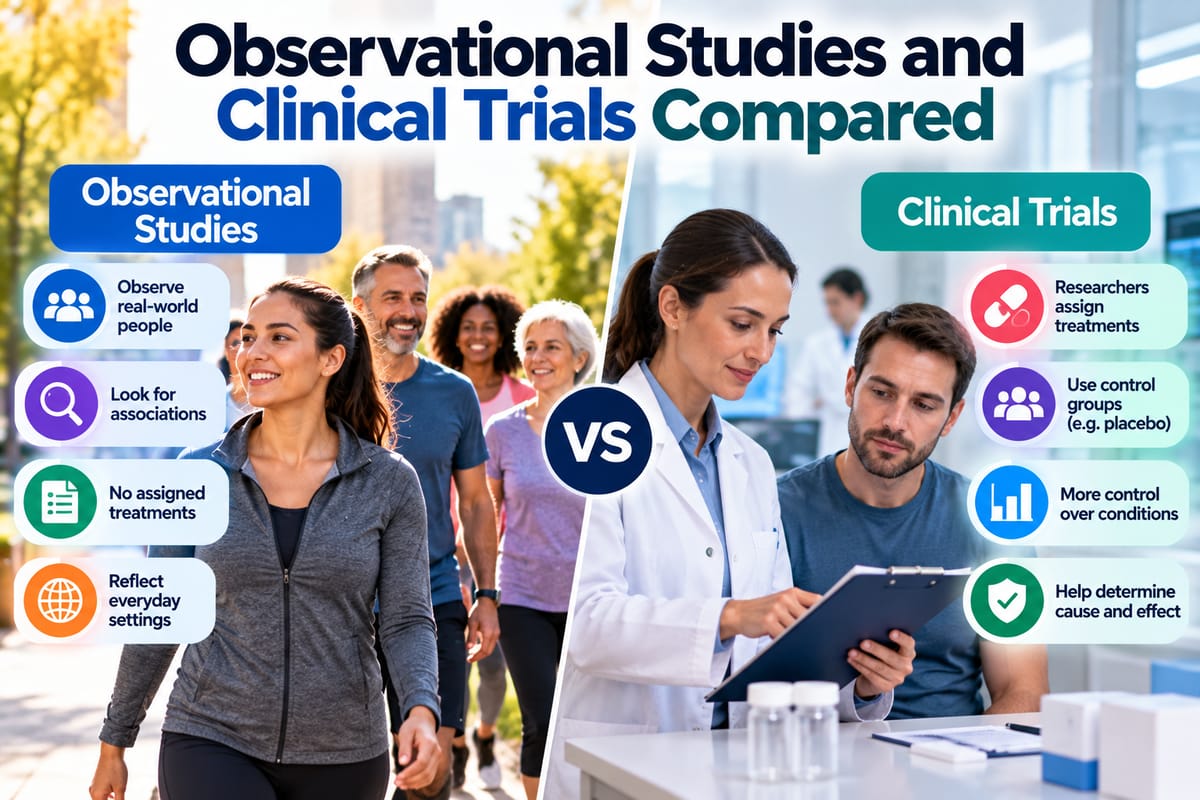
Observational Studies and Clinical Trials Compared
Health research relies on different types of studies to answer different questions. Two of the most important are observational studies and clinical trials.
Both can provide valuable evidence, but they work in fundamentally different ways.
In an observational study, researchers collect information about what happens to people without assigning them to a particular treatment or exposure. In a clinical trial, researchers deliberately assign participants to interventions or comparison groups according to a study protocol.
Understanding this difference is essential when interpreting health claims. A study may find that two factors are associated with each other without demonstrating that one caused the other. Conversely, a well-designed clinical trial can provide stronger evidence about whether a specific intervention produces a particular outcome.
The distinction becomes much easier to understand when the two approaches are compared in terms of design, control, bias, causation, ethics, and practical applications.
What Is an Observational Study?
An observational study is a research design in which investigators observe and analyze naturally occurring differences between people.
Researchers do not normally assign participants to receive a particular exposure simply for the purpose of the study. Instead, they collect information about factors that already exist and examine how those factors relate to health outcomes.
For example, researchers might compare health outcomes among people who:
- Exercise regularly and those who exercise less often
- Follow different dietary patterns
- Have different smoking histories
- Live in different environments
- Have different sleep habits
- Take particular medications as part of routine care
The researchers can then examine whether certain exposures or behaviors are associated with particular outcomes.
What Is a Clinical Trial?
A clinical trial is a study in which researchers evaluate an intervention under defined conditions.
The intervention could involve:
- A medication
- A vaccine
- A medical procedure
- A behavioral intervention
- A dietary intervention
- A diagnostic strategy
- Another healthcare approach
Participants may be assigned to different groups according to the trial design.
For example, one group might receive the intervention while another receives a placebo, standard treatment, or another comparison.
The researchers then measure predefined outcomes and compare the groups.
The Main Difference Between the Two
The simplest distinction is researcher intervention.
| Feature | Observational Study | Clinical Trial |
|---|---|---|
| Researcher assigns exposure/intervention | Usually no | Yes |
| Participants observed over time | Often | Often |
| Randomization | Usually no | Common in randomized trials |
| Control over conditions | Limited | Greater |
| Useful for real-world patterns | Yes | Yes, depending on design |
| Ability to study causation | More limited | Often stronger |
| Ethical constraints | Important | Particularly important |
| Common data sources | Surveys, records, cohorts | Trial participants and study assessments |
Neither design is automatically appropriate for every research question.
The best approach depends on what researchers are trying to learn.
How Observational Studies Work
Observational research can take several forms.
Cohort Studies
A cohort study follows a group of people over time.
Researchers may classify participants according to an exposure and then observe whether different outcomes develop.
For example, a cohort study might compare people with different levels of physical activity and follow them for several years.
Cohort studies can be:
- Prospective, where researchers collect information going forward.
- Retrospective, where researchers analyze information that already exists.
Case-Control Studies
A case-control study begins with people who have a particular outcome and compares them with people who do not have that outcome.
Researchers then investigate previous exposures or characteristics to determine whether particular factors were more common among the people with the outcome.
This approach can be particularly useful for studying relatively uncommon conditions.
Cross-Sectional Studies
A cross-sectional study examines exposure and outcome information at a particular point in time.
For example, researchers could survey a population about physical activity, diet, sleep, and current health conditions.
Cross-sectional research can reveal patterns and associations, but it generally cannot establish which factor came first.
How Clinical Trials Work
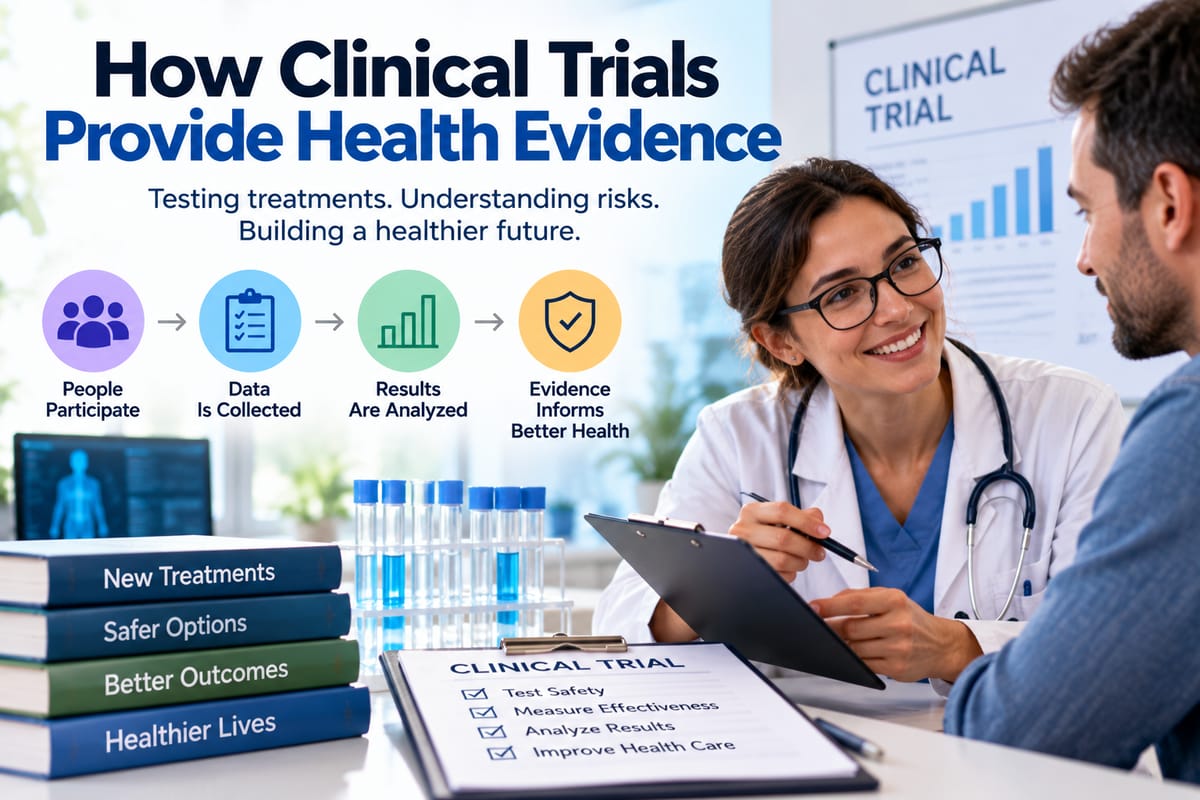
Clinical trials use predefined protocols to study interventions.
A trial may specify:
- Who can participate
- Who cannot participate
- What intervention participants receive
- How long the intervention lasts
- What comparison group is used
- Which outcomes will be measured
- How safety will be monitored
- How results will be analyzed
This structure allows researchers to compare groups under controlled conditions.
Clinical trials can range from small early-stage studies to large trials involving thousands of participants.
Randomization and Why It Matters
Randomization is a defining feature of many clinical trials.
In a randomized trial, participants are assigned to different study groups using a random process.
The purpose is to reduce systematic differences between groups at the beginning of the study.
If randomization works as intended, factors that might otherwise influence the outcome are more likely to be distributed between groups rather than concentrated in one group.
This helps researchers distinguish the effects of the intervention from differences that existed before the intervention began.
Randomization does not eliminate every possible source of error, but it can substantially strengthen the design of a study.
What Is a Control Group?
A control group provides a comparison against which the intervention group can be evaluated.
Depending on the research question, a control group might receive:
- A placebo
- Standard treatment
- No intervention
- An alternative intervention
Without an appropriate comparison, it can be difficult to determine whether an observed change is actually attributable to the intervention.
For example, people may improve during a study simply because symptoms naturally fluctuate, because they receive attention from healthcare professionals, or because they change other behaviors.
A comparison group helps researchers account for some of these possibilities.
Blinding in Clinical Trials
Some clinical trials use blinding to reduce bias.
In a single-blind design, participants may not know which treatment group they are in.
In a double-blind design, both participants and relevant researchers or study personnel may be unaware of group assignments until a specified point in the study.
Blinding is particularly useful when expectations could influence how outcomes are reported or assessed.
However, blinding is not practical or ethical in every type of trial. For example, participants generally know whether they underwent a surgical procedure.
Why Observational Studies Are Still Important
The stronger experimental control of clinical trials does not make observational research unnecessary.
Observational studies can answer questions that would be difficult, impractical, or unethical to investigate through randomization.
Researchers cannot ethically assign people to harmful exposures simply to determine whether those exposures cause disease.
Observational studies can therefore provide important information about:
- Long-term health patterns
- Rare outcomes
- Environmental exposures
- Lifestyle factors
- Medication use in routine care
- Population-level trends
- Potential risk factors
They can also identify relationships that later deserve investigation through clinical trials.
Association Does Not Automatically Mean Causation
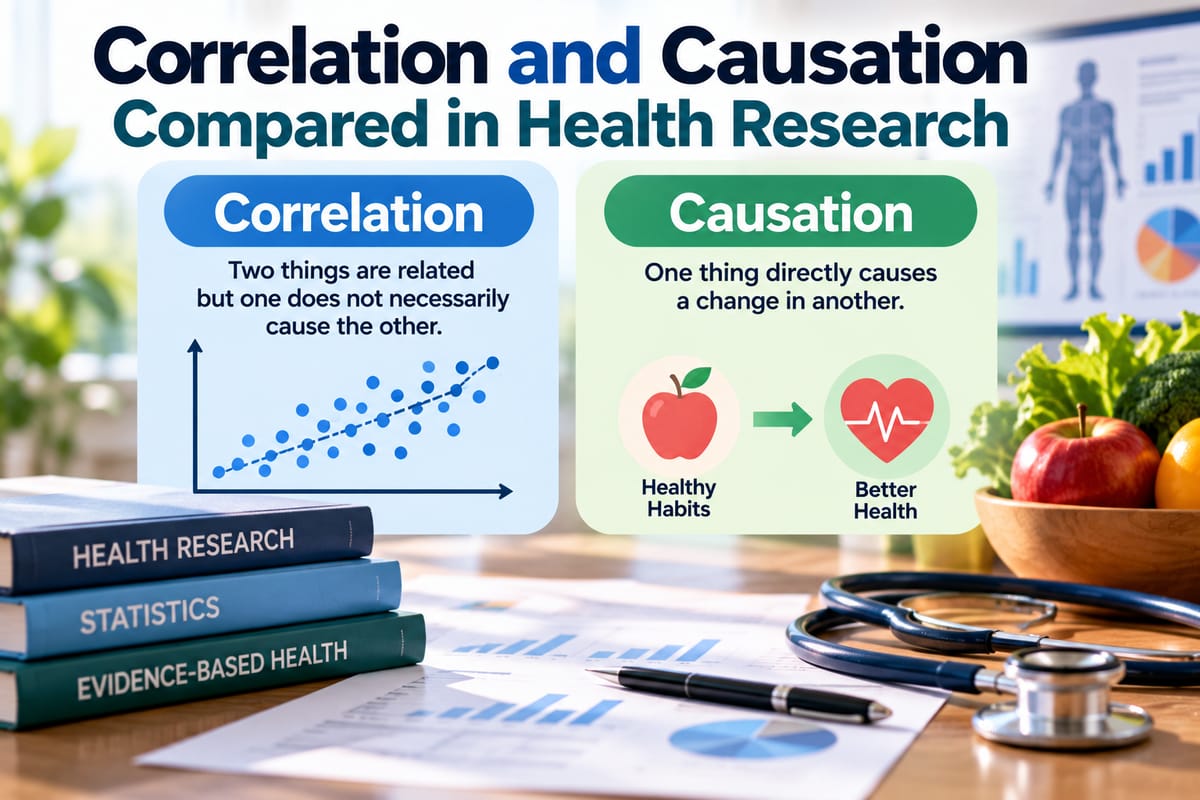
One of the most important concepts in health research is the difference between association and causation.
Suppose an observational study finds that people who engage in a particular behavior have a lower rate of a certain health outcome.
That finding establishes an association if the study is appropriately conducted.
It does not automatically establish that the behavior caused the lower rate.
Other factors could contribute to the relationship.
For example, people who engage in a particular healthy behavior may also:
- Have different diets
- Have different income levels
- Access healthcare more frequently
- Smoke less
- Sleep differently
- Have different levels of education
- Engage in other forms of physical activity
These factors can complicate interpretation.
Confounding Factors
A confounder is a factor associated with both the exposure and the outcome that can distort the apparent relationship between them.
Researchers use statistical methods and study-design techniques to account for potential confounding.
However, statistical adjustment cannot guarantee that every relevant confounder has been identified or measured accurately.
This is one reason observational findings need to be interpreted carefully.
A broader understanding of evidence evaluation begins with the Scientific Method and How Science Works, which explains how scientific questions are investigated, tested, and refined.
Clinical Trials Can Also Have Limitations
Clinical trials are often valuable for testing interventions, but they are not perfect.
Potential limitations include:
- Small sample sizes
- Short follow-up periods
- Participant dropout
- Strict eligibility requirements
- Adherence problems
- Measurement errors
- Missing data
- Differences between trial conditions and everyday healthcare
A trial can therefore provide strong evidence about a specific intervention under particular conditions without necessarily answering every question about how that intervention will perform across the entire population.
Internal Validity and External Validity
Researchers often consider two broad concepts when evaluating evidence.
Internal Validity
Internal validity concerns whether the study was designed and conducted well enough to support its conclusions about the participants studied.
Randomization, appropriate comparison groups, blinding, accurate measurement, and careful analysis can strengthen internal validity.
External Validity
External validity concerns how well the findings apply to people and circumstances beyond the study.
A highly controlled trial may have strong internal validity but involve participants who differ from the broader population.
For example, a trial may exclude people with certain medical conditions, take place in specialized healthcare settings, or require participants to follow procedures that are difficult to reproduce in ordinary life.
Both forms of validity matter.
Observational Studies Often Reflect Real-World Conditions
One advantage of observational research is that it can capture what happens in ordinary settings.
Participants may receive routine healthcare, follow their usual diets, take medications prescribed by their clinicians, and live their normal lives.
This can make observational evidence useful for understanding how treatments, behaviors, and exposures operate outside highly controlled research environments.
However, the same real-world complexity that makes observational studies valuable can also introduce confounding and other sources of bias.
Clinical Trials Provide Controlled Comparisons
Clinical trials can control important elements of the research environment.
Researchers may determine:
- Which intervention participants receive
- When it is administered
- How much is administered
- How outcomes are measured
- When participants are assessed
This control makes it easier to compare groups systematically.
The trade-off is that the study environment may differ from everyday life.
Different Questions Require Different Study Designs
Consider several common research questions.
Question: Is a behavior associated with a health outcome?
An observational study may be appropriate.
Question: Does a new medication improve a specific condition?
A clinical trial may be appropriate.
Question: What happens to people who use a medication in routine healthcare?
An observational study may provide valuable evidence.
Question: Is a new treatment better than an existing treatment?
A comparative clinical trial may be useful.
Question: Is a potentially harmful environmental exposure associated with disease?
Observational research may be essential because deliberately assigning people to the exposure would be unethical.
The research question should therefore guide the study design.
Evidence Often Comes From Multiple Study Types
Health decisions rarely depend on one study alone.
Researchers and evidence reviewers may consider findings from:
- Laboratory research
- Observational studies
- Clinical trials
- Systematic reviews
- Meta-analyses
- Population studies
- Other forms of scientific evidence
Each type can contribute different information.
A clinical trial may provide evidence about whether an intervention causes a measurable effect under defined conditions, while observational research may reveal how that intervention performs across broader populations over longer periods.
This is why evidence should be considered as a body of research rather than reduced to a single headline.
How Study Results Become Health Recommendations
Health recommendations generally require more than simply finding one statistically significant result.
Researchers and guideline developers may consider:
- The quality of the evidence
- Consistency across studies
- Magnitude of effects
- Potential harms
- Benefits
- Applicability to different populations
- Certainty of the evidence
- Patient preferences and practical considerations
The process is explored further in How Scientific Evidence Is Used to Develop Reliable Health Recommendations.
A recommendation can therefore reflect the combined evidence rather than the result of a single observational study or clinical trial.
The Importance of Health Literacy
Being able to distinguish between study types is an important part of health literacy.
A news headline might say that researchers “found a link” between two factors. That wording describes an association, but readers may incorrectly interpret it as proof of causation.
Similarly, a clinical trial might report a statistically significant result without that result necessarily being large enough to make a major practical difference for every person.
Health literacy involves asking questions such as:
- What type of study was conducted?
- Who participated?
- How large was the study?
- What was actually measured?
- Was there a comparison group?
- Was the study randomized?
- How large was the observed effect?
- Could other factors explain the result?
- How certain are the researchers about the finding?
The role of these skills is explored in How Health Literacy Helps People Make Informed Health Decisions.
Different Scientific Fields Contribute Different Evidence
Health research is not isolated from other scientific disciplines.
Medicine and public health may draw on knowledge from:
- Biology
- Chemistry
- Physics
- Psychology
- Epidemiology
- Statistics
- Genetics
- Environmental science
- Social sciences
Each discipline can contribute different methods and perspectives.
The broader landscape of scientific fields is described in What Are the Main Scientific Disciplines?.
Understanding these connections can help explain why complex health questions often require evidence from multiple areas of science.
How to Read an Observational Study
When reviewing an observational study, consider:
- Who was studied?
- What exposure was measured?
- What outcome was measured?
- How were participants selected?
- Were important confounding factors considered?
- How large was the association?
- How precise was the estimate?
- Could reverse causation be possible?
- Do other studies show similar findings?
These questions do not automatically determine whether a study is correct, but they provide a useful framework for interpreting its results.
How to Read a Clinical Trial
For a clinical trial, consider:
- Who participated?
- How were participants assigned to groups?
- Was randomization used?
- What was the comparison group?
- Was the trial blinded?
- What outcomes were measured?
- How long were participants followed?
- Were participants lost to follow-up?
- Were benefits and harms both reported?
- How large was the actual effect?
A statistically significant result is only one part of understanding a clinical trial.
Neither Study Type Tells the Whole Story
Observational studies and clinical trials should not be treated as competing forms of research where one is always useful and the other is always inferior.
They answer different questions.
Observational studies can reveal patterns in real-world populations, identify potential risk factors, examine long-term outcomes, and investigate situations where experiments would be unethical or impractical.
Clinical trials can provide controlled evidence about interventions and are particularly valuable when researchers need to determine whether an intervention itself produces an effect.
Together, these approaches can provide a more complete picture than either one alone.
Understanding Evidence Before Acting on It
The most useful way to compare observational studies and clinical trials is to focus on what each design can and cannot tell us.
An observational study may identify an important relationship without proving causation. A clinical trial may provide stronger evidence that an intervention causes a particular outcome while still having limitations involving participants, duration, setting, or measurement.
For readers, the key skill is not memorizing which study type is “better.” It is learning to ask what question the researchers were trying to answer, how the study was conducted, what sources of uncertainty remain, and whether the evidence applies to the situation being considered.
That approach makes health research easier to interpret and helps separate meaningful scientific evidence from conclusions that go beyond what a study can actually demonstrate.



2 Comments
Micle harison
June 7, 2019Lorem ipsum dolor sit amet, usu ut perfecto postulant deterruisset, libris causae volutpat at est, ius id modus laoreet urbanitas. Mel ei delenit dolores.
John Doe
June 7, 2019Some consultants are employed indirectly by the client via a consultancy staffing company.