
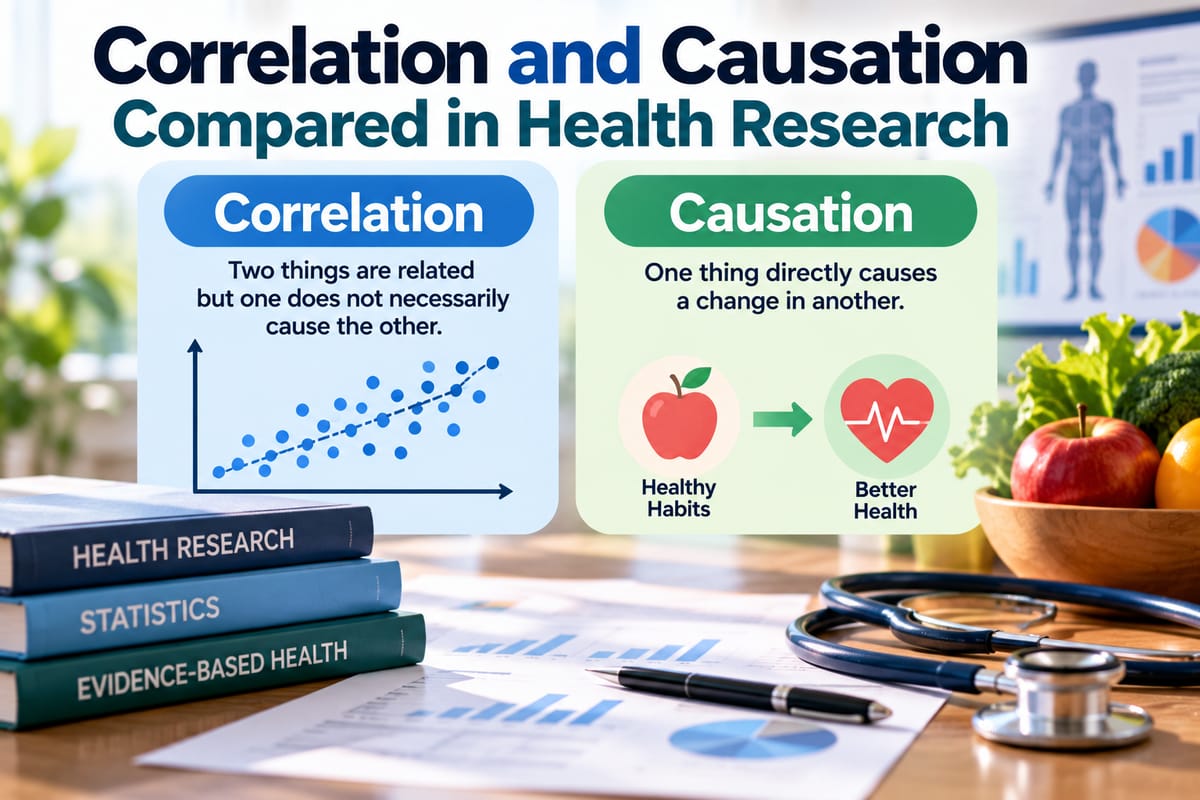
Correlation and Causation Compared in Health Research
Health research often examines relationships between behaviors, exposures, diseases, treatments, and outcomes. Researchers may discover that two factors occur together or change in related ways. But an observed relationship does not automatically mean that one factor caused the other.
This distinction between correlation and causation is fundamental to understanding health research.
For example, researchers might find that people who exercise regularly tend to have lower rates of a particular health condition. That finding may be important, but it does not by itself prove that exercise caused the lower rate. Other differences between people who exercise regularly and those who do not could contribute to the observed relationship.
Understanding the difference helps readers interpret scientific studies more carefully and avoid drawing conclusions that the evidence does not support.
What Is Correlation?
Correlation describes a statistical relationship between two variables.
When two variables are correlated, changes in one variable are associated with changes in the other.
The relationship can be:
- Positive: Both variables tend to increase or decrease together.
- Negative: One variable tends to increase as the other decreases.
- Weak: The variables have only a limited relationship.
- Strong: The variables show a more consistent relationship.
- Absent: There is little or no measurable relationship.
Correlation can be useful because it helps researchers identify patterns that may deserve further investigation.
However, correlation alone does not establish why the relationship exists.
What Is Causation?
Causation means that a change in one factor produces a change in another under the conditions being studied.
For example, if a carefully designed study demonstrates that an intervention produces a particular health outcome while accounting for other important explanations, researchers may have evidence supporting a causal relationship.
Causation is therefore a stronger claim than correlation.
A causal question asks:
Does changing X cause a change in Y?
A correlational question asks:
Are X and Y associated?
The distinction is important because health decisions can be affected by how research findings are interpreted.
Why Correlation Does Not Prove Causation
Two variables can be associated for several reasons.
The first variable may genuinely influence the second, but other explanations are possible.
These include:
- Confounding factors
- Reverse causation
- Chance
- Selection effects
- Measurement problems
- Shared underlying causes
Researchers therefore need appropriate study designs and analytical methods to investigate whether an observed relationship is causal.
A Simple Example of Correlation
Imagine researchers observe that people who regularly eat a particular food tend to have better cardiovascular health.
It would be tempting to conclude that the food itself causes better cardiovascular outcomes.
But people who consume that food regularly might also:
- Exercise more
- Smoke less
- Have different dietary patterns
- Have different incomes
- Receive more preventive healthcare
- Sleep differently
- Have different levels of health literacy
Any of these factors could influence the observed relationship.
The food could still have an effect, but the correlation alone cannot determine how much of the observed difference is actually attributable to it.
The Role of Confounding Factors
A confounder is a factor associated with both the exposure and the outcome that can create or distort an apparent relationship.
Suppose researchers observe that people who regularly participate in a certain activity have better health outcomes.
Age could potentially be a confounding factor if younger people are both more likely to participate in the activity and less likely to experience certain health conditions.
If researchers do not account for age appropriately, the relationship between the activity and the health outcome could be misleading.
Confounding is one reason researchers carefully consider the characteristics of study participants.
Reverse Causation
Another possible explanation is reverse causation.
This occurs when researchers observe that X and Y are related but assume that X causes Y when the actual direction may be reversed.
For example, suppose poor health is associated with lower levels of physical activity.
It might be tempting to conclude that reduced physical activity caused the health problem.
But it is also possible that an existing health problem caused the person to become less physically active.
Both processes could even occur simultaneously.
Determining the direction of causation requires appropriate evidence and study design.
Chance Can Produce Apparent Relationships
Sometimes two variables appear related simply because of random variation.
This is particularly important when researchers examine large numbers of variables.
If enough comparisons are made, some relationships may appear statistically unusual even when there is no meaningful underlying connection.
Researchers use statistical methods to estimate how compatible their findings are with random variation.
However, statistical significance alone does not establish causation.
Correlation Coefficients Provide Information About Association
Researchers can use correlation coefficients to describe the strength and direction of certain relationships.
For example, the Pearson correlation coefficient ranges from -1 to +1.
A value near:
- +1 indicates a strong positive linear relationship.
- 0 indicates little or no linear relationship.
- -1 indicates a strong negative linear relationship.
The coefficient describes an association between variables. It does not determine whether one variable causes the other.
This distinction remains important even when a correlation is very strong.
A Strong Correlation Can Still Be Non-Causal
It may seem intuitive that an extremely strong relationship must represent causation.
That is not necessarily true.
Two variables can be closely correlated because they are both influenced by another factor.
For example, two measurements might increase together because both are affected by age, environmental conditions, or another underlying variable.
A strong statistical association can therefore be a useful clue without being definitive proof of cause and effect.
How Researchers Investigate Causation
Researchers use study design, statistical analysis, biological understanding, and evidence from multiple sources to investigate causal relationships.
The Scientific Method and How Science Works provides broader context for understanding how researchers develop questions, test hypotheses, collect evidence, and refine explanations.
A causal investigation may involve:
- Developing a specific hypothesis
- Identifying relevant variables
- Selecting an appropriate study design
- Measuring exposures and outcomes
- Controlling or accounting for important confounders
- Analyzing the data
- Evaluating alternative explanations
- Comparing results with previous research
- Replicating findings when possible
No single analytical technique automatically establishes causation in every situation.
Randomized Controlled Trials and Causal Evidence
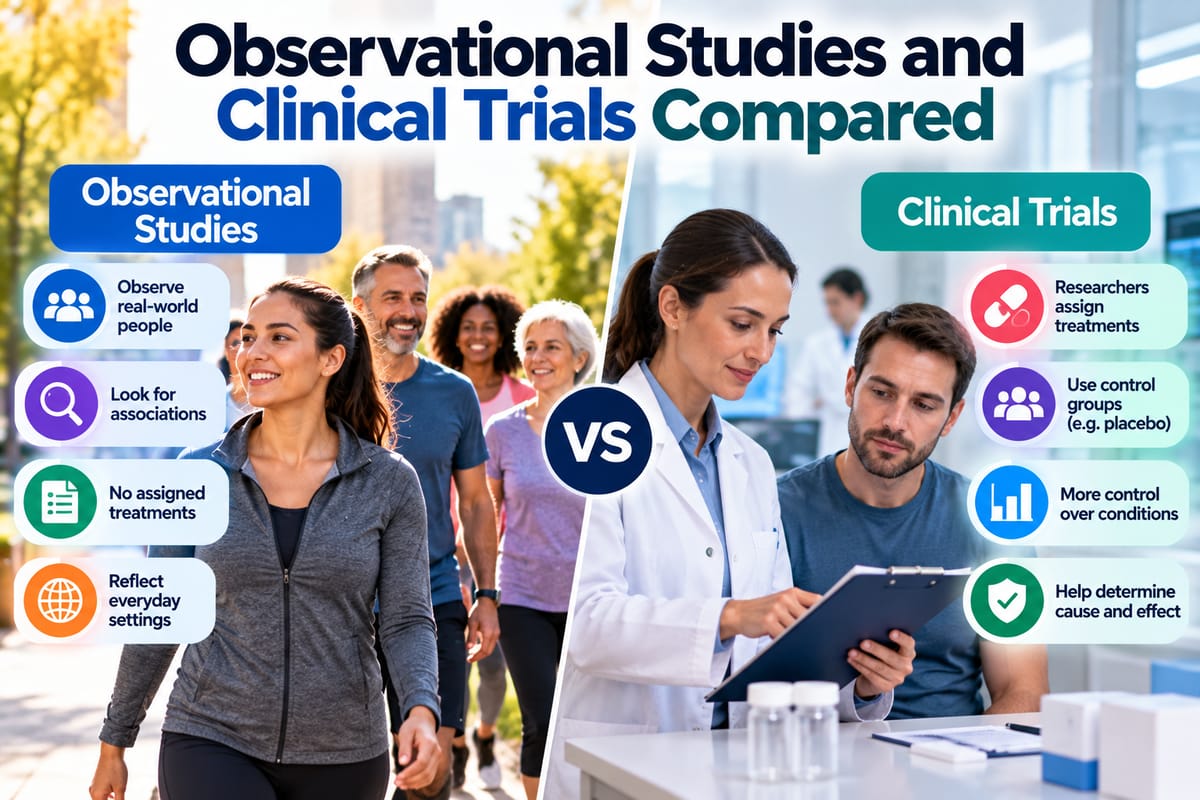
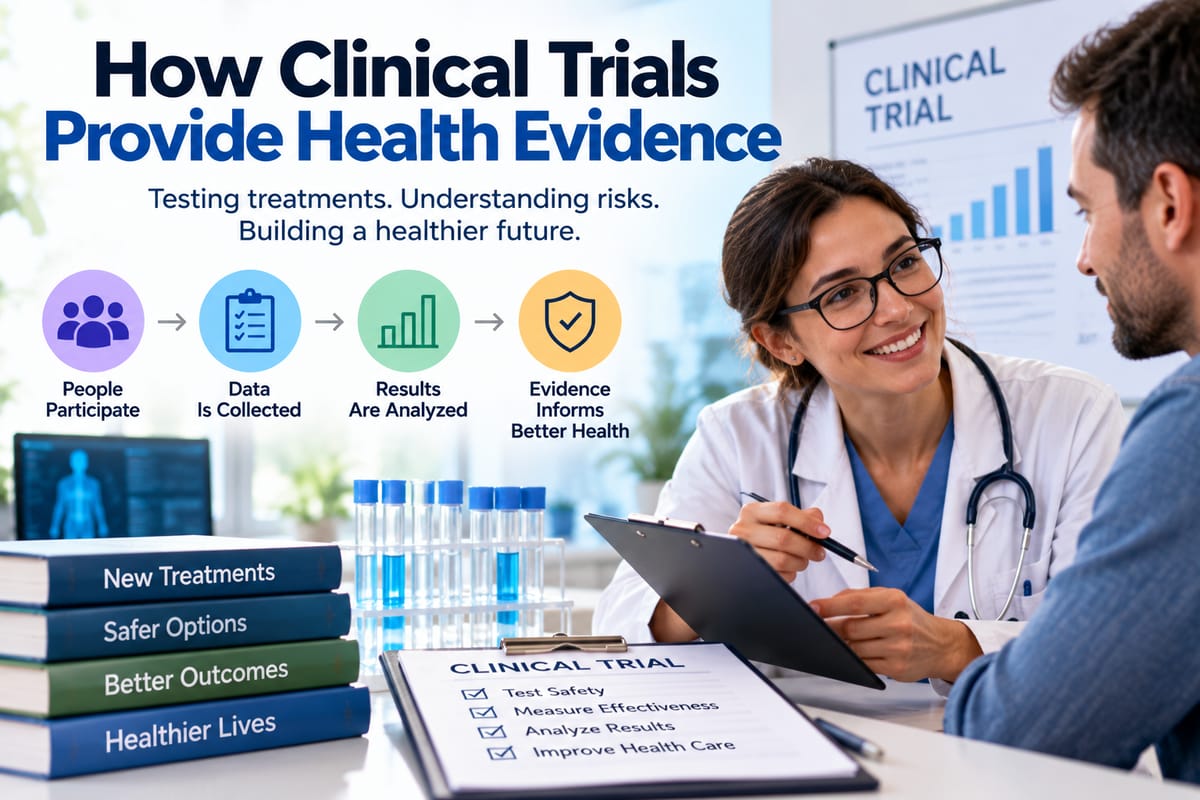
Randomized controlled trials are particularly valuable when researchers want to investigate whether an intervention causes a specific outcome.
In a randomized trial, participants are assigned to different groups using a process based on chance.
For example, one group might receive an intervention while another receives a comparison treatment or placebo, depending on the research question.
Randomization can help distribute many potential confounding factors between groups.
Researchers can then compare outcomes and assess whether the intervention is associated with a meaningful difference.
This does not mean every randomized trial is perfect. Study quality, adherence, sample size, outcome measurement, participant selection, and other factors still matter.
Observational Studies Have an Important Role
Not every health question can be investigated through a randomized trial.
Researchers may use observational studies when:
- Randomization would be unethical
- An exposure cannot reasonably be assigned
- Researchers are studying long-term patterns
- A rare exposure needs investigation
- Researchers want to examine real-world populations
Observational studies can provide valuable evidence about relationships between exposures and health outcomes.
However, because researchers do not necessarily control who receives an exposure, these studies can be more vulnerable to confounding and other sources of bias.
This does not make observational research unhelpful. It means the findings need to be interpreted according to the study design.
Why Biological Plausibility Matters
Researchers may also consider whether there is a credible mechanism through which one factor could influence another.
For example, if a proposed exposure is associated with a health outcome, researchers may investigate whether laboratory, physiological, or clinical evidence provides a plausible explanation.
Biological plausibility alone does not prove causation.
A mechanism can support a causal hypothesis, but it must be considered alongside other evidence.
Consistency Across Studies
Confidence in a possible causal relationship can increase when multiple well-designed studies produce similar findings.
Researchers may examine evidence from:
- Clinical trials
- Cohort studies
- Case-control studies
- Laboratory research
- Mechanistic studies
- Population studies
Different types of evidence can provide different perspectives.
The broader scientific landscape matters because a single study may contain limitations that become clearer when compared with other research.
Dose-Response Relationships
Another factor researchers may examine is whether greater exposure is associated with progressively different outcomes.
For example, if increasing levels of an exposure consistently correspond with increasing risk under appropriate conditions, that pattern may provide additional evidence worth investigating.
However, dose-response patterns can also have alternative explanations.
They therefore represent one piece of evidence rather than an automatic demonstration of causation.
Timing Matters
For one factor to cause another, the proposed cause generally needs to occur before the effect.
This may seem obvious, but establishing the correct sequence can be difficult in health research.
Long-term conditions may develop gradually, and exposures may change over time.
Researchers therefore need study designs that can establish when exposures occurred and when outcomes developed.
Longitudinal studies can be particularly useful when investigating relationships that unfold over extended periods.
Why Health Research Requires Multiple Scientific Disciplines
Health questions rarely belong to a single field of science.
Research can involve biology, chemistry, epidemiology, medicine, psychology, statistics, nutrition, environmental science, and other disciplines.
The broader main scientific disciplines provide different methods for understanding complex questions.
For example, laboratory research may investigate biological mechanisms while epidemiological research examines patterns across populations.
Combining evidence from different disciplines can provide a more comprehensive understanding of a health question.
How Correlation Can Still Be Valuable
The fact that correlation does not prove causation does not mean correlations are unimportant.
A strong association can identify questions that deserve further research.
Researchers may discover:
- Unexpected disease patterns
- Potential risk factors
- Possible protective factors
- Differences between populations
- Emerging health concerns
- Relationships that require experimental testing
Correlation can therefore serve as a starting point for scientific investigation.
The mistake is not finding a correlation. The mistake is automatically treating the correlation as proof of cause and effect.
How Headlines Can Oversimplify Research
Health research is sometimes summarized in headlines that make causal claims stronger than the underlying evidence.
A study may report that a particular behavior is “linked to” an outcome, while a headline describes the behavior as something that “causes” the outcome.
These statements are not necessarily equivalent.
When reading health research, it can help to look at:
- The study design
- The population studied
- The variables measured
- The size of the observed association
- Potential confounding factors
- Whether researchers adjusted for important variables
- The study’s limitations
- Whether similar research has produced comparable findings
These details provide context that a headline may not include.
Relative Risk Does Not Automatically Mean Causation
Researchers often report measures such as relative risk or odds ratios when comparing health outcomes between groups.
Suppose one group has twice the observed risk of an outcome compared with another group.
That finding may indicate an important association.
But the difference could still be influenced by confounding, selection effects, measurement issues, or other factors.
The size of an association therefore needs to be interpreted together with the study design and broader evidence.
Absolute Risk Provides Additional Context
Absolute risk can help put relative differences into perspective.
Imagine an outcome occurs in 1 out of 1,000 people in one group and 2 out of 1,000 people in another.
The relative risk is doubled, but the absolute difference is 1 additional case per 1,000 people.
Both measures describe the same data, but they answer different questions.
Understanding these distinctions is particularly important when evaluating health claims.
From Research Evidence to Health Recommendations
Even when evidence supports a causal relationship, translating that evidence into a health recommendation requires additional consideration.
Researchers and guideline developers may evaluate:
- Strength of evidence
- Magnitude of benefit
- Potential harms
- Consistency across studies
- Applicability to different populations
- Costs and resources
- Patient preferences
- Feasibility
The process is explored in How Scientific Evidence Is Used to Develop Reliable Health Recommendations.
This is important because evidence about what causes an outcome is not necessarily the same as evidence about what an individual should do.
Health Literacy Helps People Interpret Causal Claims
Understanding the difference between correlation and causation is an important part of health literacy.
A person reading that a particular food, supplement, behavior, or environmental exposure is “associated with” a health outcome should not automatically interpret that statement as proof of causation.
How Health Literacy Helps People Make Informed Health Decisions provides broader context on evaluating health information and making informed decisions.
Useful questions include:
- Was the research observational or experimental?
- How many people participated?
- How was the exposure measured?
- How was the outcome measured?
- Could other factors explain the association?
- Did the researchers establish the correct time sequence?
- Are the findings consistent with other studies?
- What limitations did the researchers identify?
A Practical Example: Exercise and Health
Suppose researchers observe that physically active adults tend to have lower rates of a particular chronic condition.
This finding is a correlation.
Several explanations might contribute to it. Physically active individuals may differ from less active individuals in diet, sleep, healthcare use, smoking behavior, income, age, or other characteristics.
Researchers can use different study designs and analytical approaches to investigate these possibilities.
If multiple forms of evidence consistently indicate that physical activity contributes to a particular outcome, confidence in a causal relationship may increase.
Even then, the specific size of the effect and the circumstances in which it occurs still need to be evaluated.
A Practical Example: Sleep and Health Outcomes
Imagine a study finds that people who sleep fewer hours tend to have a particular health outcome more frequently.
The finding establishes an association, but several questions remain.
Could an underlying health condition cause both poor sleep and the outcome?
Could stress influence both?
Could lifestyle factors explain part of the relationship?
Could the relationship operate in both directions?
Further research can help investigate these possibilities.
This illustrates why a single association rarely provides a complete explanation for a complex health outcome.
What Readers Should Remember
Correlation and causation are related concepts, but they answer different questions.
Correlation tells us that variables are associated.
Causation tells us that changing one factor contributes to a change in another.
A correlation can be an important scientific finding without proving that one variable causes the other.
When evaluating health research, readers should consider the study design, potential confounding factors, timing, measurement methods, statistical results, biological evidence, and consistency with other research.
Reading Health Research With Greater Context
The distinction between correlation and causation helps prevent both overinterpretation and dismissal of scientific evidence.
A correlation can reveal an important pattern. A carefully designed study can investigate whether that pattern reflects a causal relationship. Multiple studies and different types of scientific evidence can then contribute to a more complete understanding.
For anyone trying to make sense of health information, the most useful approach is to look beyond a single statistic or headline and ask what the research actually demonstrates.
That habit of careful interpretation can make health information easier to evaluate and help distinguish promising evidence from conclusions that go beyond what a study can establish.



2 Comments
Micle harison
June 7, 2019Lorem ipsum dolor sit amet, usu ut perfecto postulant deterruisset, libris causae volutpat at est, ius id modus laoreet urbanitas. Mel ei delenit dolores.
John Doe
June 7, 2019Some consultants are employed indirectly by the client via a consultancy staffing company.