
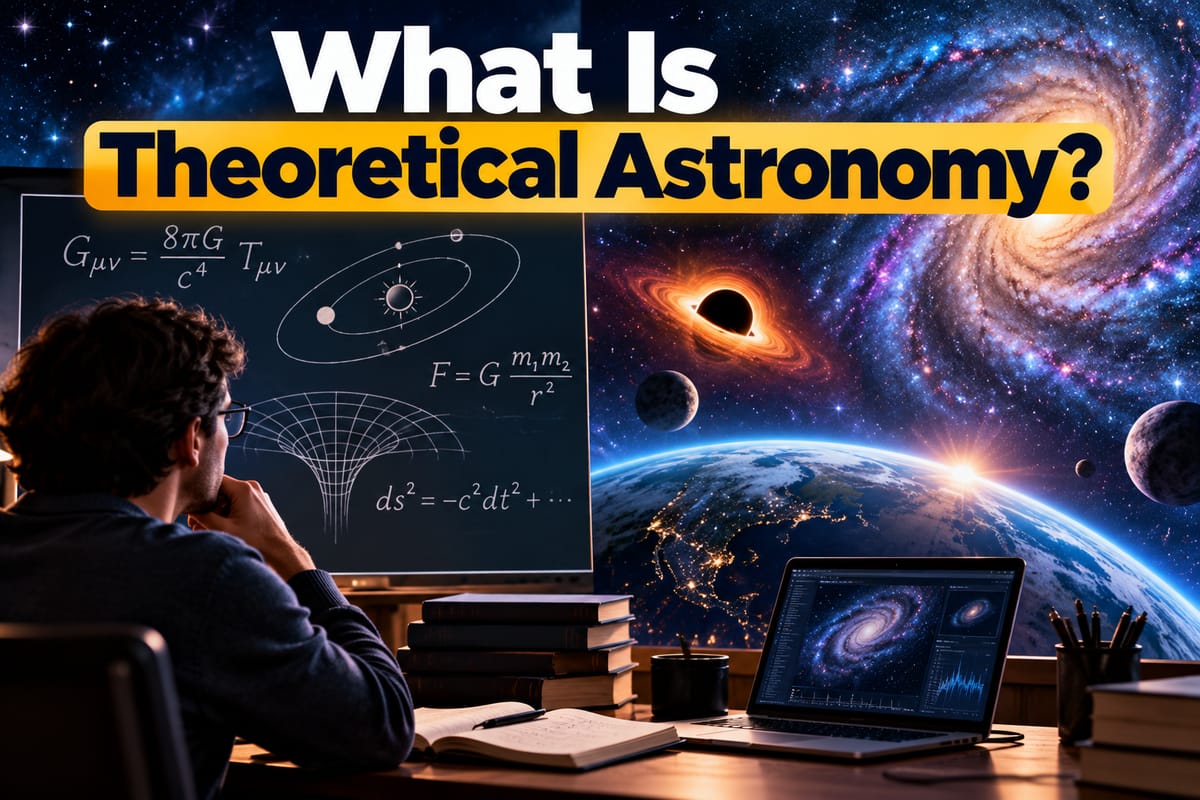
What Is Theoretical Astronomy?
Astronomy is often associated with telescopes, observatories, spacecraft, and spectacular images of distant galaxies. But observing the universe is only one part of understanding it. Astronomers also use mathematics, physics, and computer simulations to investigate phenomena that may be difficult or even impossible to observe directly.
This is where theoretical astronomy plays an important role.
Theoretical astronomy uses mathematical models, physical laws, and computational methods to explain how astronomical objects and systems behave. Rather than relying primarily on direct observation, theoretical astronomers develop ideas about how the universe works and then compare the predictions of those ideas with observations.
The field covers an enormous range of subjects, from the motion of planets and stars to black holes, galaxies, cosmic evolution, and the large-scale structure of the universe.
What Does Theoretical Astronomy Mean?
Theoretical astronomy is the branch of astronomy concerned with developing mathematical and physical models of astronomical phenomena.
A theoretical astronomer may begin with a question such as:
- How does a star evolve?
- How do galaxies form?
- What happens to matter near a black hole?
- How do planets move around stars?
- How did structures in the early universe develop?
- What could happen to a particular astronomical system over millions or billions of years?
The astronomer then uses established physical principles, mathematical equations, observations, and computer simulations to investigate the question.
The objective is not simply to create an interesting explanation. A useful theoretical model should make predictions that can be tested against evidence.
How Is Theoretical Astronomy Different From Observational Astronomy?
Observational astronomy focuses on collecting and analyzing information about objects and events in space.
Astronomers may use:
- Optical telescopes
- Radio telescopes
- Infrared observatories
- X-ray telescopes
- Space-based instruments
- Spectrometers
- Detectors
- Spacecraft
Theoretical astronomy approaches many of the same questions from the modeling side.
The two areas are closely connected.
An observation can reveal something unexpected, prompting theorists to develop an explanation. A theoretical model can also predict a phenomenon that observers subsequently search for.
This relationship creates a continuous cycle:
Observation → Model → Prediction → New Observation → Improved Model
Neither approach exists entirely separately from the other.
The Role of Physics in Theoretical Astronomy
Physics provides many of the fundamental tools used by theoretical astronomers.
The behavior of astronomical systems can involve principles from:
- Classical mechanics
- Electromagnetism
- Thermodynamics
- Quantum mechanics
- Relativity
- Nuclear physics
- Fluid dynamics
- Statistical physics
Different astronomical problems require different combinations of these principles.
For example, calculating the motion of a spacecraft may rely heavily on gravitational physics and orbital mechanics, while understanding the interior of a star requires knowledge of nuclear reactions, pressure, temperature, radiation, and fluid behavior.
The enormous variety of astronomical environments is one reason theoretical astronomy draws from so many areas of physics.
Mathematics Is Central to Theoretical Astronomy
Mathematics allows astronomers to turn physical ideas into models that can be calculated and tested.
Equations can describe relationships between quantities such as:
- Mass
- Energy
- Temperature
- Pressure
- Distance
- Velocity
- Time
- Gravity
Some astronomical systems can be described with relatively simple equations.
Others are so complicated that analytical solutions are difficult or impossible to obtain. In those cases, astronomers often rely on numerical calculations and computer simulations.
Mathematics therefore acts as a language through which theoretical astronomers describe physical processes.
What Questions Does Theoretical Astronomy Try to Answer?
Theoretical astronomy covers questions across nearly every major area of space science.
Researchers may investigate:
- The formation and evolution of stars
- Planet formation
- Exoplanet atmospheres
- Galaxy formation
- Black holes
- Gravitational waves
- Dark matter
- Dark energy
- The early universe
- Cosmic structure
- Orbital systems
- Stellar explosions
- Interactions between galaxies
Some questions concern individual objects, while others involve the universe as a whole.
This makes theoretical astronomy both highly specialized and remarkably broad.
Theoretical Models of Stars
Stars are among the most important subjects in theoretical astronomy.
A star may appear relatively stable when viewed from Earth, but enormous physical processes are taking place inside it.
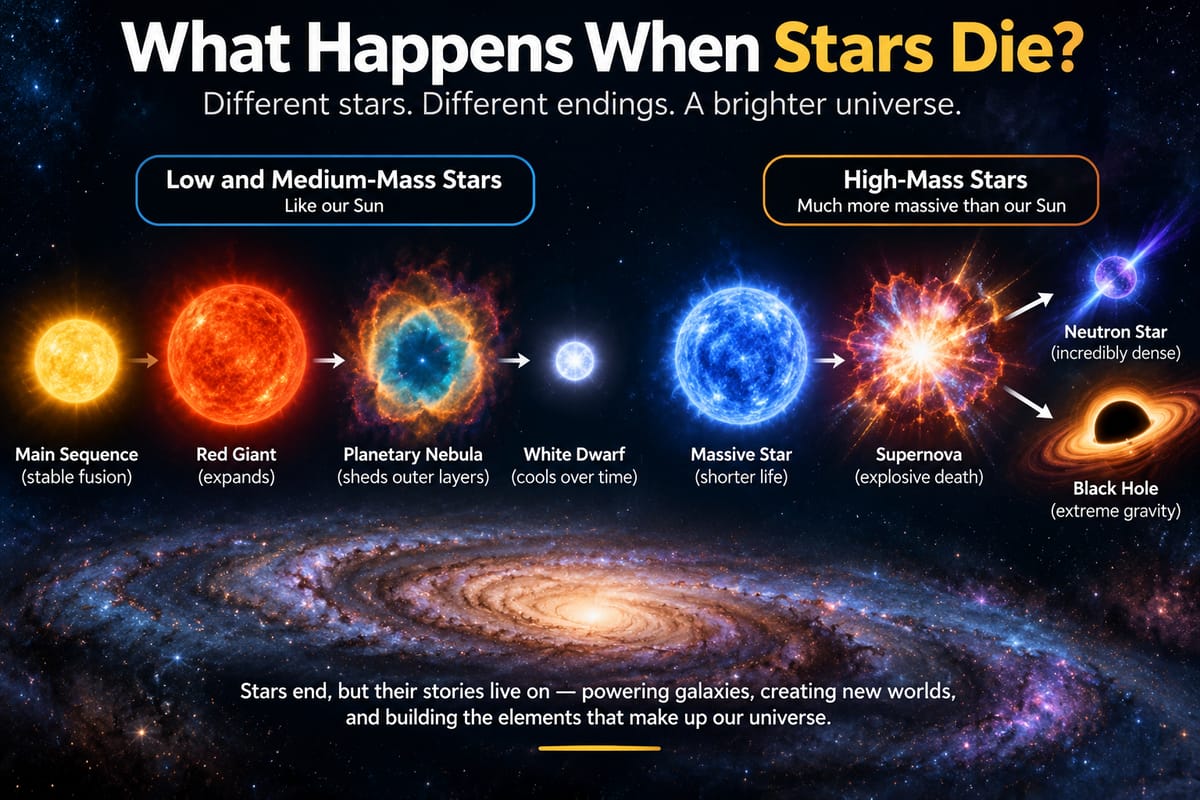
Theoretical models can help explain how stars:
- Form from clouds of gas and dust
- Contract under gravity
- Begin nuclear fusion
- Change as their fuel is consumed
- Lose mass
- Expand or contract
- End their lives in different ways
The precise evolution of a star depends on properties such as its mass and composition.
Because astronomers cannot observe the entire lifetime of a single star, theoretical models are especially useful. Researchers can observe many stars at different stages and use models to connect those observations into an evolutionary picture.
How Theoretical Astronomy Helps Explain Black Holes
Black holes are another area where theory is essential.
A black hole’s defining properties are closely connected to general relativity and the behavior of gravity under extreme conditions.
Theoretical astronomers use mathematical models to investigate questions involving:
- Event horizons
- Accretion disks
- Relativistic effects
- Black hole mergers
- Jets
- Gravitational waves
- Matter falling toward black holes
Readers interested in this subject can explore How Black Holes Work for a broader explanation of their physical behavior.
Theoretical models can also help astronomers understand what signals might be produced by black holes and what instruments should look for.
Theoretical Astronomy and the Early Universe
The universe has changed dramatically over cosmic time.
Theoretical astronomy helps researchers construct models of how the universe evolved from its early state into the enormous collection of galaxies, stars, planets, and other structures observed today.
These models can address questions involving:
- The expansion of the universe
- The formation of the first structures
- The development of galaxies
- The distribution of matter
- The cosmic background radiation
- The evolution of large-scale structures
The goal is not to reconstruct every event in perfect detail. Instead, scientists develop models that can explain multiple independent observations consistently.
Modeling the Size and Structure of the Universe
The observable universe contains an enormous number of astronomical objects separated by vast distances.
Determining how large the observable universe is and understanding its structure requires observations combined with mathematical models.
The subject becomes particularly interesting because the universe is expanding, meaning that distances between sufficiently separated galaxies can change over cosmic time.
The How Large Is the Known Universe? guide explores the scale of the cosmos and why measuring the universe is more complicated than simply estimating the distance to its most distant visible object.
Theoretical models help connect observations of distant galaxies with the underlying geometry and expansion of the universe.
Planet Formation and Theoretical Astronomy
Theoretical astronomy is also important for understanding how planets form.
Planets develop within disks of gas and dust surrounding young stars. Over time, material can collide, combine, migrate, and interact through gravity.
Computer models can simulate parts of these processes.
Researchers can investigate questions such as:
- How quickly planets form
- Why planets have different compositions
- How planetary systems become organized
- Why some planets migrate toward or away from their stars
- How giant planets influence smaller bodies
- How debris becomes incorporated into planets
These models can then be compared with observations of young planetary systems and the growing population of discovered exoplanets.
Exoplanets and Their Atmospheres
Thousands of planets have been identified beyond our solar system, but detecting a planet is only the beginning.
Astronomers also want to understand what these worlds are like.
Theoretical models can help researchers interpret measurements of exoplanet atmospheres.
Models may consider:
- Atmospheric composition
- Temperature
- Pressure
- Radiation from the host star
- Atmospheric circulation
- Cloud formation
- Chemical reactions
- Atmospheric escape
When observations produce unusual measurements, theoretical models can help determine which physical scenarios might explain them.
Theoretical Astronomy and Orbital Mechanics
The motion of planets, moons, asteroids, comets, and spacecraft is strongly influenced by gravity.
Orbital mechanics provides mathematical methods for describing these motions.
The subject becomes especially important when multiple gravitational bodies interact.
A spacecraft traveling through the solar system, for example, may be affected by the gravitational fields of the Sun, planets, and moons.
The What Is Orbital Mechanics and How Does It Control Spacecraft Motion? guide explores the principles behind these trajectories in greater detail.
Theoretical calculations can help determine how an object will move, how much energy is required for a maneuver, and how a trajectory may change under different conditions.
Why Computer Simulations Are Important
Many astronomical systems are too complicated to solve using simple equations.
Computers allow researchers to perform enormous numbers of calculations and simulate processes over long periods.
A simulation might model:
- Millions of particles
- Gas clouds
- Gravitational interactions
- Galaxy formation
- Star formation
- Planetary systems
- Collisions between astronomical objects
Researchers can change variables and observe how the modeled system responds.
For example, a galaxy simulation might investigate how changing the amount or distribution of matter affects the resulting structure.
Computer simulations do not automatically prove that a model is correct. They are tools for exploring the consequences of particular assumptions and physical laws.
What Makes a Good Astronomical Model?
A useful theoretical model generally needs to do more than reproduce something that has already been observed.
It should ideally provide a coherent physical explanation and make predictions that can be compared with additional observations.
Researchers may ask:
- Does the model agree with existing evidence?
- Does it rely on established physical principles?
- Can its predictions be tested?
- Does it explain multiple observations?
- Does it require unnecessary assumptions?
- Does new evidence support or contradict it?
Models can be refined as new information becomes available.
A scientific model is therefore not necessarily a permanent final answer. It is a structured way of describing and predicting physical behavior based on available evidence.
Theory Does Not Mean Guesswork
The word “theoretical” can sometimes create confusion.
In everyday language, a theory may mean an idea or speculation.
In science, theoretical work generally refers to systematic explanations developed using established principles, mathematics, evidence, and testable predictions.
Theoretical astronomy is therefore not simply imagining what might exist in space.
Researchers must work within physical laws and compare their models against observations.
A theoretical prediction that repeatedly conflicts with reliable observations may require modification or rejection.
The Relationship Between Theory and Observation
The strongest progress in astronomy often occurs when theoretical and observational research reinforce each other.
Suppose observations reveal an unexpected pattern.
Theoretical astronomers may develop several possible explanations. Each explanation can produce different predictions.
Observers can then search for evidence that distinguishes between those possibilities.
The process can work in the opposite direction as well.
A theoretical model may predict a phenomenon that has not yet been detected. Astronomers can then design observations to search for it.
This interaction has contributed to many important developments throughout astronomy.
Theoretical Astronomy and Gravitational Waves
Gravitational waves provide a useful example of theory leading toward new observational possibilities.
General relativity predicts that accelerating massive objects can produce disturbances in spacetime that propagate outward.
Theoretical calculations can model the expected signals from events such as compact-object mergers.
Researchers can compare those predictions with signals recorded by gravitational-wave observatories.
Theoretical models are important for interpreting the signals and estimating properties such as the masses and other characteristics of the objects involved.
The Challenge of Extreme Distances and Timescales
Astronomy presents an unusual scientific challenge because many phenomena occur over enormous distances and timescales.
A star can take millions of years to evolve through major stages.
A galaxy can change over billions of years.
Light from distant objects can take millions or billions of years to reach Earth.
Astronomers therefore cannot simply watch most cosmic processes from beginning to end.
Instead, they combine observations of different objects with theoretical models.
In a sense, the universe provides snapshots from different periods of cosmic history, while theory helps researchers understand how those snapshots may fit together.
Theoretical Astronomy and Dark Matter
Dark matter is another area where theoretical work plays an important role.
Astronomers observe gravitational effects that appear difficult to explain using only the matter that can be directly detected through electromagnetic observations.
Theoretical models have been developed to investigate how an unseen component of matter could influence galaxies and larger cosmic structures.
Researchers then compare these models with observations.
The study of dark matter illustrates an important feature of theoretical astronomy: a model can be motivated by an observed physical effect even when the underlying cause is not yet directly understood.
Theoretical Astronomy and Dark Energy
The expansion of the universe provides another major theoretical challenge.
Observations indicate that cosmic expansion has changed over time in a way that requires explanation within modern cosmological models.
The term “dark energy” is used to describe the unknown component associated with the observed accelerated expansion in the standard cosmological framework.
Theoretical astronomers investigate different possibilities for explaining this behavior.
Some models involve properties of space itself, while others explore modifications to our understanding of gravity or other physical mechanisms.
Observations remain essential for determining which models can successfully describe the universe.
How Theoretical Astronomy Advances
The field advances through a combination of mathematical work, observations, experiments, simulations, and debate.
A typical research process might involve:
- Identifying an astronomical question
- Reviewing existing observations and theories
- Developing a mathematical model
- Running calculations or simulations
- Generating predictions
- Comparing predictions with observations
- Refining the model
- Testing it against additional evidence
Sometimes a model succeeds.
Sometimes observations reveal that an assumption was incomplete.
In other cases, a model may remain useful for certain conditions while requiring modification for others.
This gradual process is a normal part of scientific research.
Why Theoretical Astronomy Matters
Much of what humans know about the universe depends on our ability to connect observations with physical explanations.
A telescope might reveal an unusual object, but theory helps determine what that object could be.
A spacecraft might collect measurements from another world, but models help researchers understand the physical processes responsible for those measurements.
A detector might record a distant signal, while theoretical calculations help identify the type of cosmic event that could have produced it.
Theoretical astronomy provides the framework for making these connections.
The Broader Field of Astronomy
Theoretical astronomy is one part of a much larger scientific discipline.
Astronomy encompasses the study of planets, stars, galaxies, black holes, cosmic structures, and the universe itself.
The The Complete Guide to Astronomy provides a broader overview of these subjects and how different areas of astronomy fit together.
Within that larger field, theoretical astronomy serves as a bridge between physical laws and astronomical observations.
It helps transform measurements into models and models into testable predictions.
The Future of Theoretical Astronomy
Theoretical astronomy is likely to become increasingly connected to powerful computing, large astronomical surveys, and increasingly precise observations.
Modern instruments can collect enormous quantities of data, creating new opportunities for researchers to test increasingly detailed models.
Artificial intelligence and advanced computational techniques may also help researchers analyze complex datasets and explore large numbers of possible models. However, these tools do not replace the need for physical reasoning, mathematical understanding, and observational testing.
As humanity discovers more planets, observes more distant galaxies, detects more cosmic events, and gathers better measurements of the universe, theoretical astronomy will continue to provide frameworks for understanding what those discoveries mean.
Connecting Equations to the Cosmos
Theoretical astronomy demonstrates that understanding space requires more than simply looking farther into the sky.
The universe is governed by physical processes that can be described with mathematics, tested through observations, and explored through computer simulations.
From the motion of spacecraft to the evolution of stars and the behavior of black holes, theoretical models allow astronomers to investigate systems that are too distant, too large, too small, or too slow to study through direct observation alone.
The field ultimately brings together two fundamental aspects of astronomy: what we observe in the universe and the physical principles that explain why it behaves the way it does.


2 Comments
Micle harison
June 7, 2019Lorem ipsum dolor sit amet, usu ut perfecto postulant deterruisset, libris causae volutpat at est, ius id modus laoreet urbanitas. Mel ei delenit dolores.
John Doe
June 7, 2019Some consultants are employed indirectly by the client via a consultancy staffing company.