
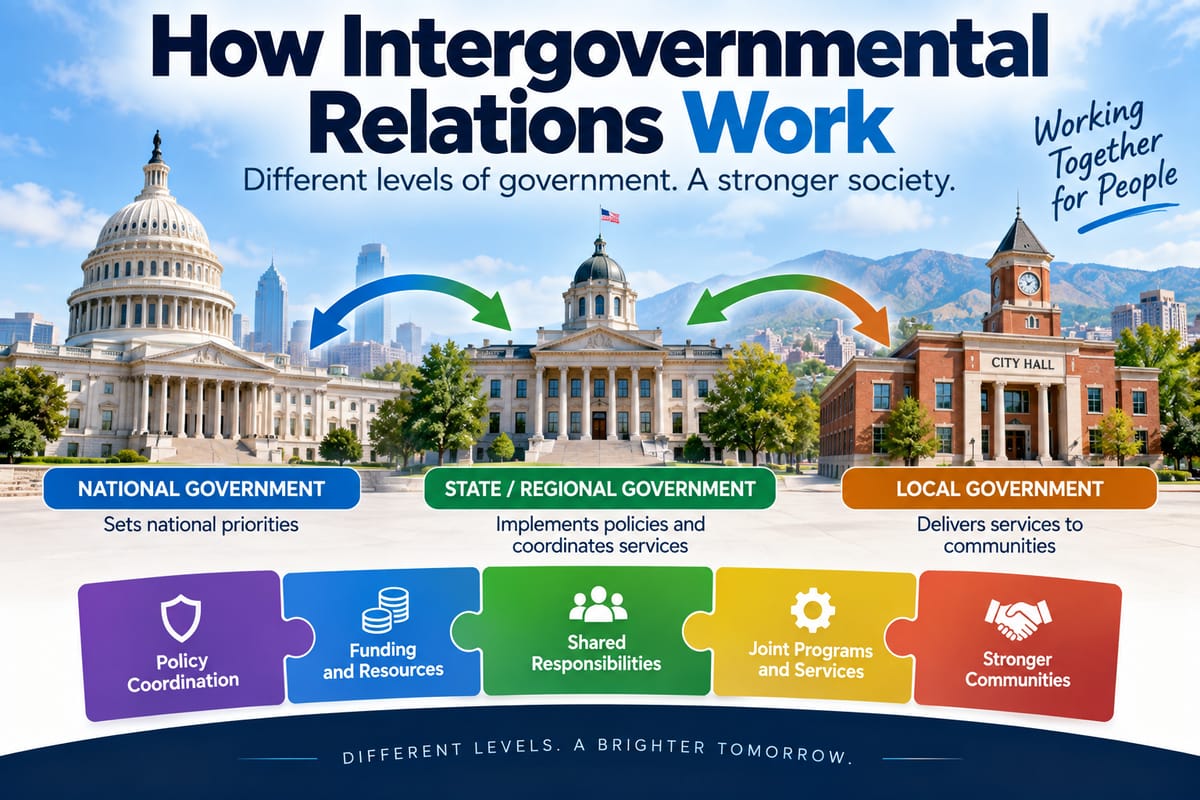
How Intergovernmental Relations Work
Governments rarely operate entirely on their own. In many countries, national, regional, provincial, state, county, or municipal governments share responsibilities for public services, infrastructure, taxation, economic development, environmental management, and emergency response.
The relationships between these different levels of government are known as intergovernmental relations.
Intergovernmental relations describe how governments communicate, coordinate, share resources, divide responsibilities, resolve disagreements, and work together when their areas of authority overlap. They exist in federal countries, decentralized unitary states, and other systems where public responsibilities are distributed across multiple levels.
The exact structure differs from one country to another because constitutions, laws, political institutions, fiscal arrangements, and administrative traditions determine how power is distributed. The OECD describes multi-level governance as involving policy and decision-making among national, regional, and local governments.
What Are Intergovernmental Relations?
Intergovernmental relations are the formal and informal interactions between different levels of government within a country.
These interactions can involve:
- National and regional governments
- National and local governments
- Regional and local governments
- State or provincial governments working with municipalities
- Governments sharing responsibility for the same policy area
- Governments negotiating funding and resource allocation
- Joint programs involving multiple levels of government
The purpose is not necessarily to make every level of government operate in the same way. Instead, intergovernmental relations provide mechanisms for coordinating responsibilities that cannot be handled effectively by one level alone.
For example, a national government may establish broad infrastructure priorities while regional governments oversee implementation and local authorities manage individual projects.
Why Do Different Levels of Government Exist?
Countries divide governmental responsibilities for several reasons.
Some decisions affect the entire country and therefore may be handled nationally. Others are highly dependent on local conditions and may be better administered closer to the communities affected by them.
A national government might be responsible for matters such as:
- National defense
- Foreign affairs
- Monetary policy
- National taxation
- National legislation
Subnational governments may have responsibilities involving:
- Local roads
- Public transport
- Waste management
- Local planning
- Community services
- Regional development
- Local economic programs
The exact allocation varies considerably between countries.
Understanding these different political structures provides useful context in the Complete Guide to Political Systems.
Intergovernmental Relations in Federal Systems
Federal systems constitutionally distribute governmental authority between a national government and constituent units such as states, provinces, or regions.
International IDEA describes federalism as a constitutional arrangement combining elements of self-government and shared government. The constituent units have constitutionally protected authority in some areas while participating in broader national governance.
This creates a permanent need for cooperation.
A federal government may have authority over one policy area while state or provincial governments have authority over another. Some responsibilities may also be shared.
As a result, governments need mechanisms for determining:
- Who has authority
- Who pays for a program
- Who implements a policy
- How governments exchange information
- How disagreements are resolved
- How joint programs are administered
Intergovernmental Relations in Unitary Systems
Intergovernmental relations are not limited to federal countries.
Unitary states can also decentralize authority to regional and local governments. In these systems, the national government generally remains constitutionally sovereign, but legislation can transfer responsibilities, resources, or administrative functions to subnational authorities.
The degree of decentralization varies considerably.
Some unitary countries may give municipalities substantial responsibilities and financial resources, while others retain much stronger central control.
The OECD distinguishes decentralization, devolution, and federalization as different arrangements rather than treating them as identical concepts.
How Responsibilities Are Divided
One of the central questions in intergovernmental relations is determining which government should perform which function.
This can become complicated when responsibilities overlap.
For example, education may involve:
- National curriculum standards
- Regional administration
- Local school management
- Shared funding
- National examinations
- Local infrastructure
Similar overlaps can occur in health care, transportation, environmental protection, housing, and economic development.
The OECD notes that assigning responsibilities clearly across levels of government is a major issue in effective decentralization because poorly designed arrangements can create overlaps, fragmentation, or gaps in public services.
Constitutional Rules Provide the Framework
In many political systems, the constitution establishes the basic boundaries of governmental authority.
A constitution may specify:
- Which powers belong to the national government
- Which powers belong to regional governments
- Which powers are shared
- How legislation is made
- How disputes between governments are resolved
- How financial arrangements operate
- How subnational governments are represented nationally
In federal systems, these constitutional arrangements are particularly important because the division of authority between levels of government is part of the constitutional structure.
Federal arrangements can also differ significantly from one country to another.
Shared Powers Require Coordination
Some responsibilities cannot easily be assigned to only one level of government.
Environmental protection is a good example.
A national government may establish broad environmental standards, regional authorities may manage natural resources, and municipalities may control local waste or land-use programs.
Each government can therefore have legitimate responsibilities in the same policy area.
Coordination becomes necessary to prevent contradictory rules and ensure that policies work together.
This is one reason multi-level governance involves not only the distribution of powers but also mechanisms for cooperation among institutions.
How Governments Coordinate
Intergovernmental coordination can take many forms.
Intergovernmental Councils
Governments may establish councils or committees where representatives from different levels meet to discuss shared responsibilities.
These bodies can provide a regular forum for negotiation and information exchange.
Ministerial Meetings
National and subnational ministers may meet to coordinate policy in areas such as health, education, transportation, agriculture, or finance.
Formal Agreements
Governments can establish agreements defining responsibilities, funding arrangements, targets, or implementation procedures.
Joint Programs
Multiple governments may contribute funding, personnel, infrastructure, or administrative capacity to a common program.
Information Sharing
Governments may exchange statistics, research, administrative data, and policy information to coordinate decisions.
The specific arrangements differ according to each country’s constitutional and administrative system.
Fiscal Intergovernmental Relations
Money is one of the most important parts of intergovernmental relations.
Governments need revenue to perform the responsibilities assigned to them. Yet revenue-raising powers and spending responsibilities are not always located at the same level.
A national government may collect a large share of taxes while regional or local governments are responsible for delivering important public services.
This creates a need for fiscal arrangements between levels of government.
Fiscal relations can include:
- Tax sharing
- Grants
- Transfers
- Revenue-sharing arrangements
- Equalization mechanisms
- Joint funding programs
- Borrowing rules
- Spending responsibilities
The OECD describes fiscal federalism as involving the distribution of taxation and spending powers across levels of government.
Why Government Transfers Exist
Transfers can help subnational governments finance responsibilities that exceed their own revenue capacity.
For example, a municipality may have substantial responsibilities for public services but a relatively limited local tax base.
A national or regional government can provide funding through grants or transfers.
Some transfers may be unrestricted, allowing local governments to decide how to use the money. Others may be tied to specific programs or conditions.
The design of these arrangements can influence how much autonomy subnational governments have over spending.
Equalization Between Regions
Economic conditions can vary substantially within a country.
One region may have a large tax base and significant natural resources, while another may have fewer revenue-generating opportunities.
Intergovernmental fiscal systems can include equalization mechanisms designed to address differences in fiscal capacity or the cost of providing services.
The specific objectives and formulas differ between countries.
The broader issue is how a country balances regional autonomy with national objectives such as access to public services and fiscal stability.
Intergovernmental Relations and Public Services
Citizens often experience intergovernmental relations through public services rather than through formal government meetings.
Consider public transportation.
A national government may establish transportation regulations or provide infrastructure funding. A regional authority may coordinate major transport networks, while municipalities operate local services or manage roads.
If these institutions fail to coordinate, projects can overlap or leave gaps.
Effective coordination can help governments align planning, funding, construction, regulation, and service delivery.
The OECD notes that coordination among national, regional, and local governments is important because subnational authorities often cannot implement major public programs entirely on their own.
Federalism, Decentralization, and Intergovernmental Relations
Federalism and decentralization are closely related to intergovernmental relations, but they are not interchangeable terms.
Federalism involves a constitutional division of authority between a national government and constituent units.
Decentralization refers more broadly to transferring responsibilities, powers, or resources from central government to lower levels.
Devolution is a form of decentralization in which powers are transferred to legally constituted autonomous governments.
The OECD identifies devolution as a stronger form of decentralization because it transfers powers to autonomous lower-level governments.
Intergovernmental relations describe the interactions that take place once multiple levels of government have responsibilities that require coordination.
For a more detailed examination of how powers are divided, see How Federal and Decentralized Governments Divide Political Power.
Horizontal and Vertical Relations
Intergovernmental relations can occur both vertically and horizontally.
Vertical Relations
Vertical relations occur between different levels of government.
Examples include:
- National government and regional government
- Regional government and municipality
- National government and local government
These relationships often involve funding, regulation, implementation, and policy coordination.
Horizontal Relations
Horizontal relations occur between governments at the same level.
Examples include:
- Two neighboring municipalities cooperating
- Several provinces coordinating a transportation project
- Regional governments sharing environmental information
- Cities working together on infrastructure
Horizontal cooperation can be especially useful when a problem crosses administrative boundaries.
Why Local Governments May Need to Cooperate
Many issues do not stop at municipal boundaries.
A river may pass through several local jurisdictions. A metropolitan transportation network may connect multiple cities. Air pollution can spread across administrative borders.
Individual municipalities may therefore need to coordinate with neighboring governments.
Cooperation can involve shared infrastructure, joint services, common planning, data sharing, or coordinated regulation.
This approach can help governments address problems at a geographic scale that matches the problem itself.
Intergovernmental Relations and Policy Implementation
Passing a law is only one stage of policymaking.
Implementation may require several levels of government.
A national legislature might establish a policy, but regional or local authorities may be responsible for putting it into practice.
This means the effectiveness of a policy can depend partly on:
- Administrative capacity
- Available funding
- Clear responsibilities
- Information sharing
- Coordination
- Local conditions
- Monitoring
- Accountability
A policy can therefore look straightforward at the national level while becoming much more complicated during implementation.
Disagreements Between Governments
Different levels of government do not always agree.
Disputes can arise over:
- Constitutional authority
- Funding
- Taxation
- Regulation
- Natural resources
- Infrastructure
- Environmental rules
- Administrative responsibilities
- Policy priorities
Intergovernmental systems therefore need mechanisms for resolving disagreements.
These may include:
- Negotiation
- Mediation
- Administrative review
- Legislative processes
- Arbitration
- Courts
- Constitutional courts
- Intergovernmental councils
The appropriate mechanism depends on the country’s legal and political framework.
The Role of Courts
Courts can become important when governments disagree about the scope of their constitutional powers.
In federal systems, constitutional courts or supreme courts may interpret provisions governing the division of authority.
For example, a dispute might involve whether a national law falls within federal authority or improperly intrudes into an area assigned to a state or province.
Judicial decisions can therefore influence the practical boundaries of intergovernmental authority.
Intergovernmental Relations During Emergencies
Emergencies often reveal how well different levels of government can coordinate.
Natural disasters, public health emergencies, major infrastructure failures, and other crises may require national resources while relying heavily on regional and local implementation.
During an emergency, governments may need to coordinate:
- Emergency funding
- Medical resources
- Evacuation
- Public communications
- Transportation
- Security
- Infrastructure repair
- Relief programs
The need for rapid coordination can expose both strengths and weaknesses in existing intergovernmental arrangements.
Intergovernmental Relations and International Affairs
Domestic governments can also interact with international institutions and foreign governments in ways that affect intergovernmental coordination.
For example, a national government may negotiate an international agreement while regional governments implement parts of the resulting policy.
This creates an intersection between domestic intergovernmental relations and international affairs.
Readers interested in the broader relationship between governments and international actors can explore International Relations Explained.
Diplomatic institutions can also interact with subnational authorities on issues involving trade, investment, cultural exchange, development, and international cooperation. For a broader look at formal relations between states, see the Complete Guide to Diplomacy and Diplomatic Relations.
Intergovernmental Agreements
Formal agreements can clarify how governments will cooperate.
An agreement might specify:
- The responsibilities of each government
- Funding contributions
- Implementation schedules
- Reporting requirements
- Performance measures
- Dispute-resolution procedures
- Information-sharing arrangements
Such agreements can be particularly useful when responsibilities are shared rather than exclusively assigned to one government.
They can also reduce uncertainty by establishing expectations before a joint program begins.
Accountability Across Multiple Levels
Multiple levels of government can make accountability more complicated.
When a public service fails, citizens may want to know which institution is responsible.
If responsibilities are unclear, different governments may blame one another.
Clear assignment of responsibilities can make it easier to determine:
- Who makes the decision
- Who controls the budget
- Who implements the program
- Who monitors performance
- Who answers to voters or other oversight institutions
The OECD has identified unclear or overlapping responsibilities as an important challenge in multi-level governance.
The Challenge of Coordination
Coordination itself can be difficult.
Different governments may have different:
- Political priorities
- Budgets
- Administrative capacities
- Legal responsibilities
- Electoral incentives
- Policy preferences
A national government may want a uniform national approach, while regional governments may argue that local circumstances require flexibility.
Neither approach automatically applies in every situation. Effective arrangements depend on the particular policy, constitutional system, and administrative context.
Capacity Matters
Giving a government responsibility for a policy does not automatically give it the ability to implement that policy effectively.
Subnational governments may differ considerably in:
- Revenue
- Staff
- Technical expertise
- Infrastructure
- Administrative systems
- Data capacity
- Planning capabilities
This means decentralization can require investments in institutional capacity as well as transfers of formal authority.
The OECD emphasizes that effective multi-level governance involves not only assigning responsibilities but also building the capacity and coordination mechanisms needed to carry them out.
Why Intergovernmental Relations Matter
Intergovernmental relations affect many ordinary aspects of public life.
They influence how governments:
- Build infrastructure
- Deliver public services
- Raise and distribute revenue
- Respond to emergencies
- Implement national policies
- Manage natural resources
- Coordinate economic development
- Regulate businesses
- Protect the environment
- Resolve disputes over authority
When responsibilities are divided across multiple levels, cooperation becomes an essential part of governance.
A Simple Example of Intergovernmental Cooperation
Imagine a country planning a major regional railway.
The national government could provide significant funding and establish national transportation standards.
A regional government could coordinate the route and connect the railway to regional development plans.
Municipal governments could manage stations, local roads, zoning, and connections to public transportation.
Private companies might construct or operate parts of the system under government regulation.
The project therefore depends on multiple institutions performing different functions.
If each government works independently, the project could encounter delays, conflicting plans, or funding gaps.
If the governments coordinate responsibilities, financing, construction, regulation, and local planning can be aligned.
This illustrates the basic purpose of intergovernmental relations: different governments working within their respective areas of authority while coordinating where their responsibilities overlap.
How Intergovernmental Relations Can Change
Intergovernmental arrangements are not necessarily permanent.
Governments may reform them in response to:
- Population growth
- Urbanization
- Economic changes
- Administrative problems
- Political reforms
- Constitutional amendments
- Regional demands
- Fiscal pressures
- New public-service needs
Reforms can transfer responsibilities, change funding systems, create new regional institutions, or modify coordination mechanisms.
The OECD’s comparative work on multi-level governance shows that countries have adopted a wide variety of institutional reforms to reorganize powers, responsibilities, and resources across levels of government.
Intergovernmental Relations in Everyday Governance
Intergovernmental relations may sound like an abstract constitutional concept, but they are present throughout everyday government.
When a local road is repaired using national funding, when regional authorities implement national environmental standards, or when several municipalities cooperate on public transportation, multiple levels of government are interacting.
The quality of those interactions can affect whether policies are implemented consistently, whether resources reach intended programs, and whether responsibilities are clear.
There is no single model that applies equally to every country. Federal systems, decentralized unitary states, and other arrangements organize authority differently.
What they share is the need to manage relationships among institutions that operate at different levels.
Coordinating Power Across Levels of Government
Intergovernmental relations provide the connective structure between different layers of government.
They establish ways for governments to divide responsibilities, share resources, exchange information, coordinate policies, and resolve disagreements. In federal systems, constitutional rules provide an especially important foundation; in decentralized systems, legislation and administrative arrangements can define many of the relationships.
Effective intergovernmental relations do not necessarily mean that every government agrees on every issue. Instead, they provide institutions and processes through which governments can work through overlapping responsibilities while remaining within their legal authority.
As public responsibilities become increasingly interconnected across regions and jurisdictions, understanding these relationships helps explain how government decisions move from national policy to regional administration and, ultimately, into services and programs experienced by communities.





2 Comments
Micle harison
June 7, 2019Lorem ipsum dolor sit amet, usu ut perfecto postulant deterruisset, libris causae volutpat at est, ius id modus laoreet urbanitas. Mel ei delenit dolores.
John Doe
June 7, 2019Some consultants are employed indirectly by the client via a consultancy staffing company.