
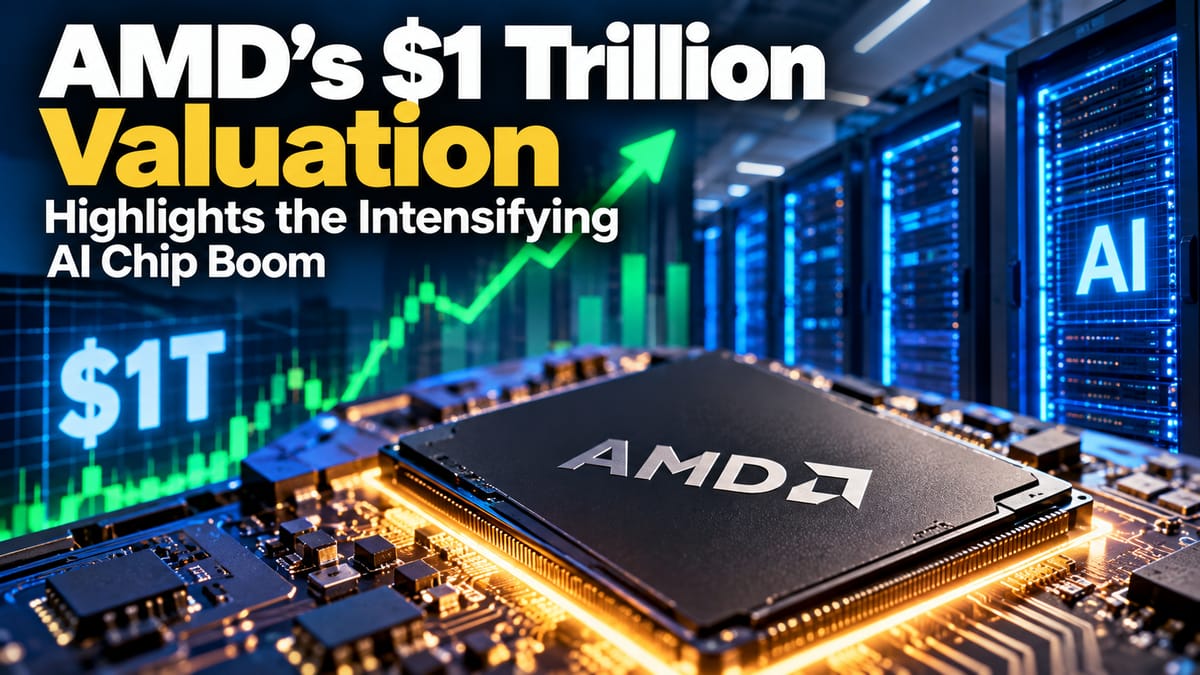
AMD’s $1 Trillion Valuation Highlights the Intensifying AI Chip Boom
Advanced Micro Devices has crossed a milestone that would have seemed distant just a few years ago: a market valuation of more than $1 trillion.
AMD’s shares surged to a record level on September 21, pushing the semiconductor company into the trillion-dollar club as investors continued to pour money into companies positioned to benefit from the artificial intelligence infrastructure boom. The stock rose 9.6% that day to close at $613.31, according to Reuters.
The milestone is more than a symbolic achievement for AMD. It reflects how dramatically the semiconductor industry has changed as AI moves from an emerging technology into one of the biggest drivers of demand for computing power, data centers, networking equipment and advanced processors.
It also raises a more difficult question for investors: how much future AI growth is already reflected in chip valuations?
AMD’s Rise Is Closely Tied to AI Infrastructure
AMD has spent years competing with Intel in central processors and Nvidia in graphics and accelerated computing. The AI boom has created an opportunity to expand that competition into one of the industry’s fastest-growing markets.
The company’s latest financial results show just how important its data center business has become.
AMD reported second-quarter 2026 revenue of approximately $11.5 billion, up 50% from the same period a year earlier. Data Center revenue reached $6.7 billion, representing a 107% increase year over year. The company attributed the growth primarily to demand for EPYC processors and Instinct GPUs.
That growth has changed the way investors view AMD.
The company is no longer being valued simply as a traditional CPU and graphics-chip manufacturer. Its role in AI servers, accelerators and large-scale data-center infrastructure has become increasingly important to its investment story.
The $1 Trillion Milestone Reflects a Much Bigger Market
AMD’s trillion-dollar valuation arrived during a broader rally in semiconductor stocks.
The AI infrastructure buildout is creating demand across several layers of the technology industry. Chips are required to train and run AI models, but those chips also need high-speed networking, memory, cooling systems, storage, power infrastructure and increasingly sophisticated server architectures.
That means the AI boom is expanding beyond individual GPU manufacturers.
The broader implications are explored in How AI Infrastructure Spending Is Reshaping the Technology Industry, where the relationship between AI investment and the wider technology supply chain becomes particularly important.
For AMD, the opportunity comes from becoming a larger supplier within that ecosystem.
Data Center Growth Has Become AMD’s Main Engine
The numbers from AMD’s second quarter make the shift particularly clear.
Data Center revenue more than doubled from the previous year, while the company’s overall revenue increased 50%. Data Center operating income reached $2.1 billion, compared with an operating loss of $155 million in the year-earlier period.
That combination of revenue growth and improved profitability is significant.
It means AMD’s AI opportunity is not simply about shipping more processors. The company is increasingly generating meaningful profits from the infrastructure supporting AI workloads.
AMD’s EPYC server CPUs are also important because AI data centers require more than accelerators alone. Conventional server processors coordinate workloads, manage systems and support the broader computing environment surrounding AI accelerators.
That gives AMD multiple avenues for participating in the data-center expansion.
MI350, MI400 and the Next AI Hardware Cycle
AMD is also moving rapidly through successive generations of its Instinct accelerator portfolio.
The company launched its Instinct MI400 series during 2026, including the MI455X and MI430X, while continuing to develop its broader Helios rack-scale platform for large AI deployments.
This is important because the AI chip market is evolving quickly.
Performance is no longer measured only by raw computing power. Customers are increasingly concerned with memory capacity, bandwidth, power efficiency, networking, software compatibility and the cost of producing AI inference at enormous scale.
AMD’s strategy therefore increasingly involves selling complete computing solutions rather than competing solely on individual chips.
Its Helios platform is designed to bring processors, accelerators and other components together into a larger AI computing system. AMD says the platform is being deployed by AI labs and cloud providers including Microsoft, Meta, OpenAI, Oracle and others.
OpenAI and Meta Agreements Raise the Stakes
AMD’s relationships with major AI companies have also contributed to the company’s changing position in the market.
The company disclosed multi-year agreements with OpenAI and Meta under which each customer intends to deploy up to 6 gigawatts of AMD data-center GPUs, with initial deployments based on AMD’s MI450-series products.
AMD also announced a partnership with Anthropic involving up to 2 gigawatts of MI450-series GPUs in AMD Helios racks.
These agreements matter because large AI companies require enormous amounts of computing capacity.
As models become larger and AI applications become more widely used, infrastructure providers need access to multiple sources of advanced computing hardware. AMD’s ability to secure major customers therefore represents an important part of its attempt to expand its position in the AI accelerator market.
Nvidia Remains the Benchmark
AMD’s rise does not mean the AI chip market has become evenly balanced.
Nvidia remains the dominant force in AI accelerators, and its market capitalization is still several times larger than AMD’s. Reuters reported that AMD’s trillion-dollar milestone placed it alongside Nvidia, Broadcom and Micron among major U.S. chip companies that have reached that valuation threshold.
Nvidia’s scale, software ecosystem and established relationships with AI developers remain important factors in the competitive landscape.
For investors trying to understand the broader semiconductor cycle, Nvidia Earnings: What the Results Mean for the Future of the AI Boom provides additional context on how Nvidia’s financial performance can influence perceptions of the entire AI market.
AMD’s opportunity is therefore not simply to replace Nvidia. It can also benefit from a market where AI companies increasingly want multiple suppliers and where total computing demand continues to expand.
Software Could Be Just as Important as Silicon
One of AMD’s biggest challenges is that AI hardware is not judged solely by the physical processor.
Software plays a major role.
Nvidia’s CUDA ecosystem has helped make its accelerators deeply integrated into AI development, while AMD has been investing heavily in its ROCm software platform.
During its second-quarter results, AMD announced ROCm.ai, an AI-focused developer experience intended to make it easier to build, deploy and optimize workloads across AMD platforms.
The importance of this strategy cannot be overstated.
A faster chip can have limited commercial value if developers find it difficult to migrate models and applications onto the platform. AMD therefore needs to make its hardware increasingly attractive not only to data-center operators but also to the developers and organizations building AI systems.
The AI Boom Is Moving Toward Inference
Much of the initial AI infrastructure investment focused on training enormous models.
That is changing.
As AI systems become embedded in search, productivity software, coding tools, customer service, robotics and other applications, the amount of computing required to run those systems for users could become increasingly important.
This is known as inference.
AMD has increasingly positioned its hardware around both AI training and inference. Its MI400-series portfolio and Helios systems are designed to support large-scale AI workloads as companies move from experimentation toward widespread deployment.
The shift could expand the addressable market for AI infrastructure because inference happens continuously as users interact with AI systems.
AI Agents Could Create Another Wave of Demand
The rise of autonomous and agentic AI could further increase demand for computing resources.
Traditional software often waits for a user command before performing a specific task. AI agents can potentially perform multi-step processes, interact with software tools, analyze information and make decisions across longer workflows.
That creates new computational requirements.
The long-term discussion around increasingly capable AI systems is covered in What Is Artificial General Intelligence?, which provides useful context for understanding how AI capabilities could evolve beyond today’s applications.
For chip companies, the commercial significance is straightforward: more sophisticated AI applications can require more computing capacity.
But the scale and timing of that demand remain uncertain.
China Adds Another Dimension to the Chip Race
The AI semiconductor competition is also becoming increasingly global.
China is investing heavily in domestic AI chips as restrictions on advanced semiconductor technology complicate access to some foreign products.
That creates another potential market for companies developing alternative AI computing platforms, while simultaneously increasing competition from Chinese semiconductor manufacturers.
The situation is discussed in China’s AI Chip Race Accelerates as SMIC Raises Prices on Surging Demand.
For AMD, geopolitical policy can affect both opportunities and risks.
Export restrictions can limit access to certain markets or products, while government investment in domestic semiconductor ecosystems can create new competitors.
AMD has already experienced the financial impact of U.S. export controls. Its 2026 results reflected the comparison with inventory and related charges associated with restrictions on MI308 data-center GPUs in the prior year.
The Biggest Question Is Whether Spending Can Continue
AMD’s trillion-dollar valuation ultimately depends on expectations about the future.
The company’s recent growth is substantial, but semiconductor markets can be cyclical. Companies building data centers must eventually decide how much computing capacity they actually need, and infrastructure investment can fluctuate as technology changes.
The current AI buildout has involved enormous spending by cloud providers and AI companies.
Investors therefore need to distinguish between short-term enthusiasm and durable demand.
If AI adoption continues expanding into new applications, demand for accelerators, CPUs and networking equipment could remain strong. If customers slow infrastructure spending or find ways to use computing resources more efficiently, growth expectations could change.
Valuation Creates a Higher Bar for AMD
Crossing $1 trillion can itself change the conversation around a company.
At lower valuations, investors may focus primarily on whether a business can capture a large emerging market. At much higher valuations, expectations about future revenue, margins and market share become increasingly important.
AMD’s stock had risen dramatically during 2026 before reaching the trillion-dollar milestone. Reuters reported that the shares were up about 185% for the year at the time of the September 21 move.
That kind of appreciation means investors are already pricing in significant future growth.
AMD therefore faces a different challenge from the one it faced several years ago. The question is no longer simply whether the company can participate in the AI boom.
The market is increasingly asking how large AMD’s share of that boom can become.
A Bigger AI Chip Market Could Support Multiple Winners
The semiconductor industry does not necessarily need one company to capture the entire AI market for the sector to continue growing.
AI computing demand could become large enough to support multiple accelerator providers, CPU manufacturers, networking companies and memory suppliers.
AMD’s trillion-dollar valuation reflects investors’ belief that the company can secure a meaningful position within that expanding market.
Its recent data-center growth, major AI partnerships, new accelerator generations and broader systems strategy provide the foundation for that expectation.
But the next stage of the AI chip race will depend on execution.
AMD will need to deliver competitive hardware, expand its software ecosystem, maintain relationships with major AI customers and turn rising infrastructure demand into sustained revenue and profitability.
The $1 trillion milestone shows how far AMD has come. The next phase will determine whether the company’s growing role in AI infrastructure can justify the enormous expectations now embedded in its market value.



2 Comments
Micle harison
June 7, 2019Lorem ipsum dolor sit amet, usu ut perfecto postulant deterruisset, libris causae volutpat at est, ius id modus laoreet urbanitas. Mel ei delenit dolores.
John Doe
June 7, 2019Some consultants are employed indirectly by the client via a consultancy staffing company.