
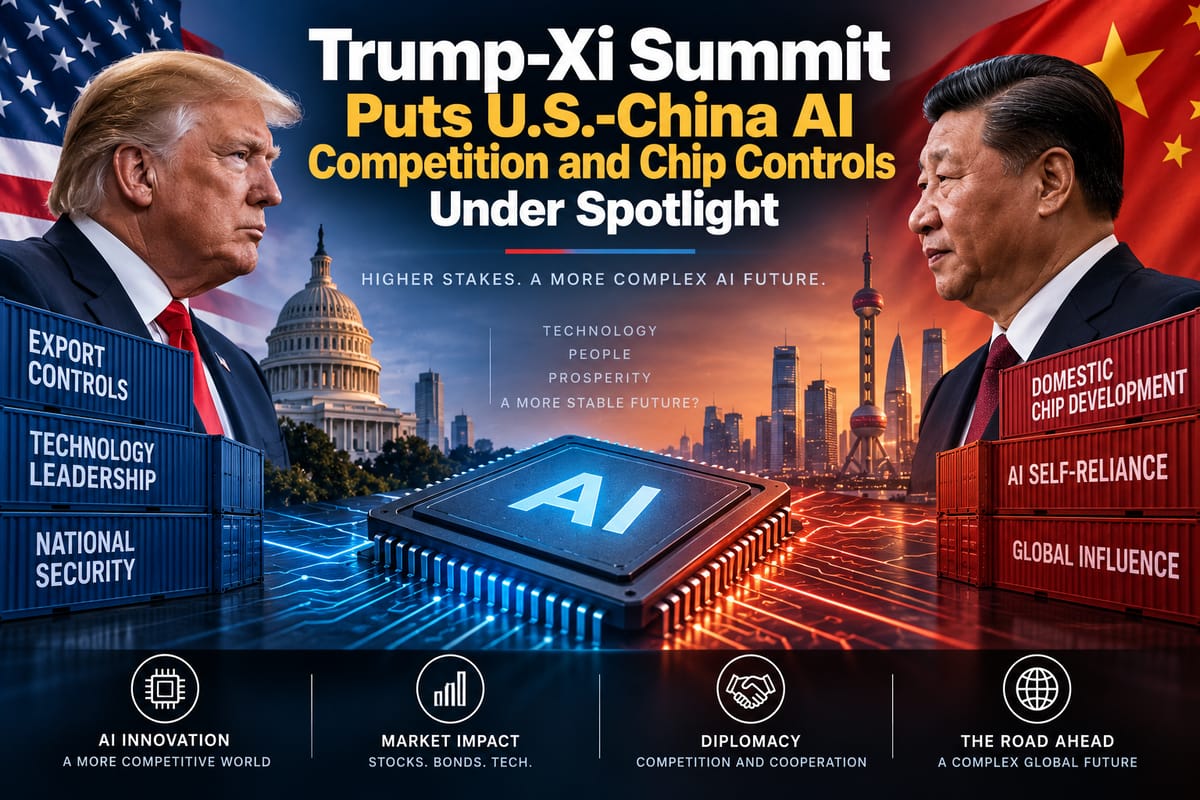
Trump-Xi Summit Puts U.S.-China AI Competition and Chip Controls Under Spotlight
Artificial intelligence is moving toward the center of the latest U.S.-China negotiations as President Donald Trump prepares to meet Chinese President Xi Jinping in Washington on September 24.
The summit comes at a particularly important moment for the global AI industry. Both countries are competing to develop increasingly capable AI systems while also trying to secure the semiconductor supply chains needed to train and operate them.
AI safety, advanced computing, semiconductor access and technology restrictions are all expected to feature in the broader discussions surrounding the meeting. U.S. and Chinese officials have already held preparatory talks, including discussions about a possible mechanism for notifying each other about AI-related incidents involving national security concerns.
At the same time, China’s domestic AI-chip industry is expanding rapidly as restrictions on access to some advanced U.S. technology push Chinese companies toward locally developed alternatives.
That makes the Trump-Xi meeting important not only for diplomacy but also for the future structure of the global AI and semiconductor industries.
AI Has Become a Strategic Technology Issue
Artificial intelligence is no longer simply a competition between technology companies.
The technology increasingly intersects with computing infrastructure, cybersecurity, defense, scientific research and economic competitiveness. Advanced AI models require enormous amounts of computing power, while the most capable systems depend heavily on sophisticated semiconductors.
That makes access to advanced chips a central component of the broader U.S.-China technology relationship.
The two countries have different approaches to AI development and regulation, while both have identified AI as an important strategic technology. Reuters reported ahead of the summit that disagreements include advanced-chip access, accusations involving AI-model copying and differing approaches to AI regulation.
For readers looking at the technological side of this competition, Understanding the Future of Advanced AI provides broader context on how increasingly capable AI systems could change computing and society.
A New AI Dialogue Is Taking Shape
One of the more unusual developments ahead of the summit is the proposal for a dedicated communication mechanism covering serious AI incidents.
Treasury Secretary Scott Bessent said after discussions with Chinese Vice Premier He Lifeng in New York that the U.S. side had proposed a notification system covering AI-related incidents that could rise to the level of national security concerns. The discussions were intended to create a possible channel between Washington and Beijing around shared risks and common threats.
The proposal does not represent a comprehensive U.S.-China agreement on AI governance.
Instead, it points to a narrower area where the two governments may have an incentive to maintain communication even while competing over technology.
That distinction could become increasingly important as AI systems become more capable and are integrated into sensitive areas such as defense, cybersecurity, finance and critical infrastructure.
Chip Controls Remain a Major Point of Tension
The semiconductor issue is considerably more complicated.
The United States has imposed restrictions on exports of advanced computing chips and semiconductor-manufacturing technology to China as part of efforts to limit access to technologies considered important to national security.
At the same time, U.S. policy has shifted in some areas during 2026.
Nvidia’s H200 AI chips, for example, have received approval for limited exports to China. A U.S. Commerce Department official said in July that only a small number had been shipped at that point.
That creates an unusual situation.
The world’s leading AI-chip companies remain important to the development of advanced AI systems, while governments are simultaneously debating which technologies should be available across national borders.
The question of how much access Chinese companies should have to advanced American computing hardware could therefore remain an important issue surrounding the summit.
China Is Building Its Own AI-Compute Ecosystem
Restrictions on advanced foreign technology have also encouraged Chinese companies to accelerate domestic alternatives.
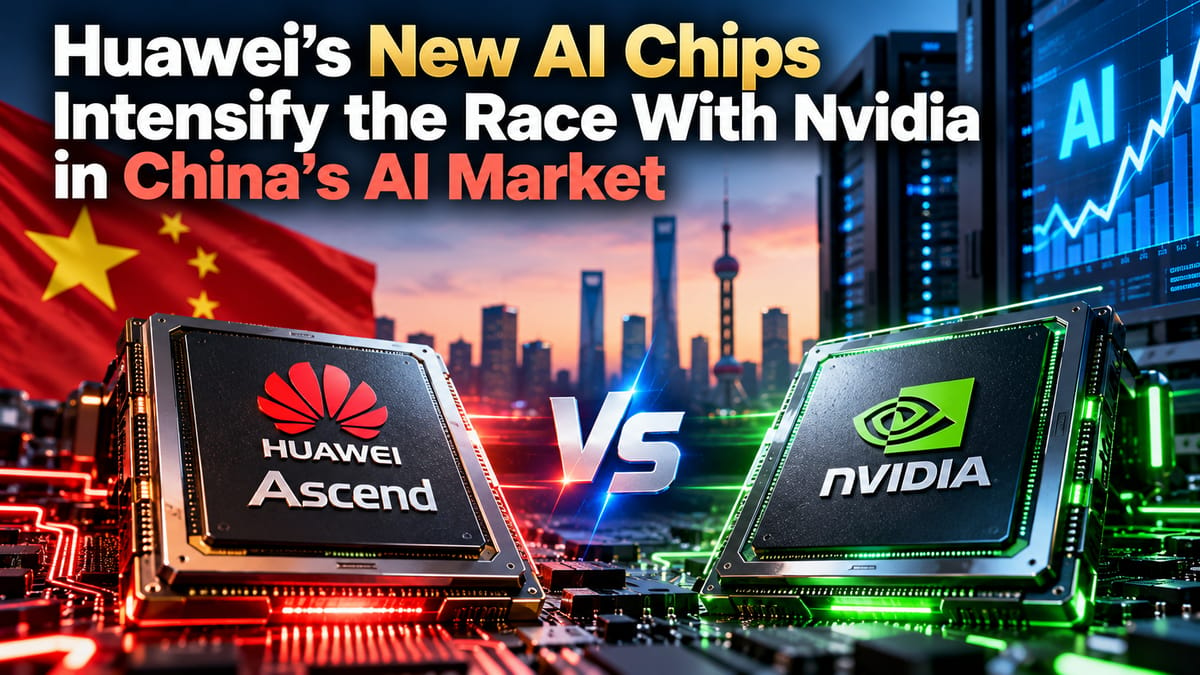
Huawei has become one of the most prominent examples.
The company said in September that demand for its AI computing equipment in China had exceeded its ability to supply the market. Huawei is preparing additional Ascend chips and developing large-scale systems designed to connect many processors together for AI workloads.
That development is important because the competition is no longer simply about designing an individual processor.
AI infrastructure increasingly depends on the entire computing stack, including processors, high-bandwidth memory, networking, software, cooling systems and data centers.
China’s ability to combine those components into large systems could influence how effectively domestic AI companies can compensate for restrictions on foreign hardware.
The rapid development of this domestic ecosystem is explored further in Huawei Unveils New AI Chip Roadmap as China Pushes to Reduce Reliance on Nvidia.
Memory Constraints Are Adding Another Challenge
China’s semiconductor ambitions are also facing supply constraints of their own.
Reuters reported in September that Chinese AI-chip companies including Huawei and Cambricon had raised prices for current and upcoming processors as higher costs for high-bandwidth memory put additional pressure on domestic alternatives to Nvidia.
High-bandwidth memory is particularly important for AI computing because advanced models require enormous amounts of data to be moved quickly between memory and processors.
That means producing an AI accelerator is only one part of the problem.
A company can design a competitive processor but still face difficulties scaling production if it cannot secure sufficient memory, advanced manufacturing capacity or other critical components.
SMIC and Domestic Manufacturing
China’s broader semiconductor strategy also depends on domestic manufacturing capacity.
Chinese chipmakers have been working to increase production and reduce dependence on overseas semiconductor technology, but advanced manufacturing remains technically demanding.
The combination of U.S. export restrictions, domestic production limitations and strong AI demand has created a complicated environment for Chinese chip companies.
The situation is explored in China’s AI Chip Race Accelerates as SMIC Raises Prices on Surging Demand.
For the AI industry, the significance extends beyond China.
Any major changes in semiconductor trade rules can affect chip designers, equipment manufacturers, cloud-computing companies and AI developers across multiple countries.
Alibaba Is Expanding the Domestic AI Push
Huawei is not the only Chinese company investing heavily in AI hardware.
Alibaba announced a new AI chip and plans for a much larger AI model at its annual conference in September. Its Zhenwu V900 chip is designed by Alibaba’s T-Head semiconductor unit, while the company said it plans to develop a model with between 5 trillion and 10 trillion parameters.
Alibaba also plans to expand its cloud data-center capacity to more than 20 gigawatts by 2032.
The developments illustrate how Chinese technology companies are increasingly attempting to build complete AI ecosystems rather than relying entirely on imported hardware.
That could eventually make export restrictions less straightforward as a tool for controlling China’s access to AI computing.
Nvidia Remains at the Center of the Debate
Nvidia occupies an unusual position in the U.S.-China AI relationship.
Its GPUs are among the most important computing technologies used to train and operate advanced AI models, making the company strategically significant to both the commercial AI industry and policymakers.
Nvidia CEO Jensen Huang is also expected to attend the state dinner for Xi at the White House. His presence highlights the close connection between the technology industry and the diplomatic discussions surrounding AI and semiconductors.
For Nvidia and other American chip companies, China represents both a major technology market and a geopolitical risk.
Greater restrictions can limit potential sales, while looser access can raise questions about whether advanced computing technology is reaching Chinese companies that Washington considers sensitive.
That tension is unlikely to disappear after a single summit.
The AI Race Is Also About Software
Semiconductor access is only one part of AI competitiveness.
Software ecosystems can determine how efficiently developers use hardware, how quickly models can be trained and how easily AI systems can be deployed.
Nvidia’s CUDA ecosystem, for example, has become an important component of its competitive position.
Chinese companies are therefore investing not only in chips but also in software frameworks, model development tools and integrated computing platforms.
Huawei has been developing its own software ecosystem alongside its Ascend processors, while Alibaba and other Chinese technology companies are pursuing similar efforts.
The result is a competition increasingly focused on complete AI infrastructure rather than individual components.
The Global AI Supply Chain Could Become More Divided
One potential long-term consequence of the U.S.-China technology rivalry is greater fragmentation of the AI supply chain.
For years, the semiconductor industry developed around a highly internationalized model in which chip design, manufacturing, equipment, memory, packaging and software were distributed across multiple countries.
Strategic competition is putting pressure on that structure.
The United States is seeking to maintain access to advanced computing and semiconductor capabilities while restricting certain technologies from reaching China. China is simultaneously trying to expand domestic alternatives and reduce exposure to foreign technology.
This could result in companies designing products for different technological ecosystems depending on where they are sold.
AI Safety Creates a Narrow Area for Cooperation
Despite the competition, AI safety may provide one area where Washington and Beijing have overlapping interests.
Both countries face risks from increasingly capable AI systems, including cybersecurity threats, misuse and the possibility that advanced systems could be incorporated into sensitive national-security applications.
The proposed AI incident notification mechanism reflects an attempt to create communication around those risks without requiring the two countries to agree on every aspect of AI policy.
Whether such a mechanism develops into a meaningful diplomatic channel will depend on what both governments are willing to share and how narrowly its scope is defined.
The technological rivalry, meanwhile, is likely to continue.
What the Trump-Xi Meeting Could Clarify
The September 24 summit will take place against a much broader backdrop that includes trade, critical minerals, Taiwan and other areas of disagreement. But AI has become increasingly difficult to separate from those economic and strategic issues.
The White House has already described AI leadership as an important national priority, while U.S. and Chinese officials have been preparing discussions around technology and trade.
Several questions will therefore be closely watched:
- Whether the two governments establish a formal AI dialogue.
- Whether discussions about AI safety produce a concrete communication mechanism.
- How both sides approach advanced semiconductor exports.
- Whether Nvidia’s H200 shipments to China expand or remain limited.
- How China responds to continued restrictions on advanced computing technology.
- Whether the two countries can separate AI safety discussions from broader technology competition.
None of those questions has a predetermined outcome.
A New Phase in U.S.-China Technology Competition
The Trump-Xi summit arrives as both countries are investing heavily in AI while simultaneously trying to manage the risks created by their technological rivalry.
The developments of the past several weeks show how quickly the landscape is changing. Huawei is accelerating its chip roadmap, Alibaba is expanding its AI ambitions, Chinese chipmakers are dealing with memory constraints, and U.S. companies remain central to the global AI infrastructure market.
At the same time, Washington and Beijing are exploring whether limited communication around AI risks is possible despite their disagreements over technology and national security.
The September summit may therefore be less about resolving the entire U.S.-China AI competition than about establishing where cooperation, competition and restrictions will sit alongside one another.
For the global technology industry, that distinction could shape the next stage of the AI and semiconductor race.



2 Comments
Micle harison
June 7, 2019Lorem ipsum dolor sit amet, usu ut perfecto postulant deterruisset, libris causae volutpat at est, ius id modus laoreet urbanitas. Mel ei delenit dolores.
John Doe
June 7, 2019Some consultants are employed indirectly by the client via a consultancy staffing company.