
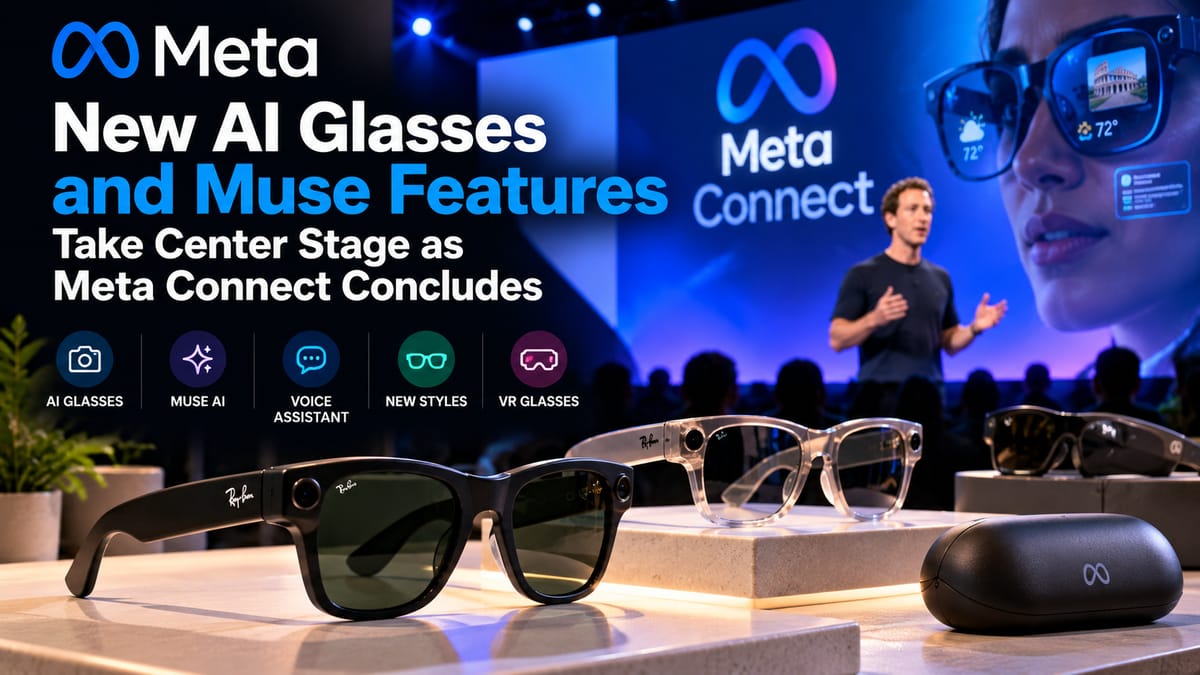
Meta’s New AI Glasses and Muse Features Take Center Stage as Meta Connect Concludes
Meta Connect 2026 has wrapped up with a clear message from the company: artificial intelligence is moving beyond phones and computers and increasingly into the devices people wear and use throughout the day.
The company’s latest announcements put AI glasses, the Muse personal AI agent and new forms of hands-free computing at the center of its hardware and software strategy. Meta also introduced new glasses designs, its first audio-only AI glasses, expanded capabilities for Meta Ray-Ban Display and a new Meta VR Glasses platform.
The event represents a significant expansion of Meta’s AI ambitions. Rather than treating AI as an assistant that users open when they need it, the company is building toward a model where AI can remain available throughout the day and act on a user’s behalf.
Meta Puts Muse at the Center of Its AI Strategy
Muse was introduced earlier this month as Meta’s personal AI agent, designed to do more than answer questions.
The system can work across connected apps and services, handle tasks, develop plans and continue working after a user closes the app. Meta says Muse operates through a dedicated secure virtual machine and can ask for approval before sensitive actions such as sending emails or making purchases.
At Connect, Meta expanded that vision by bringing Muse directly into its AI glasses.
This means users will eventually be able to interact with their personal agent through voice while keeping their phone in their pocket. Meta demonstrated potential uses including getting assistance with workouts, managing meals, scheduling appointments and shopping.
The shift is important because it changes the role of AI from something accessed through a screen into something that can accompany a person throughout the day.
AI Glasses Become the Main Hardware Story
Meta’s latest announcements significantly expand its AI glasses lineup.
The company introduced Ray-Ban Meta Audio, its first audio-only glasses, alongside additional Meta Glasses styles and updates to existing Ray-Ban Meta products.
Ray-Ban Meta Audio glasses weigh 43 grams and are designed around open-ear audio, calls and AI interactions without a built-in camera. Meta says the glasses can provide access to Muse while also supporting music, podcasts, calls and other audio experiences.
The camera-free design is particularly notable because it creates a different category of smart glasses.
Instead of attempting to reproduce everything a smartphone camera can do, the glasses focus on sound, communication and AI while reducing some of the privacy concerns associated with wearable cameras.
The Camera-Free Approach Could Broaden AI Glasses
AI glasses have faced an unusual challenge.
Their cameras can make them useful for visual AI applications, photography and video, but cameras worn in public can also create questions about privacy and consent.
Meta’s Ray-Ban Meta Audio takes a different approach.
Without a camera, the glasses cannot capture photographs or video. Their purpose instead centers on audio and AI interactions.
That gives Meta another way to position smart glasses as an everyday wearable rather than a miniature camera attached to a person’s face.
The company is also expanding the broader glasses lineup. Meta says that by the end of 2026 it expects to offer more than 100 AI-glasses options across Ray-Ban, Oakley and Meta Glasses.
Ray-Ban Meta Gen 3 Adds More Capability
Meta also announced the next generation of its camera-equipped Ray-Ban Meta glasses.
The new models include additional styles and improvements to hardware and controls, while Meta says the glasses will benefit from longer battery life and enhanced AI capabilities.
The Gen 3 models feature a 12-megapixel camera capable of 3K Ultra HD video, a six-microphone array and up to nine hours of battery life, according to reporting from TechCrunch.
The combination of improved hardware and increasingly capable AI means the glasses are becoming less like conventional wearables with a few smart features and more like computing devices in their own right.
Muse Gives the Glasses a Personal AI Layer
The most important software development may be the connection between Muse and the glasses.
Meta’s earlier AI glasses could answer questions, provide information and interact with users through voice. Muse adds a more agentic layer to that experience.
An assistant that simply answers “What is this?” is useful.
An assistant that can understand the context, remember relevant information and take an action is potentially much more powerful.
Meta has already positioned Muse as an agent capable of tasks such as booking travel, sending emails, shopping and working across connected services.
Putting that capability into glasses could make the interaction substantially more natural.
The Difference Between an Assistant and an Agent
The broader AI industry is moving toward the concept of AI agents.
Traditional AI assistants generally respond to prompts. Users ask a question, receive an answer and decide what to do next.
Agents are designed to take additional steps.
For example, a user might ask an agent to arrange a trip. Instead of simply providing a list of flights and hotels, an agent could research options, compare them, prepare an itinerary and potentially complete approved transactions.
Muse was built around this more active model from the beginning. Meta says it can open a browser, fill out forms, work across apps and continue tasks over time.
Readers interested in the longer-term development of AI can also explore What Is Artificial General Intelligence? to understand how today’s increasingly capable systems relate to the broader concept of advanced AI.
Muse’s New Features Expand Its Role
Meta Connect also gave Muse a number of new capabilities.
One of the more visible additions is a digital avatar that users can interact with through real-time video conversations. Meta is using a new Muse Realtime Avatar model to give the agent a face, body and voice.
The company is also expanding the number of services Muse can connect to.
Meta announced integrations involving services and companies including Shopify, Stripe, PayPal, Best Buy, Gap, Sephora, Walmart and Wayfair, while other connectors include GitHub, Notion and Granola.
That reflects an important part of Meta’s strategy: making Muse useful not just as a chatbot but as an interface to other digital services.
The Muse Model Family Is Expanding
Meta’s AI strategy also depends on the models powering these experiences.
Muse Spark is the company’s model family built specifically for agentic and multimodal tasks. Meta has described Muse Spark as capable of reasoning through complex problems while understanding text, images and the physical world.
The company’s model development is becoming increasingly broad.
That includes models for general assistance, image generation and agentic tasks, as well as smaller systems designed to operate efficiently on different types of hardware.
The development of smaller AI models is particularly relevant to the growth of AI devices because not every AI interaction can depend entirely on large cloud systems.
The previously published Meta’s New Muse Glimmer AI Model Can Run on a Laptop explores that broader shift toward more accessible AI models and what it could mean for local computing.
AI Is Moving Closer to the Physical World
One of the biggest themes emerging from Meta Connect is the growing relationship between AI and physical computing.
A chatbot lives primarily inside a screen.
An AI-enabled pair of glasses can see or hear aspects of the user’s surroundings, provide information while they move through the world and respond without requiring them to stop and pick up a phone.
Meta has already described its glasses as a way for AI to understand what users are looking at. Earlier Muse Spark updates added multimodal capabilities that allow Meta AI to process visual information and respond to questions about images and the physical environment.
That makes glasses an interesting platform for the next stage of AI development.
Meta Ray-Ban Display Gets More Capable
Meta also used Connect to announce new features for its display-equipped Ray-Ban glasses.
The updates include hands-free navigation, cycling and public-transit directions, a personalized hologram for video calls and an Explore app designed specifically for the glasses.
The company is also expanding availability of the display glasses into additional markets, including the United Kingdom, Canada, France, Italy and Germany.
This pushes the product beyond the category of audio AI glasses.
Instead, Meta is building toward glasses that combine AI, visual information, communication and navigation into a single wearable interface.
AI Browsers and AI Agents Are Moving in the Same Direction
The development of Muse also connects with a larger transformation happening across the internet.
AI systems are increasingly becoming interfaces through which people discover information, compare products, conduct research and complete tasks.
That is closely related to the trend explored in AI Browsers Are Changing the Internet.
The traditional internet requires people to move between websites, search engines, apps and checkout pages.
Agentic AI attempts to compress some of those steps.
A user can describe an objective, while the AI handles some of the navigation and decision-making required to accomplish it.
Muse’s ability to interact with websites and connected services fits directly into that transition.
Shopping Could Become an Important Test
Shopping is one of the clearest examples of where this technology could have an impact.
Meta has announced partnerships and integrations that allow Muse to search products and assist with transactions. The company says Muse can access Shopify’s product catalog and use payment systems including Link from Stripe, with Shop Pay support also planned.
But the development also illustrates one of the biggest challenges facing AI agents.
Websites and platforms do not necessarily want autonomous agents accessing their services in the same way that human users do.
Amazon, for example, has blocked Meta’s Muse from making purchases through its platform, citing concerns related to unauthorized access, privacy and security.
That conflict highlights a major question for the agentic internet: Who controls the relationship between the user, the AI agent and the website?
Entertainment Is Another Major Use Case
Meta’s AI glasses also have implications beyond productivity and shopping.
Wearable AI could eventually change how people consume and interact with entertainment. Music, podcasts, live events, gaming and video experiences can all become more accessible through hands-free interfaces.
Meta’s new VR Glasses announcement reinforces that direction.
The company introduced a new VR device weighing about 100 grams and positioned it as a lightweight system for entertainment, spatial computing, gaming and productivity. Meta says the device can provide an IMAX-quality cinema experience and other immersive applications.
The relationship between AI and entertainment is becoming increasingly important as well. Artificial Intelligence in Entertainment looks at how AI is already influencing the way entertainment is created, distributed and experienced.
Meta’s Hardware Strategy Is Becoming More Diverse
Meta’s Connect announcements show that the company is no longer betting on a single hardware format.
Its lineup now spans:
- Camera-equipped AI glasses
- Audio-only AI glasses
- Display-equipped glasses
- VR glasses
- AI-powered software
- Personal AI agents
That diversity gives Meta multiple ways to bring AI into people’s daily lives.
It also reduces the company’s dependence on convincing consumers to replace their smartphones.
Instead, Meta can attempt to make AI available through devices people already understand: glasses, headphones, phones and messaging applications.
Privacy Remains a Critical Part of the Conversation
The expansion of personal AI agents inevitably raises questions about data access.
Muse is designed to interact with email, calendars, shopping services and other applications, meaning an effective personal agent potentially needs access to highly sensitive information.
Meta says Muse operates inside a dedicated secure virtual machine, uses a separate Sentinel system to control internet access and requires user approval for sensitive actions. The company also says users control which services Muse can access and can disconnect those services.
Meta has additionally said it plans to introduce a Confidential VM later this year in which the user’s data and conversations would be encrypted with a key controlled by the user.
Those protections will become increasingly important if AI agents move from answering questions to handling financial, personal and professional tasks.
Meta Is Betting on AI That Is Always Available
The most significant theme from Connect may ultimately have little to do with any single pair of glasses.
Meta is trying to change how people interact with computing.
Instead of opening an application, typing a request and waiting for a response, users could eventually speak naturally to an AI that knows their context and can take action.
Glasses make that model particularly interesting because they are already designed to be worn throughout the day.
The combination of microphones, speakers, cameras, displays and AI could turn glasses into an always-available computing interface.
What Meta Connect Means for the AI Industry
Meta Connect 2026 demonstrated how quickly the AI industry is moving from software toward integrated hardware.
The company’s latest announcements connect several trends that were previously developing separately: personal AI agents, multimodal models, wearable computing, AI-powered shopping, spatial computing and hands-free interfaces.
Muse provides the agent.
AI glasses provide the physical interface.
Meta’s expanding model family provides the intelligence underneath.
The challenge now is turning those pieces into products that people trust enough to use every day.
Meta has made clear that it sees glasses as a major part of the future of AI. With Muse increasingly connected to those devices, the company’s latest strategy points toward a world in which AI is not something people simply open when they need it, but something that increasingly accompanies them wherever they go.





2 Comments
Micle harison
June 7, 2019Lorem ipsum dolor sit amet, usu ut perfecto postulant deterruisset, libris causae volutpat at est, ius id modus laoreet urbanitas. Mel ei delenit dolores.
John Doe
June 7, 2019Some consultants are employed indirectly by the client via a consultancy staffing company.