
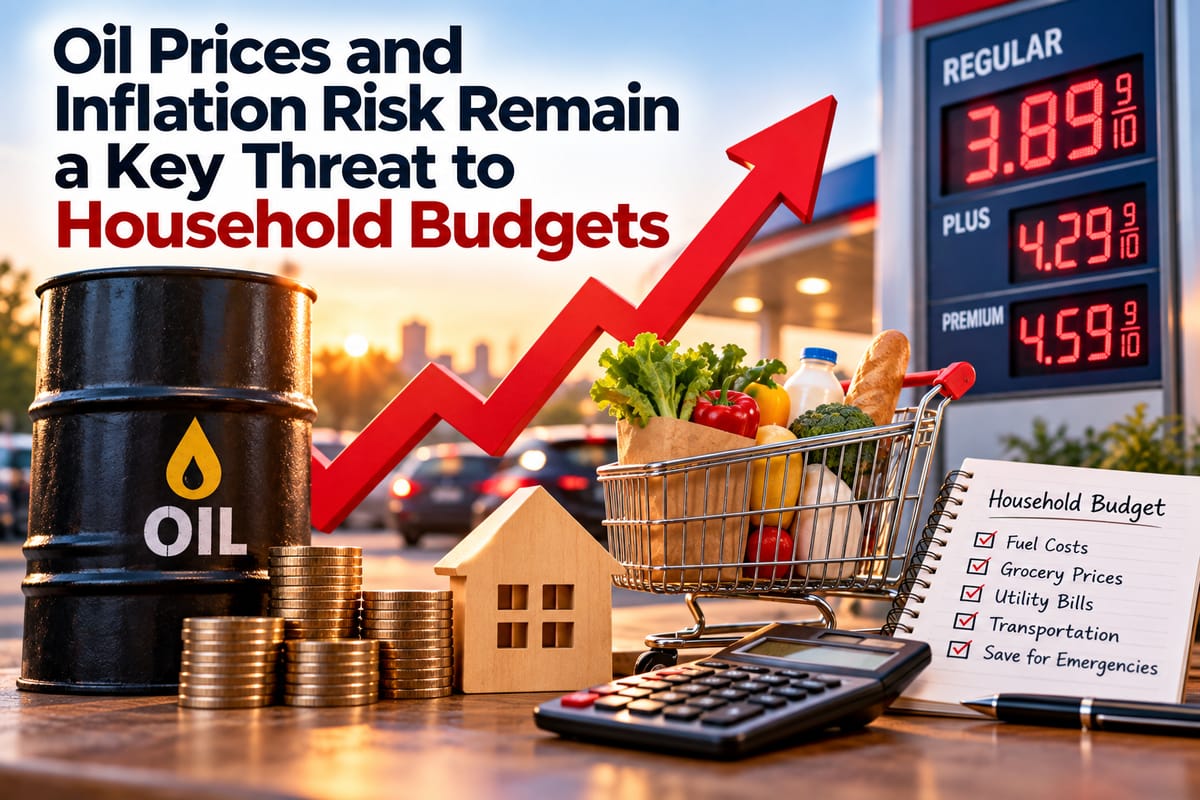
Oil Prices and Inflation Risk Remain a Key Threat to Household Budgets
Oil prices are once again becoming an important concern for household budgets as elevated energy costs feed into gasoline, transportation and other everyday expenses.
For consumers, the concern is not limited to what appears on the gas-station price board. Oil is a fundamental input across the economy, affecting transportation, manufacturing, shipping, agriculture and the production of many consumer goods. When crude prices rise sharply or remain elevated for an extended period, businesses can eventually pass some of those costs on to households.
That makes energy prices an important part of the inflation picture, particularly at a time when overall U.S. inflation remains above the Federal Reserve’s long-term 2% goal.
The latest U.S. Consumer Price Index showed that consumer prices rose 3.4% over the 12 months through August 2026. Energy prices rose 16.3% over the same period, while gasoline prices were up 27.4%. Food prices increased 2.7%.
For families already managing higher housing, transportation and food costs, another sustained increase in energy expenses could make monthly budgeting more difficult.
Why Oil Prices Matter to Household Finances
Crude oil is one of the world’s most widely used energy commodities.
Its most visible impact on consumers comes through gasoline and diesel prices. But the effects can extend much further.
Trucks, ships, airplanes and other forms of transportation rely heavily on petroleum-based fuels. Businesses that move products from factories and farms to stores can face higher operating costs when fuel prices rise.
Those higher costs can eventually affect the prices consumers pay for goods and services.
This is why understanding the global economy and how its major forces interact can provide useful context for household financial planning. Energy markets are connected to inflation, trade, economic growth and monetary policy, meaning an oil-price shock can have consequences well beyond the energy sector.
Gasoline Is the Most Immediate Pressure Point
For many households, gasoline provides the clearest connection between oil markets and the monthly budget.
The August CPI report showed gasoline prices rising 3.9% in a single month and 27.4% over the previous 12 months. Energy overall increased 2.1% in August and 16.3% year over year.
For a household that drives regularly, even a moderate increase in the price per gallon can translate into a noticeable increase in monthly spending.
The effect depends on several factors, including the number of vehicles in the household, commuting distance, vehicle fuel economy and driving habits.
A household that spends $200 a month on gasoline, for example, has considerably less exposure than one spending $600 or more.
But when gasoline rises alongside other household expenses, the cumulative effect can become more significant.
Higher Oil Prices Can Reach Beyond the Gas Pump
The relationship between crude oil and consumer prices is more complicated than a direct one-to-one connection.
A rise in crude prices does not mean every product will immediately become more expensive by the same percentage.
Companies have different cost structures, contracts and pricing strategies. Some businesses may absorb higher energy costs temporarily, while others may pass them to customers.
Transportation is particularly important because fuel is an operating expense for many industries.
Higher trucking costs can influence the cost of moving food and manufactured goods. Airlines can face higher fuel expenses. Delivery companies can face increased costs for transporting packages.
This is why what higher oil prices could mean for gas prices, grocery costs, transportation and household budgets is a broader question than simply asking how much gasoline will cost.
Inflation Is Still Making Household Budgeting Difficult
Energy is not the only source of inflation pressure.
The August 2026 CPI report showed overall consumer prices rising 3.4% over the year, while prices excluding food and energy increased 2.4%. Food prices rose 2.7%, with food consumed at home increasing 2.2%.
That means households are dealing with several different price trends simultaneously.
A family may face higher gasoline costs while also paying more for groceries, insurance, housing or services.
Even when individual price increases appear manageable, their combined effect can reduce the amount of money available for saving, debt repayment and discretionary spending.
This is one reason how inflation is affecting household budgets remains an important consideration for anyone trying to maintain a sustainable monthly financial plan.
Energy Costs Can Crowd Out Other Spending
Household budgets generally have limits.
When gasoline, electricity or heating expenses increase, families may have to find the additional money somewhere else.
That could mean reducing restaurant spending, delaying a purchase, cutting entertainment expenses or saving less during a particular month.
For households with very little financial flexibility, however, there may be fewer discretionary expenses available to cut.
The result can be a reduction in savings or an increase in credit-card balances.
This is particularly significant because energy is often a necessary expense. People still need to commute to work, transport children, purchase food and heat or cool their homes regardless of short-term changes in oil prices.
Higher Energy Prices Can Affect Businesses Too
The household impact of oil prices is also connected to what happens to businesses.
Companies facing higher fuel and transportation expenses have several potential responses. They can absorb the additional cost, reduce other expenses, become more efficient or increase prices.
The response varies by industry and company.
Small businesses with limited margins may have less ability to absorb cost increases than larger companies. Transportation-intensive businesses can be particularly exposed to changes in fuel prices.
If higher operating expenses are passed through to customers, households can experience a second-round effect after the initial increase at the gas pump.
That is one reason sustained energy inflation can matter more than a short-lived jump.
Oil Prices Are Also Connected to Monetary Policy
The relationship between energy prices and interest rates adds another layer to household finances.
When inflation remains elevated, central banks can face pressure to keep monetary policy restrictive for longer.
The Federal Reserve raised its target range for the federal funds rate by a quarter percentage point at its September 16, 2026 meeting, bringing the range to 3.75% to 4%. The Fed said inflation remained elevated.
The Fed’s September projections showed a median 2026 PCE inflation projection of 3.7%, above its 2% longer-run objective. The projections also showed substantial uncertainty around the inflation outlook, with most participants viewing the risks to inflation as tilted upward.
Higher energy prices do not automatically result in higher interest rates. Monetary policymakers consider a wide range of economic information.
However, if an oil shock contributes to persistent inflation, it can complicate decisions about how quickly interest rates can return to lower levels.
That matters to households because interest rates influence borrowing costs for mortgages, credit cards, auto loans and other forms of consumer debt.
Global Oil Supply Remains a Major Source of Uncertainty
Oil prices can change rapidly because the global petroleum market is sensitive to supply disruptions, geopolitical developments, production decisions and changes in demand.
The U.S. Energy Information Administration reported in its September 2026 Short-Term Energy Outlook that Brent crude averaged $91 per barrel in August, $7 higher than in July. The agency attributed the increase in part to constraints on Middle Eastern oil exports and production disruptions.
The EIA also expected some restrictions on Middle Eastern oil exports to persist through the end of 2026, while assuming that flows through the Strait of Hormuz would gradually improve.
That outlook illustrates why oil prices can remain difficult to predict.
Supply disruptions can push prices higher, while increased production, weaker demand or improved transportation routes can move them lower.
Recent market movements have also demonstrated that prices can respond quickly to developments in international diplomacy and supply conditions. Reuters reported that Brent crude fell to around $100 per barrel in late September as markets responded to signs of possible diplomatic progress involving the United States and Iran and indications of recovering Saudi exports.
For household budgeting purposes, this volatility makes it difficult to assume that today’s fuel price will remain unchanged for the rest of the year.
Families May Need More Flexible Budgets
When important expenses can move significantly from month to month, rigid budgets can become difficult to maintain.
A household may establish a gasoline budget based on historical spending, only to find that higher fuel prices push actual costs above that amount.
One approach is to create a flexible category for variable expenses.
Instead of assuming that gasoline, utilities and groceries will cost exactly the same every month, households can establish reasonable ranges and keep some money unallocated for unexpected increases.
This can reduce the need to take money from savings or use credit when essential costs temporarily rise.
Transportation Choices Can Become More Important
Higher fuel prices can also influence household decisions about transportation.
Some families may reduce unnecessary driving, combine errands or use public transportation when available.
Others may consider fuel efficiency when purchasing their next vehicle.
These decisions are not equally available to everyone. A person living in an area with limited public transportation may have little choice but to drive, while someone working remotely may have considerably more flexibility.
That difference is important when discussing household responses to energy inflation.
Budgeting strategies need to reflect actual circumstances rather than assuming that every family has the same ability to reduce fuel consumption.
Energy Costs Can Put Pressure on Savings Goals
When essential expenses increase, savings can become one of the first categories households reduce.
A family that planned to put $500 into savings each month might instead save $300 if gasoline, utilities and other costs increase.
A temporary adjustment may not be significant, but prolonged energy inflation can slow progress toward emergency savings, retirement contributions or other financial goals.
This is one reason households may want to review their budgets whenever major recurring expenses change.
The objective is not necessarily to maintain every savings target at exactly the same level regardless of circumstances. Instead, households can identify which financial goals are most important and adjust spending around them.
Higher Energy Prices Could Create a Wider Cost-of-Living Problem
Energy prices become particularly important when they rise alongside other major expenses.
The August CPI data already show that energy was increasing substantially faster than overall consumer prices. Energy rose 16.3% over the year, compared with a 3.4% increase for the overall CPI.
Gasoline was an especially large contributor, rising 27.4% over the same period.
Those figures do not mean every household experienced the same inflation rate. Spending patterns differ considerably from one family to another.
A household that drives frequently may feel gasoline inflation much more strongly than a household that rarely uses a car. Someone living in an energy-intensive home may be more exposed to utility prices.
Personal inflation can therefore differ significantly from the headline national rate.
Budgeting for Oil Price Volatility
Households cannot control global oil markets, but they can account for some of the uncertainty in their financial planning.
Useful steps can include:
- Reviewing how much is spent on gasoline and transportation each month.
- Building some flexibility into the household’s energy budget.
- Avoiding commitments that depend on fuel prices remaining unusually low.
- Maintaining an emergency savings cushion where possible.
- Comparing recurring expenses when energy prices rise.
- Separating essential spending from discretionary purchases.
- Reviewing savings goals when major recurring expenses change.
- Tracking fuel and utility spending rather than relying entirely on estimates.
These measures do not eliminate the impact of inflation, but they can make a household budget less vulnerable to sudden changes in essential costs.
The Household Budget Is Where Global Oil Shocks Become Personal
Oil prices may be determined by global supply, demand, geopolitical developments and financial markets, but their consequences eventually appear in much more familiar places.
They can show up at the gas pump, in delivery charges, in transportation expenses and potentially in the prices of goods that depend heavily on energy-intensive production and distribution.
For consumers, the biggest challenge is that these costs can arrive at the same time as other financial pressures.
The August inflation data show that energy prices were already rising much faster than overall consumer prices, while the Federal Reserve continues to describe inflation as elevated.
The situation also remains fluid. Oil prices have recently moved sharply in response to changing expectations around Middle Eastern supply and diplomacy, demonstrating how quickly the outlook can change.
For households, that uncertainty makes flexibility increasingly valuable.
A budget that leaves some room for higher fuel, transportation and utility costs can provide more protection than one built around a fixed assumption that essential expenses will remain unchanged.
And as higher energy prices could push household costs higher, keeping a close watch on recurring expenses, maintaining an emergency cushion and regularly updating financial priorities can help households respond when global energy markets begin affecting the everyday cost of living.





2 Comments
Micle harison
June 7, 2019Lorem ipsum dolor sit amet, usu ut perfecto postulant deterruisset, libris causae volutpat at est, ius id modus laoreet urbanitas. Mel ei delenit dolores.
John Doe
June 7, 2019Some consultants are employed indirectly by the client via a consultancy staffing company.