
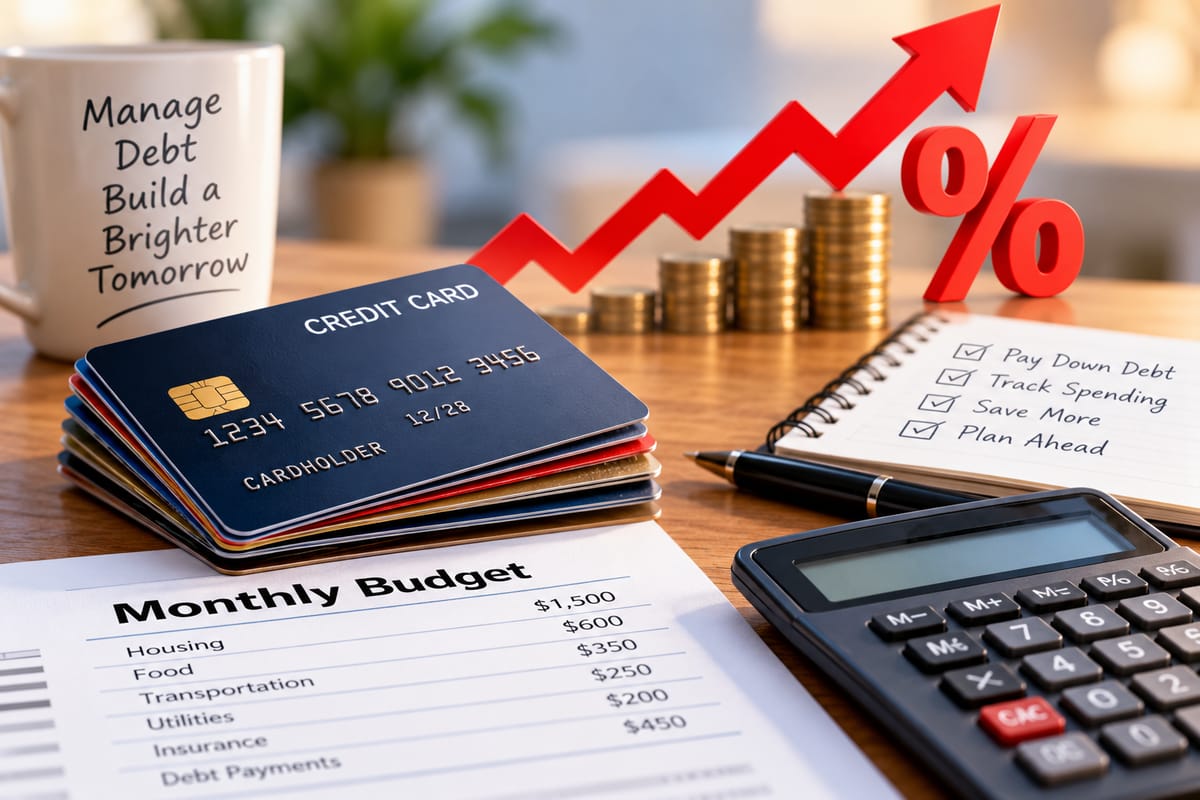
Higher Interest Rates Keep Credit-Card Borrowing Costs Elevated as Households Manage Debt
Credit-card borrowing costs remain a significant concern for U.S. households as interest rates stay elevated and consumers continue to manage substantial revolving debt.
The Federal Reserve raised its target federal funds rate by 0.25 percentage point in September 2026, bringing the target range to 3.75% to 4.00%. It was the first rate increase since 2023, as policymakers continued to deal with inflation that remains above the central bank’s 2% longer-run objective.
While the federal funds rate is not the interest rate consumers see on their credit-card statements, changes in monetary policy can influence the broader interest-rate environment. Because many credit cards carry variable APRs, changes in benchmark rates can eventually affect borrowing costs.
For households already carrying balances from month to month, even relatively small changes in interest rates can make debt more expensive to maintain.
Why Credit-Card Rates Remain So Sensitive to Interest Rates
Credit-card interest rates are generally variable rather than fixed for the life of a balance.
Many card issuers base their variable APRs on a benchmark such as the prime rate, adding a margin that reflects the cardholder’s credit profile and the terms of the account. The Federal Reserve’s H.15 data showed the U.S. bank prime loan rate at 7.00% in late September.
This creates an important connection between monetary policy and household borrowing.
When the Federal Reserve raises its policy rate, other short-term interest rates can move higher. Credit-card issuers may subsequently adjust variable APRs, increasing the cost of carrying an unpaid balance.
The opposite can happen during a sustained period of rate reductions, although cardholders should not assume that every Fed rate move will immediately translate into an equivalent change in their particular APR.
The broader relationship between interest rates, inflation and economic activity is explored in The Global Economy Explained.
The Cost of Carrying a Balance Can Add Up Quickly
The biggest difference between using a credit card as a payment tool and using it as a borrowing tool is whether the balance is paid in full.
Consumers who pay their statement balances by the due date generally avoid interest charges on ordinary purchases when their card’s terms provide a grace period. But households that carry balances from one billing cycle to the next can accumulate interest on outstanding debt.
That can make a purchase considerably more expensive than its original price.
For example, a household that charges an unexpected $1,000 expense and pays it off quickly may face relatively limited interest costs. A household that carries the same balance for many months at a high APR can pay substantially more over time.
The longer the balance remains outstanding, the more difficult it can become to reduce the underlying principal.
Household Credit-Card Debt Remains Large
The size of outstanding credit-card debt makes borrowing costs particularly important for the broader household sector.
The Federal Reserve Bank of New York reported that U.S. credit-card balances increased by $21 billion in the second quarter of 2026 to $1.26 trillion. Total household debt stood at $18.8 trillion at the end of June.
The same report found that new credit-card delinquencies remained elevated, even though overall delinquency transition rates were broadly steady.
These figures do not mean every household is struggling with debt. Many consumers continue to maintain credit in good standing and pay balances on time.
But the aggregate numbers show why the cost of revolving credit matters. When a large amount of debt is exposed to relatively high interest rates, changes in borrowing costs can affect household cash flow across the economy.
Inflation Makes Debt Payments Harder to Absorb
Interest costs do not exist in isolation from other household expenses.
When prices for food, transportation, housing and other necessities remain elevated, families may have less disposable income available for debt repayment.
A household that previously had several hundred dollars of monthly flexibility may find that higher grocery bills, insurance premiums or transportation expenses reduce that cushion.
This can create a difficult cycle.
Higher living costs can encourage consumers to rely more heavily on credit cards for unexpected expenses. Those additional balances then generate interest charges, which can further reduce the amount of money available for future expenses.
That is one reason Consumers Feel Pressure as High Interest Rates Affect Household Budgets remains relevant to the broader personal-finance discussion.
Minimum Payments Can Make Debt Feel Manageable While Extending Repayment
Credit-card minimum payments can provide short-term flexibility, but they can also extend the amount of time needed to eliminate a balance.
A minimum payment generally covers required portions of principal, interest and applicable fees. Paying only that amount can leave a substantial balance outstanding, particularly when the APR is high.
The result is that a borrower may remain current on the account while still making relatively slow progress toward becoming debt-free.
This distinction matters when assessing household financial health.
Being able to make the minimum payment is not the same as being able to comfortably eliminate the debt. A family may technically remain current while allocating a growing share of its monthly cash flow to interest and debt repayment.
Higher Rates Can Change Household Spending Decisions
Credit-card borrowing costs can influence more than debt repayment.
When households become concerned about interest expenses, they may change their spending behavior. Some consumers may postpone large purchases, reduce discretionary spending or rely more heavily on cash and debit payments.
Others may transfer balances to promotional-rate cards, consolidate debt or seek lower-cost forms of borrowing.
Those strategies can sometimes reduce interest expenses, but they also depend on eligibility, fees, promotional terms and the borrower’s ability to avoid building new balances.
Households therefore face a broader financial decision: whether to continue using revolving credit for convenience or preserve credit capacity for emergencies.
What a Future Fed Rate Cut Could Mean
The direction of Federal Reserve policy remains important for borrowers.
After the September rate increase, the federal funds target range stood at 3.75% to 4.00%. The Fed’s policy decisions will continue to depend on incoming economic information, including inflation and labor-market conditions.
A future decline in the federal funds rate could eventually reduce some variable borrowing costs, including certain credit-card APRs.
However, consumers should not assume that a rate cut would immediately make credit-card debt inexpensive.
Credit-card APRs can vary substantially between accounts, and issuers determine pricing based on their own terms and the cardholder’s circumstances. In addition, a reduction in the benchmark rate may not eliminate the underlying high margin attached to a particular credit-card account.
For households watching the rate outlook, Will Interest Rates Fall Again provides additional context on the questions surrounding the direction of borrowing costs.
Why a Fed Rate Increase Does Not Automatically Mean Every Card Rate Rises by the Same Amount
The relationship between the Fed and credit-card rates is important, but it is not a one-for-one relationship.
The federal funds rate is the rate banks charge one another for overnight borrowing of reserve balances. Credit-card APRs are consumer lending rates set by individual issuers under the terms of specific card agreements.
Other factors can influence the final APR, including:
- the card’s pricing structure;
- the borrower’s credit profile;
- the issuer’s risk assessment;
- the applicable benchmark;
- promotional periods;
- account terms; and
- broader funding and competitive conditions.
This is why consumers should look at their actual credit-card agreement and statement rather than assuming that a Federal Reserve announcement tells them exactly what their personal borrowing rate will be.
Credit-Card Balances Can Become More Difficult to Reduce
High interest rates are especially challenging when consumers are simultaneously adding to their balances.
Consider a household that uses a credit card for groceries, utilities and unexpected expenses while making only minimum payments. If new purchases continue to accumulate faster than repayments, the balance can remain elevated even when the household makes every required payment.
Interest then compounds the problem.
The household is not only trying to pay for current expenses but also carrying the cost of past spending into future months.
This is one reason debt reduction can become much more difficult during periods when household budgets are already under pressure from inflation.
Consumers May Look for Ways to Lower Borrowing Costs
As credit-card rates remain high, consumers may explore several approaches to managing revolving debt.
One option is simply paying more than the minimum whenever the household budget allows. Additional payments can reduce the principal faster and therefore reduce the balance on which future interest is calculated.
Some consumers may also compare lower-interest personal loans, balance-transfer offers or other consolidation options. However, these products can involve fees, eligibility requirements and promotional conditions that need to be considered carefully.
A lower advertised rate does not necessarily guarantee a lower total cost if fees are substantial or if the borrower continues adding new credit-card debt.
The most useful comparison is therefore the total cost of borrowing rather than the headline interest rate alone.
Household Debt Management Matters More When Budgets Are Tight
A household budget can help make the cost of revolving debt more visible.
Instead of treating a credit-card payment as one fixed monthly expense, consumers can separate the payment into interest, fees and principal reduction where their statement provides enough information to do so.
That can show whether the balance is actually declining at a meaningful pace.
Families may also review recurring expenses and discretionary purchases when deciding how much additional money can be directed toward debt repayment.
The objective is not necessarily to eliminate every nonessential expense. Rather, it is to understand where available cash is going and whether expensive debt is consuming money that could otherwise support savings or other financial priorities.
Credit-Card Debt Is Only One Part of the Household Debt Picture
Although credit cards receive considerable attention because their interest rates can be high, households manage several forms of debt simultaneously.
Mortgage balances, auto loans, student loans, personal loans and home-equity borrowing all carry different interest-rate structures and repayment terms.
The New York Fed reported that mortgage balances fell by $74 billion in the second quarter of 2026, while auto loan balances increased by $28 billion and HELOC balances rose by $13 billion.
These different debt categories respond differently to interest-rate changes.
A fixed-rate mortgage may not change when the Fed raises rates, while a variable-rate credit product can respond more directly. New borrowers, meanwhile, may face different rates from consumers who obtained financing several years earlier.
Understanding these distinctions helps households assess their own exposure rather than treating all debt as though it responds to interest rates in exactly the same way.
What Borrowers Should Watch as the Rate Environment Evolves
For consumers carrying credit-card balances, several indicators are worth following over the coming months.
The Federal Reserve’s policy decisions will remain important because they influence short-term interest rates. The prime rate is another useful reference point for understanding the broader environment for variable-rate borrowing.
Households should also pay attention to their own credit-card statements.
Changes in APRs, minimum-payment requirements, fees, promotional periods and outstanding balances can have a much more immediate effect on an individual’s finances than a national interest-rate statistic.
The Federal Reserve’s September rate decision is therefore best viewed as part of a larger financial picture. Its effect on an individual household depends on the type of debt that household carries, the terms attached to that debt and how much income remains available after essential expenses.
For consumers trying to manage revolving balances, understanding How Does the 2026 Fed Rate Hike Affect Credit Card Interest Rates? can help put the policy change into a more practical household-finance context.
The Household Debt Balancing Act
The latest rate environment leaves consumers navigating a complicated combination of elevated borrowing costs, persistent price pressures and substantial household debt.
Credit-card balances reached $1.26 trillion at the end of June, according to the New York Fed, while the Federal Reserve’s policy rate now sits at 3.75% to 4.00%.
For households carrying revolving balances, the central issue is not simply whether interest rates are high in an abstract sense. It is how much of each monthly paycheck is being directed toward interest and debt rather than current needs, emergency savings or longer-term financial goals.
As the Federal Reserve’s policy path develops, borrowers will continue to watch for signs that financing costs are becoming easier to manage. Until then, the combination of high credit-card rates and large outstanding balances means debt management remains an important part of household financial planning.



2 Comments
Micle harison
June 7, 2019Lorem ipsum dolor sit amet, usu ut perfecto postulant deterruisset, libris causae volutpat at est, ius id modus laoreet urbanitas. Mel ei delenit dolores.
John Doe
June 7, 2019Some consultants are employed indirectly by the client via a consultancy staffing company.