
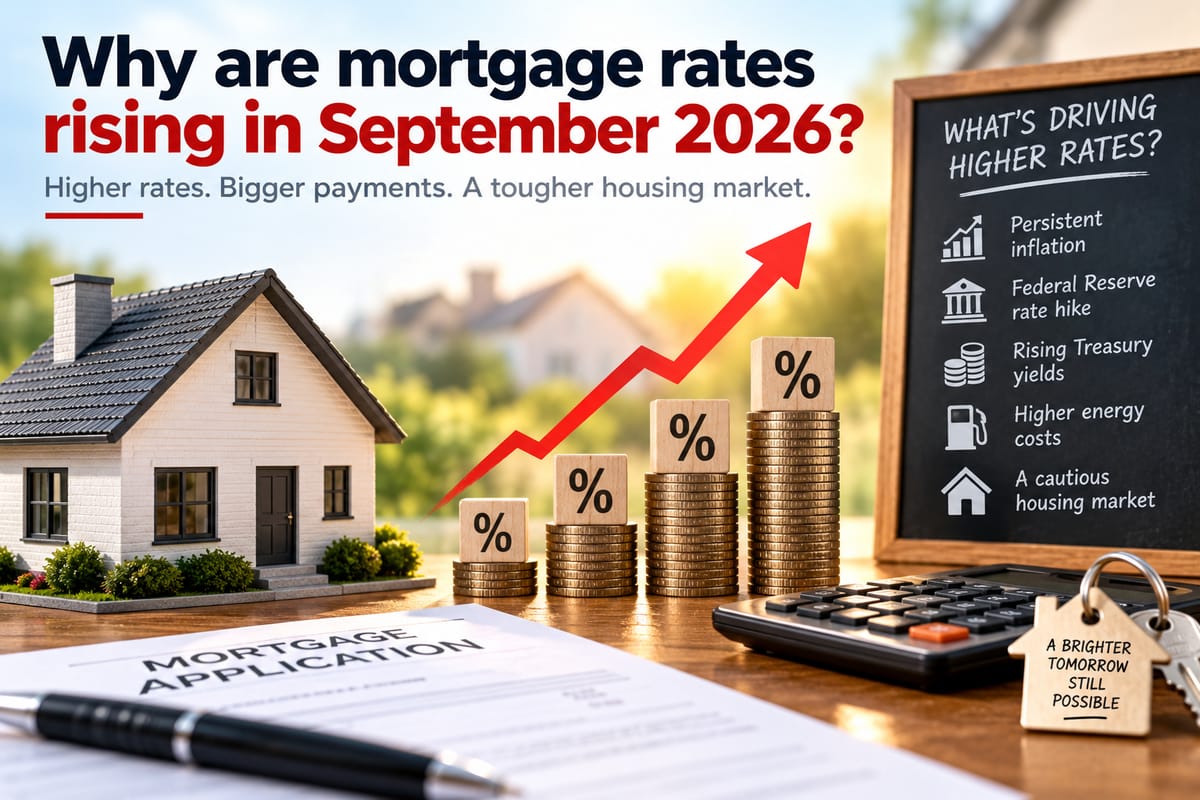
Why are mortgage rates rising in September 2026?
Mortgage rates have moved higher again in September 2026, putting renewed pressure on homebuyers who had been hoping borrowing costs would gradually fall.
The average U.S. 30-year fixed mortgage rate reached 6.95% for the week ending September 17, up from 6.76% the previous week and well above the 6.26% average recorded a year earlier, according to Freddie Mac’s Primary Mortgage Market Survey. The 15-year fixed rate also increased, reaching 6.26% from 6.09% a week earlier.
The increase comes as financial markets respond to persistent inflation, elevated Treasury yields, higher energy prices and a Federal Reserve that has shifted back toward tighter monetary policy.
On September 16, the Federal Reserve raised its target federal funds rate by a quarter percentage point to 3.75% to 4%, saying inflation remained elevated and that the move was intended to support a more timely return to its 2% inflation goal.
But the Fed’s decision is only part of the explanation for rising mortgage rates.
Unlike many consumer loans that respond more directly to short-term interest rates, fixed mortgage rates are heavily influenced by longer-term bond markets, particularly U.S. Treasury yields. That means mortgage rates can rise even when investors are already anticipating what the Federal Reserve will do.
Mortgage Rates Were Already Rising Before the Fed Hike
One of the most important points about September’s mortgage-rate increase is that the upward move began before the Federal Reserve’s latest decision.
The 30-year fixed mortgage rate had already climbed to 6.85% for the week ending September 4, its highest level in more than a year at the time. Reuters reported that rising oil prices and renewed inflation concerns were pushing Treasury yields higher, increasing pressure on residential borrowing costs.
By September 17, Freddie Mac’s weekly measure had reached 6.95%.
That means the September 16 Fed rate hike should not be interpreted as the sole reason mortgage rates increased. Financial markets had been adjusting to changing expectations about inflation, government borrowing, economic growth and future monetary policy before the Fed announced its decision.
Understanding those broader relationships is part of understanding The Global Economy Explained, particularly how interest rates, inflation and bond markets can influence household borrowing costs.
The Federal Reserve Raised Its Benchmark Rate
The Fed’s September decision nevertheless matters.
The central bank increased the federal funds target range by 0.25 percentage point to 3.75%-4%. The committee said economic activity was expanding at a solid pace and that inflation remained elevated.
The federal funds rate primarily affects very short-term borrowing costs. Mortgage rates, however, are generally tied more closely to longer-term market rates.
That distinction explains why a Fed rate hike does not automatically translate into a 0.25 percentage-point increase in a 30-year mortgage rate.
Instead, investors consider what the Fed’s decision means for inflation and future interest rates. If markets believe monetary policy will need to remain restrictive for longer, longer-term bond yields can rise, which can place upward pressure on mortgage rates.
Conversely, mortgage rates can sometimes fall even while the Fed is holding its benchmark rate steady if investors expect inflation to decline and future interest rates to fall.
Treasury Yields Are a Major Part of the Story
The 10-year U.S. Treasury yield is one of the most closely watched market indicators when economists discuss mortgage-rate movements.
It is not a direct formula for determining the rate a borrower receives. Instead, it serves as an important benchmark for longer-term borrowing costs and influences the pricing of mortgage-backed securities.
In September, the 10-year Treasury yield moved close to and above the 5% level as investors dealt with inflation concerns, oil-price volatility, government borrowing and expectations for Federal Reserve policy.
Treasury yields subsequently pulled back somewhat after the September Fed meeting, with the 10-year yield falling to about 4.94% on September 17.
Even so, yields remained elevated enough to keep pressure on mortgage financing.
This is one reason mortgage rates can remain high even after a central bank meeting has taken place.
Inflation Is Still Making Markets Cautious
Inflation remains another major factor behind the September mortgage-rate environment.
The latest available U.S. Consumer Price Index showed consumer prices increased 3.4% over the 12 months through August 2026. Prices increased 0.4% in August alone, following a 0.1% increase in July.
Energy prices were particularly important. Gasoline prices rose 3.9% in August, while the broader energy index increased 2.1% during the month.
Persistent inflation creates a problem for bond investors because higher inflation can erode the future purchasing power of fixed-income payments.
If investors believe inflation will remain elevated, they may demand higher yields on longer-term bonds. Those higher yields can then feed into other long-term borrowing costs, including mortgages.
For prospective homeowners, this means mortgage rates are being influenced by the inflation outlook as much as by the Fed’s current benchmark rate.
Oil Prices Have Added to Inflation Concerns
Energy-market volatility has also played a role in the recent rise in borrowing costs.
Higher oil prices can increase transportation and production expenses across the economy. They can also directly raise gasoline prices, contributing to headline inflation.
In early September, Reuters reported that escalating Middle East tensions were pushing oil prices higher and contributing to inflation concerns and rising Treasury yields.
When investors become concerned that energy costs could keep inflation elevated, expectations for future monetary policy can change quickly.
That can happen even if the initial increase in oil prices is caused by a supply disruption rather than stronger consumer demand.
For mortgage borrowers, the important connection is indirect: higher energy prices can influence inflation expectations, which can influence bond yields, which can influence mortgage pricing.
The Fed’s September Decision Was Not a Direct Mortgage-Rate Setting
It is easy to look at the September Fed hike and conclude that the central bank simply increased mortgage rates.
The actual relationship is more complicated.
The Federal Reserve sets the federal funds target range. Banks and financial markets then respond to that policy and to expectations about the future economy.
Thirty-year fixed mortgage rates are determined in private financial markets and are influenced heavily by mortgage-backed securities and longer-term interest rates.
This distinction matters for borrowers because mortgage rates can move in either direction around a Fed meeting.
If a rate hike is already fully expected by financial markets, the announcement itself may produce relatively little movement in mortgage rates. If the accompanying economic projections or central-bank messaging change expectations about future policy, however, bond yields can react substantially.
That is why watching only the Fed’s headline rate can provide an incomplete picture of mortgage borrowing costs.
Why Mortgage Rates Can Rise Even Before the Fed Acts
Financial markets are forward-looking.
Investors do not wait until the Federal Reserve formally announces a decision before adjusting their expectations. Economic data, inflation reports, employment figures and comments from policymakers can cause traders to change their expectations weeks or months in advance.
That was particularly important in September.
The combination of persistent inflation, strong economic activity and changing expectations for Federal Reserve policy pushed Treasury yields higher before the September meeting.
By the time the Fed announced its 25-basis-point hike, some of the expected policy tightening had already been reflected in financial markets.
This helps explain why mortgage rates had been rising before September 16 and why they did not simply move in lockstep with the Fed’s announcement.
The Housing Market Is Feeling the Impact
Higher mortgage rates have consequences beyond monthly payments.
When borrowing becomes more expensive, prospective buyers may qualify for smaller loans or decide to delay purchasing a home.
That can reduce demand, particularly among buyers who are already close to the limit of what they can afford.
Pending home sales remained weak in August despite a modest 0.3% monthly increase, with transactions down 4.7% from a year earlier. Reuters reported that elevated mortgage rates were continuing to discourage buyers.
Homebuilders are also responding to the challenging environment. Builder sentiment fell to a 12-month low in September, while elevated mortgage rates, material costs and labor constraints continued to weigh on the housing market.
The result is a housing market where affordability remains a central concern even when individual home prices are not rising as quickly as they did during earlier periods.
Higher Rates Can Change the Monthly Payment Quickly
The difference between mortgage rates can have a substantial effect on the cost of a home over time.
For example, consider a hypothetical $400,000 30-year fixed mortgage with no taxes, insurance or other costs included.
At a 6% interest rate, the principal-and-interest payment would be about $2,398 per month.
At 7%, the payment would rise to approximately $2,661 per month.
That is a difference of roughly $263 every month, or more than $3,100 over a year.
The actual payment for a homeowner will depend on the loan amount, rate, down payment, property taxes, insurance, mortgage insurance and other factors. But the example illustrates why even relatively small changes in mortgage rates can affect housing affordability.
What September Means for Borrowers
The September increase does not mean every borrower should expect the same mortgage rate.
Lenders price loans differently depending on credit history, loan type, down payment, property characteristics, occupancy and other factors.
A borrower’s quoted rate can therefore differ significantly from the national weekly average.
The Freddie Mac survey itself is a market benchmark rather than a guarantee of the rate any individual borrower will receive. Its September 17 average of 6.95% represents a broad market measure of 30-year fixed-rate mortgages.
Borrowers also need to distinguish between the interest rate and the annual percentage rate, which incorporates certain loan costs.
For anyone comparing mortgage offers, looking only at the headline rate can therefore miss important differences in total borrowing costs.
Could Mortgage Rates Fall Again?
The possibility of mortgage rates declining remains closely tied to inflation, Treasury yields and expectations for Federal Reserve policy.
If inflation shows convincing signs of moving toward the Fed’s 2% target, investors could begin pricing a less restrictive monetary-policy environment. Lower Treasury yields could then put downward pressure on mortgage rates.
But the opposite is also possible.
If inflation remains elevated or investors demand higher compensation for holding long-term government debt, Treasury yields could remain high and mortgage rates could stay elevated.
That uncertainty is why discussions about Will Interest Rates Fall Again? need to distinguish between short-term central-bank policy and the longer-term bond-market forces that influence fixed mortgage rates.
Existing Homeowners Are in a Different Position
Rising mortgage rates do not affect every homeowner equally.
Someone with an existing fixed-rate mortgage generally does not see the interest rate on that loan change simply because market mortgage rates rise.
The biggest immediate impact falls on people shopping for a new mortgage, refinancing an existing loan or using certain forms of variable-rate borrowing.
Homeowners with adjustable-rate mortgages can face different risks because their payments may change according to the terms and adjustment schedule of their loans.
For households already carrying large amounts of debt, higher interest rates can also increase financial pressure elsewhere.
That broader effect is discussed in Consumers Feel Pressure as High Interest Rates Affect Household Budgets, where rising borrowing costs are considered alongside other household expenses.
What Homebuyers Can Watch Next
Several indicators will be particularly important for mortgage borrowers over the coming weeks.
Inflation reports
Future CPI and other inflation readings will help markets assess whether price pressures are continuing to ease or remain persistent.
Treasury yields
The 10-year Treasury yield will remain a key market indicator because changes in longer-term bond yields can influence mortgage pricing.
Federal Reserve communication
Investors will continue examining statements and speeches from Federal Reserve officials for clues about how policymakers view inflation and future interest-rate policy.
Employment data
A resilient labor market can give policymakers more room to focus on inflation, while significant weakness could change the balance between inflation and employment concerns.
Mortgage-market demand
Lender pricing also responds to demand for mortgages and conditions in the market for mortgage-backed securities.
Taken together, these factors provide a more complete picture than the Fed’s benchmark rate alone.
Why Mortgage Rates Are Rising in September 2026
The simplest explanation is that several forces are pushing in the same direction.
Mortgage rates have risen because long-term Treasury yields have been elevated, inflation remains above the Federal Reserve’s target, energy-price volatility has increased inflation concerns, and expectations for monetary policy have become more restrictive.
The Federal Reserve’s September 16 rate hike added to that environment by raising the federal funds target range to 3.75%-4% and signaling that inflation remains a significant concern.
But the mortgage market had already been moving higher before the Fed’s announcement. Freddie Mac’s 30-year average reached 6.95% on September 17, compared with 6.76% the previous week and 6.26% a year earlier.
For homebuyers, the key takeaway is that mortgage rates are determined by a much broader financial system than the Federal Reserve’s overnight policy rate.
Until inflation, Treasury yields and expectations for future monetary policy become more favorable for long-term borrowing, mortgage rates may remain sensitive to every major economic report and shift in financial-market expectations.





2 Comments
Micle harison
June 7, 2019Lorem ipsum dolor sit amet, usu ut perfecto postulant deterruisset, libris causae volutpat at est, ius id modus laoreet urbanitas. Mel ei delenit dolores.
John Doe
June 7, 2019Some consultants are employed indirectly by the client via a consultancy staffing company.