
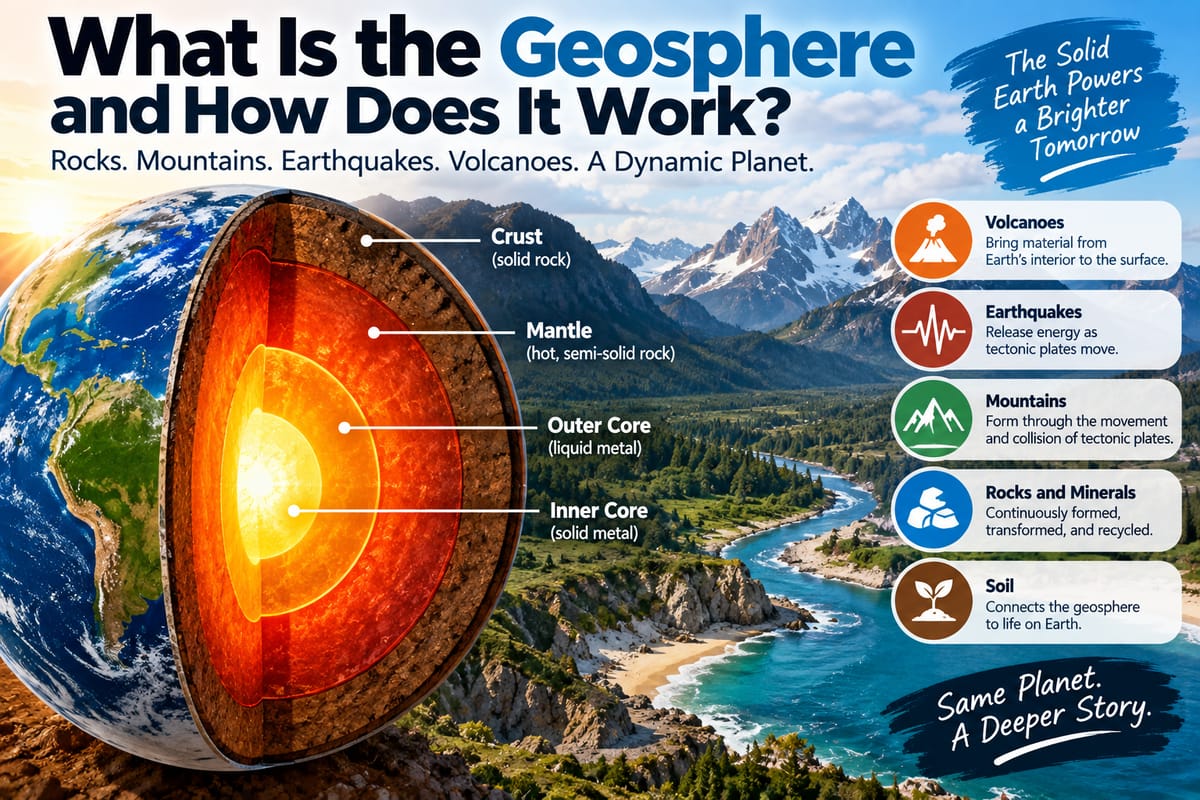
What Is the Geosphere and How Does It Work?
Earth is made up of several interconnected systems that work together to create the planet we know today. The oceans move water and heat, the atmosphere surrounds the planet with gases, living organisms form the biosphere, and the solid Earth provides the foundation on which these systems operate.
That solid part of Earth is broadly known as the geosphere.
The geosphere includes everything from Earth’s deepest interior to the rocks, minerals, soil, mountains, and landforms found at the surface. It is not a completely static structure. Geological processes continually reshape it through volcanic activity, earthquakes, erosion, weathering, tectonic movement, and the slow recycling of Earth’s materials.
Understanding the geosphere helps explain how mountains form, why earthquakes occur, how rocks are created and transformed, and how the solid Earth interacts with water, air, and living organisms.
What Is the Geosphere?
The geosphere is the solid, rocky part of Earth.
It includes several major components:
- Earth’s inner core
- Earth’s outer core
- The mantle
- The crust
- Rocks and minerals
- Soil
- Mountains
- Valleys
- Ocean floors
- Continents
- Sedimentary deposits
- Other solid geological structures
The term is often used to distinguish Earth’s solid materials from other planetary systems.
For example, the hydrosphere includes Earth’s water, the atmosphere includes the gases surrounding the planet, and the biosphere encompasses living organisms and the environments in which they exist.
These systems are not independent. Changes in one can influence the others.
Earth’s Layers Make Up the Geosphere
One of the simplest ways to understand the geosphere is to look at Earth’s internal structure.
Earth is commonly divided into four major layers:
- Inner core
- Outer core
- Mantle
- Crust
Each layer has different physical and chemical characteristics.
The inner core is extremely hot and under enormous pressure. The outer core is also extremely hot but behaves differently because it is predominantly liquid. Above the core lies the mantle, a thick layer of hot rock. The crust is the relatively thin outer layer on which continents and ocean basins are located.
Together, these layers form the interior structure of the planet.
The Inner Core
The inner core is Earth’s deepest major layer.
It is primarily composed of iron and nickel and experiences extraordinary pressure from the material surrounding it.
Despite temperatures that are extremely high, the immense pressure keeps much of the inner core in a solid state.
The inner core is important to Earth’s overall structure and contributes to the complex processes occurring deep within the planet.
Scientists cannot directly travel to Earth’s core to collect samples. Instead, they use evidence from seismic waves, laboratory experiments, Earth’s magnetic field, gravity measurements, and other observations to understand the planet’s interior.
The Outer Core
Surrounding the inner core is the outer core.
Unlike the inner core, the outer core is predominantly liquid.
The movement of electrically conductive material within the outer core plays a major role in generating Earth’s magnetic field through a process commonly called the geodynamo.
Earth’s magnetic field extends beyond the planet and interacts with the solar wind and charged particles from the Sun.
This makes the outer core important not only to Earth’s internal structure but also to conditions in the environment surrounding the planet.
The Mantle
The mantle lies above Earth’s core and represents a very large portion of the planet’s interior.
It consists mainly of solid rock, although temperatures and pressures vary considerably throughout the layer.
The mantle is not simply a motionless block of material. Over extremely long geological timescales, heat-driven movement within the mantle contributes to processes that influence the movement of Earth’s tectonic plates.
This movement is far too slow to observe directly in everyday life. However, its effects become visible through geological phenomena such as mountain building, volcanic activity, and earthquakes.
The Crust
The crust is Earth’s outermost solid layer.
It is relatively thin compared with the mantle and core.
There are two broad types of crust:
Continental Crust
Continental crust forms the foundations of Earth’s continents. It is generally thicker and less dense than oceanic crust.
It contains a wide variety of rocks and geological structures, including ancient formations that preserve evidence of Earth’s long history.
Oceanic Crust
Oceanic crust forms the floors of Earth’s oceans.
It is generally thinner and denser than continental crust and is continually created and recycled through geological processes associated with plate tectonics.
The distinction between continental and oceanic crust is an important part of understanding how Earth’s surface changes.
The Lithosphere and Asthenosphere
The crust does not exist as an isolated shell.
Together with the rigid uppermost portion of the mantle, it forms the lithosphere.
The lithosphere is divided into large sections known as tectonic plates.
Below much of the lithosphere is the asthenosphere, a hotter and mechanically weaker region of the upper mantle. It can deform slowly over geological timescales, allowing tectonic plates above it to move.
The interaction between the lithosphere and the deeper mantle is central to plate tectonics.
What Is Plate Tectonics?
Plate tectonics describes the large-scale movement and interaction of Earth’s lithospheric plates.
These plates can move toward one another, away from one another, or past one another.
Their interactions help explain many of Earth’s major geological features.
Convergent Boundaries
At convergent boundaries, plates move toward one another.
Depending on the types of plates involved, this can result in:
- Mountain building
- Subduction
- Earthquakes
- Volcanic activity
- Deep ocean trenches
When one plate is forced beneath another, the process is called subduction.
Divergent Boundaries
At divergent boundaries, plates move apart.
Magma can rise into the space created between separating plates and cool to form new crust.
This process is particularly important along mid-ocean ridges.
Transform Boundaries
At transform boundaries, plates move horizontally past one another.
Friction can cause stress to accumulate until it is released, producing earthquakes.
How the Geosphere Produces Mountains
Mountains can form through several geological processes.
One major mechanism involves the collision of tectonic plates.
When continental plates converge, neither may easily sink beneath the other. Instead, the crust can be compressed, folded, fractured, and pushed upward.
Over millions of years, these processes can create enormous mountain ranges.
Volcanic activity can also create mountains when repeated eruptions deposit layers of lava, ash, and other volcanic material around an eruptive center.
Erosion subsequently modifies these landscapes, showing that mountain building and mountain erosion are part of a continuing geological story.
How Earthquakes Are Connected to the Geosphere
Earthquakes occur when stored energy within Earth’s crust and uppermost mantle is suddenly released.
Much of this activity is associated with tectonic plates.
Stress can build along faults as plates move. When rocks eventually break or shift, energy travels outward as seismic waves.
These waves allow scientists to detect and study earthquakes and can also reveal information about Earth’s internal structure.
Seismic waves travel differently through different materials. By analyzing their behavior, scientists can infer characteristics of regions deep beneath Earth’s surface.
How Volcanoes Work
Volcanoes provide another visible connection between Earth’s interior and its surface.
Deep within Earth, temperatures can become high enough to partially melt rock. The resulting molten material, known as magma, can move through fractures or other pathways.
When magma reaches the surface, it is called lava.
Volcanic eruptions can release:
- Lava
- Ash
- Volcanic gases
- Rock fragments
- Heat
Repeated volcanic activity can build new landforms and contribute to the formation of new crust in certain geological settings.
Rocks Are Central to the Geosphere
Rocks are among the most visible components of the geosphere.
There are three major rock groups:
- Igneous rocks
- Sedimentary rocks
- Metamorphic rocks
Igneous Rocks
Igneous rocks form when molten rock cools and solidifies.
If magma cools underground, it can form intrusive igneous rocks. If lava cools at the surface, it can produce extrusive igneous rocks.
Granite and basalt are common examples.
Sedimentary Rocks
Sedimentary rocks form from accumulated sediments that become compacted and cemented over time.
Sediments can originate from weathered rock, biological material, or chemical processes.
Sandstone, shale, and limestone are examples of sedimentary rocks.
Metamorphic Rocks
Metamorphic rocks form when existing rocks are altered by heat, pressure, or chemically active fluids without completely melting.
The original rock can undergo significant changes in its minerals, texture, or structure.
Marble and slate are examples of metamorphic rocks.
The Rock Cycle
The three major rock groups are connected through the rock cycle.
A rock does not necessarily remain in one category permanently.
For example:
Magma → cooling → igneous rock → weathering → sediment → sedimentary rock → heat and pressure → metamorphic rock → melting → magma
The actual pathways can be much more complicated, and rocks can move through different stages in various sequences.
The rock cycle demonstrates one of the most important characteristics of the geosphere: Earth’s materials are continually being transformed.
A broader examination of Earth’s physical structure, rocks, minerals, and geological processes can be found in the Earth Science and Geology Complete Guide.
Weathering Changes the Geosphere
Weathering breaks down or alters rocks at or near Earth’s surface.
There are two broad categories.
Physical Weathering
Physical weathering breaks rocks into smaller pieces without fundamentally changing their chemical composition.
Examples include:
- Expansion and contraction caused by temperature changes
- Freeze-thaw processes
- Abrasion
- Pressure release
- Root growth
Chemical Weathering
Chemical weathering changes the minerals within rocks through chemical reactions.
Water, oxygen, carbon dioxide, and acids produced naturally in the environment can contribute to these reactions.
Over long periods, weathering can transform solid rock into sediments and contribute to soil formation.
Erosion Moves Geological Materials
Weathering breaks material down, while erosion involves the movement of that material.
Water, wind, ice, and gravity can transport sediments across landscapes.
Rivers can carry sediment downstream. Wind can move fine particles across dry regions. Glaciers can transport enormous quantities of rock and sediment as they move.
Erosion can reshape landscapes by removing material from one location and depositing it elsewhere.
How Soil Connects to the Geosphere
Soil develops through interactions between minerals, organic matter, water, air, organisms, and time.
Weathered rock contributes mineral material to soil, while plants and microorganisms contribute organic matter.
Soil is therefore closely connected to both the geosphere and biosphere.
It provides a medium for plant growth, stores water and nutrients, and participates in important environmental cycles.
At the same time, soil itself can be eroded, transported, deposited, and transformed.
The Geosphere and the Water Cycle
The geosphere and hydrosphere constantly interact.
Water can:
- Weather rocks
- Erode landscapes
- Transport sediments
- Fill underground pores
- Enter fractures
- Form caves
- Alter minerals
- Contribute to soil formation
Rivers and groundwater are particularly important agents of geological change.
Over geological timescales, water can carve valleys, reshape coastlines, transport sediments, and modify entire landscapes.
This illustrates why Earth’s systems cannot be studied completely in isolation.
The Geosphere and the Atmosphere
The atmosphere also interacts continuously with the solid Earth.
Rainfall and atmospheric gases contribute to weathering. Wind transports sediments. Volcanic eruptions release gases and particles into the atmosphere.
The atmosphere also influences surface temperatures and the conditions under which geological processes occur.
For a broader explanation of the gaseous environment surrounding Earth and the processes that occur within it, see the Complete Guide to Earth’s Atmosphere, Weather and Air.
The Geosphere and Living Organisms
Living organisms are another important influence on the geosphere.
Plant roots can break apart rocks and stabilize soil. Microorganisms contribute to soil formation and chemical transformations. Animals can disturb soil through burrowing and other activities.
Humans have also become a major geological force through activities such as:
- Mining
- Construction
- Agriculture
- Quarrying
- Road building
- Deforestation
- Land reclamation
These activities can change landscapes and redistribute enormous quantities of geological material.
Earth’s Natural Cycles Depend on the Geosphere
The geosphere participates in several natural cycles that move materials through Earth’s systems.
These include the:
- Rock cycle
- Water cycle
- Carbon cycle
- Nitrogen cycle
- Phosphorus cycle
The movement of carbon between rocks, oceans, atmosphere, and living organisms is particularly important to Earth’s long-term environmental system.
Weathering can remove carbon dioxide from the atmosphere through chemical processes, while volcanic activity can return carbon-containing gases to the atmosphere.
These processes occur on very different timescales.
A broader look at the movement of materials and energy through Earth’s systems can be found in Earth’s Major Natural Cycles Explained.
How Earth’s Geosphere Has Changed Over Time
The geosphere has never been exactly the same throughout Earth’s history.
Continents have moved. Oceans have opened and closed. Mountain ranges have formed and eroded. Volcanoes have created new rocks. Existing rocks have been buried, transformed, melted, and recycled.
Earth’s surface has therefore undergone continuous geological change.
Scientists reconstruct parts of this history by examining rocks, fossils, minerals, magnetic patterns, sediments, and geological structures.
Some rocks preserve evidence of environments that existed millions or even billions of years ago.
How Earth Formed Its Geological Structure
The geosphere began developing as Earth formed from material orbiting the young Sun.
As the early planet grew, collisions and gravitational compression generated heat. Dense materials migrated toward the center while less-dense materials became concentrated closer to the surface.
This process contributed to the development of Earth’s layered internal structure.
Over billions of years, volcanic activity, cooling, tectonic movement, impacts, erosion, and other processes continued to reshape the planet.
The broader history of this development is explored in How Earth Formed and How Its Planetary Systems Work.
How Scientists Study the Geosphere
Because much of the geosphere is inaccessible, scientists use indirect methods alongside direct observations.
Important tools include:
Seismology
Scientists study seismic waves from earthquakes and other sources to investigate Earth’s internal structure.
Geology
Geologists examine rocks, minerals, fossils, landforms, and geological formations.
Geophysics
Geophysical techniques use measurements of gravity, magnetism, seismic activity, and other physical properties to study Earth’s interior.
Remote Sensing
Satellites and aircraft can measure changes in Earth’s surface, vegetation, ice, water, and geological features.
Laboratory Experiments
Researchers can recreate high-pressure and high-temperature conditions to study how Earth materials behave deep underground.
Together, these methods provide evidence about parts of the planet that cannot be directly observed.
Why the Geosphere Matters
The geosphere provides the physical foundation for life on Earth.
It supplies minerals and materials used by ecosystems and human societies. It creates landscapes, stores groundwater, supports soil formation, and participates in major environmental cycles.
Many resources essential to modern civilization originate within geological systems, including:
- Metals
- Construction materials
- Industrial minerals
- Fossil fuels
- Geothermal resources
- Groundwater stored in geological formations
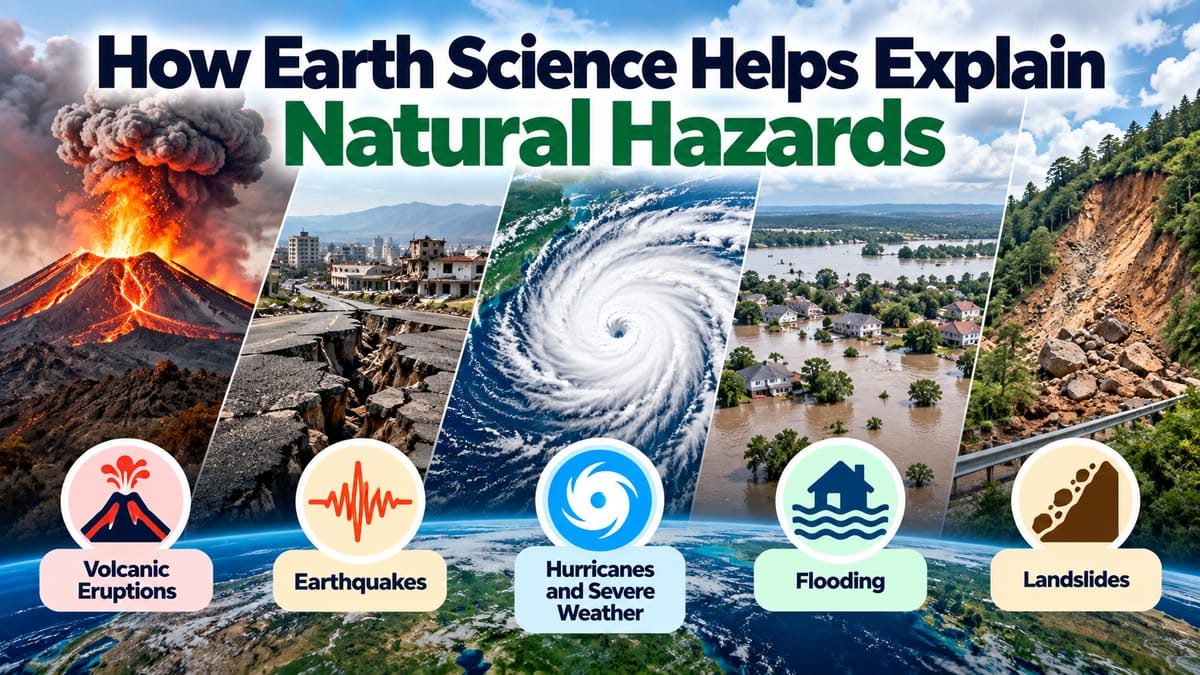
Understanding the geosphere also helps societies manage natural hazards such as earthquakes, volcanic eruptions, landslides, and erosion.
The Geosphere Is Always Changing
One of the most important things to understand about the geosphere is that it is dynamic.
Mountains may appear permanent on a human timescale, but geological processes are continually changing them. Rocks are weathered, sediments are transported, crust is created and destroyed, and materials are transformed deep within Earth.
Some changes occur rapidly.
Earthquakes can reshape landscapes within seconds. Volcanic eruptions can create or destroy land within hours or days.
Other changes happen extraordinarily slowly.
Mountain ranges can take millions of years to develop, while the transformation of one type of rock into another can occur over immense spans of geological time.
A Living Planet Built on a Dynamic Foundation
The geosphere is much more than the rocks beneath our feet. It is a vast, interconnected system extending from Earth’s surface to its deepest interior.
Its layers interact through heat, pressure, movement, chemical reactions, and the continual transformation of geological materials. Plate tectonics moves continents and creates mountains. Volcanic activity transfers material from Earth’s interior to the surface. Weathering and erosion reshape landscapes, while the rock cycle continually transforms Earth’s solid materials.
At the same time, the geosphere interacts with water, air, and living organisms, making it an essential part of the larger Earth system.
Although many geological processes operate too slowly to notice from day to day, they are constantly reshaping the planet. The landscapes people see today are temporary expressions of a much longer geological process that has been unfolding for billions of years.




2 Comments
Micle harison
June 7, 2019Lorem ipsum dolor sit amet, usu ut perfecto postulant deterruisset, libris causae volutpat at est, ius id modus laoreet urbanitas. Mel ei delenit dolores.
John Doe
June 7, 2019Some consultants are employed indirectly by the client via a consultancy staffing company.