
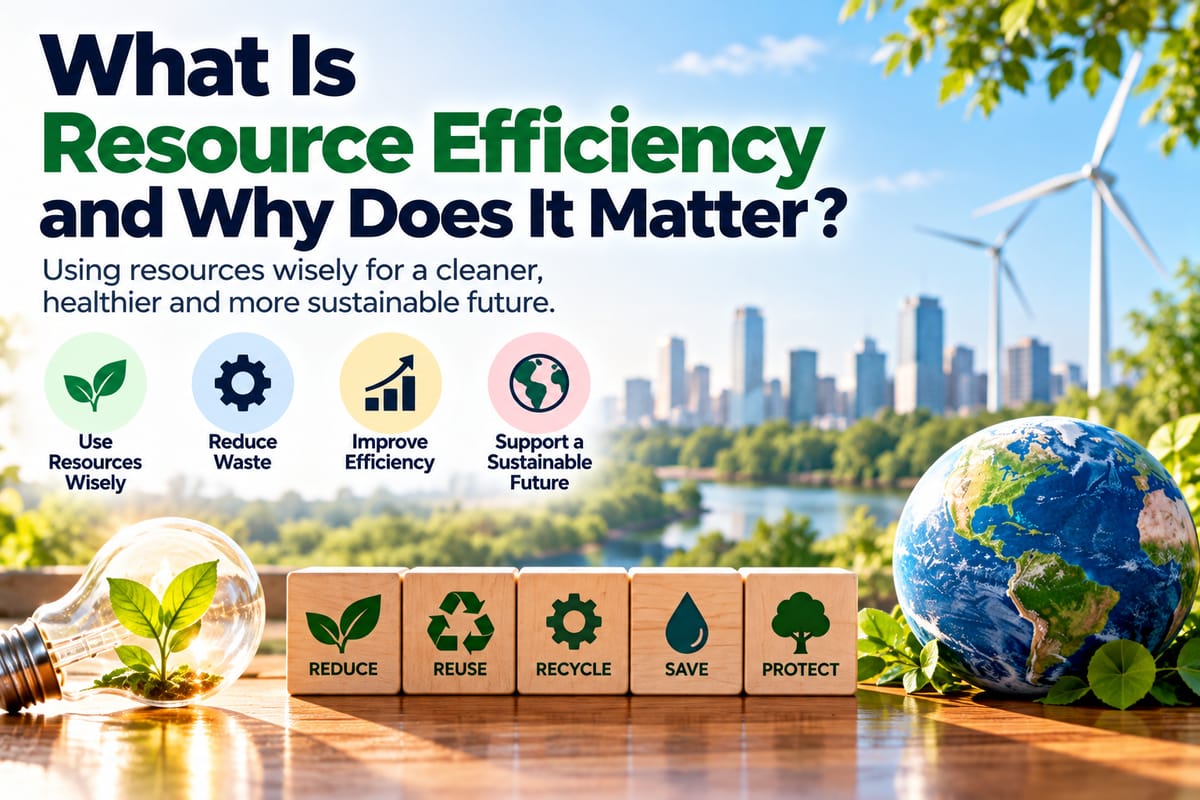
What Is Resource Efficiency and Why Does It Matter?
Resource efficiency is the practice of using materials, energy, water, land and other natural resources as effectively as possible while reducing unnecessary waste and environmental pressure.
Every product and service depends on resources. Food requires land, water and energy. Buildings require minerals, timber and manufactured materials. Electronics depend on metals, plastics and energy throughout their production and use. Even digital services rely on physical infrastructure, electricity and materials.
Because resources are finite or limited by natural regeneration, how efficiently societies use them can have major economic and environmental consequences.
Resource efficiency does not simply mean using less of everything. It means getting more useful value from the resources that are used, reducing avoidable losses and keeping products and materials useful for as long as practical.
What Is Resource Efficiency?
Resource efficiency describes the relationship between the resources consumed and the value or useful output produced.
A simplified way to think about it is:
Resource efficiency = useful output ÷ resources used
For example, if two manufacturing processes produce the same number of products but one requires less energy and raw material, the more efficient process uses resources more effectively.
Resource efficiency can apply to:
- Energy
- Water
- Raw materials
- Land
- Food
- Minerals
- Manufactured products
- Packaging
- Infrastructure
- Transportation
The concept can be applied at many levels, from an individual household to an entire economy.
Resource Efficiency Is Different From Resource Conservation
Resource efficiency and conservation are related but not identical.
Resource conservation generally focuses on protecting resources and reducing unnecessary consumption.
Resource efficiency focuses on obtaining more value from each unit of resource used.
For example, turning off unnecessary lights is a conservation measure. Replacing inefficient lighting with technology that provides the same illumination using less electricity is an efficiency measure.
Both approaches can reduce resource demand.
Why Natural Resources Matter
Natural resources provide the foundation for human societies.
They supply materials, energy and ecological services needed for everyday life and economic activity.
Resources include:
- Freshwater
- Forests
- Agricultural land
- Minerals
- Fossil fuels
- Wildlife
- Fisheries
- Sunlight
- Wind
- Soil
- Geological materials
The relationship between resources and society is explored in How Natural Resources Support Human Civilization.
Resource efficiency matters because the extraction, processing, transportation and disposal of these resources can require substantial energy and infrastructure.
Using resources more effectively can reduce some of these pressures.
Why Resource Efficiency Matters
Resource efficiency matters for several interconnected reasons.
It can help:
- Reduce material waste
- Lower energy consumption
- Reduce operating costs
- Improve productivity
- Reduce pressure on natural ecosystems
- Lower some forms of pollution
- Extend product lifetimes
- Improve resilience to resource shortages
- Support more sustainable economic activity
The benefits vary depending on the resource, industry and technology involved.
Efficiency is therefore not a single solution but a broad approach to managing resource use.
Resource Efficiency and Environmental Sustainability
Environmental sustainability depends partly on whether natural systems can continue providing resources and ecosystem services over time.
When resources are extracted or consumed faster than natural systems can replenish them, long-term pressure can increase.
Resource efficiency can help reduce the amount of new extraction required to provide a particular level of goods or services.
For example, if a building can provide the same useful space while requiring fewer construction materials, the demand for raw materials can potentially decrease.
However, efficiency does not eliminate environmental impacts entirely. Producing the more efficient technology itself still requires resources.
Resource Efficiency and Climate Change
Energy and material use are closely connected to greenhouse-gas emissions.
Many industrial processes require energy, and much of the world’s energy system has historically relied heavily on fossil fuels.
Using energy more efficiently can reduce energy demand for a particular service, potentially lowering associated emissions when the energy source has significant greenhouse-gas emissions.
The relationship between human activity, energy and the climate is discussed in Climate Change Explained.
Efficiency alone cannot address every cause of climate change, but reducing unnecessary energy and material demand can be one component of broader climate strategies.
Energy Efficiency
Energy efficiency is one of the most familiar forms of resource efficiency.
It involves providing the same or a similar service while consuming less energy.
Examples include:
- Efficient lighting
- Better building insulation
- Energy-efficient appliances
- Efficient industrial machinery
- Improved vehicle efficiency
- Efficient heating and cooling systems
- Smart energy management
Consider two refrigerators that provide comparable cooling. If one consumes substantially less electricity during normal operation, it can provide the same basic service with lower energy consumption.
Material Efficiency
Material efficiency focuses on reducing the amount of raw material required to deliver a product or service.
Manufacturers can pursue material efficiency through:
- Lightweight product design
- Reduced packaging
- Better manufacturing precision
- Longer product lifetimes
- Recycled materials
- Reusable components
- Modular designs
- Reduced production waste
The objective is not necessarily to make every product physically smaller. It is to use materials in ways that provide greater functional value.
Water Efficiency
Water efficiency means providing useful services while reducing unnecessary water consumption.
Examples include:
- Low-flow fixtures
- Efficient irrigation
- Leak detection
- Water recycling
- Rainwater collection where appropriate
- Industrial water reuse
- Drought-resistant landscaping
Agriculture is particularly important because irrigation can account for substantial water demand in many regions.
Improving irrigation efficiency can help reduce water losses, although local environmental conditions must be considered because changes in water use can also affect downstream ecosystems.
Land Efficiency
Land is another resource that can be used more or less efficiently.
Urban development, agriculture, transportation and industry all require land.
Land-use efficiency can involve:
- Compact urban development
- Reusing previously developed sites
- Multi-story buildings
- Efficient agricultural systems
- Protecting high-value ecosystems
- Reducing unnecessary land conversion
Land efficiency does not mean maximizing development everywhere. Protecting ecosystems and maintaining open space are also important considerations.
Resource Efficiency in Manufacturing
Manufacturing provides many opportunities for efficiency because factories transform large quantities of materials and energy into products.
A manufacturing facility can improve resource efficiency by reducing:
- Production scrap
- Defective products
- Energy losses
- Water waste
- Excess packaging
- Unnecessary transportation
- Raw-material losses
Better process design can sometimes reduce resource consumption while improving productivity.
Designing Products for Resource Efficiency
Resource efficiency can begin before a product reaches a factory.
Product designers can consider:
- Material selection
- Durability
- Repairability
- Recyclability
- Product weight
- Packaging
- Energy consumption
- Component replacement
- End-of-life management
A product that lasts twice as long may reduce the need for replacement products, although its overall environmental impact still depends on how it is manufactured, used and eventually disposed of.
Product Longevity
Making products last longer can improve resource efficiency because fewer replacement products may be required.
Durability can be improved through:
- Stronger materials
- Replaceable components
- Repairable designs
- Software support
- Modular construction
- Better maintenance
Product longevity is particularly relevant for electronics, appliances, furniture, vehicles and other goods that contain significant amounts of material.
Repair and Reuse
Repair and reuse can help preserve the value already invested in a product.
Instead of replacing a product because one component has failed, repair allows the remaining materials and components to continue providing useful service.
Reuse can involve:
- Donating clothing
- Reselling furniture
- Reusing containers
- Refurbishing electronics
- Sharing equipment
- Reusing building materials
These approaches can reduce demand for new products in some circumstances.
Recycling and Resource Efficiency
Recycling can recover materials from products that would otherwise become waste.
Common recyclable materials include:
- Paper
- Cardboard
- Glass
- Aluminum
- Steel
- Certain plastics
Recycling is useful, but it is not always the most resource-efficient option.
Some materials require significant energy to collect, process and transform. Products that can be safely reused without substantial additional processing may sometimes retain more value than products that are immediately recycled.
This is why resource efficiency is broader than recycling.
The Resource Efficiency Hierarchy
A useful way to think about resource management is as a hierarchy.
In many situations, the preferred sequence is broadly:
- Avoid unnecessary consumption
- Reduce resource use
- Extend product life
- Reuse products
- Repair or refurbish
- Recover materials
- Recycle
- Dispose of remaining waste responsibly
The exact hierarchy can vary by material and situation.
The general principle is to preserve the highest amount of useful value for as long as possible.
Renewable and Nonrenewable Resources
Resource efficiency applies to both renewable and nonrenewable resources.
Renewable resources can regenerate naturally under appropriate conditions. Examples include sunlight, wind and sustainably managed biological resources.
Nonrenewable resources exist in finite geological quantities or regenerate so slowly that they are effectively finite on human timescales.
The distinction and implications are explained in Renewable vs Nonrenewable Resources Explained.
Even renewable resources can be overused. A renewable resource is not automatically unlimited.
Efficiency Does Not Make Resources Unlimited
One of the most important limitations of resource efficiency is that efficiency cannot remove physical resource constraints entirely.
A more efficient vehicle still requires materials.
A more efficient building still requires construction materials.
A more efficient computer still requires metals, plastics and energy.
Efficiency reduces the amount of resources needed for a particular function, but it does not make resource consumption disappear.
The Rebound Effect
Improved efficiency can sometimes lead to an unexpected increase in total resource consumption.
This phenomenon is often discussed as the rebound effect.
Suppose a household buys an appliance that uses less electricity per hour. The lower operating cost could encourage the household to use the appliance more frequently.
Some of the expected savings could therefore be offset by increased use.
Rebound effects can occur at household, business and economy-wide levels.
This does not mean efficiency is ineffective. It means that efficiency gains need to be considered alongside changes in consumption and demand.
Resource Efficiency in Transportation
Transportation uses fuel, electricity, vehicles, roads and other infrastructure.
Efficiency can be improved through:
- More efficient engines
- Electric vehicles
- Public transportation
- Better route planning
- Freight optimization
- Vehicle sharing
- Walking and cycling
- Improved logistics
A transportation system can also become more efficient by moving more people or goods with fewer resources per passenger or unit of freight.
Resource Efficiency in Buildings
Buildings consume materials during construction and energy and water throughout their operation.
Resource-efficient buildings can incorporate:
- Insulation
- Efficient windows
- Energy-efficient lighting
- Efficient heating and cooling
- Water-saving fixtures
- Durable materials
- Passive design
- Renewable energy systems
Building efficiency is particularly important because buildings can remain in use for decades.
Decisions made during design and construction can therefore influence resource consumption for a long period.
Resource Efficiency in Agriculture
Agriculture depends on land, water, energy, nutrients and biological resources.
Efficiency can involve:
- Precision irrigation
- Efficient fertilizer application
- Soil conservation
- Crop rotation
- Reduced food loss
- Improved livestock management
- Appropriate machinery
- Better storage systems
The goal is to produce sufficient food while minimizing unnecessary resource losses.
Agricultural efficiency must also consider soil health, biodiversity and water ecosystems rather than focusing exclusively on short-term yields.
Food Waste and Resource Efficiency
Food waste represents wasted resources because producing food requires land, water, energy, labor and transportation.
When food is discarded, the resources used to produce it may have provided little or no useful benefit.
Reducing food waste can involve:
- Better meal planning
- Appropriate portion sizes
- Improved storage
- Understanding expiration and quality dates
- Donating suitable surplus food
- Using leftovers
- Better supply-chain management
Reducing waste therefore improves the resource efficiency of the food system.
Resource Efficiency in Households
Households can improve resource efficiency through relatively simple changes.
Examples include:
- Repairing appliances
- Using energy-efficient lighting
- Reducing water waste
- Buying durable products
- Reusing containers
- Avoiding unnecessary packaging
- Planning meals
- Reducing food waste
- Maintaining household equipment
- Sharing rarely used items
The goal does not need to be perfection.
Small improvements across many resource categories can contribute to lower consumption over time.
Resource Efficiency in Businesses
Businesses have strong incentives to use resources efficiently because materials, energy, water and waste disposal can represent significant operating costs.
Efficiency improvements can therefore support both environmental and economic objectives.
Businesses may examine:
- Energy consumption
- Material losses
- Production waste
- Water use
- Packaging
- Transportation
- Equipment efficiency
- Product durability
- Supply chains
Measuring resource use is often the first step toward identifying opportunities for improvement.
Resource Efficiency and the Circular Economy
Resource efficiency is closely connected to the idea of a circular economy.
A traditional linear system can be described as:
Take → Make → Use → Dispose
A circular approach seeks to maintain the usefulness of products and materials for longer:
Design → Make → Use → Repair → Reuse → Refurbish → Recycle
The goal is to reduce waste and preserve the economic value of materials.
Circular systems can involve product redesign, repair networks, sharing models, refurbishment businesses and improved recycling infrastructure.
Measuring Resource Efficiency
Resource efficiency cannot be improved effectively without measurement.
Useful indicators can include:
- Energy used per product
- Water used per unit of output
- Raw material used per product
- Waste generated per unit of production
- Percentage of materials recovered
- Product lifetime
- Fuel used per passenger or shipment
- Food waste per household
- Building energy consumption
Measurement allows organizations to compare performance over time and identify areas where resources are being lost.
Resource Productivity
Resource productivity is closely related to resource efficiency.
It describes how much economic or useful value is generated from a given quantity of natural resources.
For example, a company that generates more revenue or useful products while using the same quantity of raw material has improved its resource productivity.
At the economy-wide level, resource productivity can help indicate whether economic activity is becoming less dependent on resource consumption.
The Importance of Lifecycle Thinking
A product can appear efficient during one stage of its existence while creating significant resource demands elsewhere.
For example, an energy-efficient device may require considerable resources to manufacture.
Lifecycle thinking examines the full chain:
Raw material extraction → Manufacturing → Transportation → Use → Repair → End of life
This approach helps avoid shifting environmental impacts from one stage to another.
Resource Efficiency and Technology
Technology can improve resource efficiency in many ways.
Examples include:
- Smart energy systems
- Precision agriculture
- Automated manufacturing
- Advanced recycling
- Water-monitoring systems
- Efficient batteries
- Building-management systems
- Digital logistics
- Industrial sensors
Technology can provide better information about where resources are being consumed and where losses occur.
However, technology itself requires materials and energy, so its overall resource efficiency should be evaluated across its lifecycle.
Resource Efficiency and Innovation
Innovation can create products and processes that deliver more value with fewer inputs.
Examples might include:
- Lightweight materials
- More efficient motors
- Longer-lasting batteries
- Modular electronics
- Low-water manufacturing
- More precise agricultural equipment
- Reusable packaging systems
Innovation is particularly valuable when it reduces resource consumption without reducing the quality or usefulness of the service being provided.
Resource Efficiency and Economic Costs
Resource waste often has a financial cost.
A factory that loses raw materials during production is paying for materials that do not become useful products.
A building that wastes energy increases operating expenses.
A household that loses water through leaks pays for water that never provides useful service.
This creates an important connection between environmental sustainability and economic efficiency.
Reducing resource waste can sometimes save money while also reducing environmental pressure.
Resource Efficiency and Resilience
Efficient resource use can also contribute to resilience.
A business that depends heavily on one scarce material may be vulnerable to supply disruptions.
A city that uses water inefficiently may face greater challenges during drought.
A household with highly energy-intensive equipment may be more exposed to rising energy costs.
Using resources efficiently can reduce dependence on vulnerable inputs and create greater flexibility when conditions change.
Resource Efficiency Does Not Mean Sacrificing Quality
Efficiency is sometimes misunderstood as simply using cheaper materials or reducing consumption regardless of the consequences.
True efficiency should consider the function being provided.
A product that uses fewer materials but breaks quickly may not actually be resource-efficient if it needs frequent replacement.
Likewise, a cheap appliance that consumes substantially more electricity throughout its lifetime may not be the most efficient choice.
The objective is to maximize useful service relative to total resource requirements.
Resource Efficiency and Sustainable Living
Individuals can incorporate resource efficiency into everyday decisions without completely changing their lifestyles.
A sustainable household might focus on:
- Buying durable goods
- Repairing instead of replacing when practical
- Reducing food waste
- Conserving water
- Improving energy efficiency
- Reusing products
- Recycling appropriate materials
- Sharing rarely used equipment
These ideas are explored more broadly in the Sustainable Living Guide.
Sustainable living is not about eliminating resource use. It is about using resources thoughtfully and reducing unnecessary environmental impacts.
Barriers to Resource Efficiency
Despite its potential benefits, resource efficiency can face several obstacles.
These include:
- Upfront investment costs
- Lack of information
- Outdated infrastructure
- Limited recycling systems
- Poor product design
- Short-term decision-making
- Lack of incentives
- Consumer habits
- Inconsistent standards
An efficient technology may require a larger initial investment even when it saves money over its lifetime.
This is why policies, financing, education and better market information can influence how quickly efficiency improvements are adopted.
The Role of Governments
Governments can influence resource efficiency through:
- Building standards
- Energy-efficiency requirements
- Water regulations
- Waste policies
- Product standards
- Infrastructure investment
- Public procurement
- Research funding
- Economic incentives
Governments can also improve resource efficiency by designing infrastructure that makes efficient choices easier.
For example, reliable public transportation can make lower-resource transportation options more practical.
The Role of Consumers
Consumers influence resource demand through purchasing and usage decisions.
Choices can include:
- Buying durable products
- Selecting energy-efficient appliances
- Repairing products
- Reusing items
- Reducing food waste
- Choosing appropriate product sizes
- Avoiding unnecessary purchases
Consumer behavior is only one part of the broader resource system, but demand can influence which products and services businesses provide.
The Role of Manufacturers
Manufacturers have substantial influence because they determine how many resources are required to make products.
Manufacturers can improve efficiency through:
- Better product design
- Reduced production waste
- More efficient machinery
- Recycled materials
- Renewable energy
- Durable products
- Repairable designs
- Reusable packaging
Resource efficiency can therefore begin long before a product reaches a consumer.
Common Misunderstandings About Resource Efficiency
“Efficiency Means Using as Little as Possible”
Not necessarily. Efficiency means obtaining useful value with fewer unnecessary resource inputs.
“Recycling Is the Same as Resource Efficiency”
Recycling is one component of resource management, but reuse, repair, durability and waste prevention can also be important.
“Renewable Resources Cannot Be Depleted”
Renewable resources can be overused if consumption exceeds their rate of regeneration.
“Technology Automatically Makes Systems Sustainable”
Technology can improve efficiency, but its environmental impact depends on its materials, energy use, lifespan and lifecycle.
“Individual Actions Are Enough”
Individual behavior matters, but infrastructure, businesses, governments and economic systems also influence resource consumption.
Practical Ways to Improve Resource Efficiency
A practical approach is to look for resource losses before attempting major changes.
At home:
- Identify high-energy appliances.
- Check for water leaks.
- Reduce food waste.
- Repair usable products.
- Buy durable goods.
- Reuse suitable materials.
- Recycle materials accepted by local systems.
In a business:
- Measure material use.
- Identify production waste.
- Monitor energy consumption.
- Examine water use.
- Improve equipment maintenance.
- Reduce unnecessary packaging.
- Design products for longer lifetimes.
The specific priorities depend on where the largest resource losses occur.
Why Resource Efficiency Matters for the Future
Human societies will continue to need energy, materials, water, food and land.
The question is how effectively those resources can be used as populations, economies and technologies change.
Resource efficiency provides one way to address this challenge by focusing on the amount of useful value obtained from natural resources.
It connects environmental protection with practical concerns such as productivity, operating costs, resilience, innovation and long-term resource availability.
It also encourages a shift in thinking from simply asking “How much can we produce?” to asking “How much useful value can we create from the resources we use?”
That shift can influence everything from the design of a household appliance to the operation of a factory or the planning of an entire city.
Making More From the Resources We Already Use
Resource efficiency matters because natural resources form the physical foundation of modern life, while the extraction and use of those resources can create environmental and economic pressures.
Using resources more efficiently can reduce unnecessary waste, lower certain costs, extend product lifetimes and help reduce pressure on ecosystems. It can also support resilience by reducing dependence on scarce or vulnerable resources.
The most effective approach is rarely a single technology or behavior. It involves better design, smarter consumption, maintenance, reuse, appropriate recycling, efficient infrastructure and informed decision-making across households, businesses and governments.
Resource efficiency ultimately asks society to make better use of what it already takes from the planet—producing useful goods and services while minimizing avoidable losses and keeping resources valuable for as long as possible.



2 Comments
Micle harison
June 7, 2019Lorem ipsum dolor sit amet, usu ut perfecto postulant deterruisset, libris causae volutpat at est, ius id modus laoreet urbanitas. Mel ei delenit dolores.
John Doe
June 7, 2019Some consultants are employed indirectly by the client via a consultancy staffing company.