
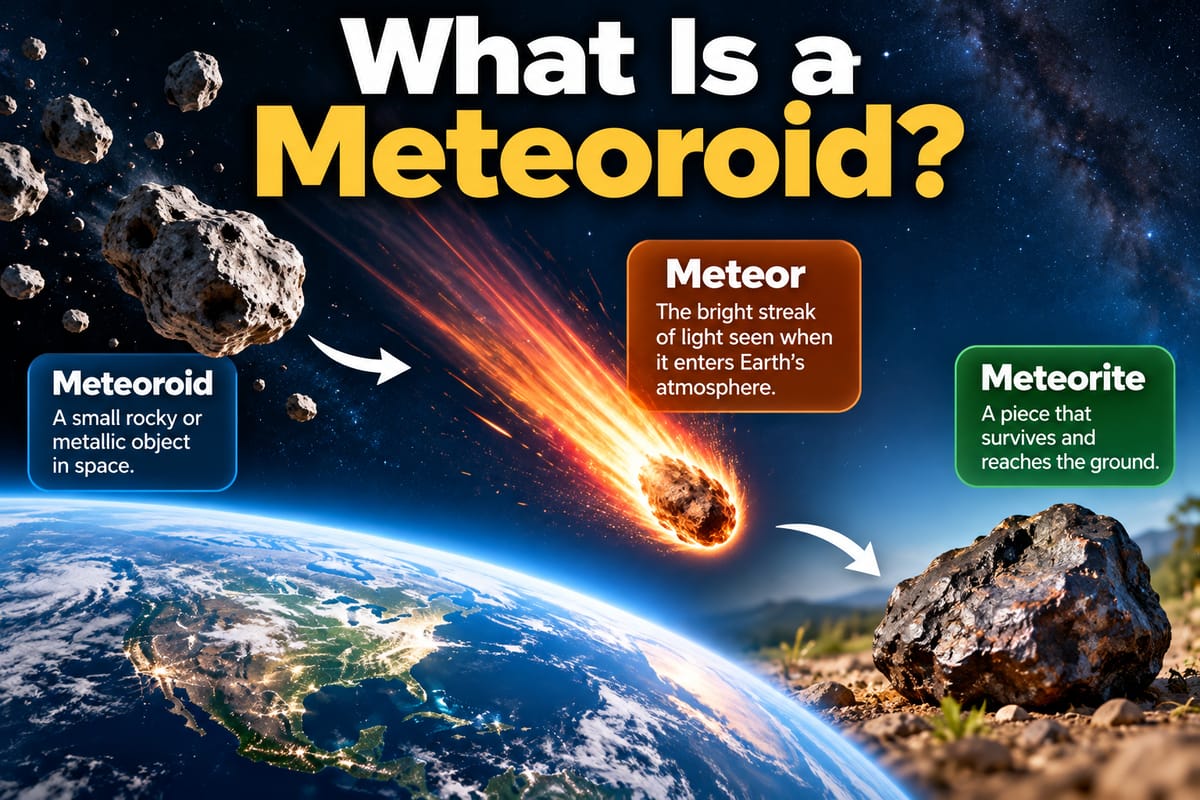
What Is a Meteoroid?
A meteoroid is a relatively small natural object traveling through space. Meteoroids can range from tiny grains of dust to rocky or metallic bodies large enough to produce spectacular flashes when they enter a planet’s atmosphere.
They are part of the constantly changing population of material moving through the solar system. Some originate from asteroids, while others are fragments of comets or debris produced by collisions between larger objects.
Although the word meteoroid is often confused with meteor and meteorite, the three terms describe different stages or phenomena. Understanding the distinction makes it easier to understand what happens when space rocks approach Earth.
For a broader introduction to stars, planets, galaxies, and other celestial objects, The Complete Guide to Astronomy provides useful context.
What Exactly Is a Meteoroid?
A meteoroid is a natural solid object in space that is substantially smaller than an asteroid.
Meteoroids can be composed of:
- Rock
- Metal
- A mixture of rock and metal
- Dust and other solid particles
Their sizes can vary enormously. Some are microscopic or extremely small, while others can measure several meters across.
There is not a single simple characteristic that determines whether every small object should be classified as a meteoroid. Astronomers use terminology based on an object’s size, origin, composition, and behavior.
The key distinction is that a meteoroid is still traveling through space.
Meteoroid vs. Meteor vs. Meteorite
These three terms describe different things.
A meteoroid is a small natural object moving through space.
A meteor is the visible phenomenon produced when a meteoroid or related space object enters an atmosphere and creates a bright streak of light.
A meteorite is a piece of the original object that survives its journey through the atmosphere and reaches the ground.
A simple way to remember the distinction is:
Meteoroid → space
Meteor → atmosphere
Meteorite → ground
This terminology is especially useful when discussing objects that approach Earth.
Where Do Meteoroids Come From?
Meteoroids have several possible origins.
Many are fragments of asteroids that broke apart during collisions. Others are pieces of cometary material released as comets travel through the solar system.
Meteoroids can also form when larger objects collide and produce debris.
Over long periods, these fragments can spread along different orbits and become part of the population of small bodies moving around the Sun.
Meteoroids From Asteroids
Asteroids are rocky or metallic bodies that orbit the Sun.
When two asteroids collide, the impact can break pieces away from one or both objects. Some of these fragments become meteoroids.
Over time, gravitational interactions can alter their paths and potentially place some fragments on trajectories that intersect Earth’s orbit.
Many meteorites recovered on Earth are believed to have originated from asteroids.
Meteoroids From Comets
Comets are made largely of ice, dust, and rocky material.
As a comet approaches the Sun, heating causes some of its volatile materials to turn directly into gas. This activity releases dust and other particles into space.
The resulting debris can remain distributed along the comet’s orbit.
When Earth passes through one of these debris streams, the particles can enter the atmosphere and produce a meteor shower.
The What Is the Difference Between Asteroids and Comets? guide explores the characteristics that distinguish these two types of solar system objects.
How Large Are Meteoroids?
Meteoroids cover a wide range of sizes.
Some are so small that they are better thought of as cosmic dust particles. Others can be large enough to produce exceptionally bright atmospheric events.
As an object becomes larger, scientists may classify it differently depending on its characteristics and context.
The terminology is therefore not simply based on a single universal size cutoff.
A small fragment from an asteroid can be a meteoroid even though the parent asteroid may be hundreds of kilometers across.
What Are Meteoroids Made Of?
The composition of a meteoroid depends on where it originated.
Some are primarily rocky. Others contain substantial amounts of iron and nickel or mixtures of metal and rock.
Primitive meteoroids can contain material that has changed very little since the early history of the solar system.
This makes meteorites particularly valuable to planetary scientists because they can preserve clues about the materials from which planets and other bodies formed.
Rocky Meteoroids
Rocky meteoroids are among the most common types associated with meteorites.
They can contain silicate minerals and other materials found in terrestrial and extraterrestrial rocks.
Some are fragments of differentiated asteroids, while others come from more primitive parent bodies.
Their mineral composition can provide information about the environment in which their parent objects formed.
Metallic Meteoroids
Some meteoroids contain significant quantities of iron and nickel.
These metallic fragments can originate from the interiors of larger differentiated bodies.
A sufficiently large asteroid can become heated during its early history, allowing heavier metals to sink toward its center. If that body later breaks apart, pieces of its metallic interior can become meteoroids.
Metal-rich meteorites recovered on Earth provide evidence of these processes.
Stony-Iron Meteoroids
Some meteoroids contain substantial amounts of both rock and metal.
These materials may have formed in transitional regions within differentiated parent bodies.
Stony-iron meteorites are relatively uncommon compared with some other meteorite groups, but they provide important information about the internal structures of their parent asteroids.
How Do Meteoroids Move Through Space?
Meteoroids travel through space according to the laws of physics.
Their motion is influenced primarily by gravity, including the gravitational effects of the Sun and planets.
A meteoroid may orbit the Sun independently, follow an orbit associated with its parent asteroid or comet, or have its trajectory altered after passing near another celestial body.
The basic principles are explained further in How Gravity Controls Motion and Orbits in Space.
Why Do Some Meteoroids Reach Earth’s Orbit?
Earth travels around the Sun along its own orbit.
Some meteoroids happen to travel along paths that intersect Earth’s orbital path.
This does not mean that a meteoroid is necessarily heading directly toward Earth. Earth and the meteoroid must also arrive at the intersection point at approximately the same time for an encounter to occur.
Gravitational interactions can alter the trajectories of small bodies over time, creating opportunities for some objects to move into Earth-crossing orbits.
What Happens When a Meteoroid Approaches Earth?
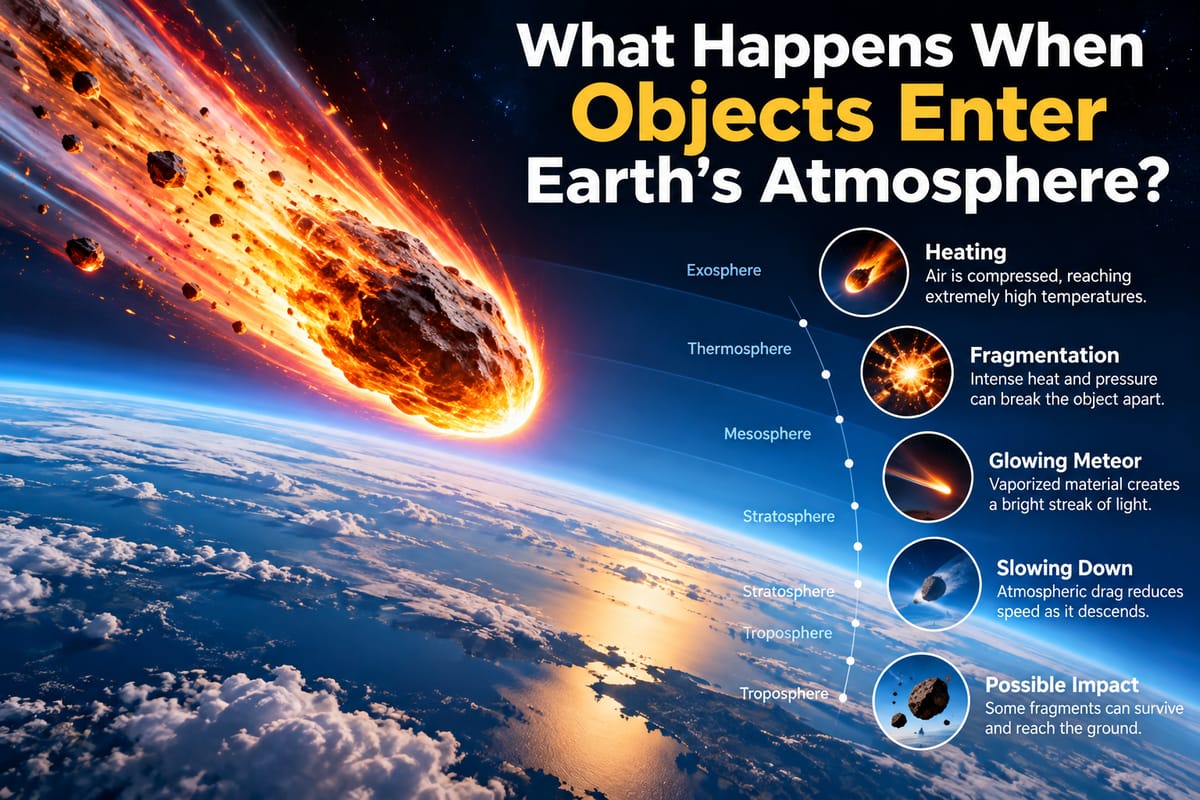
When a meteoroid enters Earth’s atmosphere, its behavior changes dramatically.
It encounters increasingly dense air as it descends. At high speed, the interaction with the atmosphere creates intense heating and can remove material from its surface.
The surrounding gas can become highly energized and emit visible light.
At this point, observers no longer see simply a meteoroid traveling through space. They see a meteor.
Why Do Meteoroids Produce Meteors?
A meteor appears as a streak of light because the incoming object interacts with Earth’s atmosphere at high speed.
The process involves intense heating, compression of air, excitation of atmospheric gases, and material being removed from the meteoroid.
Depending on its size and composition, the object may produce anything from a faint streak to an exceptionally bright fireball.
Most small meteoroids do not survive the atmospheric journey intact.
What Is a Fireball?
A fireball is an exceptionally bright meteor.
Fireballs can be produced by relatively large or energetic incoming objects and can sometimes be visible over wide areas.
Some may become bright enough to be noticed even before the sky is completely dark.
Very bright events can also produce fragmentation, flashes, or other observable effects.
The term describes the brightness of the atmospheric phenomenon rather than a specific type of space rock.
Can a Meteoroid Explode in the Atmosphere?
Yes.
A sufficiently large meteoroid can experience intense aerodynamic pressure as it moves through the atmosphere.
If its structure cannot withstand those forces, it can fragment rapidly.
The breakup can release a substantial amount of energy into the atmosphere, producing an airburst.
Different meteoroids have different strengths and structures, so two objects of similar size can behave very differently during atmospheric entry.
What Happens if It Survives?
If part of a meteoroid survives atmospheric entry and reaches Earth’s surface, the surviving material is called a meteorite.
The recovered meteorite can then be studied in laboratories.
Scientists examine its mineral composition, chemical elements, isotopes, internal structure, and other properties to determine where it may have originated and what processes affected it.
Why Meteorites Matter
Meteorites provide scientists with physical samples of material from beyond Earth.
Many meteorites contain minerals that formed billions of years ago.
Some preserve chemical and isotopic information from the early solar system. Others originated on differentiated asteroids or even from planetary bodies.
Because spacecraft have not visited every type of object in the solar system, meteorites provide a valuable source of extraterrestrial material for laboratory research.
Meteoroids and the Early Solar System
The solar system formed from a rotating cloud of gas and dust more than four billion years ago.
Small particles gradually collided and accumulated into larger bodies.
Some material remained relatively unchanged, while other material was heated, melted, differentiated, or chemically altered.
Meteoroids and meteorites can preserve evidence of these different stages.
Studying them helps scientists investigate how the planets, asteroids, and other bodies developed.
Meteoroids and the Formation of Planets
Planets formed through the accumulation of smaller solid objects.
These early building blocks collided repeatedly and combined into progressively larger bodies.
Over millions of years, some grew large enough to become planetary embryos and eventually planets.
Modern meteoroids are not simply leftovers with no scientific significance. They can represent fragments of the same types of material involved in the formation and evolution of larger worlds.
The Complete Guide to Planets and Worlds provides broader context about planetary bodies and the worlds that populate the solar system.
What Is Cosmic Dust?
Cosmic dust consists of extremely small solid particles found throughout space.
Some dust particles can overlap with the smallest objects considered meteoroids.
These particles can originate from comets, asteroids, stars, planetary collisions, and other processes.
Earth constantly encounters small particles as it moves through space. Most are too small to produce dramatic visible events, although their interaction with the atmosphere contributes to the continuous deposition of extraterrestrial material on Earth.
Meteoroid Streams and Meteor Showers
Some meteoroids travel in groups along related orbits.
Comets are particularly important sources of such streams. As they orbit the Sun, they can leave trails of dust and debris behind.
If Earth’s orbit intersects one of these streams, many particles can enter the atmosphere over a relatively short period.
This produces a meteor shower.
The meteors appear to radiate from a particular region of the sky because the particles are traveling along similar trajectories.
Do Meteoroids Orbit the Sun?
Yes.
Most meteoroids associated with the solar system travel around the Sun.
Their orbits can be highly varied. Some follow paths similar to their parent asteroids or comets, while others have trajectories that have been altered by gravitational interactions.
A meteoroid’s orbit can change over time due to encounters with planets, collisions, and other gravitational or physical effects.
Can Earth’s Gravity Capture a Meteoroid?
Earth’s gravity affects meteoroids that pass nearby, but permanently capturing an object into orbit is more complicated than simply pulling it toward the planet.
An incoming meteoroid has its own velocity relative to Earth.
For it to become permanently bound to Earth, it generally needs to lose enough energy relative to the planet. Atmospheric drag can provide some energy loss for objects that pass through the atmosphere, but most meteoroids entering the atmosphere are traveling too fast to become ordinary long-term satellites.
What Determines Whether a Meteoroid Survives?
Several factors influence survival.
Size
Larger objects generally contain more material and may have a greater chance of leaving fragments behind.
Composition
Metal-rich objects can behave differently from fragile, porous rocky bodies.
Structure
A strong, coherent object may withstand atmospheric forces better than a loosely assembled body.
Speed
Higher entry speeds generally involve greater kinetic energy and more intense atmospheric interactions.
Entry Angle
The angle at which an object enters the atmosphere influences how long it travels through different atmospheric densities and how forces are distributed across it.
Meteoroids Are Different From Asteroids
The terms are sometimes used interchangeably in casual conversation, but they describe different categories.
An asteroid is a larger rocky or metallic body orbiting the Sun. A meteoroid is a smaller natural object in space.
A collision can turn part of an asteroid into a much smaller fragment. That fragment may then become a meteoroid.
In other words, an asteroid can be a source of meteoroids.
Meteoroids Are Different From Comets
Comets are larger bodies containing significant amounts of ice, dust, and rocky material.
As they approach the Sun, their volatile materials can become active and release gas and dust.
Some of the released solid material can later become meteoroids.
The relationship between comets and meteoroids is particularly important for understanding meteor showers.
Can Humans See Meteoroids From Earth?
Normally, the meteoroid itself is too small and faint to see while it is traveling through space.
What people usually observe is the meteor created when the object enters the atmosphere.
In some cases, astronomers can detect incoming objects before atmospheric entry using telescopes and other observation systems.
Once an object becomes a bright meteor, it may be visible to people across a large area depending on its brightness, altitude, weather conditions, and local sky visibility.
How Scientists Study Meteoroids
Scientists study meteoroids using several methods.
They can observe meteors with specialized cameras, radar systems, telescopes, and other instruments.
When meteorites reach the ground, researchers can analyze the physical samples directly.
They may examine:
- Mineral composition
- Chemical composition
- Isotopic ratios
- Magnetic properties
- Internal structures
- Age
- Evidence of heating or alteration
Combining observations of meteors with laboratory analysis of meteorites provides a more complete picture of small bodies in the solar system.
Why Meteoroids Are Important to Astronomy
Meteoroids may be small compared with planets and asteroids, but they can reveal important information about the solar system.
They can preserve fragments of larger bodies, carry material from ancient collisions, create meteor showers, and provide physical samples of extraterrestrial matter.
Their movements also demonstrate how gravity, orbital dynamics, collisions, and atmospheric processes interact.
Studying these objects therefore connects several areas of astronomy.
A Small Object With a Large Story
A meteoroid may be little more than a fragment of rock or metal traveling through the darkness of space, but its history can stretch back billions of years.
It may have broken away from an asteroid, been released by a comet, or formed during a collision between larger bodies. Its orbit can be altered by gravity before eventually bringing it close to Earth.
If it enters the atmosphere, it can produce a meteor. If it survives the intense journey and reaches the ground, the remaining material becomes a meteorite that scientists can study.
The distinction between meteoroids, meteors, and meteorites helps reveal a much larger story: the solar system is a dynamic environment in which material is continually broken apart, transported, transformed, and incorporated into new worlds. Meteoroids are some of the smallest pieces of that story, but they can provide valuable clues about how the larger solar system came to exist.


2 Comments
Micle harison
June 7, 2019Lorem ipsum dolor sit amet, usu ut perfecto postulant deterruisset, libris causae volutpat at est, ius id modus laoreet urbanitas. Mel ei delenit dolores.
John Doe
June 7, 2019Some consultants are employed indirectly by the client via a consultancy staffing company.