
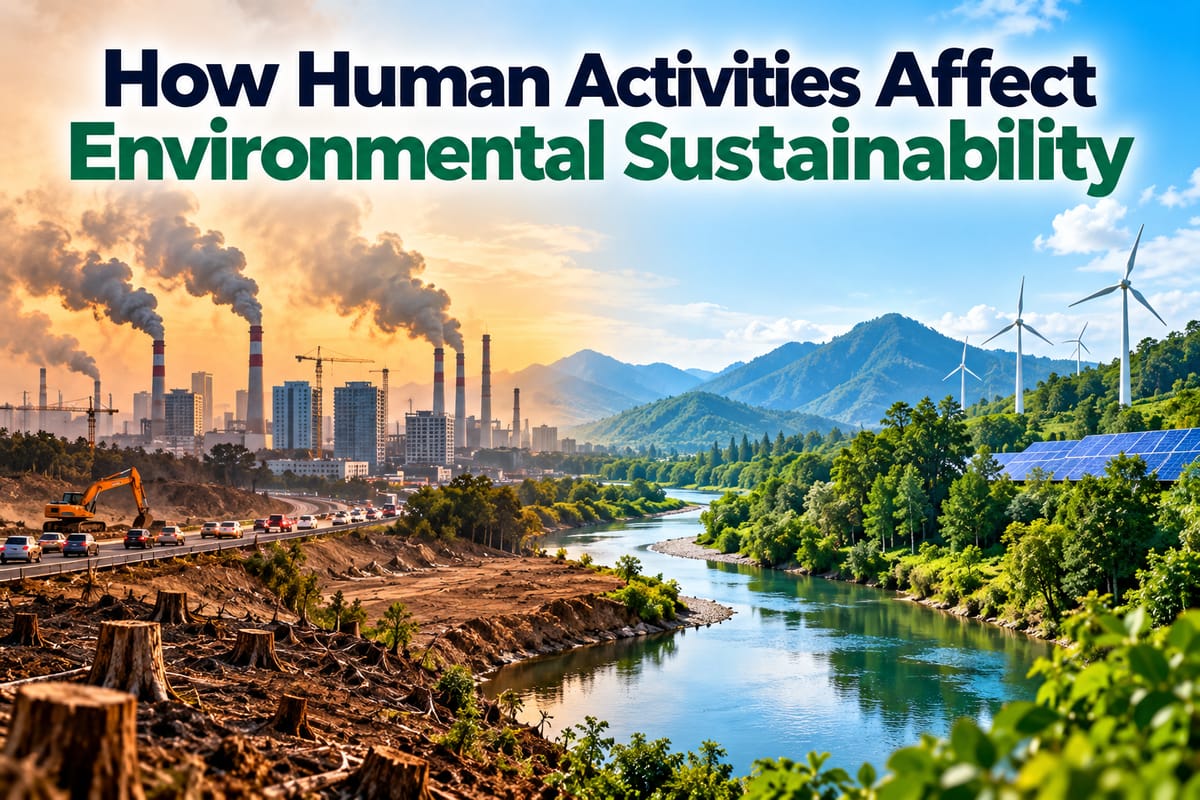
How Human Activities Affect Environmental Sustainability
Environmental sustainability depends on the ability of natural systems to continue supporting life, communities and economies over long periods of time. Forests, oceans, freshwater systems, soils, minerals, wildlife and the atmosphere all provide conditions or resources that societies depend on.
Human activity is closely connected to every one of these systems.
People use land to grow food, extract resources to manufacture products, build cities, generate energy and transport goods and people. These activities can improve living standards and support economic development, but they can also place pressure on ecosystems when resources are consumed faster than they can recover or when waste exceeds the environment’s ability to absorb it.
Understanding this relationship is important because environmental sustainability is not simply about protecting nature from people. It is about finding ways for human societies and natural systems to continue functioning together over the long term.
What Is Environmental Sustainability?
Environmental sustainability generally refers to using natural resources and interacting with ecosystems in ways that allow environmental systems to remain healthy and productive over time.
A sustainable approach considers questions such as:
- Can a resource regenerate at the rate it is being used?
- Can ecosystems continue providing essential services?
- Can pollution remain within levels that ecosystems can safely absorb?
- Can biodiversity and habitats remain viable?
- Can future generations access essential natural resources?
- Can economic activity continue without permanently degrading environmental systems?
Sustainability therefore involves more than reducing visible pollution. It encompasses resource consumption, land use, energy production, waste, biodiversity, climate and the long-term condition of ecosystems.
Why Human Activities Matter
Natural systems are constantly changing, but human activities can alter the scale and speed of those changes.
A forest can naturally regenerate after disturbance, for example. However, repeated clearing can prevent recovery. A river can naturally process some organic material, but excessive pollution can overwhelm that capacity.
The same principle applies to many environmental systems.
Human activities can influence:
- Air quality
- Water quality
- Soil health
- Forest cover
- Wildlife populations
- Biodiversity
- Climate
- Natural resource availability
- Waste generation
- Ecosystem resilience
The effects can be local, regional or global depending on the activity.
Population Growth and Resource Demand
As populations grow and living standards change, demand for food, water, energy, housing, transportation and manufactured goods generally increases.
Population growth is not inherently an environmental problem. The environmental impact of a population depends on many factors, including consumption patterns, technology, infrastructure, resource efficiency and how energy and materials are produced.
For example, two communities with similar populations can have very different environmental footprints depending on their energy systems, transportation patterns, diets, waste-management infrastructure and industrial activities.
This makes environmental sustainability a question of both how many resources are used and how those resources are produced and consumed.
Agriculture and Environmental Sustainability
Agriculture is essential for feeding human populations, but farming can affect ecosystems in several ways.
Agricultural activities can involve:
- Land clearing
- Water extraction
- Fertilizer use
- Pesticide use
- Soil disturbance
- Livestock production
- Energy consumption
- Food transportation
Poorly managed agricultural practices can contribute to soil erosion, nutrient runoff, water pollution and habitat loss.
At the same time, agricultural land can be managed in ways that protect soil, improve water efficiency and support biodiversity.
Practices such as crop rotation, cover cropping, conservation tillage, agroforestry and improved irrigation can contribute to more sustainable agricultural systems when appropriately designed for local conditions.
Deforestation and Land-Use Change
Forests provide habitats for wildlife, store carbon, influence water cycles and support human livelihoods.
Human activities can remove or fragment forests for:
- Agriculture
- Livestock production
- Timber
- Mining
- Roads
- Housing
- Industrial development
- Infrastructure
Deforestation can reduce habitat and biodiversity while also changing local water and soil conditions.
Forest loss can also affect the amount of carbon stored in vegetation and soils.
Protecting existing forests and restoring degraded landscapes can therefore be important components of environmental sustainability.
Urbanization Changes the Environment
Cities concentrate large numbers of people, buildings, transportation systems and economic activities into relatively small areas.
Urbanization can create environmental pressures through:
- Land conversion
- Energy consumption
- Transportation
- Construction
- Water demand
- Waste generation
- Air pollution
- Increased surface runoff
However, cities can also create opportunities for more efficient resource use.
Dense communities can support public transportation, shared infrastructure, compact housing and centralized waste and water systems.
Sustainable urban planning can therefore influence how much energy, land and materials are required to support a growing population.
Energy Production and Environmental Impact
Modern societies depend heavily on energy.
Energy is needed for homes, factories, transportation, agriculture, communications, hospitals and virtually every major economic activity.
The environmental effects depend significantly on how energy is generated.
Fossil fuels release greenhouse gases when burned and can also be associated with air pollution and environmental impacts from extraction and transportation.
Renewable energy technologies such as solar, wind and hydropower can reduce reliance on fossil fuels, although they also require land, materials, infrastructure and manufacturing.
The environmental sustainability of an energy system therefore involves considering its entire lifecycle rather than looking only at the point where electricity is generated.
Climate Change and Human Activity
Human activities have significantly increased atmospheric concentrations of greenhouse gases, particularly through fossil-fuel combustion, land-use change and other industrial and agricultural activities.
These changes are associated with warming of the climate system and can affect temperatures, precipitation patterns, ice, sea levels and ecosystems.
The broader science and consequences are explored in Climate Change Explained.
Climate change matters to environmental sustainability because ecosystems and human systems depend on relatively stable environmental conditions. Changes in climate can influence agriculture, water availability, coastal areas, forests, biodiversity and infrastructure.
Reducing greenhouse-gas emissions and improving resilience to environmental changes are therefore important parts of long-term sustainability.
Water Use and Human Activities
Freshwater is essential for drinking, agriculture, industry, sanitation and ecosystems.
Human activities can affect freshwater systems through:
- Excessive water extraction
- Agricultural runoff
- Industrial pollution
- Urban wastewater
- Dam construction
- Wetland drainage
- Land-use change
When water is extracted faster than natural systems can replenish it, supplies can become stressed.
Pollution creates another challenge. Even when sufficient water exists physically, contamination can reduce the amount suitable for particular uses.
Sustainable water management therefore involves both conserving water and protecting its quality.
Mining and Mineral Extraction
Modern civilization depends on minerals and materials.
Metals and other geological resources are used in:
- Buildings
- Vehicles
- Electronics
- Electrical infrastructure
- Machinery
- Medical equipment
- Renewable energy technologies
Mining can disturb land, consume water and generate waste. Depending on the material and extraction method, mining operations can also affect habitats and local communities.
At the same time, eliminating resource extraction entirely is not realistic for modern societies.
This makes responsible extraction, efficient material use, recycling, restoration and technological innovation important elements of sustainability.
The relationship between resources and society is explored further in How Natural Resources Support Human Civilization.
Manufacturing and Industrial Activity
Manufacturing transforms raw materials into products used throughout society.
Industrial activity can create environmental pressures through:
- Energy consumption
- Raw-material extraction
- Water use
- Air emissions
- Chemical waste
- Industrial wastewater
- Packaging
- Product disposal
Manufacturers can reduce environmental impacts through more efficient production, cleaner energy, material efficiency, waste reduction and improved product design.
The concept of sustainability therefore extends beyond the finished product. It includes the entire process required to obtain materials, manufacture goods, transport them and eventually manage them at the end of their useful lives.
Transportation and Environmental Sustainability
Transportation connects people, businesses and markets, but it also consumes energy and requires infrastructure.
Cars, trucks, aircraft, ships and other vehicles can contribute to greenhouse-gas emissions and air pollution depending on their energy sources and technologies.
Road construction can also fragment habitats and increase land consumption.
Potential approaches to more sustainable transportation include:
- Public transportation
- Walking and cycling infrastructure
- More efficient vehicles
- Electric vehicles
- Cleaner fuels
- Better freight logistics
- Urban planning that reduces unnecessary travel
No single transportation solution works equally well everywhere. Geography, population density, infrastructure and economic conditions all influence which approaches are practical.
Waste and Environmental Sustainability
Human societies generate waste whenever materials are discarded.
Household waste can include:
- Food scraps
- Paper
- Plastics
- Glass
- Metals
- Textiles
- Electronics
- Packaging
Industrial and commercial activities can produce additional waste streams.
Waste can create environmental problems when it is poorly managed. Landfills can occupy land and produce methane as organic materials decompose under certain conditions. Improperly discarded materials can enter waterways or ecosystems.
Waste management therefore plays an important role in environmental sustainability.
Pollution Changes Environmental Conditions
Pollution occurs when substances or forms of energy are introduced into the environment at levels that can cause harmful effects.
Pollution can affect:
- Air
- Water
- Soil
- Oceans
- Wildlife
- Plants
- Human communities
Sources can include transportation, industry, agriculture, energy production, wastewater and household activities.
A broader explanation of these environmental pressures can be found in Environmental Pollution Explained.
Reducing pollution often requires addressing its source rather than relying entirely on cleanup after contamination has already occurred.
Plastic and Persistent Waste
Plastic has become an important environmental issue because many plastic products are designed for durability while being used for relatively short periods.
Some plastics can persist in the environment for long periods and break into increasingly small particles rather than completely disappearing.
Plastic pollution can affect terrestrial and aquatic environments.
Reducing unnecessary single-use products, improving waste collection, increasing reuse and developing effective recycling systems can help reduce the amount of plastic entering the environment.
Reuse and Repair Can Reduce Environmental Pressure
Not every product needs to be discarded when it develops a problem or reaches the end of its first owner’s use.
Reuse extends the useful life of products, while repair can prevent functional items from becoming waste.
Examples include:
- Repairing appliances
- Reusing containers
- Donating clothing
- Refurbishing electronics
- Repairing furniture
- Buying durable products
- Sharing infrequently used equipment
The environmental benefits depend on the product, repair process and alternative options, but extending product lifetimes can reduce demand for new materials and manufacturing.
The role of these practices is discussed in How Reuse and Repair Reduce Household Waste.
Consumption Patterns Matter
Environmental impacts are influenced not only by population size but also by what people consume and how products are produced.
Consumption includes:
- Food
- Clothing
- Electronics
- Transportation
- Energy
- Housing
- Household goods
- Services
Buying more durable products, reducing unnecessary consumption and using resources efficiently can reduce environmental pressure.
However, individual choices are only one part of the sustainability equation. Infrastructure, industrial practices, government policies, technology and economic systems also influence environmental outcomes.
Biodiversity and Habitat Loss
Biodiversity refers to the variety of living organisms and ecosystems.
Human activities can reduce biodiversity through:
- Habitat destruction
- Pollution
- Overexploitation
- Invasive species
- Climate change
- Land fragmentation
Biodiversity matters because ecosystems contain interconnected species and processes that support functions such as pollination, nutrient cycling, soil formation and water regulation.
Protecting biodiversity therefore involves more than protecting individual species. It also requires maintaining the habitats and ecological relationships that allow species to survive.
Overfishing and Marine Ecosystems
Human activity also affects oceans.
Fishing provides food and livelihoods to millions of people, but excessive fishing pressure can reduce some fish populations and alter marine ecosystems.
Other human pressures include:
- Plastic pollution
- Agricultural runoff
- Coastal development
- Shipping
- Ocean warming
- Habitat destruction
- Chemical contamination
Sustainable fisheries depend on management approaches that consider reproduction, population sizes, ecosystems and the capacity of fish populations to recover.
Soil Is an Important Environmental Resource
Soil supports agriculture, stores carbon, provides habitat for organisms and participates in nutrient and water cycles.
Human activities can degrade soil through:
- Erosion
- Intensive cultivation
- Loss of organic matter
- Contamination
- Compaction
- Unsustainable land management
Soil degradation can reduce agricultural productivity and affect surrounding ecosystems.
Maintaining vegetation cover, reducing erosion and improving soil-management practices can help preserve this essential resource.
Technology Can Reduce Environmental Pressure
Technology can contribute to environmental problems, but it can also help address them.
Examples include:
- More efficient solar panels
- Battery technologies
- Energy-efficient appliances
- Precision agriculture
- Water-monitoring systems
- Pollution sensors
- Smart electricity grids
- Improved recycling technologies
- Low-emission industrial processes
Technology alone does not guarantee sustainability.
A technology must be considered in terms of its materials, energy requirements, lifecycle, economic accessibility and actual environmental performance.
The Importance of Circular Resource Use
Traditional economic systems often follow a relatively linear pattern:
Extract → Make → Use → Dispose
A more circular approach attempts to keep materials and products useful for longer.
This can involve:
Design → Make → Use → Repair → Reuse → Refurbish → Recycle
The objective is to reduce unnecessary extraction and waste while retaining as much value as possible in products and materials.
Circular approaches can be applied to manufacturing, construction, electronics, clothing, food systems and household products.
Human Development and Environmental Sustainability Can Intersect
Environmental sustainability is sometimes presented as being in opposition to economic development, but the relationship is more complicated.
People need energy, housing, transportation, food, healthcare, employment and infrastructure.
The sustainability challenge is to meet these needs while reducing unnecessary environmental damage and maintaining the natural systems that support future development.
Better infrastructure, cleaner technologies, efficient resource use and environmental protection can sometimes support both human well-being and environmental objectives.
Why Environmental Impacts Can Be Difficult to See
Some environmental damage is immediately visible.
A polluted river, deforested hillside or smog-filled city can provide obvious evidence of environmental pressure.
Other impacts develop gradually.
Examples include:
- Soil degradation
- Groundwater depletion
- Biodiversity decline
- Accumulation of persistent pollutants
- Atmospheric changes
- Loss of ecosystem resilience
Because some environmental processes operate over decades or longer, sustainability requires considering long-term effects rather than focusing exclusively on immediate outcomes.
What Individuals Can Do
Individual choices cannot solve every environmental problem, but they can contribute to broader sustainability efforts.
Practical actions can include:
- Reducing unnecessary consumption
- Repairing usable products
- Reusing materials
- Recycling where effective systems exist
- Reducing food waste
- Conserving water
- Improving household energy efficiency
- Choosing durable products
- Using public transportation where practical
- Avoiding unnecessary single-use products
- Supporting responsible resource management
The most effective actions depend on local conditions and available infrastructure.
What Businesses Can Do
Businesses influence environmental sustainability through the products they manufacture, resources they consume and waste they generate.
Companies can examine:
- Energy efficiency
- Material sourcing
- Packaging
- Water use
- Transportation
- Waste management
- Product durability
- Repairability
- Supply chains
- Emissions
- Environmental risks
Businesses can also design products that use fewer materials, last longer or can be repaired and recycled more easily.
The Role of Governments and Public Policy
Governments influence environmental outcomes through infrastructure investment, environmental standards, land-use planning, energy policy, transportation systems, waste management and resource-management rules.
Effective environmental management often requires coordination because environmental systems do not follow political boundaries.
A river can cross multiple administrative regions. Air pollution can travel across cities and countries. Climate change affects the entire planet.
Environmental sustainability therefore often requires cooperation between communities, businesses, governments and international institutions.
Measuring Environmental Sustainability
Environmental sustainability can be difficult to measure with a single number.
Researchers and organizations may examine indicators such as:
- Greenhouse-gas emissions
- Air quality
- Water quality
- Forest cover
- Biodiversity
- Soil health
- Resource consumption
- Waste generation
- Recycling rates
- Energy efficiency
- Water use
- Land degradation
Using multiple indicators provides a more complete picture because improvement in one area does not necessarily mean that overall environmental conditions are improving.
Small Changes Can Become Systemic Changes
Individual behavior matters, but large-scale environmental improvements often require changes to systems.
For example, asking people to recycle is difficult if a community lacks collection infrastructure. Encouraging public transportation has limited effect where reliable services do not exist. Promoting energy efficiency becomes easier when efficient technologies are affordable and available.
This is why environmental sustainability involves both personal choices and structural changes.
Consumers, businesses, governments, researchers and communities all influence the systems through which resources are produced and consumed.
Building More Sustainable Habits
Environmental sustainability does not require perfection.
A practical approach is to identify areas where environmental impact can be reduced without creating unrealistic expectations.
A household might begin by reducing food waste. A business might improve energy efficiency. A city might expand public transportation. A manufacturer might redesign products for longer use and easier repair.
Over time, many individual improvements can contribute to broader changes.
The key is consistency and an understanding of which actions have meaningful environmental effects.
The Long-Term Sustainability Challenge
Human societies depend on the natural environment for food, water, energy, materials and countless ecosystem services. At the same time, human activities can change the systems that provide those resources.
Environmental sustainability is therefore fundamentally about managing that relationship.
Agriculture, transportation, energy production, manufacturing, construction, consumption and waste all influence environmental conditions. The challenge is not to eliminate human activity, but to develop systems that meet human needs while reducing unnecessary environmental damage and maintaining the ability of ecosystems to function over time.
As technology, economies and populations continue to change, sustainability will increasingly depend on how effectively societies use resources, manage pollution, protect ecosystems and design systems for the long term.
The choices made today can influence not only the environment people experience now, but also the environmental options available to future generations.


2 Comments
Micle harison
June 7, 2019Lorem ipsum dolor sit amet, usu ut perfecto postulant deterruisset, libris causae volutpat at est, ius id modus laoreet urbanitas. Mel ei delenit dolores.
John Doe
June 7, 2019Some consultants are employed indirectly by the client via a consultancy staffing company.