
What Happens When Stars Die?
Stars may appear permanent when viewed from Earth, but they are constantly changing. Every star has a life cycle that begins with its formation and eventually ends with a dramatic transformation.
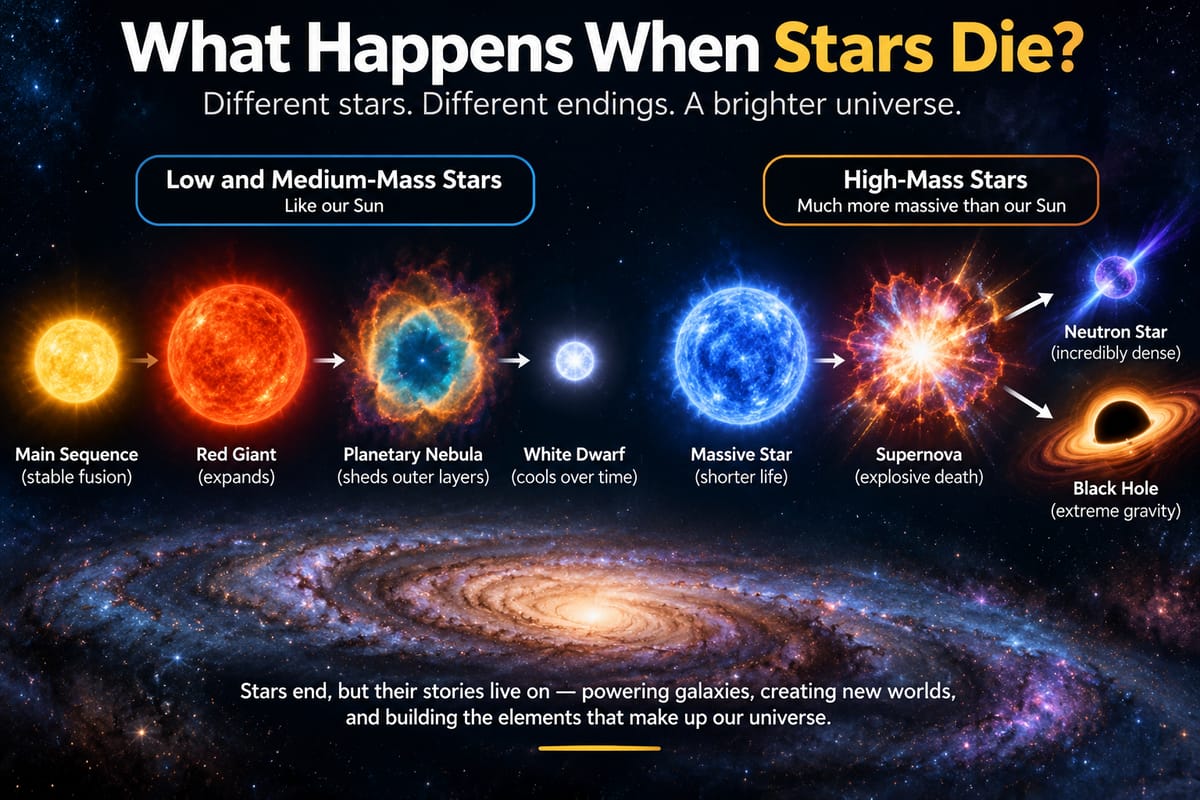
What happens when a star dies depends largely on its mass. Smaller and medium-sized stars can gradually shed their outer layers before leaving behind a dense stellar remnant. Massive stars can end in enormous explosions called supernovae, sometimes creating neutron stars or black holes.
Understanding stellar death is an important part of understanding how galaxies evolve, how elements are distributed through space, and how some of the most extreme objects in the universe are created.
For a broader introduction to the subject, The Complete Guide to Astronomy provides context on stars, galaxies, planets, and the larger structure of the cosmos.
Why Do Stars Eventually Die?
Stars are powered by nuclear fusion in their cores. During most of their lives, they fuse lighter elements into heavier ones and release enormous amounts of energy.
For stars like the Sun, hydrogen is gradually converted into helium. This process produces the energy that makes stars shine.
Eventually, however, a star’s available fuel changes. As its core evolves, the balance between gravity and internal pressure changes as well. The star then enters a new stage of its life.
The details depend heavily on the star’s original mass.
A useful overview of stellar properties and life cycles can be found in Everything You Need to Know About Stars.
What Happens to a Sun-Like Star?
A star with a mass similar to the Sun does not normally end its life in a supernova.
As hydrogen in its core becomes depleted, the star undergoes major changes. Its core contracts while its outer layers expand. The star eventually becomes a red giant, growing much larger and cooler at its visible surface.
During this stage, nuclear reactions continue in different regions of the star. Eventually, the star reaches a point where it can no longer maintain fusion in the same way it did during its main sequence lifetime.
The outer layers are then expelled into space, creating a glowing cloud of gas known as a planetary nebula.
Despite the name, a planetary nebula has nothing directly to do with planets. The term originated because some of these objects appeared somewhat planet-like through early telescopes.
The Formation of a White Dwarf
After a Sun-like star sheds much of its outer material, its remaining core becomes a white dwarf.
A white dwarf is extremely dense. It can contain a substantial fraction of the original star’s mass compressed into an object roughly comparable in size to Earth.
Unlike an ordinary star, a white dwarf does not continue producing energy through sustained hydrogen fusion in its core. Instead, it gradually releases the heat it already contains.
Over extremely long periods, the white dwarf is expected to cool and become increasingly faint.
The universe has not existed long enough for ordinary white dwarfs to have cooled completely into hypothetical objects known as black dwarfs.
What Happens to a Massive Star?
Massive stars follow a much more violent path.
They consume their nuclear fuel at a much faster rate than smaller stars. Their immense gravity allows them to reach the temperatures and pressures needed for increasingly complex fusion processes.
As the star ages, it can develop layers containing different elements. Fusion can progress from hydrogen and helium toward heavier elements.
Eventually, however, fusion reaches a critical limit.
When a massive star develops an iron-rich core, the situation becomes fundamentally different. Fusing iron does not provide the same energy advantage as fusing lighter elements.
The core can no longer generate enough energy through fusion to support itself against gravity.
The Collapse of the Stellar Core
When the core of a sufficiently massive star becomes unstable, gravity can cause it to collapse extremely rapidly.
The collapse can occur in a fraction of a second.
Matter is compressed under extraordinary conditions, and the star’s core can transform into an extremely dense compact object.
Meanwhile, the outer layers can be violently expelled.
This event can produce a supernova, one of the most energetic explosions known in the universe.
What Is a Supernova?
A supernova is a powerful stellar explosion associated with the death of certain massive stars and with some other catastrophic stellar events.
For a massive star undergoing core collapse, the explosion can send enormous amounts of material into surrounding space.
The brightness of a supernova can temporarily rival or exceed the combined light of vast numbers of stars in its host galaxy.
But the explosion is more than a spectacular display of light.
Supernovae can distribute newly created elements into interstellar space. The material released can eventually become part of new stars, planets, asteroids, and other objects.
In this way, the death of one star can contribute material to future generations of cosmic objects.
How Neutron Stars Form
If the collapsed core of a massive star remains below the threshold required to form a black hole, it can become a neutron star.
Neutron stars are among the densest known objects in the universe.
A tremendous amount of stellar material can be compressed into a sphere only a few tens of kilometers across. Under these extreme conditions, matter is compressed so intensely that much of it exists in forms dominated by neutrons.
Some neutron stars rotate extremely rapidly and emit beams of electromagnetic radiation. When those beams periodically point toward Earth, astronomers can observe the object as a pulsar.
Neutron stars can also possess extraordinarily strong magnetic fields. These highly magnetized neutron stars are called magnetars.
How Black Holes Can Form
The most massive stellar remnants can collapse further into black holes.
A black hole is an object with gravity so strong that, within its event horizon, escaping would require traveling faster than light.
The black hole itself does not shine like a normal star. However, material falling toward it can become extremely hot and produce intense radiation before crossing the event horizon.
Stellar-mass black holes can therefore affect their surroundings even though the black hole itself is not directly visible in the ordinary sense.
Astronomers can detect some of these objects through their effects on nearby stars, surrounding gas, or other matter.
What Happens to the Star’s Outer Layers?
When stars die, they do not necessarily disappear completely.
Their outer material can be expelled into surrounding space. This material can contain hydrogen, helium, carbon, oxygen, and other elements created during the star’s lifetime or during the final stages of its evolution.
The expelled material becomes part of the interstellar medium.
Over time, clouds of gas and dust can collapse under gravity and form new stars and planetary systems.
This creates a remarkable cycle: stars form from material left by earlier generations of stars, live for millions or billions of years, and eventually return some of their material to space.
Why Stellar Death Creates New Elements
The periodic table contains many elements heavier than the simplest elements produced in the early universe.
Stars play a major role in creating and distributing many of these elements.
Fusion inside stars produces progressively heavier elements up to certain limits. Explosive stellar events can also create or distribute additional heavy elements under extreme conditions.
Some elements are produced through processes associated with supernovae and other energetic cosmic events. Neutron-star mergers are also important environments for producing certain very heavy elements.
The material released through these processes can later become incorporated into new generations of stars and planets.
The atoms in rocks, planets, and living organisms therefore have a long cosmic history.
How Long Does a Star Take to Die?
There is no single timeline for stellar death.
A star’s lifetime is strongly influenced by its mass.
Massive stars burn through their fuel rapidly and can live for only millions of years. Smaller stars consume their fuel much more slowly and can remain active for billions or even much longer periods.
The Sun is approximately halfway through its main sequence lifetime and is expected to undergo major changes several billion years from now.
The difference illustrates an important principle of stellar evolution: being more massive does not necessarily mean living longer. In fact, massive stars generally consume their fuel much faster.
What Happens to the Sun?
The Sun is expected to eventually leave its current main sequence stage.
As its core hydrogen becomes depleted, the Sun will expand into a red giant. Its outer layers will extend much farther than they do today.
The inner solar system will experience dramatic changes as the Sun’s luminosity increases and its outer layers expand.
Eventually, the Sun will shed its outer material and leave behind a white dwarf.
The resulting stellar remnant will gradually cool over an extremely long period.
Can Stars Die in Different Ways?
Yes. Stellar death is not a single process.
A relatively low-mass star can evolve into a white dwarf after losing its outer layers. A massive star can undergo core collapse and produce a supernova, leaving behind either a neutron star or a black hole depending on its properties and final evolution.
There are also other types of stellar explosions and catastrophic events. For example, certain white dwarf systems can produce thermonuclear supernovae under specific conditions.
These different pathways make stellar evolution one of the most varied processes in astronomy.
What Happens to a Star After It Dies?
A stellar remnant can remain in space for an extraordinarily long time.
White dwarfs gradually cool. Neutron stars can continue spinning and interacting with their surroundings. Black holes can remain as compact gravitational objects that influence nearby matter and stars.
Meanwhile, the material released during stellar death can travel through interstellar space.
Some of it may eventually become incorporated into new clouds of gas and dust. Those clouds can form new stars and planetary systems.
This means that stellar death is not simply an ending. It is also part of the larger process through which galaxies recycle matter.
Stellar Death and the Evolution of Galaxies
Individual stars are part of much larger galactic systems.
Galaxies contain enormous collections of stars, gas, dust, dark matter, and other structures. The birth and death of stars can influence the chemical composition and physical conditions of the surrounding galactic environment.
Supernova explosions can inject energy and material into interstellar gas. This can affect nearby clouds and influence future star formation.
The relationship between individual stars and their host galaxies is therefore an important part of understanding how galaxies change over cosmic time.
For a broader look at these enormous systems, The Complete Guide to Galaxies explores how galaxies are structured and how they evolve.
How Astronomers Know When Stars Die
Astronomers study stellar death by observing light and other forms of radiation from space.
Telescopes can identify stars at different stages of evolution, while observations of supernovae can reveal how stars behave during catastrophic events.
Astronomers also study stellar remnants directly. Pulsars, neutron stars, white dwarfs, and black holes each produce observable effects that provide clues about their origins.
Computer simulations and observations from different wavelengths allow scientists to reconstruct processes that can unfold over timescales far longer than a human lifetime.
What Happens to the Universe as Stars Keep Dying?
Stars continue to form and die as galaxies evolve, but the supply of easily available material for forming new stars is not unlimited.
Over immense periods of time, star formation is expected to decline as usable gas becomes less abundant. Existing stars will eventually exhaust their fuel, leaving behind increasingly large populations of stellar remnants.
The universe will continue evolving long after individual stars have disappeared.
Its distant future is tied to questions about dark energy, cosmic expansion, matter, and the ultimate fate of galaxies and other structures. Understanding the scale involved requires looking beyond individual stars to the enormous cosmic environment described by How Large Is the Known Universe?.
A Star’s Death Is Part of a Larger Cosmic Cycle
The death of a star can take many forms, from the quiet cooling of a white dwarf to the explosive collapse of a massive star.
What remains depends largely on the star’s mass and its evolutionary history. Some stars leave behind compact white dwarfs, while others produce neutron stars or black holes. Their expelled material can enrich surrounding space with elements that later become part of new stars, planets, and other cosmic objects.
In that sense, stellar death is not simply the end of a star’s story. It is one stage in the ongoing transformation of matter across the universe, connecting the lives of individual stars with the evolution of galaxies and the broader history of the cosmos.


2 Comments
Micle harison
June 7, 2019Lorem ipsum dolor sit amet, usu ut perfecto postulant deterruisset, libris causae volutpat at est, ius id modus laoreet urbanitas. Mel ei delenit dolores.
John Doe
June 7, 2019Some consultants are employed indirectly by the client via a consultancy staffing company.